
⏱️ Little time? Here is what matters:
- ✅ Chowbus and Maple have formed a Strategic Alliance that connects multilingual phone, kiosk, and drive-thru ordering with the Chowbus POS.
- 🌐 The Voice AI can serve guests in English, Mandarin, Cantonese, and Korean, while additional languages such as Spanish and French use the same underlying engine.
- 📞 The practical objective is simple: reduce missed calls, route completed orders directly to kitchen workflows, and make Language Technology useful for real restaurant operations.
Chowbus and Maple Forge a Strategic Alliance Around Multilingual Voice AI
The new Chowbus and Maple Strategic Alliance brings together two complementary layers of restaurant technology: Chowbus manages point-of-sale operations, menus, payments, kitchen routing, and customer-facing workflows, while Maple provides Voice AI designed to conduct restaurant conversations. The result is a connected ordering environment where a guest can speak naturally and have the final order enter the same operating system used by staff.
This Partnership matters particularly for restaurants serving linguistically diverse communities across the United States and Canada. Many Asian restaurant formats rely on menus that include culturally specific dish names, custom preparation choices, multilingual descriptions, and detailed modifiers. A hot pot restaurant may need to capture broth selection, spice level, protein choices, sauces, and table preferences. A bubble tea shop may need to interpret tea base, sweetness percentage, ice level, toppings, cup size, and dietary requests.
For these operators, a standard automated phone tree is rarely sufficient. It can frustrate guests when it mispronounces names, cannot recognize familiar food terms, or forces every customer through a single-language script. Maple’s Artificial Intelligence layer is designed to detect the language used by the caller early in the exchange and continue that interaction in the same language. That approach supports English, Mandarin, Cantonese, and Korean ordering from the start.
Chowbus was founded in Chicago in 2016 with a strong focus on the operational needs of immigrant-owned restaurants. Its technology has long incorporated language into practical workflows: menu data may be multilingual, kitchen tickets can be presented in the language read by a station, and support teams can assist owners in their preferred language. Extending that logic to spoken ordering closes a gap that remained difficult to solve through screens alone.
A guest ordering at a counter, via QR code, on a kiosk, or through an online menu can often review visual information at their own pace. A caller cannot. If the staff member answering the phone is handling payment, packing takeaway bags, greeting seated guests, or does not speak the caller’s language, the conversation can end before an order is completed. This is where Voice Recognition becomes an operational issue rather than a novelty.
Published information surrounding the announcement indicates that restaurants can miss approximately 21% to 43% of calls during high-demand periods. For an individual location, that may translate into around $30,000 in unrealized annual order value. Those figures will vary by restaurant, opening hours, and local demand, but they explain why call handling deserves the same attention as table service or online ordering.
Consider a fictional restaurant called Golden Lantern Hot Pot in Vancouver. At 6:30 p.m. on a Saturday, the front counter is managing walk-ins, delivery drivers, and guests waiting for tables. A Cantonese-speaking customer calls to order a family meal. Rather than depending on whoever is free to pick up, Maple can handle the spoken conversation, confirm selections, and transmit the order into Chowbus. The kitchen receives it through the normal workflow rather than through a handwritten note or a verbal relay.
This model is useful because it does not require the restaurant to create a separate operational universe for automation. The guest uses speech; the restaurant receives structured order data. Staff can stay focused on hospitality, food safety, and order handoff. Multilingual service becomes part of the workflow, not an extra task added to an already busy shift.
For readers tracking the announcement, Chowbus publishes relevant product and company updates through its restaurant technology news hub. The broader lesson for tourism, hospitality, and food-service teams is equally clear: accessibility improves when language support is built into the service channel itself, not added as an afterthought.
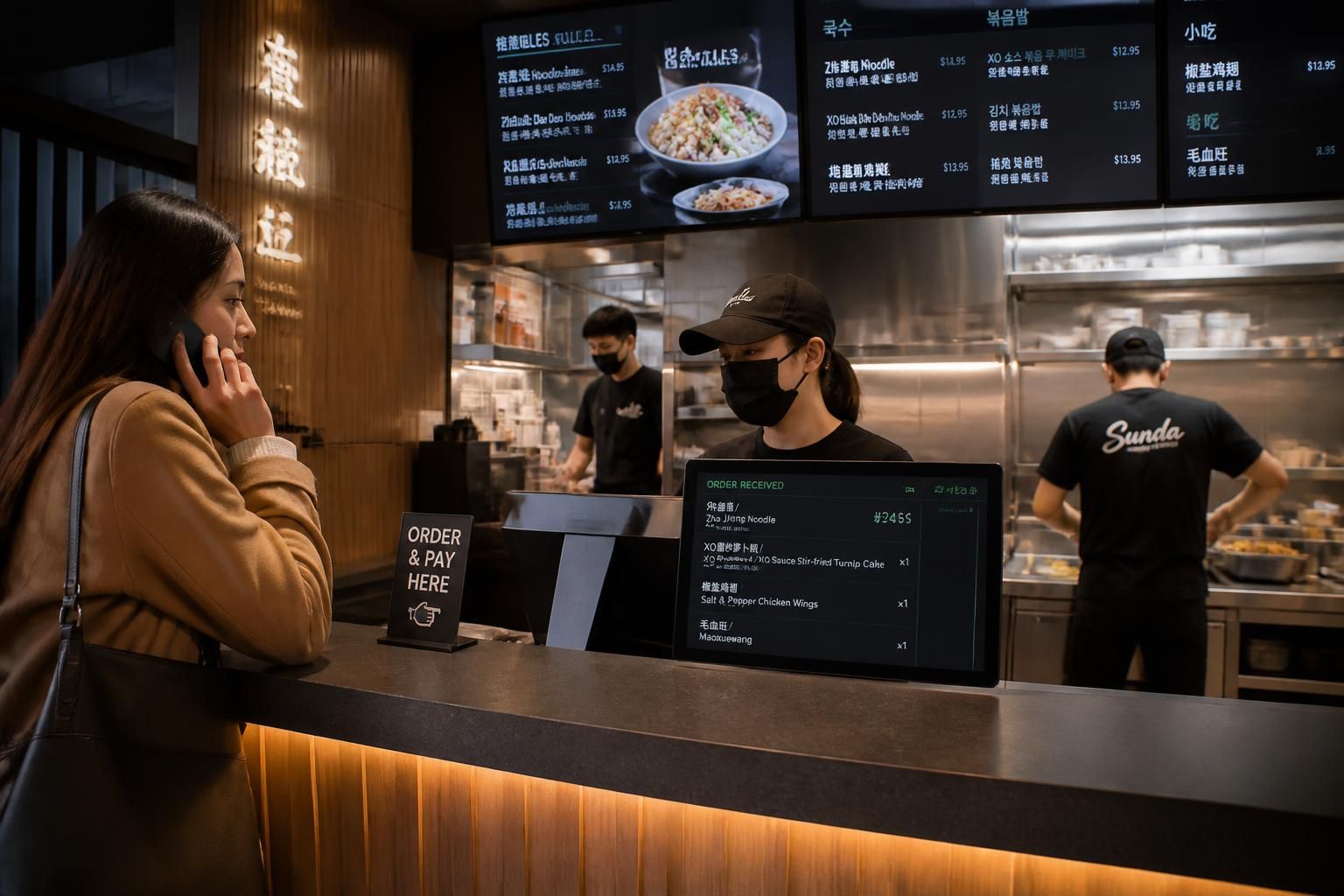
How Maple Voice AI Connects Spoken Orders to the Chowbus POS
The technical value of this AI Solutions rollout lies in integration discipline. Voice automation can only improve restaurant service if the information it collects arrives accurately at the POS, follows menu logic, and reaches the right production station. Maple connects directly with Chowbus so that conversational orders become structured orders without requiring staff to manually re-enter them.
Maple retrieves menu data from Chowbus rather than asking operators to build and maintain a second voice-only menu manually. This is significant because menu maintenance is one of the most common weak points in restaurant automation. When one platform displays a current price but another still uses an old modifier, staff must correct mistakes at the counter or kitchen window, creating friction for both employees and guests.
With live synchronization, the voice system can access items, pricing, modifier choices, and availability information maintained in Chowbus. If a restaurant temporarily sells out of a topping, removes a lunch special, or changes a price, the goal is for the spoken ordering experience to reflect that operational reality. This does not eliminate the need for teams to manage menus carefully, but it reduces duplicate work and lowers the chance of conflicting information.
Voice Recognition must understand restaurant-specific choices
Restaurant conversations are rarely as simple as “one burger, please.” A Korean barbecue guest may ask about table availability, meat combinations, allergies, or side dishes. A pho customer may request a particular noodle type, spice adjustment, or takeaway timing. A bubble tea order can include several dependent choices that must be captured in the correct sequence.
Maple’s role is to handle these exchanges in real time, clarify choices where necessary, and create an order that Chowbus can route to kitchen displays and receipt printers. The order joins counter, online, QR, and kiosk transactions instead of creating a separate queue. That unified workflow is essential for managers who need one view of demand during rush periods.
| Operational area | Connected capability | Restaurant impact |
|---|---|---|
| 📞 Phone calls | Multilingual Voice AI captures spoken orders | Fewer calls depend on staff availability |
| 🍜 Menu data | Live Chowbus synchronization for items and modifiers | More consistent pricing and customisation handling |
| 🖥️ Kitchen routing | Orders appear with regular POS transactions | Staff work from one production flow |
| 🚗 Drive-thru and kiosk | One shared voice layer across channels | Future channels can use the same language coverage |
| 📅 Guest questions | Reservations, directions, hours, and catering enquiries | Routine conversations can receive a faster response |
A practical deployment should start with menu validation. Operators should review the names that customers actually use, especially where English names differ from the spoken terms familiar to Mandarin, Cantonese, or Korean speakers. They should also inspect modifier pathways. A guest may say “less ice” rather than select a standard percentage, or describe a dish using a regional name not printed prominently on the menu.
The following checklist helps a restaurant prepare before activation:
- 🔎 Review live menu names, prices, availability, and modifier groups in Chowbus.
- 🗣️ Identify the languages most frequently used by callers and customers.
- 🍽️ Test common complex orders, including substitutions, allergy questions, and combinations.
- 📍 Confirm that hours, address details, pickup guidance, and reservation rules are current.
- 👥 Train staff on escalation procedures when a guest needs human support.
Testing should reflect actual service conditions. A quiet daytime trial is useful, but operators should also simulate an evening rush: a caller asks about a sold-out item, changes a quantity, requests a reservation, then asks for directions. The best measure is not whether the system sounds impressive in a demonstration; it is whether the restaurant receives usable, correct information without slowing the team down.
Detailed implementation information is also available in the Chowbus POS integration documentation. The strongest automation is not the one that talks the most; it is the one that reliably converts conversation into an operationally correct next step.
Once order flow is stable, the next consideration is guest experience. A technically connected system still needs to communicate clearly, respect the caller’s language, and preserve the sense that the restaurant is available when the guest reaches out.
Multilingual Language Technology Makes Restaurant Access More Practical
Language access is often discussed as a communications objective, but in hospitality it is directly tied to conversion, trust, and service comfort. A guest calling a restaurant may already know the food, the family behind the business, and the preferred dishes. Yet if they cannot place an order comfortably through the available channel, familiarity does not automatically become a completed transaction.
The Chowbus and Maple Partnership addresses this issue by allowing the caller to begin in English, Mandarin, Cantonese, or Korean without being redirected into a rigid language menu. The platform identifies the language used in the first part of the exchange and keeps the interaction in that language through order confirmation and payment steps. For customers, that reduces cognitive effort. For operators, it creates a more dependable way to serve regulars across language communities.
This is especially relevant in metropolitan areas such as Toronto, New York, Chicago, Vancouver, Los Angeles, and Seattle, where dining communities are often multilingual by default. A restaurant may have owners who speak one language, kitchen staff who use another, counter teams who serve primarily in English, and customers who choose between several languages according to context. A single-language voice channel cannot accurately represent that reality.
There is also a difference between translation and genuine Language Technology. Translation may convert a menu label from one language to another. A conversational system must do more: recognize spoken intent, understand menu-specific vocabulary, ask an appropriate clarifying question, preserve modifier logic, and confirm the final request in a way the guest can understand. That is why Voice Recognition quality must be considered alongside POS integration.
Accessibility extends beyond language preference
Multilingual ordering can support accessibility in several ways. Older customers may prefer a phone conversation to navigating a compact mobile page. Guests unfamiliar with local menu conventions may need to ask questions verbally. A traveler staying near a restaurant may call for directions, opening hours, pickup options, or allergy-related details before deciding to order.
For tourism professionals, this pattern is familiar. Visitors generally value tools that reduce friction without requiring them to download another application, learn a local interface, or interpret unfamiliar terminology. In restaurants, the phone remains an important access channel because it lets a guest ask a specific question in the moment. A capable spoken interface can provide practical guidance while helping staff avoid repetitive interruptions.
Maple is not restricted to order taking. The platform can also manage reservations, catering enquiries, common menu questions, opening times, and location details. This wider function is important because a restaurant’s missed opportunity may begin before an order. If a family calls to ask whether a dining room can accommodate eight people, a helpful response can lead to a booking. If the call is missed, the group may simply choose another venue.
A useful comparison can be made with travel-focused automation. Hotels, attractions, and transport operators increasingly use conversational tools to answer high-frequency questions outside staffed hours. Restaurant Voice AI follows the same service logic, but with an added requirement: the system must accurately move a chosen item into a live production workflow. Readers can explore related distinctions in this overview of Voice AI versus conversational AI.
Restaurants should still set boundaries. An automated agent should never invent allergy information, promise unavailable reservations, or give unclear instructions about payment and pickup. Clear escalation routes remain essential. If a guest asks a sensitive dietary question, requests a major catering quote, or becomes dissatisfied, staff need a defined way to take over.
Golden Lantern Hot Pot, for example, could configure its voice service to answer questions about standard broth ingredients while directing complex allergen queries to a trained team member. It could accept a normal reservation request while flagging large private events for follow-up. This is not a limitation of automation; it is responsible service design.
Useful multilingual service does not mean replacing human judgment. It means reserving human attention for the moments where it has the greatest value.
The guest-facing experience depends on trust, but trust also depends on measurable operational outcomes. That makes deployment data, resolution rates, and staff workflow indicators central to evaluating this alliance.
Measuring the Operational Value of Chowbus Maple AI Solutions
Restaurants should evaluate the Chowbus Maple deployment through operational evidence rather than broad claims about Artificial Intelligence. The relevant questions are concrete: Are fewer calls abandoned? Are completed orders accurate? Are staff spending less time answering repetitive questions? Does the kitchen receive information in a format it can use? These indicators reveal whether the service is creating value in a particular location.
Maple launched in December 2023 and has reported handling more than one million restaurant conversations, with a 92% resolution rate without human intervention. The company serves more than 1,000 merchant locations across phone, kiosk, and drive-thru environments. These figures indicate experience at scale, but each restaurant should establish its own baseline before treating them as an expected outcome.
A sensible starting point is call measurement. Many operators know they are busy, but do not know how many calls arrive during a service period, how many go unanswered, or how many callers abandon before placing an order. A location can monitor calls for two or three representative weeks, separating lunch, dinner, and late-evening demand. This baseline makes post-launch comparisons meaningful.
Managers should also track order corrections. If staff repeatedly adjust the same item after voice-generated orders arrive, the issue may be menu naming, unclear modifier rules, availability settings, or customer phrasing. Correcting the underlying workflow is better than asking staff to compensate indefinitely. The integration’s value comes from learning which steps need refinement.
Build a dashboard around service moments, not vanity metrics
Conversation volume alone does not explain service quality. A restaurant could process many calls while still confusing guests or creating kitchen bottlenecks. Instead, operators should combine several indicators: answer rate, completion rate, staff transfers, abandoned conversations, order correction frequency, average ticket value, and guest feedback related to clarity.
For a quick-service bubble tea venue, the most valuable indicator may be the share of peak-hour calls answered without pulling counter staff away from walk-in guests. For a full-service Korean barbecue restaurant, reservation handling and table enquiry resolution may matter more. For a takeaway pho concept, accurate modifications and pickup-time communication may be the priority.
The restaurant should also observe staff behaviour. If employees still reach for the phone constantly because they do not trust the system, the deployment has not yet reached operational maturity. If they can focus on greeting guests, checking food quality, and resolving exceptions while routine calls are handled consistently, the technology is supporting the team as intended.
Chowbus processes more than $4 billion in annual transaction volume across the United States and Canada, according to the company’s information. Its platform includes more than 40 connected products covering POS, payments, staffing, marketing, and related operational needs. That wider ecosystem matters because voice ordering should not be treated as an isolated experiment. It is one service touchpoint among many, connected to menu, production, and guest data.
Maple’s existing integrations with platforms such as Toast, Square, Oracle, and Clover also show how the voice automation category has shifted. Restaurants are no longer only asking whether Voice AI can answer a phone. They are asking whether it can fit established operating habits without forcing another disconnected dashboard on busy teams.
For a structured pilot, a restaurant can activate the service for phone calls first, review transcripts and order outcomes, then extend the same voice layer to kiosk or drive-thru use where appropriate. Because the system shares menu synchronization and language coverage across channels, a later expansion does not need to start from zero. This staged method reduces risk and lets managers improve scripts, menu data, and staff procedures with evidence.
The right performance target is not “maximum automation.” It is a more reliable service path from guest question to accurate restaurant action.
That performance standard leads directly to governance. Voice systems handle customer information, restaurant rules, and brand tone, so responsible configuration is as important as technical convenience.
Deploying Multilingual Voice AI Responsibly Across Restaurant Channels
A successful Strategic Alliance between a POS platform and a voice automation provider should be implemented with clear operational ownership. Restaurant managers need to know who updates menus, who reviews unavailable items, who checks reservation policies, who handles escalation, and who assesses customer feedback. Without this structure, even a well-designed AI service can become inaccurate over time.
First, restaurants should define the role of the automated agent. Maple can answer calls, take orders, provide hours and directions, handle reservations, respond to common questions, and support catering enquiries. Not every location needs every function activated on day one. A narrow initial scope can be more effective, especially for businesses with complex dining-room policies or highly seasonal menus.
Second, teams should create clear handling rules for exceptions. The agent should know when to transfer or flag a conversation rather than guessing. Sensitive dietary requests, major event bookings, complaints, payment disputes, and ambiguous customisation requests often require a trained employee. Restaurants should provide a simple internal guide so that staff understand what happens after an escalation.
Third, owners should review branding and spoken tone. A neighborhood dim sum restaurant may prefer concise, practical language, while a premium sushi counter may want reservation interactions to include specific dining policies. The objective is not to make the Artificial Intelligence sound theatrical. It is to make each answer understandable, accurate, and consistent with the way the restaurant serves people in person.
Privacy also needs practical attention. Customers should receive clear communication when automated systems are used, particularly where conversations may be processed for quality or improvement. Operators should only collect the information required to complete the service. Payment handling, customer contact details, reservation information, and order history must be managed according to applicable local requirements and the restaurant’s own policies.
Use the same service principles across phone, kiosk, and drive-thru
One of the most relevant capabilities in this rollout is the shared voice layer across multiple channels. A restaurant that begins with telephone ordering can later use the same underlying system at a kiosk or drive-thru. That continuity is valuable because menu data, language support, and conversational logic remain connected rather than being rebuilt for each new touchpoint.
However, each channel requires context-specific testing. A phone caller can take time to ask questions. A drive-thru customer may be affected by traffic noise, accents, weather, and queue pressure. A kiosk user may switch between voice and screen input. Teams should test realistic scenarios and confirm that the system offers a clear fallback when Voice Recognition confidence is low.
Restaurant operators can activate the Maple integration through their Chowbus representative in the United States and Canada. For a product-level view of the configuration, the Maple and Chowbus integration page outlines the connected workflow. The most effective next step is to audit the current call journey: identify the busiest periods, the languages customers use, the questions repeatedly asked, and the orders most likely to be missed.
For Golden Lantern Hot Pot, this audit might reveal that Cantonese and English callers frequently ask about wait times, broth options, and large-table availability between 5:00 p.m. and 8:00 p.m. The restaurant could begin by automating those enquiries and standard takeaway orders, while routing allergy questions and private-event requests to staff. After reviewing performance, it could add voice-enabled kiosk support for lunchtime guests.
This approach keeps technology aligned with genuine hospitality. It gives guests a practical way to communicate in their preferred language, keeps operational data inside the POS workflow, and lets teams focus on the exceptions where empathy and judgment matter most. A fluent customer experience starts with a simple principle: every guest should be able to be heard, understood, and served through the same reliable system.
Which languages are supported by the Chowbus and Maple Voice AI integration?
The announced service supports English, Mandarin, Cantonese, and Korean for restaurant conversations. Maple states that Spanish, French, and other languages operate through the same voice technology engine.
How do voice orders reach the restaurant kitchen?
Maple captures the conversation and sends the completed order directly into Chowbus. The order can then appear alongside other transactions on kitchen display systems and receipt printers.
Can the system answer questions beyond food ordering?
Yes. The platform can assist with reservations, catering enquiries, business hours, directions, menu questions, and other common guest requests, depending on the restaurant configuration.
Should restaurants replace staff with Voice AI?
No. The strongest use case is handling routine conversations consistently while giving staff more time for hospitality, food preparation, complex requests, and situations that require human judgment.
