
Short on time? Here is what matters most:
✅ Farm in the Woods adds a nature-based learning environment to Amelia Park Children’s Museum in Westfield. ✅ The Outdoor Playscape combines climbing, digging, planting, imaginative play, and accessible family use. ✅ Its public-access model offers a practical example for museums planning a cost-conscious Museum Expansion with lasting community value.
Amelia Park Children’s Museum Brings Farm Learning Outdoors with Farm in the Woods
Amelia Park Children’s Museum has expanded its hands-on offer with Farm in the Woods, an Outdoor Playscape designed to help young children explore how farm life, natural materials, movement, and imagination connect. The new Children’s Play Area was formally opened during a ribbon-cutting event on September 2, 2026, attended by city and state representatives, members of the Greater Westfield Chamber of Commerce, museum board members, and community partners.
Located at 29 South Broad Street in Westfield, Massachusetts, the museum already serves children aged one to seven through tactile, age-appropriate indoor displays. This outdoor addition extends that educational approach beyond the building’s walls. Rather than treating play as a break from learning, Farm in the Woods makes physical activity the learning method: children climb, dig, plant, balance, observe, and invent stories while using the space.
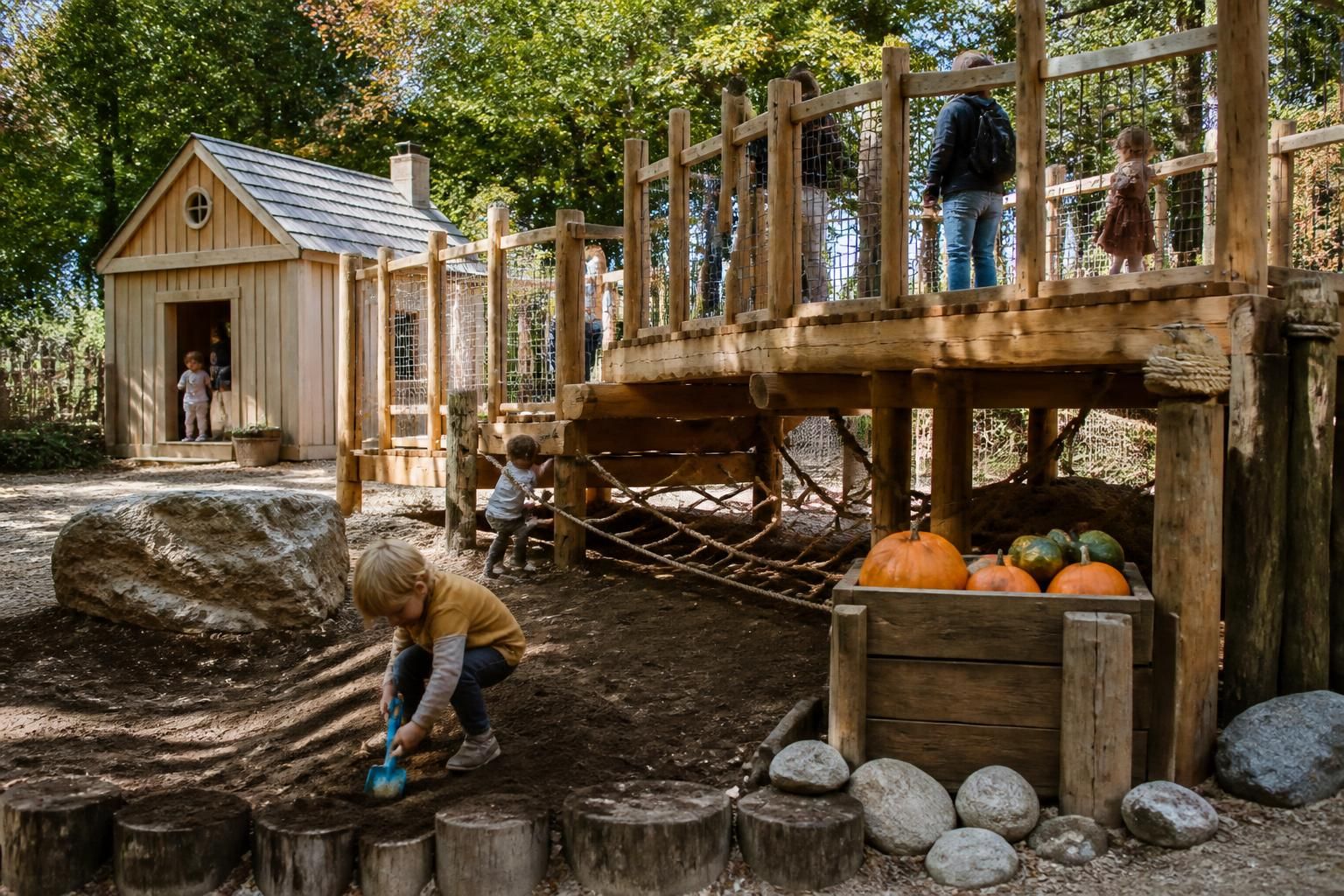
The project was shaped around two practical principles promoted by the museum: stay curious and respect everything around you. Those values are easy to state but harder to build into a real environment. At Farm in the Woods, they become actions. A child who scoops soil in the digging zone can consider where food comes from. A child who climbs toward the raised deck practices confidence, coordination, and judgment. A child arranging objects inside the playhouse can turn a simple structure into a farm kitchen, a shop, or a home.
The playscape avoids the common mistake of separating “education” from “fun.” A conventional Playground may prioritize a slide or a single piece of equipment. Here, the variety of settings encourages longer visits and different forms of engagement. The site includes a raised deck, rope-climbing elements beneath it, a playhouse with handmade furniture, a barn-facing view, a digging area, and a wishing-well feature that quickly became a point of interest for adventurous five-year-olds at the opening.
That variety matters for caregivers as much as for children. A family with siblings at different developmental stages does not need every child to use the same feature in the same way. One child may play quietly in the house while another climbs or explores the ground-level farm zone. This makes the site more flexible for Family Activities, school groups, grandparents, and repeat visitors.
The museum’s leadership did not select the concept casually. Diane Chambers, the executive director, described an evaluation process that compared several types of outdoor learning spaces. Some options felt too focused on infants, while others leaned so heavily into rustic aesthetics that they did not meet the needs of a children’s museum. The final direction aimed for an environment that was imaginative, durable, child-led, and clearly connected to the museum’s educational identity.
Panoptic Design of West Springfield, led by children’s-space specialists Terra Fletcher and Evan Tvrdik, developed the project in detail. Their involvement is significant because successful Interactive Exhibits are not simply themed structures. They need to account for sightlines, supervision, different mobility levels, material resilience, safe circulation, and the ways children actually move between zones. Good design leaves room for discovery without creating unnecessary confusion for adults supervising the visit.
For museums considering similar Outdoor Fun investments, Farm in the Woods demonstrates that an outdoor setting can be more than an auxiliary amenity. It can become a core interpretation space where children understand a topic through their bodies, choices, and conversations. The strongest learning environments do not tell children what to imagine; they give them meaningful reasons to imagine.
Why This Outdoor Playscape Supports Hands-On Learning and Family Activities
Farm in the Woods reflects a simple but important idea: young children learn differently when they can manipulate real materials, test their balance, and make choices independently. Inside a museum, an Interactive Exhibit may introduce a concept through objects, role-play, or art-making. Outside, the same principle gains another dimension because the child is also responding to weather, sound, texture, scale, and movement.
Consider a typical visit with a fictional family: Maya, age four, and her older brother Theo, age six, arrive with their grandfather. Maya begins by filling a container in the digging area, carefully transferring loose material and narrating that she is “feeding the chickens.” Theo heads to the rope structure, climbs halfway up, then pauses to watch children moving across the deck. Their grandfather does not need to deliver a formal lesson. He can simply ask, “What do you think a farm needs every day?” That question links free play to observation and conversation.
This is where the exhibit’s farm theme becomes useful. It creates a recognizable setting without dictating a single correct outcome. Children can explore ideas about growing, caring, building, transporting, sheltering, and seasonal change. They are not required to complete a screen-based task or follow a prescribed route. Instead, they learn through repetition, peer interaction, and the freedom to revise their own play scenarios.
For cultural and educational venues, this approach is increasingly valuable. Families are looking for activities that are engaging without requiring complicated instructions or costly equipment. An Outdoor Playscape can provide this when it uses clear visual cues, durable features, and play opportunities that work at different speeds. A child who prefers calm observation can sit in the playhouse. A child seeking physical challenge can use the climbing features. Both remain part of the same shared experience.
Designing for curiosity rather than passive consumption
Many destinations now compete for attention through digital attractions. Technology can enhance interpretation, but it does not replace the need for physical, unstructured discovery. Farm in the Woods is notable because it begins with embodied play. It gives children a reason to look closely, take manageable risks, cooperate, and notice their surroundings before introducing any additional layer of information.
That does not mean digital interpretation has no role. A museum could use a simple mobile audio guide or QR-linked soundscape to offer optional content for caregivers: short stories about local agriculture, prompts for observing birds or plants, or practical accessibility information. The key is to make the digital layer optional and lightweight. No family should need an app or headphones before a child can enjoy the space.
For example, an audio prompt placed near the planting area could invite adults to ask children what seeds need to grow. A second prompt near the deck could explain how climbing supports body awareness and spatial reasoning. These are not lectures. They are short, accessible prompts that help visitors notice what is already happening in front of them.
Accessibility is also central to the visitor experience. An inclusive Children’s Play Area must consider more than physical access. Families need understandable opening hours, transparent pricing, clear arrival information, and spaces where adults can supervise children comfortably. The museum’s emphasis on a safe, welcoming environment is therefore part of the exhibit’s educational value, not a separate operational detail.
Parents and caregivers often remember whether a visit felt manageable. Were the activities intuitive? Could children stay engaged without constant correction? Was there room for siblings to play differently? Did the environment feel genuinely welcoming? These questions shape whether families return, recommend the venue, or include it in their routine.
Farm in the Woods shows how an exhibit can support both play and local connection. Its farm-inspired setting is broad enough for imaginative exploration yet specific enough to encourage conversations about land, food, animals, and care. When children can touch, move, and invent, learning becomes an experience they can carry into everyday life.
How the Amelia Park Museum Expansion Was Funded Through Community Engagement
The Farm in the Woods project offers a clear example of Community Engagement translated into a tangible cultural asset. The total project cost was estimated at $425,000, an amount that required coordinated financial support rather than a single funding source. This matters because outdoor museum projects involve more than the visible structures: design, fabrication, installation, safety considerations, site preparation, and long-term maintenance all need to be addressed from the beginning.
A major step came from the Westfield Community Preservation Committee, which awarded the project $150,000 in February. The Westfield City Council approved that grant in March, allowing the museum to move forward with greater certainty. Support also came from the Beveridge Family Foundation, the Massachusetts Office of Travel and Tourism, and elected officials including state Senator John Velis and state Representative Kelly Pease.
Community support was not limited to grants. Museum leadership also acknowledged the role of Amelia Park Arena representative Billy Fellows, Mayor Michael McCabe, Boys & Girls Club CEO Bo Sullivan, City Planner Jay Vinskey, board president Eric McDowell, and other local partners who provided advocacy or letters of support. These contributions can be essential when a cultural project needs to show that it serves a broader public purpose.
For a children’s museum, the case for investment is especially strong when the project offers both educational value and practical public access. Chambers described the Outdoor Playscape as a cost-efficient way to attract visitors. That assessment is credible because outdoor structures can continue serving families outside ticketed museum hours, extending the value of the original investment without requiring a separate event each time.
| Project component | What it delivers | Community value |
|---|---|---|
| 🌿 Farm in the Woods design | Climbing, digging, planting, and imaginative play zones | Supports active learning for children aged 1–7 |
| 💰 $150,000 preservation grant | Critical funding approved by the city in March | Turns local preservation resources into family infrastructure |
| 🏛️ Partner support | Letters, advocacy, planning input, and public visibility | Builds confidence in the project’s local relevance |
| 🚪 Extended public access | Use outside regular indoor museum hours | Creates more opportunities for affordable Outdoor Fun |
From a visitor-economy perspective, this model is relevant beyond Westfield. Small and mid-sized museums often have limited floor area and tight capital budgets. They may assume expansion requires a major new building. In many cases, a carefully planned exterior project can create new capacity more quickly, while making the venue visible to passers-by and more useful to local residents.
The project’s opening also reinforced the museum’s role as a community institution rather than a standalone attraction. Several co-founders of the original children’s museum on Elm Street attended the event, including Chambers, M.J. McMahon, Gina Broderick, and Eileen Sullivan. Their presence linked the new site to the organization’s earlier community roots and showed that the development is part of an ongoing local story.
Public communication has helped make that story accessible. Families can review the museum’s current hands-on exhibit information before planning a visit, while coverage of the opening provides context on how the outdoor facility was delivered. This type of clear information is not a minor detail: it reduces uncertainty and helps caregivers decide whether the journey, schedule, and cost fit their needs.
For other institutions, the lesson is not to replicate the exact farm theme. It is to define a concept that fits the site, identify a clear public benefit, involve relevant partners early, and explain how the finished space will operate over time. A well-supported Museum Expansion is strongest when funding, access, and purpose are designed together rather than treated as separate tasks.
Planning a Visit to the Farm in the Woods Children’s Play Area
Farm in the Woods is structured to serve both museum visitors and the wider Westfield community. During the museum’s regular open days, Thursday through Tuesday, the Outdoor Playscape is available to patrons from 9 a.m. to 4 p.m. It also has public access from dawn until 9 a.m. and again from 4 p.m. until dusk on those days. On Wednesdays, when the indoor museum is closed, the outdoor area is open from dawn to dusk.
This timetable is more than a convenience. It makes the space usable for morning walks, after-school play, caregiver meetups, and low-cost weekend routines. Families do not always have the time or budget to plan a full museum visit. By opening the outside area beyond standard ticketed hours, Amelia Park creates a practical bridge between a museum experience and a neighborhood resource.
The museum celebrated the launch with a free admission day on Saturday, September 12, from 9 a.m. to 4 p.m. Families and caregivers could use both the indoor galleries and Farm in the Woods without admission charges, alongside a special indoor craft activity. The event offered a useful example of how an opening celebration can create access rather than simply mark a ribbon-cutting for invited guests.
Regular admission remains straightforward: standard entry is $8 per person, seniors and grandparents pay $4, valid EBT cardholders can access the museum for $2 per person for up to six people, and infants under one enter free. These price points help the organization maintain a broad welcome, particularly for households that may otherwise view museum visits as occasional rather than routine Family Activities.
Practical steps for a smoother family visit
- 🧥 Check the weather: the outdoor setting is designed for active use, so layers, closed-toe shoes, and sun protection can make the visit more comfortable.
- 🕘 Match the schedule to your child: early access may suit families with younger children, while after-school hours can work well for children who need time to move after a classroom day.
- 👀 Plan for supervision: the deck, rope elements, and digging spaces invite independent exploration, but caregivers should choose activities appropriate to each child’s confidence and age.
- 🎒 Combine indoor and outdoor learning: use the outdoor farm setting first, then look for related objects, stories, or craft activities inside the museum.
- 📱 Confirm details before travelling: consult the Amelia Park Children’s Museum visitor information for current programming, contact options, and updates.
For tourism and museum professionals, this operating model also offers a useful customer-experience lesson. Clear schedules should be visible in the same places visitors already use to plan: a mobile-friendly website, local calendars, social media, and partner channels. If an outdoor zone has different access hours from an indoor venue, the distinction must be simple enough to understand in seconds.
Audio technology can support that clarity without overcomplicating the visit. A brief welcome message accessed by smartphone could explain site rules, point out quieter play zones, and suggest a 20-minute activity route for families with limited time. This is particularly helpful for first-time visitors, multilingual groups, and grandparents visiting with young children. It also reduces repeated staff questions while preserving a warm, human experience.
A good visitor journey begins before arrival. People need to know where the museum is, when the outdoor feature is available, what it costs, and what kind of play is offered. They also need confidence that the experience will work for the children in their care. Clear information turns a promising destination into an easy decision for families.
What Cultural Venues Can Learn from Amelia Park’s Outdoor Fun Model
The Farm in the Woods project is relevant to more than children’s museums. Historic sites, parks, visitor centers, libraries, zoos, botanical gardens, and tourism offices all face a similar challenge: how can they offer meaningful experiences for young visitors without turning every activity into a staff-led program? Amelia Park’s answer is an environment that can be discovered repeatedly, used in different ways, and shared across generations.
Its strength lies in the combination of a clear theme and open-ended use. Farm life gives the space an identity, but the setting does not demand factual knowledge before a child participates. A visitor can arrive knowing nothing about planting or animal care and still enjoy the climbing, digging, and role-play opportunities. Later, educators and caregivers can introduce richer interpretation as interest develops.
This matters for tourism because families often judge destinations by their flexibility. A two-hour drive may feel worthwhile if a venue offers enough variety for toddlers, siblings, and adults. A local visit may become habitual if the setting changes with seasons, weather, and a child’s growing abilities. Outdoor learning areas offer this repeat value naturally: a familiar deck can feel different in spring rain, summer sun, or beneath autumn leaves.
There is also an operational advantage. An exterior play environment can support spontaneous participation while allowing staff to concentrate on indoor programs, admissions, maintenance, or scheduled workshops. That does not remove the need for inspection, cleaning, safety protocols, and clear visitor guidance. It does mean that the space itself becomes a reliable program asset, not merely a backdrop for special events.
Digital tools should serve this physical experience, not compete with it. For example, a museum can use an accessible smartphone audio guide to offer optional short tracks: “Listen for three natural sounds,” “What do you think grows underground?” or “Can you spot a place where someone built with wood?” Such prompts are effective because they bring attention back to the place. They do not ask children to stare at a screen while standing in a thoughtfully designed landscape.
For organizations evaluating modern visitor tools, the priority should be usability. Audio must be easy to launch, content must be short, and instructions must remain clear for adults who may not consider themselves tech-savvy. A platform such as Grupem can help venues deliver mobile listening experiences without investing in dedicated receiver hardware, making it relevant for guided tours, temporary outdoor routes, and family-oriented interpretation.
Sector professionals tracking recent openings can also compare Farm in the Woods with other notable museum debuts of 2026. The useful comparison is not about scale alone. It is about whether a new feature removes barriers, creates a distinct reason to visit, and gives audiences an experience they cannot reproduce by scrolling at home.
Amelia Park’s next stated capital priorities—lighting, carpeting, HVAC improvements, and another roof project—also underline a reality sometimes overlooked in cultural planning. Visitor-facing innovation and building care must progress together. A new play environment can attract attention, but comfort, safety, climate control, and maintenance determine whether an organization can sustain public trust over the long term.
That balance makes this Outdoor Playscape particularly instructive. It is not presented as a miracle solution or a replacement for indoor learning. It is a focused addition that broadens the museum’s offer, activates exterior space, and creates more reasons for families to engage with the institution. The most durable innovation is useful, understandable, and grounded in the everyday needs of the people it serves.
Where is Farm in the Woods located?
Farm in the Woods is located at Amelia Park Children’s Museum, 29 South Broad Street, Westfield, Massachusetts.
Who is the Outdoor Playscape designed for?
The museum serves children ages one to seven, and the outdoor space is designed for active, supervised play by children and their families or caregivers.
When can the public use the outdoor play area?
From Thursday through Tuesday, it is open to the public from dawn to 9 a.m. and from 4 p.m. to dusk. On Wednesdays, it is available from dawn to dusk while the indoor museum is closed.
How much does admission to Amelia Park Children’s Museum cost?
Regular admission is $8 per person. Grandparents and seniors pay $4, valid EBT cardholders pay $2 per person for up to six people, and infants under one are admitted free.
What types of activities are available in Farm in the Woods?
Children can climb, explore rope elements, dig, imagine farm routines, use the playhouse, and engage with planting-inspired and nature-based play features.
