
Inside Alan Jackson’s Nashville Museum: A Career Told Through Personal Objects
Alan Jackson’s Silverbelly Whiskey Distillery and Museum brings a personal perspective on a major country music career to downtown Nashville. Located at 121 3rd Avenue South, the destination combines an exhibition about the singer’s life with a whiskey-focused visitor experience, connecting musical storytelling and hospitality within one address.
The artist’s official museum announcement identifies June 25 as the opening date, while coverage places the launch in 2026. For visitors, the practical distinction is between that opening announcement and current operating arrangements: admission options, public hours, and access to individual experiences should come from the venue’s latest information.
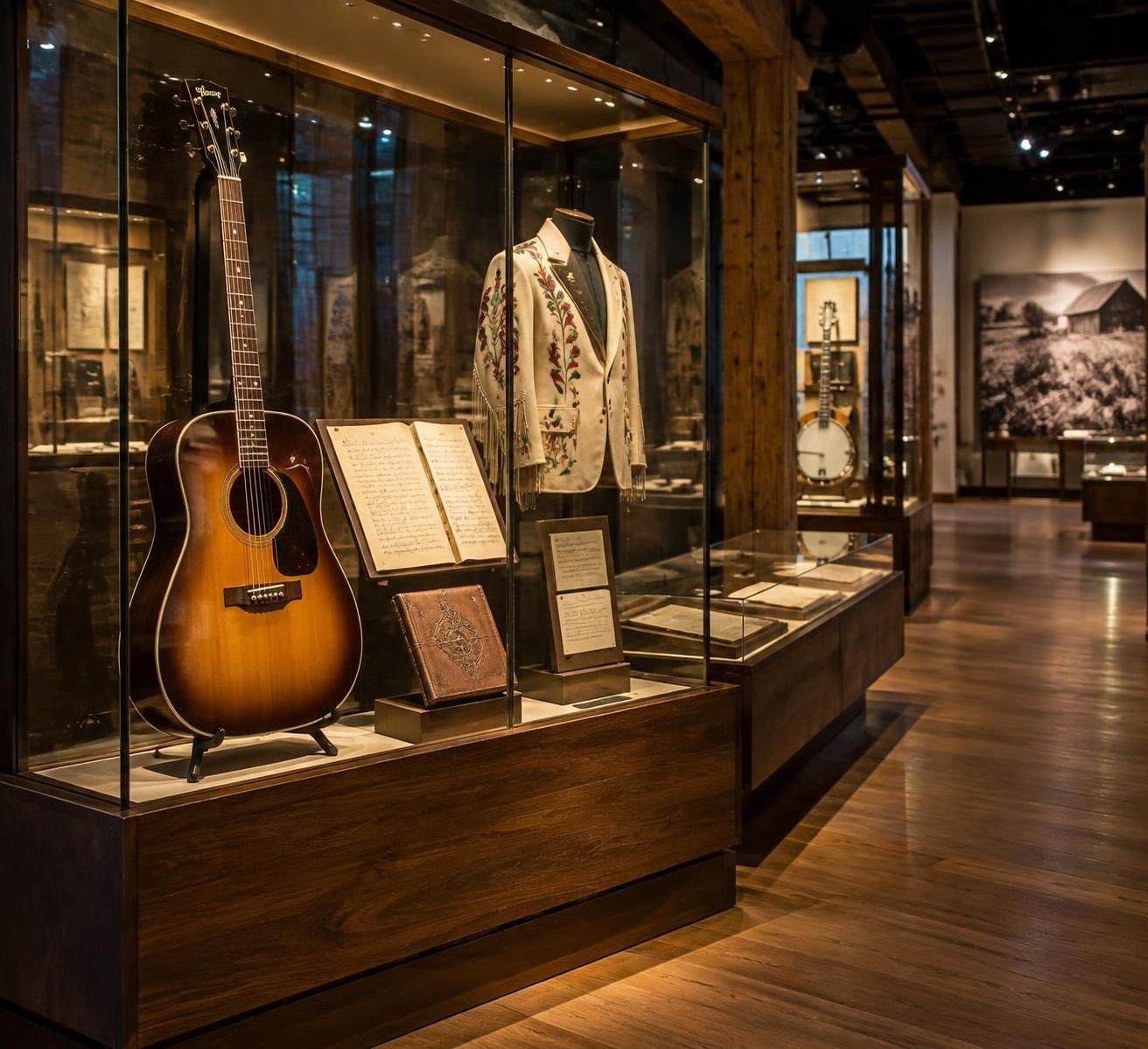
The central attraction is the opportunity to encounter memorabilia with a biographical purpose. Reports describe nearly 600 artifacts covering Jackson’s childhood, marriage, songwriting, move to Music City, and professional achievements, rather than presenting his career only as a sequence of chart successes.
How Alan Jackson’s memorabilia makes country music history tangible
A stage outfit can reveal how a performer developed a recognizable public identity. A personal possession can explain something different: the family relationships, working habits, or ambitions behind that identity. Placing those objects within a chronological narrative helps visitors understand how an ordinary life became a nationally significant artistic career.
That distinction matters for audiences with different levels of familiarity. A longtime listener may recognize a song title immediately, while a younger visitor needs enough context to understand why the recording mattered. Effective interpretation gives both people a useful entry point without making either feel overlooked.
Consider a hypothetical group coordinator, Rachel, planning a visit for travelers with mixed musical interests. Instead of asking everyone to memorize award totals, she could organize discussion around three questions: What shaped the songwriter? How did his public style develop? Which stories continued to resonate across generations?
Those questions turn display cases into evidence. An award demonstrates professional recognition, but its meaning becomes clearer when connected to the song, performance, or career stage that earned it. Likewise, clothing becomes more revealing when discussed alongside television appearances, touring, or the visual traditions of the genre.
Country Now’s look inside the attraction provides another starting point for understanding its focus. Visitors preparing a group itinerary can use such coverage to identify themes, then rely on the official venue for operational details rather than assuming every photographed display or experience will remain unchanged.
The museum opening also illustrates a broader shift in artist-led attractions: audiences increasingly expect a coherent story, not simply proximity to famous possessions. Authentic objects create interest; clear explanations establish why those objects deserve attention.
For cultural professionals, the useful lesson is to separate significance from celebrity. Recognition may bring people through the door, but specific details about work, place, and relationships give them something meaningful to remember after leaving.
That approach also improves the visit for accompanying partners or relatives who are not dedicated fans. They can engage with migration, persistence, family life, and creative labor even when individual recordings are unfamiliar. The strongest biographical displays make a famous career understandable through recognizably human experiences.
Understanding Alan Jackson’s Musical Legacy Beyond the Awards
The significance of this music museum extends beyond the number of trophies on display. Alan Jackson helped sustain a recognizable connection between mainstream success and traditional country expression, making his career a useful lens through which to explore changes in the recording industry, audience expectations, and musical identity.
His work is often associated with straightforward storytelling, distinctive vocal delivery, and arrangements that leave room for familiar country instruments. For visitors, those characteristics are easier to understand through a focused listening exercise than through a dense explanation of musical terminology.
Listen for the storytelling behind the country music legend
Take “Chattahoochee,” whose appeal involves more than an energetic rhythm. Its setting, conversational language, and memories of growing up give listeners a specific world to enter. A useful interpretive question is not simply whether visitors recognize the chorus, but how the song makes a local experience feel widely relatable.
“Remember When” offers a contrasting route into the catalog. Its reflective perspective encourages attention to time, commitment, and shared experience rather than the movement and release associated with a lively performance. Comparing these approaches shows why an artist’s legacy cannot be reduced to one mood or audience expectation.
“Where Were You (When the World Stopped Turning)” requires a different interpretive tone because of its connection to September 11, 2001. Any discussion should establish that historical context clearly and allow visitors to engage without being pushed toward a prescribed emotional response.
These examples demonstrate a practical principle for exhibition design: pair musical evidence with one clear question. Asking what changes between a reflective ballad and an upbeat recording encourages active listening. Listing numerous technical features without an audible reference usually creates more work for the visitor than insight.
Jackson’s recognition by both the Country Music Hall of Fame and the Songwriters Hall of Fame reinforces the value of examining performance and authorship separately. One perspective concerns the artist audiences see and hear; the other concerns the construction of songs that can outlive a particular performance.
For Rachel’s hypothetical group, a short pre-visit listening session could establish that distinction. Participants might hear two legally available recordings before arrival, identify a lyrical detail in each, and then look for related biographical context during the exhibition visit. This is preparation, not a claim that the venue provides a particular listening program.
A digital guide can support this approach by connecting an object description with a concise explanation of songwriting or arrangement. However, music playback requires appropriate permissions; access to a commercial streaming service does not automatically authorize public exhibition use or redistribution within an audio tour.
For educators, the same method offers a way to discuss country music history without treating it as a fixed set of stylistic rules. Visitors can consider how an artist maintains a recognizable voice while responding to different subjects, production choices, and stages of life.
The most productive interpretation therefore avoids declaring every object “iconic.” It explains what a particular recording, lyric, or performance reveals and gives the audience enough evidence to hear that distinction themselves. A musical legacy becomes clearer when recognition develops into attentive listening.
Planning an Alan Jackson Museum Visit in Downtown Nashville
The attraction’s downtown location makes it relevant to travelers already exploring Nashville’s music district. Its address sits close to Lower Broadway and the Johnny Cash Museum, creating opportunities to combine an artist-focused exhibition with other cultural stops rather than treating the visit as an isolated excursion.
Proximity, however, does not make an itinerary automatically manageable. Busy sidewalks, traffic crossings, waiting times, and the transition between quiet galleries and lively entertainment streets all affect how a group experiences the day. Plan around the visitor journey, not just the distance between pins on a map.
Separate museum admission from whiskey-related experiences
The combined concept requires careful reading of booking information. A museum visit, a distillery-related activity, and a hospitality reservation are different products, even when they share a building. Do not assume that one purchase provides access to every part of the property.
Nashville Guru’s venue overview describes an upstairs exhibition, on-site blending and bottling, and a private speakeasy called The Vault. Those distinctions help explain the layout, but current availability and eligibility should be checked directly before making commitments to travelers.
For families and mixed-age parties, alcohol-related conditions deserve particular attention. Ask which areas admit younger visitors, whether any experience requires identification, and whether museum-only access is available. These are booking questions, not details to resolve after the group reaches the entrance.
| Planning point | What to confirm | Why it matters |
|---|---|---|
| 🎟️ Admission | Ticket inclusions and any timed entry | Avoids confusing exhibition access with separate experiences |
| ♿ Access | Step-free routes, elevator access, and seating | Supports comfortable movement through an upstairs gallery |
| 🥃 Distillery activities | Age rules, identification, and reservations | Keeps mixed-age itineraries realistic |
| 🎧 Group visits | Guide policies and permitted audio equipment | Prevents disruption and last-minute changes |
| 📍 Arrival | Meeting point and late-arrival procedure | Reduces confusion in a busy downtown setting |
Rachel’s hypothetical itinerary could place the exhibition before a broader neighborhood walk. That sequence gives travelers shared context before they encounter the surrounding honky-tonk environment, where live performance, crowds, and commercial activity create a very different atmosphere from a curated display.
Build flexibility around individual interests rather than requiring everyone to participate in every activity. A whiskey enthusiast and a visitor focused on songwriting may want different extensions to the same cultural stop. Establishing a clear regrouping location allows both interests to be accommodated without fragmenting the entire day.
Digital ticketing also needs a backup plan. One person holding every confirmation on a single phone creates an avoidable dependency if the battery fails or the group separates. Share essential booking details with another responsible participant and keep the venue’s contact information accessible.
For a broader comparison of admission-planning issues, Grupem’s resource on museum entrance arrangements offers a related operational topic. Its venue-specific information should not be transferred to this attraction; the useful connection is the habit of checking precisely what an admission product includes.
Finally, distinguish recommended preparation from confirmed facilities. Seating, storage, re-entry, photography, and group arrangements should never be promised without checking the current policy. A reliable visit begins with a clear account of what is booked, what is optional, and what still needs confirmation.
Making Country Music Heritage Accessible Through Clear Audio
A music-centered attraction presents an unusual interpretation challenge: sound is part of the subject, but uncontrolled sound can make the subject harder to understand. Spoken commentary, nearby conversations, music excerpts, and street noise can compete, particularly when groups move between indoor galleries and downtown sidewalks.
The answer is not simply to increase volume. Intelligibility depends on separation, pacing, and appropriate delivery. A clearly spoken explanation at a comfortable level is usually more useful than a louder narration competing with another loud source.
Use smartphone audio without adding friction to the Nashville visit
A smartphone-based guide can reduce dependence on a guide’s projected voice, provided the venue permits the equipment and the workflow has been tested. Grupem is relevant to organizations evaluating smartphone audio for guided visits, but no deployment or partnership at this property should be inferred.
Start by defining the task. Does the group need to hear a live guide, follow prerecorded interpretation, or access supplementary material independently? These are different workflows, and selecting a tool before clarifying that need can produce unnecessary setup and confusing instructions.
For Rachel’s group, the simplest approach might be a short equipment check before entering. Participants should know how to adjust volume, reconnect if necessary, and request help without interrupting the entire party. Instructions are most effective when demonstrated rather than delivered as a long technical briefing.
- 🎧 Test speech clarity: check an actual spoken passage in the expected environment, not only whether a device produces sound.
- 📝 Provide a text alternative: make essential interpretation available to visitors who cannot or prefer not to listen.
- 🔋 Prepare for battery loss: explain the fallback arrangement before anyone depends on a phone for the full experience.
- 🔈 Avoid open-speaker playback: prevent personal commentary from spilling into shared galleries.
- ♿ Ask about access needs: do not assume one headset or listening method suits every participant.
Accessibility also concerns how content is written. Short sentences, explicit references to the object being discussed, and pauses between ideas help visitors follow narration while looking around. An audio description that repeatedly says “this” without identifying its subject can quickly become difficult to use.
Visual information needs equivalent attention. Describing the shape, material, and relevant details of a costume can support visitors who cannot inspect it closely. Yet description should remain purposeful: explaining why a garment matters is more valuable than reciting every decorative feature without context.
Multilingual interpretation should preserve meaning rather than mechanically reproduce wording. Song titles, cultural references, and regional expressions may require a brief explanation. A translated script also needs a listening test because a comfortable reading length can become tiring when spoken aloud.
Any use of recorded songs within a guided product must be assessed separately from spoken interpretation. Rights, playback conditions, and platform terms matter, even when the educational intention is clear. Linking visitors to an authorized recording is not the same as obtaining permission to incorporate that recording into a commercial tour.
For operators, the meaningful performance measure is whether people can participate comfortably, not how many digital features appear on a screen. Useful audio technology removes obstacles between visitors and the story instead of becoming another attraction they must learn to operate.
What Alan Jackson’s Museum Offers Tourism and Cultural Professionals
The combined attraction provides a useful case for examining how biography, cultural heritage, and a commercial brand can share one visitor destination. Its strength depends on making those elements legible: visitors should understand when they are encountering historical interpretation, when they are exploring a product story, and when they are entering a hospitality experience.
That separation does not require an austere presentation. A welcoming environment can still communicate accurately, and a commercial setting can still offer meaningful learning. Transparency protects trust, especially when a celebrated performer’s name connects the exhibition and the whiskey brand.
Turn an artist-led museum opening into a coherent visitor experience
For destination managers, the opportunity lies in complementarity rather than repetition. An artist-specific collection can provide personal detail, while a broader institution explains industry development and a neighborhood walk explores performance culture. Each stop should answer a different question instead of presenting several versions of the same biography.
A practical itinerary might connect three perspectives: the individual songwriter, the wider history of recording and broadcasting, and the live entertainment economy visible downtown. This approach gives travelers a richer understanding of place without requiring them to become specialists in every era of the genre.
Rachel could make that distinction explicit in her group briefing. At the exhibition, participants look for evidence of a personal journey; elsewhere, they consider how venues, audiences, and institutions supported careers like Jackson’s. The connection is thematic rather than dependent on a claim that any particular business formally collaborates with the attraction.
Cultural teams can apply the same discipline to digital interpretation. Before producing a new recording, identify one question visitors regularly ask and one object that can answer it. A short, well-focused explanation often provides more value than an extensive recording that duplicates the wall text.
Grupem’s discussion of an immersive exhibition at the Sixth Floor Museum offers a separate reference point for considering interpretation and visitor attention. The subject and institutional setting differ substantially, so the useful comparison concerns storytelling methods rather than equivalence between the histories being presented.
Evaluation should also distinguish commercial success from interpretive success. Ticket sales show demand, but they do not reveal whether visitors understood the relationship between a displayed object and a career milestone. A few carefully designed questions can uncover confusion that attendance figures cannot.
Ask whether people could identify the exhibition’s central themes, locate essential information, and move comfortably through the space. For guided groups, note where participants stop listening, struggle to hear, or gather too closely around a display. These observations can inform practical changes without requiring intrusive tracking.
Staff feedback is equally important. Front-of-house teams hear repeated questions about tickets, age restrictions, routes, and schedules, while guides notice which stories prompt genuine discussion. Bringing those observations together helps align pre-visit information with the experience people actually encounter.
For smaller museums, the transferable lesson is not to imitate a celebrity attraction’s scale or branding. It is to connect distinctive collections with clear interpretation and dependable service. A modest archive, local music collection, or temporary display can benefit from the same disciplined approach.
Before adding another digital feature, test one existing interpretive stop with a small, varied group and record where understanding breaks down. The most valuable innovation is the change that makes a specific story easier to access, hear, and understand.
Where is Alan Jackson’s museum in Nashville?
Alan Jackson’s Silverbelly Whiskey Distillery and Museum is located at 121 3rd Avenue South in downtown Nashville, close to Lower Broadway and the Johnny Cash Museum.
What does the Alan Jackson Museum display?
Coverage describes nearly 600 artifacts relating to Jackson’s personal life and career, including stage clothing, personal possessions, and awards. The exhibition traces his journey from Georgia to national recognition.
Does museum admission include whiskey experiences?
Do not assume that exhibition admission includes tastings, distillery activities, or access to The Vault. Check the current ticket description and reserve separate experiences where required.
Can families and visitors with accessibility requirements plan a visit?
Before booking, confirm age policies for each part of the property, step-free access to the upstairs exhibition, elevator arrangements, seating, and available interpretation formats directly with the venue.
Does the museum offer Grupem audio guides?
No Grupem installation or partnership is established here. Organizations considering smartphone-guided visits should confirm the venue’s equipment policies and evaluate audio delivery against their group’s practical and accessibility needs.
