
AI-Generated Voice Impersonating Nithya Raman Triggers Election Ethics Complaints
An AI-generated voice presented as Nithya Raman is at the center of complaints against Thrive LA, a political action committee supporting Los Angeles Mayor Karen Bass. According to FOX 11’s October 26 reporting on the disputed phone line, Raman’s campaign alleges that the operation fabricates statements in her voice while failing to provide adequate disclosure about its artificial nature and financial sponsorship.
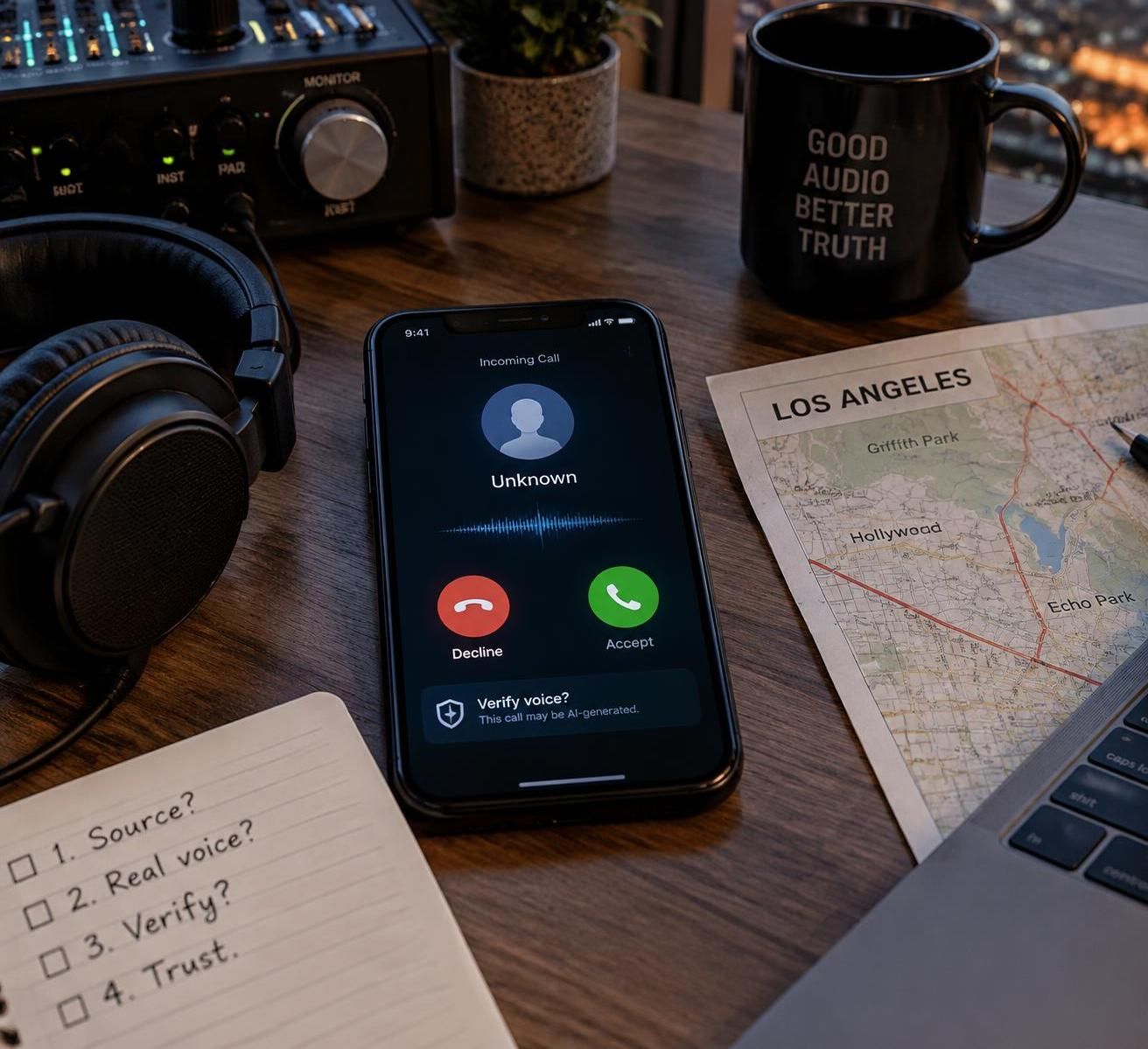
The reported distribution method makes this more than a dispute over an isolated recording. Signs around Los Angeles and promotional material direct people toward a telephone service advertised as “Nithya Raman Realty,” where an interactive synthetic speaker responds to callers.
That interaction matters because a conversation can feel more authoritative than a conventional attack advertisement. A listener asks a question, receives an apparently relevant answer, and may interpret the exchange as evidence of what the candidate believes rather than what an opponent has programmed a system to say.
Why interactive voice impersonation changes the listener’s experience
Traditional political parody usually arrives in a recognizable container: a cartoon, a comedy sketch, or an advertisement with an identifiable sponsor. A telephone conversation offers fewer visual cues, leaving vocal identity, introductory wording, and the caller’s expectations to carry much of the meaning.
Consider Maya, a hypothetical Los Angeles museum operations manager who encounters a sign during her commute. If she calls while walking to work, she may hear only the greeting and one answer before hanging up; whether those opening seconds establish parody becomes central to her understanding.
FOX 11 reported that the service opened with a notice about recording for quality and training purposes. That is a familiar customer-service formula, but a recording notice is not the same as a synthetic-voice disclosure: it explains that a conversation may be captured, not who or what is speaking.
The station also described responses that mocked Raman’s campaign promises and acknowledged that the resemblance to her voice was intentional. Those details support the operator’s characterization of the experience as ridicule, while leaving a separate question about whether every reasonable caller would recognize the framing immediately.
Thrive LA’s satire defense and Raman’s deception allegation
Thrive LA executive director Ana Dahan defended the project as protected political satire and argued that callers would recognize the voice as artificial. Raman’s campaign takes the opposite position, alleging that the presentation misleads voters and obscures responsibility for the operation.
Both positions need to remain attributed. The filing of ethics complaints does not establish a legal violation, and the operator’s assertion that the joke is obvious does not settle how audiences actually encounter it.
The available account also does not independently establish the technical method used to produce the resemblance. Whether the service uses a dedicated voice clone, another synthesis technique, or a combination of tools, the practical concern is the attribution of invented speech to an identifiable person.
For audio professionals, the distinction is immediately useful: intelligibility and realism are production qualities, while identity and authorization are governance questions. A polished listening experience can still be misleading if its source is unclear.
⚠️ The central issue is not simply whether a voice sounds artificial, but whether listeners understand whose words they are hearing and who created the experience.
What the Nithya Raman Ethics Complaints Mean for AI Campaign Advertising
Raman’s campaign reportedly submitted complaints to the California Fair Political Practices Commission and the Los Angeles City Ethics Commission on Monday, October 26, 2026. The allegations concern deceptive election media, artificial-intelligence disclosures, and identification of the party paying for the communication.
These are related but distinct questions. A message can identify its sponsor while leaving its synthetic speaker unexplained; conversely, it can acknowledge that a voice is computer-generated without making clear which organization financed or distributed it.
Reporting described by Los Angeles Magazine’s account of the impersonation allegations places those disclosure concerns at the heart of the dispute. Evaluating them requires the actual signs, advertisements, recordings, and interaction flows—not just selected quotations from either campaign.
Separate the legal allegations from an enforcement finding
The complaint reportedly invokes California Elections Code Section 20012 in connection with certain digitally fabricated candidate depictions near an election. It also cites Government Code Section 84514 concerning disclosures on covered political advertisements containing generated or substantially altered material.
Those references describe the campaign’s legal theory, not an adjudicated outcome. The operative statutory text, applicable exceptions, constitutional considerations, and any court orders affecting enforcement would need to be checked before determining how either provision applies to this particular service.
The timing nevertheless explains the urgency. October 26 falls eight days before the November 3 election, leaving little room for a disputed message to be investigated, corrected, and understood before voting ends.
For Maya, the practical distinction is straightforward: a headline saying that a complaint was filed should not become a social-media post announcing that an organization was found guilty. Accuracy requires preserving the procedural stage as carefully as the underlying accusation.
| Issue | Evidence to examine | Why it matters |
|---|---|---|
| 🎙️ Synthetic identity | The opening message and subsequent responses | Shows whether listeners are told that the speaker is artificial and not the candidate |
| 💳 Sponsorship | Signs, advertisements, landing pages, and audio notices | Helps establish whether the responsible organization is clearly identified |
| 🗓️ Distribution timing | Publication dates and records of changes | Connects the communication to any applicable election-period requirements |
| ⚖️ Procedural status | Complaint documents and agency decisions | Distinguishes accusations from findings or enforcement action |
Why satire and disclosure should be evaluated separately
Political satire has a long history of exaggerating candidates’ language and public personas. However, an argument that material is humorous does not, by itself, answer every question about sponsorship, distribution, or a listener’s ability to distinguish imitation from authentic speech.
The reverse is equally important: convincing synthetic speech is not automatically unlawful merely because it criticizes a public figure. The legal analysis depends on the relevant rules and the facts of the communication, rather than the emotional force of the label “deepfake audio.”
A sound review therefore preserves context. Investigators or journalists should distinguish what appeared on a street sign, what a caller heard first, what emerged only after questioning, and whether disclosures changed over time.
This sequence also helps explain why a screenshot alone may be insufficient. An interactive service can generate different answers for different users, so a complete assessment needs documented examples rather than an assumption that every caller received an identical experience.
The strongest election ethics analysis follows the evidence from first contact through the full interaction, without treating an allegation or a satire defense as the final verdict.
Rick Caruso Backs Karen Bass as the AI Voice Dispute Intensifies
Alongside the synthetic-audio controversy, Rick Caruso announced that he would vote for Karen Bass, the opponent he challenged in the 2022 Los Angeles mayoral election. In the October 26 account, he presented the decision as support for Bass rather than simply opposition to Raman.
Caruso said he believed the incumbent would do a better job going forward. That assessment is a political judgment from a prominent former rival, not independent evidence about the disputed telephone service or the merits of the complaints.
Keeping these developments separate is essential. Their appearance in the same news cycle does not establish that Caruso participated in the project, approved its content, or had any role in its distribution.
What the endorsement adds to the mayoral contest
An endorsement from a previous challenger can signal a shift in political alliances or priorities. It may also reach voters who supported that challenger before and are reconsidering their options in a different electoral environment.
Bass welcomed Caruso’s support by emphasizing their work connected with Pacific Palisades recovery after the wildfires. Her statement pointed to his nonprofit, Steadfast LA, and referenced rebuilding efforts, the Palisades Recreation Center, and the reopening of Palisades Village.
Those references explain the rationale Bass offered for their working relationship. They should not be mistaken for an independent audit of recovery outcomes, emergency preparedness, or the performance of particular projects.
When asked about readiness for another major fire, Caruso expressed hope that the city was better prepared and said he would continue holding officials accountable. His support therefore came with an expressed expectation of scrutiny rather than an assertion that every concern had been resolved.
For a reader such as Maya, this distinction helps organize competing messages. A vote recommendation, an account of collaboration, and an assessment of operational readiness answer different questions, even when a campaign presents them together.
Steve Hilton’s criticism introduces another accountability argument
Steve Hilton, identified in the reporting as the Republican candidate for California governor, criticized support for Bass in a post on X. Asked to explain his position, he framed the issue around holding public officials responsible when government performs badly.
He also acknowledged that he did not live in Los Angeles and stopped short of directly recommending a mayoral vote to city residents. That qualification belongs alongside his criticism because it defines the scope of what he said.
The exchange illustrates how a local race can become a platform for broader arguments about governance. Public safety, rebuilding, housing, and institutional responsibility may attract attention from figures whose own campaigns operate at another level of government.
None of those interventions resolves whether the AI phone line complied with applicable requirements. Political accountability and legal accountability overlap in public debate, but they are not interchangeable tests.
How to read endorsements without importing unsupported connections
A useful reading method assigns each statement to its actual subject. Caruso’s announcement concerns his voting preference; Bass’s response concerns their relationship and recovery work; Hilton’s remarks concern his criticism of the incumbent; the complaints concern a separate communication operation.
That separation also protects against misleading summaries. A headline can legitimately connect simultaneous developments, but the body of a report should explain their relationship rather than imply a common organizer, shared intention, or established coordination without evidence.
For tourism offices and cultural venues that circulate local civic information, this is a practical editorial discipline. Sharing election coverage through a newsletter or visitor-information channel requires the same care with attribution as publishing it originally.
Caruso’s support changes the political narrative; it does not change the evidentiary standard for judging the disputed audio.
How to Check Deepfake Audio Without Relying on Whether It Sounds Real
The Raman controversy highlights a weakness in everyday media literacy: listeners often treat vocal familiarity as proof of identity. Yet a recognizable rhythm, accent, or speaking style can be reproduced or imitated without establishing that the named person authorized the recording.
Sound quality is therefore a poor authentication test. A genuine recording may sound compressed or unnatural after transmission, while generated speech can sound smooth, expressive, and entirely ordinary over a telephone connection.
Interactive systems create an additional challenge. Their ability to answer a follow-up question can produce the impression of a live encounter, even though responsiveness establishes only that a system can generate a reply—not that the represented person is present.
A practical verification workflow for disputed political audio
Maya’s hypothetical encounter offers a useful workflow. Instead of forwarding the most provocative response to colleagues, she first records where she found the number, checks whether an official campaign channel acknowledges the service, and looks for clearly attributed reporting about its operator.
This approach does not require specialist software. It replaces an unreliable question—“Does that sound like the candidate?”—with more useful questions about provenance, authorization, and corroboration.
- 🔎 Check the origin: identify the account, sign, website, or telephone number that delivered the message, rather than relying on a forwarded clip.
- 🏛️ Consult official channels independently: navigate to a known campaign or institutional website instead of following only the disputed message’s links.
- 🎧 Listen for explicit identification: distinguish a statement that the speaker is synthetic from a generic notice that the call is being recorded.
- 🧾 Preserve context: note the date, opening language, sponsor information, and questions that produced the response.
- ⏸️ Pause before amplifying: avoid presenting an unverified excerpt as an authentic statement by the person being imitated.
If documentation involves recording a call, applicable consent and recording rules should be checked first. A written contemporaneous account can preserve important details without assuming that every method of capture is lawful in every setting.
Why automatic deepfake detectors are not enough
Detection tools may provide useful signals, but their output should not be treated as a definitive identity certificate. Telephone compression, background noise, editing, and unfamiliar synthesis methods can all complicate an assessment.
A detector score also cannot answer every relevant question. It may indicate manipulation without identifying the sponsor, establishing permission, or determining whether a particular disclosure appeared before the listener heard the imitation.
For professional teams, provenance is often more actionable than acoustic speculation. An approved script, a documented voice license, a publication record, and a named editor provide an accountability trail that an isolated waveform cannot supply.
Make verification accessible to people who cannot inspect a screen
Audio-only users need essential context within the audio itself. A label displayed on a landing page may not reach someone who dials directly, uses a screen reader, or receives a number from another person.
The same principle applies to translated experiences and forwarded excerpts. If a disclosure disappears when content moves between formats, the audience may encounter the imitation without the information that originally explained it.
For museums and visitor services, this is familiar accessibility territory: crucial instructions should be available at the point of use, not hidden in a separate document. Identity information deserves the same treatment as navigation or safety instructions.
Reliable verification combines source checks, contextual evidence, and clear attribution; listening harder cannot substitute for knowing where a recording came from.
What the Nithya Raman Voice Controversy Teaches Audio Teams About Consent
The immediate dispute concerns a political campaign, but its operational lessons extend to museums, guided tours, public institutions, and audio applications. Any organization using a recognizable voice must distinguish permission to publish a recording from permission to synthesize new speech in that person’s likeness.
A guide may agree to narrate a museum route without agreeing to have their vocal identity used for future announcements. Likewise, permission for one language, exhibition, or campaign should not be treated as unlimited authorization for unrelated content.
Consent needs a defined scope, not merely a signature. The agreement should explain the intended uses, duration, audiences, editing rights, approval process, and whether generating entirely new statements is allowed.
Build authorization around the actual listening experience
Suppose Maya’s museum wants an interactive guide that answers visitors’ questions in the voice of a familiar educator. The first decision should be whether that recognizable identity adds genuine value compared with a clearly identified generic narrator.
If the educator’s likeness is used, the organization should document permission for synthesis and establish boundaries around topics and tone. The speaker should also understand whether the service draws only from approved material or can generate open-ended responses.
This distinction changes the risk profile. A fixed recording can be reviewed sentence by sentence, while an interactive assistant needs controls for questions that were not anticipated during production.
For example, a visitor might ask for medical advice, a political opinion, or an explanation of a disputed historical event. The system needs a defined way to decline, qualify, or redirect such requests without inventing an authoritative answer in the educator’s voice.
Keep identity, content approval, and sponsorship visible
A practical opening might explain that the visitor is hearing an AI-generated guide using an authorized voice, then identify the institution responsible for the content. That wording should be adapted to the experience rather than treated as a universal legal formula.
The disclosure must also remain understandable. Long technical explanations can overwhelm listeners, while vague labels such as “enhanced audio” may fail to communicate that the words were generated rather than personally recorded.
Where audio is downloadable or shareable, context should travel with it where feasible. A clip detached from its original interface should not suddenly appear to be a personal endorsement or spontaneous statement by the speaker.
For teams considering Grupem or another smartphone-based guiding solution, the same procurement questions apply: how are scripts approved, who controls publication, what permissions cover the narration, and how can incorrect material be withdrawn? These questions evaluate responsible deployment without assuming that any platform automatically supplies every safeguard.
Plan correction and withdrawal before publication
An organization should identify who can suspend a disputed voice experience and who will respond if the represented person challenges its use. Waiting until a complaint arrives creates avoidable delays and uncertainty over ownership.
Maintain versions of approved scripts, records of permissions, and dates of publication. If content changes, the team should be able to identify which version visitors heard and whether a correction needs to appear in the same channel.
A useful pre-launch test asks someone unfamiliar with the project to explain who is speaking, whether the narration is synthetic, and which institution is responsible. If those answers are unclear, the experience needs revision before it reaches the public.
For an interactive service, repeat that test across several realistic questions rather than examining only the welcome message. The trust boundary extends through the conversation, especially when a response could be mistaken for a personal view.
Useful audio innovation preserves a clear chain from permission to publication, so a convincing voice never becomes a substitute for accountable authorship.
What does Nithya Raman’s campaign allege about the AI voice?
The campaign alleges that Thrive LA used a synthetic voice resembling Raman to generate fabricated statements and mislead voters without adequate disclosure about the artificial speaker or sponsorship. These are allegations, not established legal findings.
How did Thrive LA respond to the impersonation complaints?
Executive director Ana Dahan defended the project as political satire and argued that callers would recognize the voice as artificial. That defense does not itself resolve the separate questions raised about disclosure and applicable election rules.
Does Rick Caruso’s support for Karen Bass connect him to the phone line?
The reported endorsement establishes Caruso’s voting preference. It does not establish that he created, financed, approved, or coordinated the disputed audio operation.
How can listeners check whether political audio is authentic?
Check the original source, consult independently located official channels, look for explicit synthetic-media disclosures, and compare reliable reporting. Vocal resemblance or an automatic detector result should not be treated as sufficient proof of identity.
What should an organization obtain before synthesizing someone’s voice?
Obtain explicit permission covering synthetic use, define the approved purposes and duration, establish content-review responsibilities, and agree on correction or withdrawal procedures. Permission to publish an existing recording should not be assumed to authorize new generated speech.
