
Two Renoir Paintings Recovered in France: What the Reports Establish
Two paintings by Pierre-Auguste Renoir taken from the museum bearing his name in Cagnes-sur-Mer have been recovered, and six people have been arrested, according to reports dated October 9, 2026. The announcement concerns “Portrait of Madame Colonna Romano” and “Young Woman at the Well,” the two works still missing after the original break-in.
The account attributed to local authorities describes a theft carried out the previous month. Intruders cut through a perimeter fence, entered through a window and initially removed four valuable works, abandoning two as they escaped.
According to the regional prosecutor’s account reproduced in the reporting, the operation lasted less than three minutes and targeted the institution’s most valuable pictures. Investigators subsequently launched a national search for those responsible.
Cagnes-sur-Mer mayor Bryan Masson praised the investigators who located the missing works and identified suspects. His statement did not explain how the recovery was achieved, and a news conference was announced for later that Friday.
Six Arrests Do Not Establish Six Convictions
Arrests are a procedural development, not a finding of guilt. The available account does not establish the role attributed to each detained person, whether charges followed, or whether any individual participated directly in the break-in.
This distinction matters when updating public-facing material. A museum newsletter should not turn “six people arrested” into “six thieves caught,” because the latter assigns responsibility that a court has not established.
Similarly, the recovery announcement does not disclose the location where the objects were found, the investigative techniques used, or their physical condition. Those gaps should remain gaps rather than becoming opportunities for a dramatic reconstruction.
The Associated Press report on the recovered Renoir works and France 24’s coverage of the Riviera investigation provide reference points for following the announcement. For visitor communications, official statements should remain the basis for operational information such as gallery access or display dates.
| Reported development | What it establishes | What it does not establish |
|---|---|---|
| 🖼️ Two missing works recovered | The objects have reportedly been located | Their condition or readiness for display |
| ⚖️ Six people arrested | Authorities have detained suspects | Guilt, individual roles or a final judicial outcome |
| ⏱️ Break-in lasted under three minutes | The reported intrusion was extremely rapid | The complete sequence of security responses |
| 🔎 National search launched | The inquiry extended beyond an initial local response | The methods that led to recovery |
A Practical Standard for Museum News Updates
Consider Claire, a fictional visitor-services manager at a regional art institution. When a major cultural crime enters the news, her team receives questions about safety, opening arrangements and whether recovered objects can immediately return to their galleries.
Her most useful response is a short, dated information sheet separating confirmed developments from matters awaiting clarification. It gives reception staff consistent wording without asking them to interpret criminal proceedings or speculate about conservation.
The earlier theft of crown jewels at the Louvre, referenced in the reporting, helps explain the renewed attention to cultural-site protection. It does not establish that the two incidents involved the same offenders, methods or institutional weaknesses.
The announcement therefore has two different meanings: a significant development in a police investigation, and the beginning of further work before the recovered objects can resume their public role. Finding a missing work answers where it is; it does not yet answer when visitors can see it.
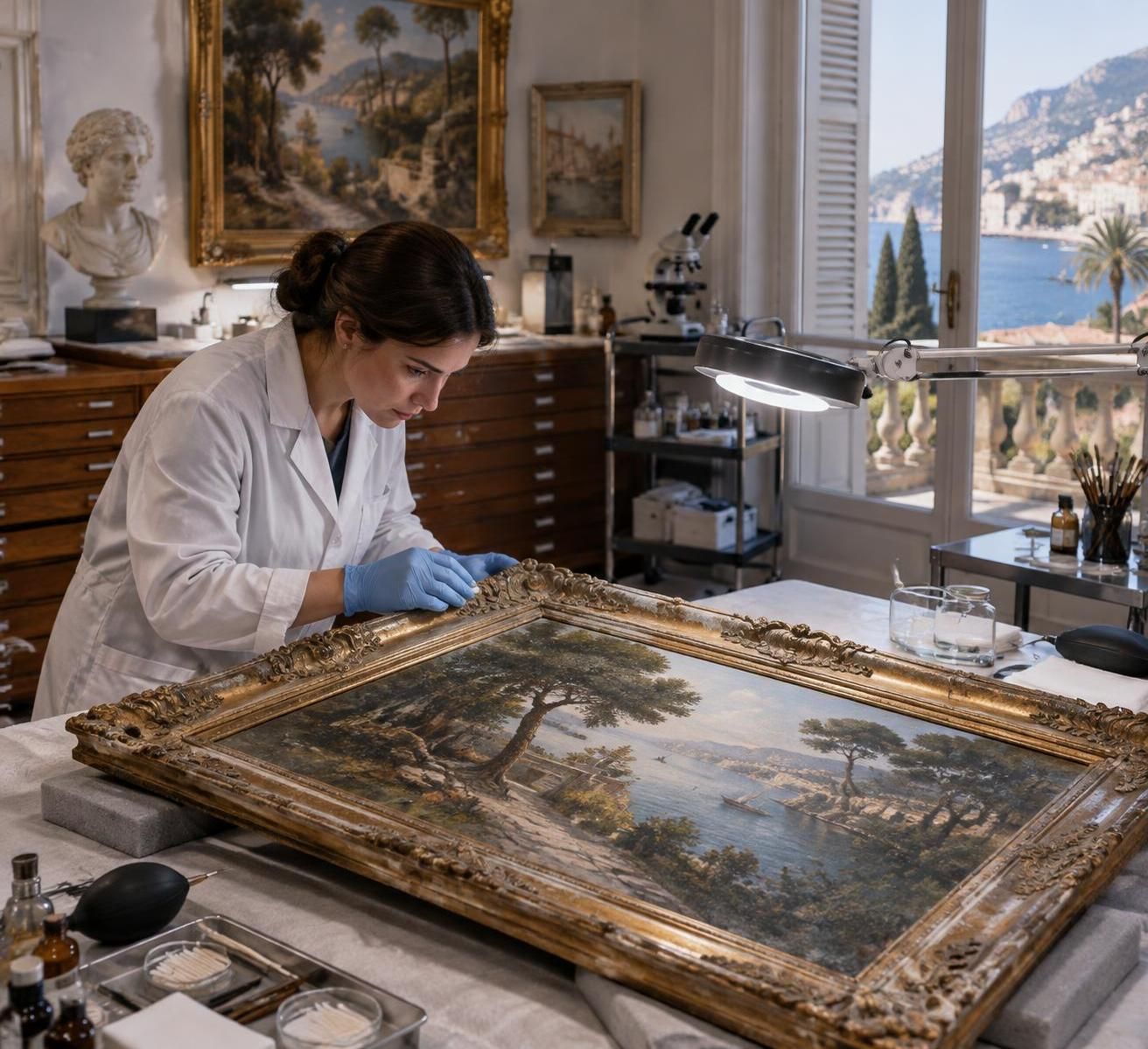
Recovered Renoir Paintings Need Conservation Checks Before Redisplay
The return of stolen artwork is often described as the end of a crisis. For collection professionals, it is a transition into another demanding phase: confirming identity, recording condition, maintaining evidentiary integrity and deciding how the object can be handled safely.
No condition assessment is established by the recovery announcement alone. Even an apparently intact picture may require close examination before transport, storage or exhibition decisions are made.
A work can suffer during hurried removal without showing an obvious tear. Changes in canvas tension, movement within a frame, pressure against the painted surface or exposure to unsuitable humidity may require specialist attention.
Why Identification and Condition Records Matter
Identification should draw on the institution’s existing documentation, including inventory entries, dimensions, photographs, provenance information and distinguishing physical features. Depending on the circumstances, specialists may also examine labels, inscriptions or previous treatment records.
These checks are not evidence of a reported authenticity problem in the Cagnes-sur-Mer case. They illustrate the normal professional distinction between announcing that an object has been located and completing the documentation needed for its return to collection care.
Condition recording serves a different purpose. A conservator compares the object’s present state with earlier records, noting changes to its support, surface, frame and mounting without treating every visible irregularity as new damage.
For example, an old crack in a painted surface may already appear in a pre-theft photograph. A newly loosened frame joint, by contrast, could affect safe handling even when the image itself looks unchanged.
Where criminal proceedings remain active, coordination with investigators is essential. An intervention that removes material, alters packaging or changes a surface may affect evidence, so treatment decisions should follow an agreed process rather than an improvised effort to prepare a display quickly.
Protecting Cultural Heritage Beyond Its Market Value
Financial valuations attract headlines, but they cannot fully describe the loss caused by art theft. An absent object also interrupts research, education and the relationship between a collection and its local setting.
Renoir’s association with Cagnes-sur-Mer makes that relationship particularly important. A portrait or figure painting displayed there belongs to an encounter with the artist’s surroundings, working life and broader contribution to French art.
For a visiting school group, the consequence of an empty space is practical: a planned discussion about brushwork, representation or artistic development needs another focus. For researchers, access to the original surface may be postponed even when high-quality photographs remain available.
Claire’s fictional institution therefore prepares two interpretation plans. One supports a future redisplay if conservation and legal requirements allow it; the other explains an absence through clearly identified reproductions and related objects.
The second plan avoids suggesting that a digital image is equivalent to the original. It instead helps visitors understand what a reproduction can reveal—composition and subject, for example—and what it cannot reliably communicate, such as scale, texture and subtle surface effects.
The related Grupem article on the theft of Renoir masterpieces offers a contextual reading route for professionals considering how collection losses affect interpretation. Any public-facing account should distinguish that background material from current official updates.
Responsible recovery protects both the physical object and the knowledge attached to it. That principle explains why a careful return to public view can be more valuable than a hurried announcement of immediate redisplay.
The Renoir Art Theft Shows Why Museum Security Must Be Layered
The reported sequence—a breached fence, entry through a window and removal of valuable works within minutes—raises a practical question for cultural institutions: can a protective system detect, assess and respond to an intrusion quickly enough? The answer depends on the whole arrangement, not on a single device.
The available reporting does not provide a full security audit of the Cagnes-sur-Mer museum. It would therefore be inappropriate to claim that a particular alarm, camera or staffing decision caused the loss.
Nevertheless, the incident offers a reason to review how perimeter protection, building maintenance, detection, collection safeguards and response procedures work together. Each layer has a different job, and none should be mistaken for a complete solution.
Connect Detection to a Clear Response Procedure
A sensor can register an event without ensuring that the right person acts on it. A monitoring arrangement needs defined responsibilities, reliable contact routes and an agreed procedure for assessing and escalating alerts.
A hypothetical regional gallery might discover during a review that its alarm contractor holds outdated emergency telephone numbers. Replacing those contacts and testing the notification chain could improve readiness without buying an entirely new system.
Another institution might find that temporary maintenance has changed how a door closes or how a protected area is monitored. The useful action is to restore the intended arrangement and document the change, rather than assume that installed equipment continues to perform as originally designed.
- 🔎 Review the complete protective system: assess physical barriers, detection, monitoring and response together with qualified specialists.
- 📞 Test notification routes: confirm that responsible staff and contractors receive alerts through current, agreed channels.
- 🛠️ Record maintenance changes: ensure building work does not quietly weaken existing safeguards.
- 🖼️ Maintain collection documentation: keep usable identification photographs and records in securely managed systems.
- 👥 Train visitor-facing teams: explain reporting procedures without asking staff to confront suspected offenders.
Use Technology Without Creating New Blind Spots
Connected equipment can improve oversight, but it also introduces dependencies on power, connectivity, software maintenance and access control. A procurement decision should include those operating requirements rather than compare only purchase prices.
For cameras, the practical questions include whether recordings can be retrieved, whether time settings are consistent and whether authorized personnel understand the system. Collecting footage that cannot be accessed when needed provides less value than its presence might suggest.
Privacy also matters. Visitor monitoring should have a defined purpose and appropriate governance under applicable requirements, including GDPR where personal data is processed; collecting more information is not automatically a better security strategy.
Claire’s fictional institution assigns operational responsibility rather than leaving every digital tool with whichever employee first installed it. A named manager oversees maintenance schedules, while designated colleagues know how to escalate a fault.
That arrangement keeps security separate from visitor convenience. Audio-guide software, online ticketing and collection interpretation may improve the public experience, but they should not be presented as substitutes for dedicated protective measures.
Funding decisions benefit from the same discipline. A documented maintenance problem, a tested communication failure or a specialist recommendation gives decision-makers a stronger basis for action than a general demand for “more technology.”
Detailed weaknesses should be discussed with appropriate professionals rather than published in public materials. Institutions can explain that safeguards are being reviewed without disclosing information that could facilitate another intrusion.
A layered system is only as useful as the coordination between its parts. The operational lesson is to test that coordination, maintain it and give staff a clear role before an emergency occurs.
Explain the Renoir Recovery Clearly Through Accessible Museum Audio
When a major collection story changes quickly, visitor interpretation can become inconsistent. A website may carry the latest announcement while an audio track, printed handout or tour script still describes the objects as missing.
A coordinated editorial workflow prevents those channels from contradicting one another. This is where digital tourism tools can support museum operations: not by solving the investigation, but by making approved information easier to distribute and maintain.
The task begins with content ownership. One designated editor should maintain the verified version of the update, obtain appropriate approval and record when the wording was last checked.
Write Audio That Separates Facts From Commentary
A useful spoken update should identify the recovered works, describe the reported arrests accurately and explain what remains unannounced. It should not imply that display arrangements are confirmed unless the institution has expressly said so.
For example, a script could state: “Authorities have announced the recovery of the two missing paintings. Information about their condition and any return to public display should be checked through the museum’s official updates.”
This wording avoids suspenseful storytelling and answers the visitor’s immediate question. It also remains usable if the investigation continues without a rapid change in exhibition arrangements.
Historical interpretation should be kept distinct from the crime update. A discussion of Renoir’s painting technique can remain valuable for years, while a statement about proceedings may become outdated within days.
Separating those elements allows an editor to replace a short news segment without rerecording an entire tour. It also reduces the chance that visitors will confuse a permanent interpretation track with a current announcement.
Make Updates Accessible Without Requiring a Smartphone
Audio helps some visitors engage with complex information, but it is not universally sufficient. An equivalent written version supports people who are deaf or hard of hearing, prefer reading, or cannot comfortably listen in the gallery.
Clear language helps across formats. “Recovered” means located and retrieved; “restored” may refer to conservation treatment, and the two should not be used interchangeably.
Translations need the same care. Legal terminology, object titles and operational notices should be reviewed for meaning rather than transferred mechanically between languages.
Visitors should also have an alternative when their phone has no battery, their device is incompatible or they prefer not to use it. Depending on the institution, that might involve a printed update, an accessible information desk or another supported listening arrangement.
Grupem can be considered within a smartphone-based audio-guidance workflow, alongside the institution’s accessibility and editorial requirements. Before deployment, your team should verify the features relevant to its own use case, including language handling, content updates, device compatibility and available access alternatives.
The Grupem coverage of the recovered Renoir paintings provides a related reading option. It should complement, rather than replace, the institution’s authoritative notices about attendance, opening conditions or collection access.
Claire’s fictional team tests its proposed update with a receptionist, a guide and an accessibility adviser. Their review identifies different issues: a confusing date, an awkward spoken title and an instruction that assumes every visitor can scan a code.
Correcting those details produces a more useful experience than adding dramatic music or unnecessary interactive features. Where personal data is collected, the team also checks purpose, access and retention rather than treating analytics as an automatic requirement.
Effective digital interpretation makes verified information easier to understand, not merely easier to publish. That standard remains valuable after the immediate news cycle has passed.
Plan Museum Reopening and Cultural Heritage Funding After Art Theft
A recovery announcement can generate renewed public interest before an institution is ready to answer every operational question. Visitors may expect an immediate return to normal, while staff are still coordinating conservation, legal requirements, building checks and exhibition planning.
Reopening a venue, reopening a gallery and redisplaying a recovered object are separate decisions. Communicating them separately prevents a positive announcement from becoming an unintended promise about what visitors will encounter.
A clear notice should explain which spaces are available, whether particular works remain absent and where updates will appear. If ticketing or group arrangements change, those instructions should be easy to find before arrival.
Give Each Operational Decision an Owner
Responsibility can become blurred when several departments are working under pressure. Conservation may assess handling requirements, facilities staff may oversee building work, and visitor services may manage enquiries, but none should assume that another team has approved the full public announcement.
A simple decision register can record the question, the responsible role, the evidence required and the next review point. It need not contain sensitive investigative information to be useful.
For Claire’s fictional institution, one entry concerns access to an affected room. Another concerns a temporary interpretive display, while a third tracks whether booked groups need a revised route.
This separation helps the team move forward where appropriate without treating every decision as dependent on the same milestone. A temporary exhibition may be ready even though an original object remains unavailable.
Staff wellbeing also belongs in that plan. Employees who handled the incident or repeated visitor enquiries may need a briefing, clear escalation routes and practical support rather than an expectation that they resume normal duties without discussion.
Build Funding Requests Around Specific Needs
The reporting connects the theft with renewed calls for stronger security and better funding across France’s cultural sites. For an individual institution, the most persuasive request translates that broad concern into documented needs and achievable work.
A proposal might identify overdue maintenance, insufficient staff training or a collection-documentation backlog. Each item should explain the problem, the proposed remedy, its ongoing cost and how completion will be verified.
For instance, purchasing equipment without budgeting for maintenance can create a future gap. Likewise, producing excellent identification photographs has limited operational value if they remain scattered across personal devices or cannot be retrieved promptly by authorized staff.
Preventive conservation, security and accessibility should therefore be considered together in financial planning, while retaining their distinct purposes. An accessible audio update supports interpretation; it does not replace an alarm review, and an alarm upgrade does not resolve inaccessible visitor information.
Insurance arrangements also warrant professional review. Coverage, documentation requirements and incident procedures vary, so decision-makers should seek case-specific advice rather than assume that a high-value collection is automatically protected against every financial consequence.
Measure Readiness Without Publishing Sensitive Details
Useful internal measures include completion of maintenance actions, successful notification tests, staff participation in training and the availability of current collection records. These indicators show whether agreed work is happening without exposing the configuration of protective systems.
Visitor-facing measures can be equally practical: whether booking notices match gallery conditions, whether accessible information is available, and whether staff give consistent answers. Such checks connect institutional recovery with the experience people actually receive.
A brief scheduled review brings those strands together. It gives responsible teams an opportunity to identify unresolved tasks before increased interest creates additional pressure at reception or in exhibition spaces.
The strongest recovery plan assigns responsibility, verifies readiness and communicates only what the institution can deliver. That turns public attention into a manageable operational process rather than another source of uncertainty.
Which two Renoir paintings were recovered?
The reported recovered works are Portrait of Madame Colonna Romano and Young Woman at the Well, the two paintings still missing after the theft from the Renoir Museum in Cagnes-sur-Mer, southern France.
How many people were arrested in connection with the theft?
Local authorities reported six arrests. Arrest does not establish guilt, and the available account does not specify each person’s alleged role or the eventual judicial outcome.
Were four paintings originally taken?
According to the reported account, intruders initially removed four works but abandoned two while escaping. The subsequent recovery announcement concerned the two that remained missing.
Does recovery mean the paintings can immediately return to display?
No. Recovery does not establish condition or exhibition readiness. Identification, conservation assessment, evidentiary requirements and safe display arrangements may need to be addressed before redisplay.
How should museums update their audio guides after a recovery announcement?
Use approved, dated wording; distinguish recovery from conservation treatment and arrests from convictions; provide an equivalent written version; and keep changing news updates separate from permanent interpretation.
