
Claudia Winkleman’s Bayeux Tapestry Film Turns Waiting into an Engagement Opportunity
Claudia Winkleman’s appearance in a British Museum film offers a useful case study in a familiar tourism problem: what happens when public enthusiasm exceeds the pace at which an exhibition can admit people? Reporting from The Telegraph on the Bayeux Tapestry queues describes waits reaching two hours before scheduled 40-minute visits, alongside measures intended to make those delays more manageable.
The television presenter plays a fictional security chief recruited by museum director Nicholas Cullinan. Her supposed experience with suspicious personalities becomes the comic premise for an encounter with Anglo-Saxon and Norman fighters, who bring a medieval confrontation into the museum.
The promotional role is also covered in reporting on Winkleman’s exhibition trailer. For cultural organisations, the important distinction is between the film’s original purpose—generating interest—and its secondary use as entertainment for people already waiting to enter.
Why Claudia Winkleman’s Trailer Works as a Queue Companion
A recognisable performer can provide an immediate point of connection for audiences who know little about Norman history. Humour lowers the threshold for engagement, while the museum setting links the fictional action to the physical surroundings visitors are about to explore.
However, attention is not the same as improved service. A short film can make several minutes feel more purposeful, but it cannot compensate for an unexplained delay, a missed appointment or uncertainty about whether entry remains possible.
Consider Maya, a fictional guide accompanying a mixed-age group to the display. If she shares the trailer while also explaining the current waiting estimate, the entertainment supports her communication; if she offers it instead of answering practical questions, the same content risks appearing dismissive.
This distinction matters because frustration often comes from losing control rather than simply standing still. Visitors want to know where they should remain, whether they can sit down, and what will happen if their booked time passes.
The reported plan to place QR codes along the waiting route makes the film available without requiring a large screen at every location. Yet placement determines whether that approach is helpful: a code mounted where people must stop, turn around or cross a moving line can introduce another obstruction.
Give Museum Visitors Choice Rather Than Compulsory Entertainment
The strongest deployment offers several ways to spend the interval. Some people will enjoy the comic trailer, others will prefer historical preparation, and some will need a quiet place to rest without further stimulation.
A family activity can complement the film without competing with it. For example, a printed challenge might ask children to recognise a ship, a horse and a shield in a reproduction, preparing them to identify visual storytelling later.
Questions should encourage observation rather than reward prior knowledge. Asking which scene suggests movement is more inclusive than expecting a child to recall the names of unfamiliar medieval nobles before the visit begins.
Staff also need language that sets the right expectation. “There is an optional short film while you wait” is more respectful than implying everyone should watch it or suggesting that entertainment resolves the disruption.
Success can be assessed through voluntary engagement, visitor feedback and the number of repeated information requests. Film views alone reveal little about whether people understood the delay or felt appropriately supported.
The practical value of Claudia Winkleman’s performance lies in offering a welcome distraction alongside clear service information—not in presenting distraction as a solution to congestion. That distinction leads directly to the operational question: why does the waiting line build in the first place?
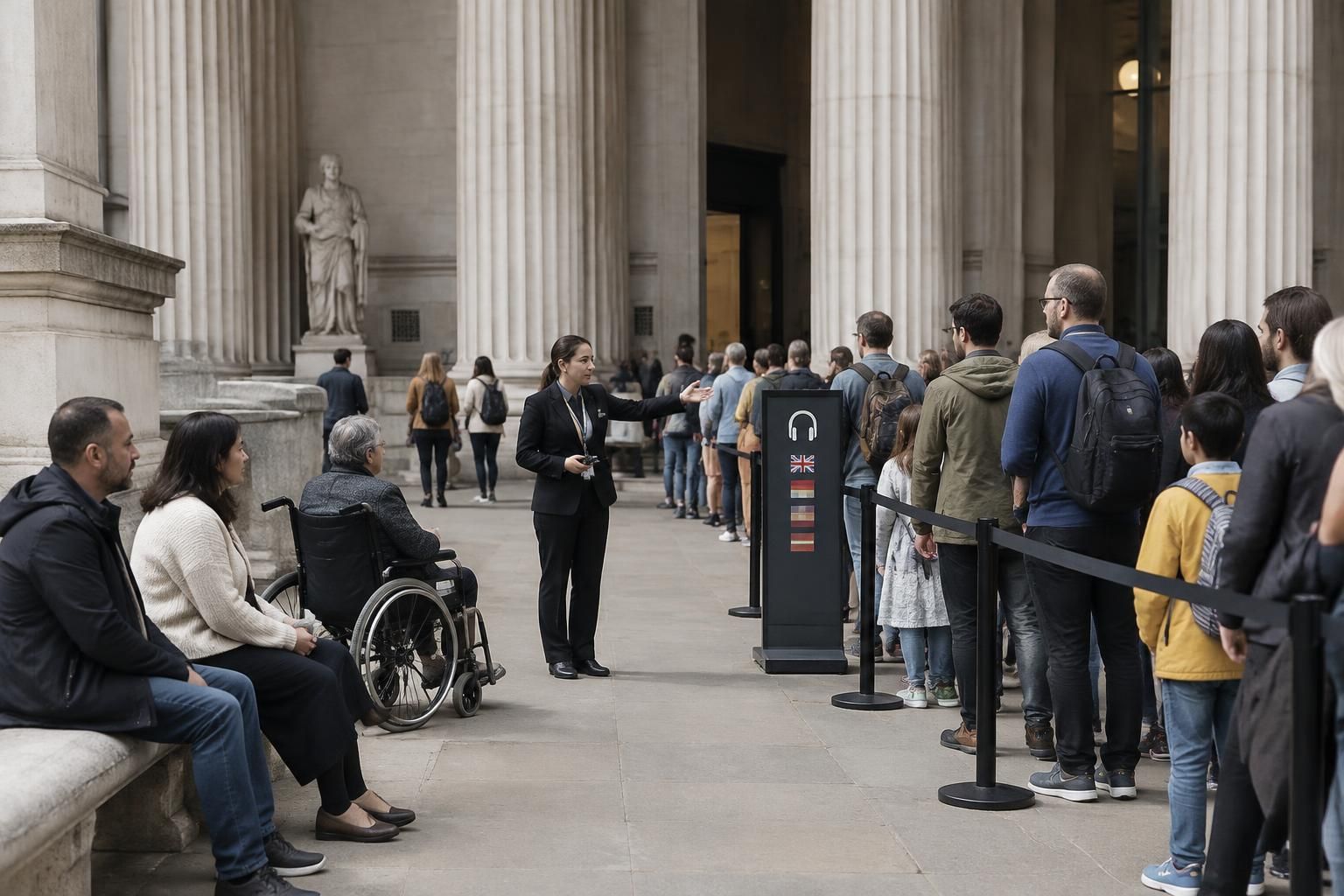
Reducing the Bayeux Tapestry Queue Requires Better Crowd Management
The reported admission model combines timed entry with a long, linear viewing route. That arrangement creates a predictable difficulty: people enter in scheduled groups, but they do not examine an intricate historic object at a uniform speed.
The Bayeux Tapestry is approximately 70 metres long and contains numerous scenes that invite close inspection. One visitor may move steadily through the story, while another pauses to examine clothing, lettering or an unusual detail in the borders.
When overtaking space is limited, these differences accumulate. A brief stop near the entrance can slow people farther back, and later admissions may inherit the delay even when their own ticket-holders arrive punctually.
Separate Security Delays from Bayeux Tapestry Viewing Delays
Effective crowd management begins with identifying the actual bottleneck. External security, ticket scanning, the approach to the gallery and movement beside the embroidery are different stages, each requiring its own observations.
A single estimate for the entire journey conceals useful information. If screening is moving normally but the display is congested, additional staff outside will not necessarily increase admission capacity.
Maya’s fictional group illustrates the distinction. All participants may clear security promptly, yet remain delayed near the gallery because earlier viewers are progressing slowly; telling them simply to arrive earlier next time would misdiagnose the problem.
A practical monitoring sheet should record scheduled admission, actual entry and departure for a sample of groups. Supervisors can then see whether lost time is occurring before viewing begins or within the interpretive route itself.
| Visitor stage | What to observe | Operational response |
|---|---|---|
| 🛂 External screening | Processing time and accessibility assistance | Clarify arrival guidance and separate assistance needs from routine checks |
| 🎟️ Ticket validation | Scanning failures and booking queries | Provide a nearby help point outside the main flow |
| 🚶 Gallery approach | Available space and accumulated lateness | Adjust release timing before the approach becomes overcrowded |
| 🔎 Viewing route | Repeated stopping points and opportunities to pass | Review interpretation placement and circulation with conservation staff |
| ♿ Resting areas | Seat availability and unobstructed movement | Place seating where it does not narrow the accessible route |
Protect Looking Time Without Letting Delays Accumulate
There is a fundamental tension in asking museum visitors to keep moving past an object whose value depends on looking closely. An admission strategy should acknowledge that tension rather than treating every pause as poor behaviour.
Where the layout allows, clearly marked observation positions can separate longer examination from through-movement. Where it does not, detailed reproductions and preparatory interpretation can help people identify their priorities before reaching the original.
These measures require testing rather than assumption. A sign explaining a complex scene may help comprehension, but it may also create a gathering point if placed in the narrowest part of the route.
Managers should examine the longest delays as well as the typical experience. An average wait of reasonable length can conceal a small but significant group facing much longer disruption, particularly late in the day.
Reported extensions to opening hours should therefore be understood as additional operating flexibility, not proof that capacity problems have disappeared. Security staffing, transport availability, employee breaks and conservation conditions still need to support the revised schedule.
The Grupem resource on Bayeux Tapestry ticket planning provides a related starting point for readers considering the booking journey. Any visit plan should still be checked against the museum’s current official arrangements.
A better timetable absorbs realistic viewing behaviour instead of relying on everyone moving at exactly the same speed. Once the physical process is understood, digital interpretation can support it without becoming another source of friction.
Use Smartphone Audio to Prepare Bayeux Tapestry Visitors Before Entry
The reported waiting-area content includes a longer educational film presented by curator Michael Lewis. This serves a different purpose from the Winkleman trailer: it introduces the historical context and helps visitors understand what they will encounter.
For heritage professionals, that pairing suggests a useful editorial model. Entertainment earns attention; interpretation gives that attention direction, provided visitors can choose the format and depth that suit them.
A smartphone-based experience can extend this approach beyond video. Short audio segments allow people to listen while seated, without needing to keep their eyes fixed on a small display throughout the wait.
Build Bayeux Tapestry Audio Around Practical Viewing Questions
Preparation should answer questions that improve the encounter with the object. Who are the principal figures, how does the narrative progress, and which visual details help distinguish a journey, a negotiation or a battle?
For Maya’s group, three short segments would be more manageable than one uninterrupted lecture. The first could introduce the succession dispute, the second explain the embroidered storytelling, and the third suggest details worth noticing.
Each segment should have a clear purpose and a natural stopping point. If admission begins unexpectedly, visitors should be able to stop listening without losing an essential instruction or feeling obliged to finish.
Audio should prepare observation, not dictate every second of it. An overly prescriptive commentary can cause listeners to halt at identical locations, reproducing the same congestion the digital service was intended to reduce.
Grupem’s smartphone-based guiding approach is relevant where an organisation wants to use visitors’ own devices for spoken interpretation. Before deployment, the team should confirm the available features, device compatibility, connectivity requirements and support arrangements for its particular use case.
Using personal phones does not remove operational responsibility. Staff still need a simple joining process, an alternative for people without suitable equipment, and a plan for visitors whose batteries are low.
- 🎧 Encourage headphones: speaker playback can make a shared waiting area uncomfortable and interfere with staff announcements.
- 📝 Offer equivalent text: transcripts support people who cannot hear the recording or prefer reading.
- 📱 Keep access straightforward: avoid unnecessary forms or account creation for a brief interpretive experience.
- 🔋 Plan a non-digital alternative: printed prompts remain useful when a device is unavailable.
- 🌍 Prioritise understandable language: translate essential visitor instructions before expanding optional historical content.
Test the QR Journey Under Real Museum Conditions
A successful scan in an office does not demonstrate successful access in a crowded hall. Reflections, low signal strength, small signage and the angle from a wheelchair can all affect the experience.
Testing should follow the complete journey: noticing the sign, scanning the code, opening the page, choosing the content and starting playback. A delay at any one of those stages can cause people to abandon the experience.
Safety messages require particular attention. Headphone users must still receive essential instructions, so staff should have a clear method for requesting attention when the line moves or an urgent announcement is made.
Digital content should also be separated from booking support. A visitor seeking a revised admission time should not need to navigate historical material before finding operational information.
The useful performance measures are straightforward: successful access, time to playback, requests for assistance and visitor comprehension. These reveal more than the number of QR scans, which may include failed attempts.
The best smart tourism tool reduces effort for visitors and staff simultaneously. Its educational value depends on the quality of the historical explanation delivered through it, not simply on the presence of technology.
Explain Norman History Without Oversimplifying the Bayeux Tapestry
The Bayeux Tapestry offers more than a sequence of dramatic battle scenes. Its embroidered narrative depicts journeys, political relationships, preparations for war and the conflict associated with the Norman Conquest of England in 1066.
Although conventionally called a tapestry, it is technically an embroidery worked on linen. Explaining that distinction gives visitors an immediate way to appreciate the object as something made through skilled labour, rather than simply as an illustrated historical account.
Interpretation should also distinguish between what the surviving scenes show and what historians infer from them. A medieval image is evidence, but it is not a neutral recording of events.
Connect Claudia Winkleman’s Comic Film with Serious Historical Interpretation
The trailer’s fictional confrontation supplies an accessible entrance into the period, yet its theatrical shorthand should not become the entire explanation. Audiences need a bridge from familiar entertainment to the more complicated political story represented in the embroidery.
A short interpretive sequence might introduce Edward the Confessor, Harold Godwinson and William of Normandy before discussing Hastings. This helps visitors understand why the battle occurred rather than remembering only that two armies fought.
Dates should be used selectively. The year 1066 is essential, but a dense succession of names and chronology can overwhelm people who are already managing tickets, children or a lengthy wait.
Maya could ask her fictional group to look for evidence of preparation before looking for combat. Ships, horses and transported equipment demonstrate that conquest depended on organisation and resources as well as fighting.
That question works across age groups because it starts with visible evidence. A child can notice a vessel, while an adult can consider what transporting an army across the Channel required.
Good interpretation makes visitors more observant rather than merely more informed. It provides a method for looking that remains useful when the guide or recording falls silent.
Use Bayeux Tapestry Details to Encourage Independent Looking
The Latin inscriptions, central narrative and decorative borders offer several levels of engagement. An introductory commentary can explain how these elements relate without expecting everyone to decode every scene.
The appearance of a comet, commonly identified with Halley’s Comet, provides a memorable example. Visitors can consider how an unusual celestial event might be understood in a medieval political narrative rather than treating it solely as a modern astronomical fact.
Another productive approach is to distinguish observation from interpretation explicitly. “Several figures point upward” describes visible action; explaining the significance of their gestures introduces a historical reading that deserves context.
This method is particularly valuable for school groups. It encourages pupils to support an answer with evidence, while leaving room for different responses to the same image.
Reproductions can support that exercise before admission, allowing discussion away from the constrained viewing route. Once inside, visitors can recognise a detail they have already considered without needing a long explanation beside the original.
Cross-Channel context matters as well. The object connects English and Norman history, and its stewardship involves institutions and communities with different responsibilities and relationships to that past.
Readers interested in those arrangements can explore Grupem’s discussion of the Bayeux museum and tapestry loan context. Exhibition logistics should be explained alongside, rather than in place of, the object’s historical and cultural significance.
Interpretive materials should identify their editorial responsibility and undergo specialist review. Attractive production cannot correct a misleading script, and a confident voice should never obscure the distinction between established fact and interpretation.
Cultural heritage becomes accessible when complexity is explained clearly, not removed. That same respect for evidence is necessary when communicating the conservation limits that shape public access.
Protect Bayeux Tapestry Access Through Conservation and Clear Visitor Policies
Longer opening hours can provide breathing room after delays, but a fragile embroidered object cannot be treated like an attraction with unlimited operating capacity. Access must remain compatible with conservation requirements, staffing and the conditions of any loan agreement.
The reported response includes an additional hour of opening and the use of a reserved allowance for light exposure. These details highlight a wider principle for museum planning: operational flexibility should be negotiated before a busy exhibition begins, rather than improvised after disruption occurs.
Explain Bayeux Tapestry Light Exposure in Plain English
Light can contribute to the deterioration of sensitive materials, and exposure is cumulative. Lux-hours measure illumination multiplied by time, so the concept is not simply a count of how many hours a gallery remains open.
For illustration, an object exposed to 50 lux for ten hours receives 500 lux-hours of exposure. This example explains the calculation only; it does not describe the permitted lighting level or exposure budget for the Bayeux Tapestry.
The supplied reporting does not disclose the precise allowance agreed for the loan. Visitor-facing communication should therefore avoid inventing a limit or implying that extended access has no conservation cost.
A clear explanation might state that additional viewing periods are being managed within agreed conservation conditions. That tells the public why flexibility has boundaries without burdening them with technical documentation.
It is equally important not to suggest that dimming lights automatically solves every problem. Visibility, accessibility, security and specialist assessment all influence how a display can operate.
For cultural organisations, this is a lesson in joined-up planning. Conservation specialists and visitor-service teams need a shared understanding of which adjustments are possible, which require approval and which are unavailable.
Handle Missed Exhibition Slots Before Trust Breaks Down
The Telegraph account also describes ticket-holders unable to enter after earlier delays, with a subsequent sponsored event affecting available time. The museum’s reported response included an apology, a refund and free rescheduling for those affected.
Whatever the cause, a missed visit carries costs beyond the admission price. Travel, accommodation, childcare and limited holiday time can make a later appointment an incomplete remedy.
For Maya’s fictional group, one cancelled slot could disrupt an entire day’s programme. An effective response would give her a named contact, written confirmation of the options and a realistic explanation of when a decision will be made.
Frontline staff should not have to invent compensation rules while facing frustrated visitors. A prepared service-recovery policy creates consistency and allows employees to focus on individual needs.
Private functions and public admissions also require explicit scheduling safeguards. A programme should account for clearance time and foreseeable delays rather than assuming that every visitor will leave precisely on schedule.
Useful management records include the number of missed admissions, the notice provided, the remedy selected and whether it was completed. Tracking only the initial complaint leaves the organisation unable to judge whether its response worked.
Accessibility needs should be recorded with consent and handled discreetly. Someone unable to stand for a prolonged period may need immediate practical assistance, not simply the same written notice distributed to everyone else.
There is also a distinction between explaining disruption and defending it. Visitors need an honest account of what happened, but lengthy institutional reasoning can sound evasive when the immediate question is whether they will see the object.
Protecting trust means matching conservation limits with realistic scheduling and dependable remedies. A clearly communicated contingency plan is as important to the visitor experience as the film, the commentary or the booking interface.
What does Claudia Winkleman do in the Bayeux Tapestry film?
She plays a fictional British Museum security chief who encounters Anglo-Saxon and Norman fighters. The comic promotional film offers an accessible connection to the exhibition, rather than serving as a complete historical explanation.
Does watching the trailer reduce the exhibition queue?
The film can make waiting more engaging, but it does not increase admission capacity. Shorter delays depend on scheduling, circulation, staffing and realistic allowances for viewing the object.
What should visitors check before travelling to the exhibition?
Check the museum’s current official booking guidance, arrival requirements, accessibility arrangements and any service updates. Reported waiting times and opening-hour changes should not be treated as permanent arrangements.
How can smartphone audio help people waiting to enter?
Short, optional recordings can explain the historical context and suggest details to notice. A useful service includes straightforward access, transcripts, headphones guidance and a non-digital alternative.
Why are longer opening hours subject to conservation limits?
Sensitive materials can deteriorate through cumulative light exposure. Additional display time must remain within approved conservation conditions, alongside suitable staffing, security and visitor-support arrangements.
