
Baltimore Through the Lens: What BMA’s 185-Year Photography Survey Reveals
“Flashback: Two Centuries of Baltimore Photography” examines Baltimore as both a subject for the camera and a contributor to the medium’s development. Scheduled at the Baltimore Museum of Art from October 4, 2026, through February 21, 2027, the exhibition connects early studio practice with contemporary documentary work, offering a substantial resource for cultural guides, educators, and museum visitors.
The museum describes a presentation of more than 200 works by 90 named artists and historic studios, spanning more than 185 years. BmoreArt reports a more specific total of 210 images; these descriptions are compatible, but the museum’s broader wording is the clearest figure to use in visitor-facing materials.
The distinction between “two centuries” and “185 years” also matters. The title places the material within two centuries of photographic history, rather than claiming a full 200-year interval between the earliest and latest objects.
How Baltimore’s early studios changed access to portraiture
Photography’s public announcement in 1839 quickly generated experimentation and commercial opportunities. According to the museum’s account of Baltimore’s early photographic development, Henry Fitz Jr. established one of the first daguerreotype studios in the United States in the city in 1840, following his encounter with Daguerre’s invention in Europe.
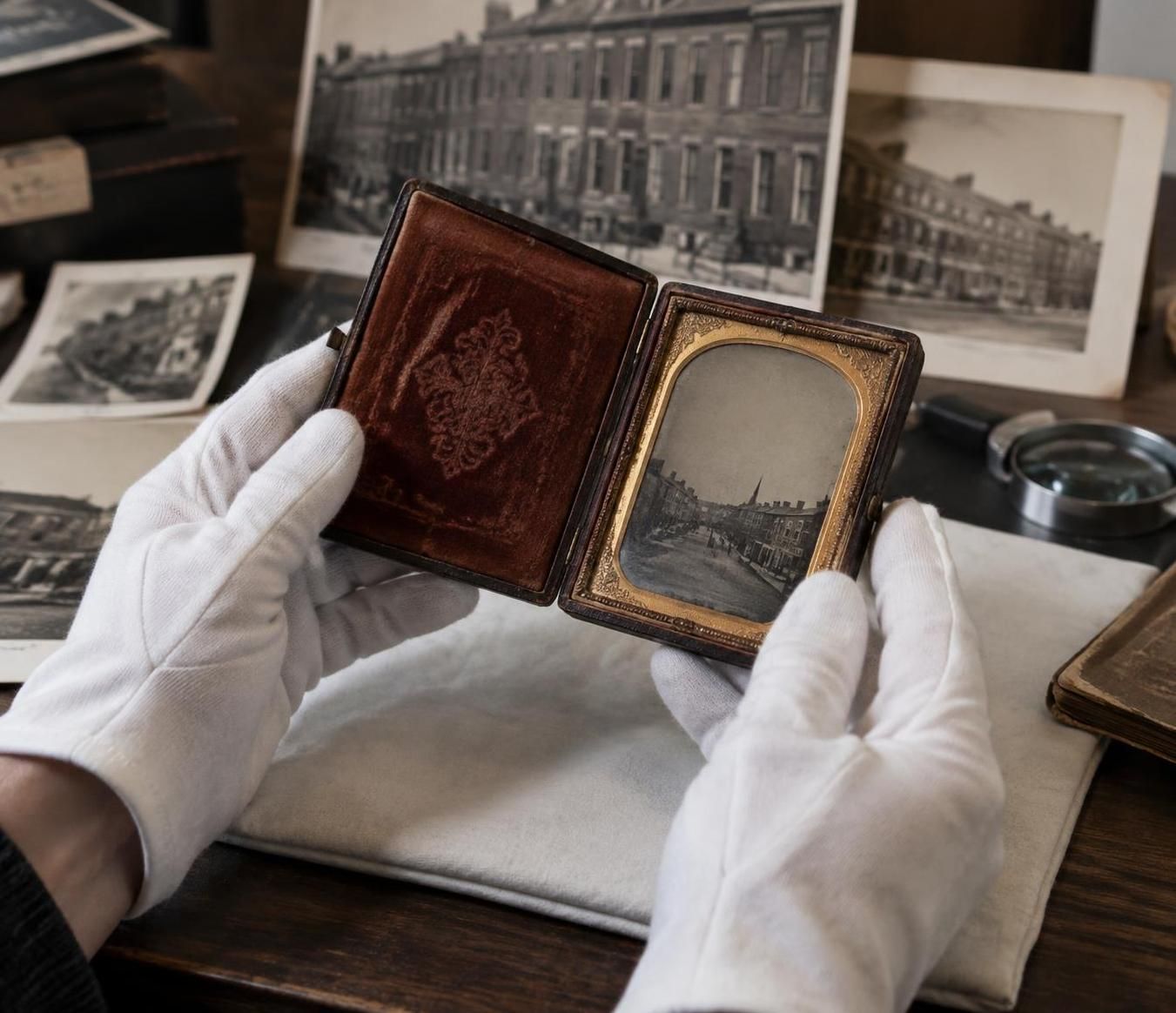
A daguerreotype is not simply an old photograph printed on unusual paper. It is a unique image formed on a silver-coated metal plate, with a reflective surface that can change dramatically according to the viewing angle.
That physical difference gives guides a useful starting point. Rather than immediately reciting dates, they can ask visitors to consider how an image’s material affects the experience of looking: a small, reflective object encourages a different encounter from a large contemporary print.
Early studios also altered the possibilities of self-representation. Portraiture remained shaped by cost, access, and social inequality, but the camera created another route through which individuals could construct and preserve a public likeness.
Reading photographic change without reducing it to better technology
The exhibition’s historical range should not become a simple story of equipment getting faster and images getting sharper. Changes in photographic processes also affected who could make pictures, where those pictures circulated, and which experiences entered the historical record.
A studio portrait, a newspaper photograph, and a digital protest image serve different purposes. Their meaning depends partly on the circumstances of production and partly on the audiences that encountered them.
Consider Maya, a fictional cultural guide preparing a small-group visit. Her first interpretive exercise could compare a nineteenth-century portrait with a later documentary image, asking participants to identify the intended audience before discussing technical differences.
This approach creates an accessible framework for visitors without specialist knowledge. It also prevents a long chronology from becoming a sequence of disconnected inventions, because each object answers a practical question about communication.
For museums developing audio interpretation, a short explanation of process should therefore lead toward human consequences. Explain what the technique enabled, what it constrained, and why someone chose to use it.
The strongest historical reading connects the camera’s changing capabilities to people’s changing opportunities to be seen. That connection becomes particularly important when the exhibition turns toward Black identity and civic visibility.
Frederick Douglass and Black Baltimore: Reading Portraits as Civic Presence
One of the exhibition’s most significant inclusions is an 1841 portrait of Frederick Douglass, described by the museum as the earliest known photograph of the abolitionist. That qualification should remain intact in labels, tour scripts, and promotional copy: “earliest known” identifies the current historical record without making an absolute claim about every image ever produced.
The portrait offers more than an encounter with a famous historical figure. It opens a discussion about how a person’s appearance, bearing, and control over representation can challenge the assumptions circulating in a wider society.
Douglass understood photography’s importance and became a prominent subject of nineteenth-century portraiture. Within this exhibition, his early likeness provides a foundation for exploring the relationship between visual culture, dignity, and public recognition.
Why Black newspaper photography belongs at the center of the story
The survey also includes work by Irving Henry Phillips Sr., whose photographs documented Black life in Baltimore through the Afro-American newspaper. His presence broadens the historical narrative beyond celebrated individuals and exceptional political events.
Newspaper photographs can preserve the everyday structures of a community: its institutions, relationships, achievements, and public gatherings. Their significance lies not only in what happened at a particular moment, but also in what an editorial organization considered worth recording.
Guides should distinguish that wider context from the contents of any individual print. Before naming an event or identifying a person, use the accompanying label rather than inferring a story from clothing, architecture, or facial expression alone.
Maya’s hypothetical group could examine one newspaper image through three questions: who appears, what information the caption supplies, and what remains outside the frame. This exercise demonstrates that archival images are evidence requiring interpretation, not transparent windows into an entire community.
The method is especially useful when visitors bring strong assumptions about the city. A carefully contextualized image can complicate those assumptions without replacing them with another oversimplified narrative.
Connecting the Baltimore Uprising with contemporary visual testimony
The exhibition includes photographs associated with the 2015 Baltimore Uprising and the 2020 Black Lives Matter protests. Among the represented photographers are Devin Allen, Sheila Pree Bright, Joseph Mario Giordano, and Shawn Hubbard, according to the museum’s materials.
These events belong to distinct historical moments. A responsible tour should name the date and context of each work rather than merging different demonstrations into a generic account of unrest.
What changes when a protest photograph moves from a news report into an art museum? Its immediate informational role remains important, but visitors may also study composition, authorship, distribution, and the relationship between the person behind the camera and those being photographed.
Audio interpretation should make those distinctions explicit. A concise track can first identify the documented event, then explain the maker’s perspective where supported by reliable sources, and finally offer a question that encourages close observation.
Avoid dramatic sound effects that turn difficult civic history into spectacle. Clear narration, accurate context, and room for reflection are more useful than a soundtrack designed to dictate an emotional response.
The museum’s emphasis on creators affected by racial and gender prejudice also requires attention to attribution. Naming the maker and explaining the conditions of their work helps restore authorship rather than treating every photograph as anonymous historical illustration.
Representation involves both who appears in the frame and who receives recognition for making it. The same principle helps visitors approach the exhibition’s quieter scenes of neighborhoods, domestic experience, and personal agency.
Baltimore Neighborhoods and Personal Images: Looking Beyond the Headline
Street scenes, rowhouse façades, studio portraits, and documentary photographs give “Flashback” a broader register than a timeline of public milestones. Together, they encourage visitors to study how a city becomes recognizable through repeated details as well as through exceptional events.
A building’s entrance, a pavement, or the relationship between neighboring houses can carry information about everyday experience. Such details deserve close attention, but they should not be treated as sufficient evidence for claims about residents’ income, identities, or circumstances.
The exhibition’s value lies partly in this tension between what a picture reveals and what it withholds. Looking carefully means separating visible information from assumptions.
Using rowhouses and streetscapes to develop visual literacy
For a guided group, an architectural image offers a practical observation exercise. Ask participants to identify repeated forms, variations, and signs of use before offering any historical explanation.
Maya might invite her group to spend thirty seconds studying the boundaries of a street photograph. Which doorway is included, which neighboring property is cut off, and how does the viewpoint organize attention?
Those questions demonstrate that even an apparently straightforward record contains choices. Position, framing, timing, and scale influence how an audience understands a place.
When connecting the museum visit with an outdoor itinerary, use those choices as a bridge rather than promising a direct match between past and present. Buildings change, streets are altered, and the location of a historic view may require confirmation through additional records.
A useful follow-up activity is to photograph a contemporary streetscape and write a short caption identifying the date, location, and intended subject. The exercise shows why documentation matters: without that information, tomorrow’s viewer may struggle to understand today’s ordinary scene.
Cary Beth Cryor’s photographs and the authority to document experience
CBS Baltimore’s reporting on the exhibition highlights Cary Beth Cryor’s 1978 photographs of her pregnancy and the delivery of her daughter. The report describes her effort to secure permission to bring a camera into the delivery room despite resistance from medical staff.
This example shifts attention from public visibility to personal agency. The decision to record childbirth concerns who has authority to make an image, which experiences are considered suitable subjects, and how institutions regulate documentation.
Interpretation should explain those stakes without inventing Cryor’s thoughts or reducing the work to a sensational anecdote. Her authorship matters because she was actively shaping a record of her own experience.
For contemporary cultural organizations, the case also raises practical questions about consent. Permission to photograph, permission to publish, and permission to reuse an image in a commercial tour are separate matters.
A work’s presence in an exhibition does not automatically authorize its reproduction in an app, slide presentation, or social post. Guides should check museum policies and relevant rights before copying images into their own materials.
Preserving the differences between intimate and public pictures
Private experience and civic history do not need to compete for importance. A personal image can reveal social expectations or institutional boundaries, while a public photograph can contain intimate gestures and relationships.
The interpretive task is to preserve those differences rather than forcing every object into one sweeping statement about Baltimore. Short, specific explanations give visitors more room to recognize the complexity of the people represented.
A fuller picture of the city emerges when everyday life receives the same careful attention as headline events. Delivering that attention consistently requires interpretation designed around listening, accessibility, and visitor choice.
Making BMA’s Photography Exhibition Accessible Through Better Audio Interpretation
A survey containing more than 200 works presents a practical challenge: visitors cannot give every object equal attention during a single visit. Good interpretation helps them select a meaningful route without suggesting that the remaining material is secondary.
For a guide, the answer is not continuous commentary. Use audio to support looking, not to replace it. A photograph needs time to register before a detailed explanation can become useful.
Maya’s hypothetical route could organize selected stops around three questions: how a likeness is constructed, how a community records itself, and how a picture becomes public evidence. Each stop would contribute a distinct example rather than repeat the exhibition’s entire chronology.
Writing audio that distinguishes description from interpretation
A reliable script begins with information that can be checked: the maker, date, process, subject, and source of contextual claims. It then separates visible description from interpretation so listeners understand when the guide is explaining evidence and when a reading is being proposed.
For example, “the figure faces the camera” describes an observable feature. “The pose communicates authority” is an interpretation that needs an explanation grounded in posture, framing, clothing, or historical context.
Audio description for blind or low-vision visitors requires additional care. Begin with the overall arrangement and subject before moving toward selected details, and avoid relying on directions such as “over here” without identifying a clear reference point.
Transcripts are valuable for visitors who cannot hear the recording or prefer to read. Where a museum or tour provider offers them, they should contain the substantive content rather than only a shortened promotional summary.
Discussion of emotionally difficult material should be equally deliberate. Explain the subject clearly, give visitors a choice about further detail, and avoid assuming that everyone has the same relationship to the history presented.
Choosing useful technology without claiming a BMA partnership
Smartphone audio tools can help organizations deliver spoken interpretation without requiring every participant to stand close to a guide. Grupem is one option for structures considering smartphone-based guided audio, but any proposed workflow should be tested against the actual group, venue rules, and available equipment.
This recommendation does not imply that the Baltimore Museum of Art uses Grupem or has partnered with it. Distinguishing a practical recommendation from an institutional relationship protects visitors from misleading expectations.
Before adopting any system, test speech clarity, battery demands, connection requirements, and the steps visitors must complete. A technology that works well in an office demonstration can still create friction at a busy museum entrance.
Related reading on narrative art and museum interpretation provides another context for considering how visual works support storytelling. The useful question is not how much content a device can deliver, but how effectively that content helps a person understand the object in front of them.
- 🎧 Test audibility: check speech intelligibility in realistic conditions, not only at a quiet desk.
- 👁️ Leave viewing time: pause after an observation prompt so visitors can inspect the image.
- 📝 Provide a reading alternative: make essential information available beyond spoken delivery.
- 🔋 Prepare a fallback: retain a workable route when a phone, battery, or connection fails.
Each measure reduces a different barrier, from missed words to device dependence. The best audio experience makes participation easier while keeping the photograph—not the interface—at the center of attention.
Planning a Flashback Visit: Dates, Contemporary Photographers, and Practical Checks
The exhibition’s run from October 4, 2026, to February 21, 2027 gives visitors several months to plan around the main galleries. For tourism professionals, that window also allows different approaches: an individual visit, a focused educational session, or a wider itinerary connecting museum interpretation with Baltimore’s urban history.
Start with the official Flashback exhibition page when preparing a booking or distributing visitor information. Dates, ticket arrangements, opening hours, and access provisions should be checked against current museum guidance rather than copied indefinitely from an early news report.
Baltimore Style’s fall arts guide reports that tickets start at $15. Treat that figure as a reported starting price, not a guarantee covering every visitor category, date, or booking arrangement.
Separating the main exhibition from the digital open-call presentation
Alongside the historical survey, the museum selected 12 photographers through its Flashback Open Call. According to BmoreArt, their work is presented digitally during regular museum hours in the special exhibition galleries and at BMA Lexington Market.
This distinction matters when planning an itinerary. The selected contemporary work is a digital showcase, and the Lexington Market presentation should not be described as a second installation of the entire historical exhibition.
For visitors, the open call offers a useful extension of the survey’s central question: who contributes to Baltimore’s visual record now? Its inclusion connects established archival holdings with current image-making without suggesting that all forms of presentation are identical.
A projected photograph also invites different viewing behavior from a physical print. Visitors may need to wait for a sequence to advance, so guides should allow time rather than assuming every selected image will be visible immediately.
Further context on the medium can be explored through Grupem’s coverage of photography exhibitions in Seoul. Comparative reading is most useful when it helps professionals ask sharper questions about display and interpretation, rather than treating different cities as interchangeable cultural products.
A practical planning table for guides and cultural organizers
Use the following checks to turn exhibition information into a workable visitor plan. They distinguish confirmed descriptive details from operational questions that require direct verification before arrival.
| Planning item | Relevant information | Recommended action |
|---|---|---|
| 📅 Exhibition dates | October 4, 2026–February 21, 2027 | Check museum opening hours for the intended visit date. |
| 🎟️ Admission | Tickets reported as starting at $15 | Confirm current prices, eligibility, and booking conditions. |
| 🖼️ Historical survey | More than 200 works spanning over 185 years | Select a focused route instead of promising exhaustive commentary. |
| 📱 Open-call display | Digital work by 12 selected photographers | Verify viewing arrangements at each presentation location. |
| ♿ Access and group needs | Requirements differ among visitors | Ask about relevant accommodations and organized-group policies. |
The exhibition is co-curated by Leslie Cozzi and Antoinette Roberts, with Jenna Paper-Evers, according to the museum. Recognizing that curatorial work helps guides distinguish the exhibition’s researched argument from their own supplementary examples.
For Maya’s fictional group, preparation would include checking labels, choosing a manageable set of stops, and identifying where discussion would interfere least with other visitors. She would also explain that independent looking is part of the visit, not unused time between spoken segments.
Tour organizers should confirm museum rules before using amplification, distributing devices, or making recordings. A smooth operation depends on respecting the venue’s shared spaces as well as delivering clear commentary.
A well-planned visit gives historical objects, contemporary voices, and individual visitors enough space to be understood on their own terms.
When is Flashback at the Baltimore Museum of Art?
Flashback: Two Centuries of Baltimore Photography is scheduled from October 4, 2026, through February 21, 2027. Check the museum’s official exhibition page for current opening hours and booking information.
How many photographs are included in the exhibition?
The Baltimore Museum of Art describes more than 200 works by 90 named artists and historic studios, spanning over 185 years. BmoreArt reports 210 images, which is consistent with the museum’s broader figure.
What makes the Frederick Douglass portrait significant?
The museum identifies the 1841 portrait as the earliest known photograph of Frederick Douglass. It provides an important starting point for discussing portraiture, self-representation, and Black visibility in photographic history.
Is the whole exhibition also displayed at BMA Lexington Market?
The reported Lexington Market presentation features digital work from the Flashback Open Call, which selected 12 photographers. It should not be confused with the complete historical survey at the Baltimore Museum of Art.
What should guides check before organizing a group visit?
Confirm admission, opening hours, group policies, accessibility requirements, and rules covering audio equipment and photography. Prepare a focused selection of works and verify any image-reproduction permissions separately.
