
Why Gravelotte’s War Museum Matters to European History
The Museum of the War of 1870 and the Annexation in Gravelotte addresses a conflict that is often overshadowed by the two world wars. Yet understanding the Franco-Prussian War changes how visitors read the political map of Europe, the history of the Franco-German border, and the monuments scattered across Moselle.
Opened in 2014, the museum stands roughly 10 kilometres west of Metz, close to the landscapes where French and German armies fought in August 1870. Its approximately 900-square-metre permanent exhibition connects military events with the experiences of soldiers, civilians, journalists, and communities living under a new administration.
Understanding the Franco-Prussian War without reducing it to dates
The conflict began in July 1870, when France declared war on Prussia amid a diplomatic crisis involving the Spanish succession. Prussia fought alongside other German states, and the campaign rapidly exposed weaknesses in French mobilisation, command, and coordination.
For visitors unfamiliar with nineteenth-century politics, the important distinction is that a unified German empire did not yet exist when fighting began. Victory strengthened the political conditions for its creation, and the German Empire was proclaimed at Versailles in January 1871.
France experienced an equally profound rupture. Napoleon III was captured at Sedan in September 1870, the Second Empire collapsed, and a republic was proclaimed while the fighting continued.
These developments make the museum more than a destination for enthusiasts of military history. It provides a practical starting point for understanding how battlefield outcomes can transform institutions, borders, and everyday identities.
Seeing 1870 as a turning point, not an inevitable road to 1914
The peace settlement transferred Alsace and part of Lorraine, including Metz, to the new empire. This territorial loss became a persistent issue in French political life and a major element in the development of Franco-German relations.
However, the First World War should not be presented as the automatic result of the earlier conflict. Alliances, imperial competition, domestic politics, and later crises also shaped the circumstances of 1914.
A useful museum visit therefore distinguishes long-term consequences from historical inevitability. The events of 1870–71 created important conditions for later tensions, but they did not determine every decision made over the following four decades.
For an American audience, the site offers an additional perspective. The United States remained neutral during the conflict, yet the Europe encountered by American forces in 1917 and again during the Second World War had been substantially altered by its aftermath.
Building a clear interpretive thread for visitors
Consider a hypothetical cultural-tourism team preparing a visit for adults with little prior knowledge of the period. Rather than opening with a list of generals, the guide could ask three questions: who governed this territory before the fighting, who governed it afterward, and what changed for its residents?
That approach gives visitors a framework before introducing weapons, uniforms, or campaign maps. It also helps multilingual groups follow the same story even when their school histories have emphasised different national experiences.
The Moselle tourism listing for the museum is a useful starting point for placing the attraction within a wider regional itinerary. Nearby Metz adds an urban setting in which the consequences of changing sovereignty can also be explored.
The central interpretive task is to connect a relatively unfamiliar conflict with recognisable questions about territory, government, and belonging.
Reading the Battle of Gravelotte Through Objects and Images
The Battle of Gravelotte–Saint-Privat, fought on 18 August 1870, involved more than 200,000 soldiers and produced tens of thousands of casualties. Exact totals depend on the sources and categories used, so interpretation should distinguish the dead from the wounded and missing rather than treating every casualty as a death.
The battle helped force the French Army of the Rhine back toward Metz, where it was subsequently besieged. This operational outcome is easier to understand when visitors can move between a map, an individual object, and a representation of the fighting.
Using the Panorama of Rezonville to understand battlefield experience
Among the museum’s most striking works are surviving fragments of the Panorama of Rezonville, created by Édouard Detaille and Alphonse de Neuville. The painting depicts fighting on 16 August 1870, two days before the engagement associated with Gravelotte.
The original work extended more than 100 yards and was designed for presentation in a circular setting. Its purpose was immersive: spectators could feel surrounded by a continuous painted battlefield rather than simply looking at a framed scene.
Later divided into sections, the surviving fragments now offer a different kind of encounter. Displayed around an oval room, they bring exhausted soldiers, injured bodies, horses, and disrupted formations into the visitor’s immediate field of attention.
What does such an image actually prove? It reveals how artists represented combat and how later audiences were encouraged to remember it, but it is not a neutral photographic record of everything that occurred.
A strong guided explanation therefore separates the battle from the artwork’s subsequent construction of memory. This distinction allows visitors to appreciate its emotional force without confusing artistic realism with complete documentary accuracy.
Connecting equipment with the conditions of nineteenth-century warfare
Uniforms and weapons become more informative when interpretation moves beyond naming them. A rifle can introduce questions about range, firing speed, exposure, and how troops approached a defended position.
Likewise, artillery should be connected with battlefield organisation rather than presented as an isolated technological achievement. Firepower mattered alongside terrain, leadership, supply, and the ability to coordinate large formations.
Railways helped transport mass armies, but transport capacity alone did not guarantee effective deployment. Visitors can compare the apparent efficiency of moving soldiers quickly with the difficulty of supplying and directing them once they reached the front.
For the hypothetical tourism team, one useful exercise is to select a single displayed object and ask visitors what practical problem it addressed. The guide then connects that answer with its limitations, making technology understandable without turning the tour into a catalogue.
Making room for participants beyond the familiar generals
The exhibition also addresses African troops who served France, broadening the story beyond a narrowly European cast of characters. Their presence encourages visitors to consider the relationship between imperial structures, recruitment, and the armies fighting on French soil.
Foreign correspondents provide another valuable angle. British and American journalists reported under suspicion and considerable risk; the account of a New York Tribune correspondent detained in Metz illustrates how quickly reporting could be treated as espionage.
The French expression “Ça tombe comme à Gravelotte” preserves another trace of the battle in everyday language. Its association with heavy rain, projectiles, or repeated misfortune shows how an event can remain culturally recognisable even when its detailed history fades.
Objects become meaningful when they explain a human problem: surviving, communicating, moving, witnessing, or remembering.
Understanding Annexation and Its Impact on Franco-German Relations
The museum’s title gives annexation equal importance to the fighting, and that distinction matters. A battle may last a day; a change in sovereignty can reshape schooling, administration, employment, public space, and family decisions across generations.
Following the 1871 settlement, Alsace and part of Lorraine became the imperial territory commonly known as Alsace-Lorraine. The territory returned to French administration after the First World War, ending the period of German rule explored in this part of the exhibition.
Explaining political change through everyday decisions
For residents, a new border was not simply a line on a diplomatic map. It affected which authorities governed them, the institutions they dealt with, and the political framework in which they organised their lives.
Some inhabitants left; others remained, whether through attachment to home, practical necessity, economic calculation, or family obligations. Those choices should not be reduced to a simple division between loyalty and disloyalty.
A fictional family scenario can help a guide explain the stakes, provided it is clearly identified as an interpretive example. Imagine parents weighing departure against a secure livelihood, while older relatives resist leaving familiar streets and a family burial place.
The point is not to invent a biography for an unidentified museum object. It is to demonstrate why territorial change produces difficult decisions that official treaties rarely communicate in human terms.
Recognising how government becomes visible in the landscape
Political authority also leaves physical traces. Administrative buildings, urban planning, public monuments, and infrastructure can communicate the priorities of a governing power long after that administration has disappeared.
Metz offers opportunities to extend this discussion beyond the exhibition. A regional itinerary can connect the museum’s account of annexation with the city’s German imperial-era urban development, while avoiding the assumption that every surviving building has the same historical origin.
The tourism team might ask visitors to compare two forms of evidence: a document describing an administrative change and a public building expressing institutional authority. One records a policy; the other shows how that policy became part of daily surroundings.
This method is particularly useful for visitors interested in European history but less comfortable with military terminology. It replaces an abstract discussion of sovereignty with things people can see, read, and recognise.
Handling identity without forcing a single national story
Regional identity, language, citizenship, and political allegiance do not always align neatly. Interpretation should allow for that complexity rather than assuming every resident experienced annexation in precisely the same way.
A multilingual display can support this approach, but translation alone does not guarantee balanced interpretation. Guides should examine whether different perspectives receive context, whether labels distinguish official policy from personal experience, and whether quotations are clearly attributed.
The museum’s French, German, and English information panels help visitors access the narrative across national backgrounds. For mixed groups, the guide can use this shared access to compare how the same event may be named or remembered differently.
The historical overview published by the Fondation Napoléon offers additional context for preparing this part of a visit. Supplementary reading is most useful when it supports questions rather than encouraging a guide to recite an uninterrupted chronology.
The lasting significance of annexation lies in the distance between a diplomatic settlement and the many lives required to adapt to it.
Exploring Gravelotte’s Memorial Landscape with Respect
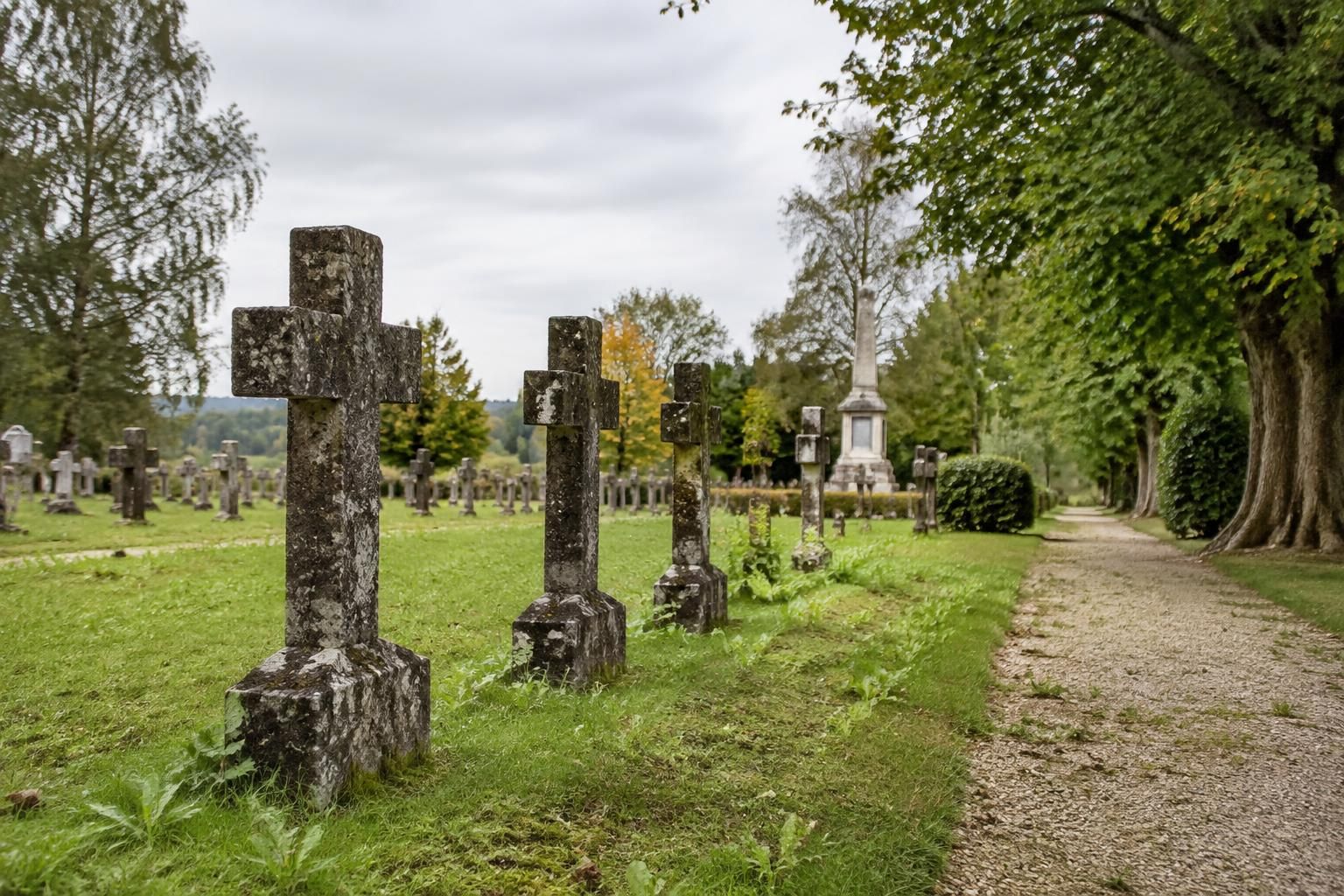
The experience extends across the road from the museum into a Franco-German military cemetery and the Hall of Remembrance. Inaugurated by Kaiser Wilhelm II on 11 May 1905, the memorial belongs to a later phase of commemoration, not to the immediate aftermath of the fighting.
This distinction gives visitors two histories to examine: what happened in 1870 and how later generations chose to represent it. A memorial is evidence of remembrance as well as a reference to an earlier event.
Separating the date of a battle from the date of its memorial
When groups encounter an imposing monument, they may assume it was erected soon after the deaths it commemorates. A guide can correct that impression by identifying the commissioning context, inauguration date, and political authority associated with the structure.
The 1905 ceremony took place during German rule, more than three decades after the conflict. That interval invites questions about how commemoration supported public identity and how rulers used historic battlefields as places of representation.
Rather than supplying one sweeping answer, interpretation should direct attention to visible evidence. The monument’s location, architectural language, inscriptions, and relationship with surrounding graves can each support a specific observation.
The museum and memorial description on Napoleon.org can help organisers understand the relationship between the indoor exhibition and the nearby commemorative landscape. Route conditions and access should still be checked locally before a group visit.
Reading “La Moselle résiliente” as a contemporary intervention
Outside the museum, Xavier Dambrine’s sculpture “La Moselle résiliente,” unveiled in 2024, honours people who suffered through the region’s wars and annexations. Its forward-moving figures introduce a different commemorative emphasis from monuments centred on military victory or imperial authority.
By 2026, this recent addition provides a useful contemporary reference point without replacing the older memorials. Visitors can examine how the language of remembrance changes when civilian endurance and regional experience move toward the centre of the story.
A productive question is: who receives attention in each commemorative work? Comparing soldiers’ graves, an imperial memorial, and a sculpture dedicated to regional suffering makes historical memory visible as an evolving practice.
The comparison should remain respectful. It is not necessary to rank monuments as better or worse to explain that different periods select different subjects, symbols, and audiences.
Organising an outdoor visit that protects the commemorative setting
For groups, practical behaviour is part of good interpretation. The tourism team should identify a gathering point away from graves, explain photography expectations, and avoid blocking narrow paths while giving commentary.
Audio delivery can reduce the need to raise a voice, but it should never turn a cemetery into a theatrical soundscape. Dramatic gunfire or simulated battle effects risk overwhelming the site’s purpose and distressing other visitors.
- 🕊️ Keep commentary measured: explain the site before introducing emotionally demanding material.
- 🚶 Check the walking route: review surfaces, crossings, distance, and opportunities to rest.
- 🎧 Preserve awareness: listeners must remain able to hear instructions and nearby traffic.
- 📍 Distinguish evidence from interpretation: identify what a plaque states before adding wider context.
A short pause without commentary can also be valuable. Visitors need time to observe names, materials, and the relationship between individual graves and collective monuments.
A memorial landscape is most revealing when interpretation explains its layers without competing with its silence.
Planning a Gravelotte Museum Visit with Clear Information and Useful Audio
A successful visit depends on more than historical preparation. Opening arrangements, reading time, outdoor conditions, language needs, and group pacing all influence whether visitors leave with a coherent understanding or simply a collection of disconnected impressions.
The museum is located at 11 Rue de Metz, 57130 Gravelotte, France. Before travelling, consult the official Moselle Culture museum page for the applicable calendar, admission conditions, temporary exhibitions, and any changes affecting access.
Checking practical details before committing to an itinerary
The supplied visitor information lists Tuesday-to-Sunday opening, including public holidays, from 10 a.m. to 1 p.m. and 2 p.m. to 6 p.m., within a seasonal calendar. These details should be confirmed for the intended date rather than treated as a guaranteed year-round timetable.
The same information gives adult admission at €7, a reduced rate of €5, and free entry for children aged 12 and under and certain eligible visitors with an accompanying person. Confirm current prices and eligibility directly, especially when budgeting for a group.
| Planning point | Information to use | Practical action |
|---|---|---|
| 📍 Location | 11 Rue de Metz, Gravelotte | Plan arrival and the road crossing to the memorial area. |
| 🕒 Opening arrangements | Published split-day hours and seasonal opening | Check your date and allow for the midday closure. |
| 🎟️ Admission | Supplied rates: €7 adult and €5 reduced | Confirm current tariffs and concession requirements. |
| 🌍 Interpretation | Information panels in French, German, and English | Match the visit format to your group’s language needs. |
| ♿ Access | Indoor and outdoor experiences have different requirements | Ask about routes, seating, surfaces, and specific assistance. |
For direct enquiries, the supplied contact details are +33 3 87 33 69 40 and [email protected]. A precise question about group size, visit date, or mobility requirements is more useful than a general request for information.
Using smartphone audio to support, not replace, the collections
The exhibition contains substantial written interpretation and is not primarily built around interactive displays. A guide should therefore select a manageable route rather than attempt to read or explain every panel aloud.
For an independently organised guided visit, a smartphone-based tool such as Grupem can support spoken interpretation without requiring visitors to gather tightly around the speaker. This is a proposed operational approach, not a claim that the museum uses or endorses the application.
The hypothetical tourism team could prepare five stops: political context, a battlefield map, the panorama fragments, annexation, and the memorial landscape. Each stop should answer one clear question, with optional detail reserved for visitors who want to explore further.
Before deployment, test the actual devices and listening setup in realistic conditions. Check speech intelligibility, battery needs, connection requirements, and whether the format remains usable for participants who cannot or prefer not to use a smartphone.
Making digital mediation accessible and historically responsible
Audio should provide an alternative route into the material, not create a new barrier. Offer a non-digital option, explain controls simply, and ensure that essential information does not depend exclusively on hearing a spoken track.
Scripts should identify whether they describe a documented event, an artwork, or an illustrative scenario. Avoid invented quotations and sound effects that imply an authenticated reconstruction when none exists.
For tourism professionals, the most useful innovation is not the most elaborate interface. It is the arrangement that lets visitors hear clearly, move safely, and connect individual exhibits with the larger process of reshaping Europe.
Plan the route around understanding first; choose the technology only after the interpretive and accessibility needs are clear.
What does the Gravelotte museum cover?
The museum explores the Franco-Prussian War of 1870–71 and the annexation of Alsace and part of Lorraine by the German Empire. Its collections connect military events with civilian life, political change, and regional remembrance.
Can English-speaking visitors follow the exhibition?
The permanent exhibition includes information panels in English, French, and German. Check directly with the museum for the languages available for any guided visit or temporary exhibition.
Can the museum visit include nearby memorials?
Yes. The Hall of Remembrance and a Franco-German military cemetery are opposite the museum, with further commemorative sites in the surrounding landscape. Confirm route conditions and allow separate time for the outdoor portion.
Are the opening hours and ticket prices fixed throughout the year?
Check the official museum page before travelling. The supplied information lists seasonal opening, a midday closure, and adult admission at €7, but the applicable calendar, prices, and concession conditions should be confirmed for your visit date.
Does the museum officially use Grupem?
No museum partnership or deployment is established by the information provided. Grupem is discussed as a possible smartphone-based tool for independently organised guided interpretation, subject to the museum’s rules and the group’s practical needs.
