
Sternberg Museum’s Future Hangs in the Balance as University Decisions Approach
The Sternberg Museum remains open to a question its visitors and staff cannot answer yet: what will Fort Hays State University decide about its future? At a Hays City Commission meeting, university president Tisa Mason said there had been no formal announcement about the museum’s fate. Reports of a possible closure have circulated, but they should not be treated as a confirmed decision.
That distinction matters to anyone planning a school trip, arranging a guided visit, or speaking with concerned residents. You can acknowledge the seriousness of the situation without telling a family that the museum has a closing date. Reporting on the university’s budget discussions describes difficult choices ahead, rather than a finalized plan for the site.
The figures explain why the discussion is urgent. Mason told commissioners that Fort Hays State University faces a $2.4 million reduction in state funding. She put the museum’s annual budget at approximately $1.3 million and identified about $20 million in deferred maintenance on its building. These amounts describe different pressures: an annual operating requirement, a university-wide funding cut, and repairs accumulated over time.
For a museum manager, separating those pressures is the first step toward a useful conversation. Cutting an operating expense would not, by itself, repair a building. Securing money for construction would not automatically pay educators, collection specialists, and visitor-facing staff year after year. Anyone evaluating the museum future needs to ask which problem a proposal actually solves, who would fund it, and how long that support would last.
What institutional uncertainty means for museum visitors
Institutional uncertainty is not the same as immediate closure. It does, however, affect ordinary decisions before any announcement is made. A teacher considering a spring field trip may hesitate to reserve transport. A guide developing a regional itinerary may need a backup stop. Employees may have to answer questions while awaiting information from university leaders themselves.
Consider a hypothetical school coordinator, Maya, preparing a natural history visit for students from a nearby district. Her sensible next step is not to cancel a learning opportunity because of a social media post. It is to confirm current booking arrangements directly with the museum, check any relevant university updates, and tell parents when the itinerary will next be reviewed. That approach protects the visit without presenting speculation as fact.
Public bodies have distinct roles, too. Hays commissioners expressed support for the university and Sternberg, while noting that the city neither owns the building nor provides its financial support. Their interest in a valued local institution should not be mistaken for authority to make its operational decision. The difference between advocating for a museum and controlling its budget is central to understanding what happens next.
In practical terms, organizations discussing the situation should keep a short, dated information sheet: confirmed university statements, current visitor arrangements, unanswered questions, and the person responsible for updating each item. If a rumor changes, the sheet can be revised without forcing staff to improvise an answer at the ticket desk. That modest communication tool is particularly useful when families, schools, and tour organizers hear the same story through different channels.
Questions worth directing to university leadership include whether visits will continue as scheduled, when a formal decision is expected, and how employees and collections would be affected by each option. Until answers are published, clear status updates are more useful than confident predictions. The budget figures establish the scale of the challenge; careful communication keeps that challenge from becoming avoidable confusion for visitors.
Museum Funding Must Account for Operations, Repairs, and Financial Stability
The Sternberg Museum’s financial challenge cannot be reduced to one number. Its approximate $1.3 million annual budget concerns recurring activity; the reported $20 million maintenance backlog concerns the condition of the building. The university’s $2.4 million state funding cut adds pressure across a wider institution. Treating all three figures as interchangeable would produce a misleading case for either closure or preservation.
An operating budget supports the work visitors notice and much of the work they do not. Exhibits must be staffed and maintained, live animals require consistent care, and school programs need people to design and deliver them. Behind the galleries, collections require documentation, appropriate storage, and professional oversight. Even a well-attended weekend does not remove those year-round responsibilities.
Deferred maintenance presents another kind of risk. A repair backlog can involve systems that are expensive precisely because they serve the whole building. Without a published breakdown, it would be inappropriate to claim that any particular roof, climate system, or gallery is failing. It is appropriate, however, to ask for a prioritized facilities assessment showing what needs attention now, what can be phased, and what the consequences of delay would be.
Questions that make a Kansas museum funding plan testable
A credible discussion of museum funding should turn broad support into specific commitments. If a partner offers help with programming, for example, the university still needs to know whether that help covers staffing, materials, or only a single event. If a capital campaign is proposed, its organizers must distinguish repair targets from operating needs. The following questions give decision-makers and supporters a common starting point.
- 💰 What is recurring? Identify annual costs and the dependable income available to meet them.
- 🛠️ What is urgent? Rank building repairs by safety, collections care, visitor access, and cost of delay.
- 👥 Who is responsible? Name the institution or partner accountable for each proposed expense.
- 📅 What is the timetable? Set review dates so temporary measures do not quietly become permanent gaps.
For example, a one-year grant could fund new school materials, while a separate university commitment pays the educator delivering them. Both contributions have value, but only the second answers the staffing question after the grant ends. The same test applies to donations: a restricted gift for an exhibit cannot necessarily be used for a building repair or employee wages.
| Financial pressure | Reported scale | Practical question |
|---|---|---|
| 🏛️ Museum operations | About $1.3 million annually | Which recurring services and positions does this support? |
| 🛠️ Building maintenance | About $20 million deferred | Which projects are essential, and how could they be phased? |
| 📉 State funding reduction | $2.4 million for the university | How will competing university obligations be assessed? |
This framework also helps residents ask productive questions at public meetings. Rather than seeking a single rescue figure, they can request the assumptions behind proposed options. What level of attendance or outside support does each option require? Which costs would remain if visitor hours changed? Would a different operating arrangement preserve professional stewardship of the collections?
Financial stability is not achieved simply by moving an expense from one budget line to another. It depends on an arrangement that can fund people, protect assets, and withstand normal fluctuations in revenue. The most useful preservation proposal is one that states both what it will pay for and what it will not. That clarity creates a firmer basis for discussing the museum’s educational value.
The financial questions lead directly to what the institution holds and teaches, not only what it costs to operate.
Museum Preservation Protects Natural History Beyond the Gallery Floor
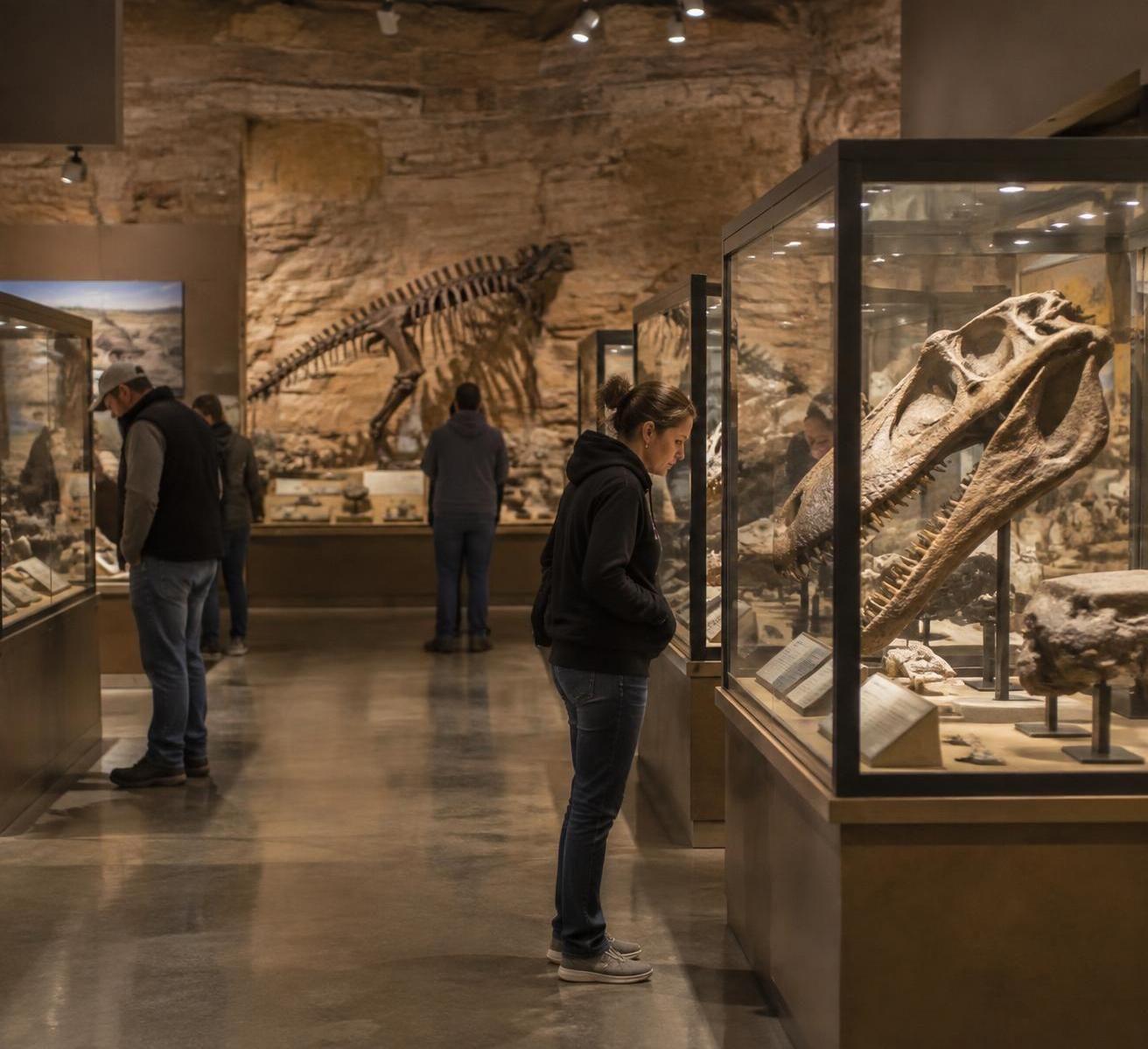
Visitors often experience the Sternberg Museum through exhibits, programs, and live animals. Those public activities are important, but they are only part of a natural history institution’s purpose. Scientific collections can support teaching and research long after a particular display changes. A decision about the museum therefore reaches beyond the question of whether families can enter the building on a given day.
The American Institute of Biological Sciences has urged Fort Hays State University to keep the museum’s collections together, accessible, and under professional care. Its letter on preserving the Sternberg collections also asks university leaders to consider the longer-term scientific, educational, and reputational costs of a decision that diminishes the institution. That intervention makes a practical point: specimens retain value only when people can responsibly identify, care for, and use them.
Imagine a student comparing a fossil seen on a class visit with related specimens held for study. The gallery label might begin the question; records associated with the collection allow the student or a researcher to investigate it properly. If objects lose their documentation, become difficult to locate, or are stored without appropriate oversight, their usefulness can decline even when the objects themselves still exist.
Why collections care matters to the Sternberg Museum’s future
Museum preservation is a continuing professional task, not a one-time act of finding storage space. It involves records, handling procedures, access policies, and staff who understand the material. Before any major change, decision-makers need an inventory of responsibilities as well as objects. Who maintains records? How would researchers request access? Which collections require particular environmental or handling conditions?
Those questions matter whether the university retains the current operation, changes its scale, or explores another arrangement. A smaller public gallery might still require substantial behind-the-scenes collections care. Conversely, a visitor experience that looks unchanged for a short period would not prove that long-term scientific access is secure. Public access and stewardship should be evaluated separately, then brought together in any workable plan.
Cultural heritage is also carried through local knowledge. A child who encounters Kansas geology during a museum program may recognize a landscape differently on the journey home. A teacher may use a specimen to make an abstract lesson tangible. These outcomes are difficult to capture in a single admissions figure, yet they help explain why residents treat the museum as more than a recreational stop.
That does not mean educational value settles a budget dispute on its own. It means each option should state its effects on education. Would school groups still be served? Could students work with collections? Would specialists remain available to support learning and research? A useful assessment puts these questions alongside costs rather than adding them after a financial decision is effectively complete.
Digital tools can help document and interpret holdings, provided they do not become a substitute for professional care. A searchable catalogue may improve discovery; an audio explanation may help a visitor understand why a specimen matters. Neither can repair a building, replace a curator’s judgment, or preserve an undocumented object by itself. Technology works best when it extends access to a collection that is already being responsibly maintained.
For supporters, the clearest request is therefore specific: ask the university to explain how every option would protect collections, expertise, and educational access. A museum’s value lies in the relationship between its objects, the people who care for them, and the people who learn from them. The next question is what happens to those people when the institution’s direction remains unresolved.
Professional stewardship depends on experienced staff, whose circumstances are part of the decision rather than an afterthought.
Staff and Community Support Shape the Sternberg Museum’s Options
Uncertainty about the Sternberg Museum has immediate human consequences. Staff members have asked university leaders to consider who might be displaced if closure occurs. Paleontology operations manager Ian Trevethan described the possibility of having to choose between a career built at Fort Hays State University and a move that would disrupt his wife’s career and their household. His account gives a concrete dimension to a decision often discussed only in budget terms.
Specialized museum work is tied to accumulated knowledge. A staff member may know the history of particular collections, the requirements of a recurring school program, or the practical steps needed to care for specimens. If positions disappear, those responsibilities do not necessarily disappear with them. Any alternative plan should say who would take them on and how that person would be supported.
Community support has been visible, including a petition calling for the museum to remain open that had drawn nearly 5,000 signatures at the time of the cited reporting. The figure demonstrates public concern, not a source of recurring revenue or a formal university decision. Petitions are most useful when they prompt detailed questions and sustained engagement rather than being treated as a complete funding plan.
How supporters can turn concern into useful participation
A resident who values the Kansas museum can describe a specific use rather than offering only a general endorsement. An educator might explain how a visit fits a science lesson; a researcher might identify the importance of access to a collection; a local organizer might document how the museum features in a regional itinerary. Such accounts help leaders see which activities would be lost or altered under different proposals.
Supporters should also direct requests to the right institution. Hays City Commission members have expressed support, but the city does not own or financially support the museum building. Asking commissioners to make the university’s decision obscures that division of responsibility. Asking them to explain possible forms of civic cooperation, while asking university leaders about governance and funding, produces a more grounded discussion.
At public meetings, useful questions are brief enough to answer and precise enough to matter. Will staff be consulted before a final decision? How will potential displacement be addressed? What opportunity will educators and researchers have to describe their needs? Local coverage of the community discussion provides a way to follow how these concerns are being raised.
For a cultural organization facing similar pressure, a small stakeholder register can prevent important voices from being overlooked. It need not be complicated: identify employees, students, visiting schools, researchers, community groups, and operational partners; record what each group needs to know; and assign a date for the next update. An unanswered question is easier to manage when someone owns the task of seeking an answer.
Communication should remain careful even when emotions run high. A post claiming a closure date may spread faster than an official statement, but speed does not make it reliable. Organizations sharing updates can identify whether information comes from university leadership, a public meeting, or an individual account. This protects employees from having to correct rumors repeatedly and helps supporters focus on decisions that can still be influenced.
Community support is strongest when it joins personal testimony with practical accountability. Signatures show that people care; documented needs and clear questions show decision-makers what must be protected. If a path forward is identified, that same discipline will matter when visitors need dependable information about how to experience the museum.
Reliable visitor information becomes especially important when a museum’s operating plans may change.
Clear Visitor Information and Accessible Audio Can Support a Changing Museum
Whatever Fort Hays State University decides, visitors need information they can act on. A museum contemplating changes may still be welcoming families today, arranging school visits, and answering accessibility questions. If operating plans change, those audiences should not have to reconstruct the facts from scattered posts. A clear visitor information process is a practical service in its own right.
Start with the questions people ask before leaving home: Is the museum open on the planned date? Are bookings being accepted? Which exhibits or programs are available? Who should a teacher contact about a group visit? A single maintained information page, paired with consistent responses from staff, can answer more effectively than several announcements that remain online after they are outdated.
Maya, the hypothetical school coordinator preparing a trip, illustrates the value of that consistency. If her group receives a booking confirmation, she also needs to know where to check for changes and how much notice the museum would provide. A short message with a confirmation date, contact point, and next update date helps her keep the trip on track without asking staff for an assurance they cannot yet give.
Using audio interpretation without adding unnecessary complexity
Audio can make a natural history visit more accessible and engaging, particularly when visitors want to examine a specimen at their own pace. It should be designed around the gallery experience rather than deployed merely because a digital tool is available. A concise explanation might help a family understand what a fossil reveals, while a second, more detailed recording gives an interested student a route into the evidence.
For a small pilot, select a few stops with a clear learning objective at each one. Write scripts in plain language, record them in a quiet space, and test playback in the actual gallery. Provide a text equivalent so visitors who cannot or do not wish to listen can receive the same essential information. If an exhibit changes, assign someone to review the recording and its label together.
Smartphone-based options such as Grupem can help guides or museums deliver audio without issuing a dedicated device to every visitor. The practical decision is whether the approach suits the audience and site: check connectivity, ease of access, language needs, and whether visitors are comfortable using their own phones. A useful audio guide removes a barrier to understanding; it should not create a new barrier at the entrance.
Digital interpretation has limits in the present situation. A new audio route cannot resolve a maintenance backlog or guarantee financial stability. It can, however, help an institution make existing expertise easier to access and show which stories visitors value. If circumstances require changes to gallery space or programming, well-maintained scripts and recordings may also help staff communicate accurately across different visit formats.
Accessibility requires more than volume controls. Consider captions or transcripts for recorded content, readable instructions at the start of a route, and a way to follow it without scanning a code at every stop. Test with actual users, including someone unfamiliar with the building. A guide that staff can explain in one sentence is more likely to be used than one that needs a lengthy setup.
The same editorial discipline applies to updates about the museum future. Date every operational notice, distinguish confirmed arrangements from plans under review, and remove superseded guidance. Tour organizers and schools can then make reasonable decisions while the university works through its options. For visitors, trust begins with knowing what is available now and where to find the next verified update.
Has Fort Hays State University announced that the Sternberg Museum will close?
No formal closure announcement had been made in the reporting described here. The university said it would share further information as it became available. Check official university and museum channels for the current status.
What financial pressures are affecting the museum’s future?
University president Tisa Mason cited a $2.4 million reduction in state funding, an annual museum budget of about $1.3 million, and approximately $20 million in deferred building maintenance. These are separate financial issues.
Why do the Sternberg Museum’s collections matter?
Natural history collections support research and education beyond public displays. Their long-term value depends on documentation, access, and professional care.
How can community members help constructively?
Share specific examples of the museum’s educational or scientific value, follow verified updates, and ask university leaders clear questions about funding, staff, collections, and access.
