
George Lucas Marks a Grand Launch for the Lucas Museum in Los Angeles
🎬 Key point: the Lucas Museum of Narrative Art opens to the public on September 22, 2026, following an opening-night celebration hosted by George Lucas and Mellody Hobson in Exposition Park, South Los Angeles.
The Grand Launch of the Lucas Museum represents more than a new destination for film fans. It establishes a large-scale cultural venue dedicated to how people tell stories through images, from ancient visual traditions to contemporary illustration, photography, comic art, murals and cinema. Built on a 13-acre campus in Exposition Park, the museum brings a distinct perspective to Los Angeles: narrative images are not treated as secondary to fine art, but as a central part of how societies remember, imagine and communicate.
George Lucas and Mellody Hobson spent 17 years moving the project from concept to public opening. The path included earlier discussions around possible locations in Chicago and San Francisco before Los Angeles became the final home. That long timeline matters because it explains the scale of the institution: this is not a temporary Art Exhibition or a private collection displayed in a conventional gallery. It is a purpose-built museum designed to examine visual storytelling across eras, media and communities.
The September 19 opening night placed that ambition in public view. Lucas and Hobson welcomed guests before the museum’s public debut, with co-chairs including Tom Cruise, Julie Bell, Guillermo del Toro, Greta Gerwig, Sir Lewis Hamilton, Jensen Huang, JR, Steven Spielberg and Pharrell Williams. The guest list reflected the museum’s broad territory, connecting filmmaking, design, technology, music, illustration and popular culture rather than presenting narrative imagery as a narrow academic subject.
For visitors planning a trip to Los Angeles, the venue also introduces an important lesson in cultural positioning. A Museum Opening can attract attention through celebrity attendance, but its long-term value depends on whether the visitor understands what makes the institution relevant. In this case, the proposition is clear: a comic strip, a film storyboard, a mural, a magazine cover and an ancient sculpture can all be read as visual storytelling devices. That broad framework helps guests move beyond the expectation of a Star Wars-only experience.
📍 The Lucas Museum is located in Exposition Park, an area already connected to major museums, sporting venues and public spaces. This location gives tourism professionals, group organizers and independent travelers a practical opportunity to build a half-day or full-day cultural itinerary rather than treating the museum as an isolated stop. Clear route planning, ticket timing and a well-paced audio experience will be particularly important for groups navigating a campus of this size.
A recent overview of the museum’s collection and public opening highlights the breadth of its artistic scope. The institution’s identity rests on the idea that narrative images should be encountered with curiosity instead of hierarchy. George Lucas has repeatedly argued that art is shaped by the emotional response of the viewer, an approach that supports the museum’s inclusion of works often separated by traditional museum categories.
The launch evening began with Pharrell Williams and the Voices of Fire gospel choir, setting a communal tone before remarks from Hobson, Lucas and other contributors. Lucas described the early concept as a “temple to illustrators,” then humorously observed that the event’s choir made it feel closer to a church for illustration. The comment captures the museum’s direction: serious about visual culture, but accessible enough to welcome audiences who may not normally see themselves reflected in traditional art institutions.
For cultural organizations watching this opening, the practical takeaway is straightforward. 🎧 A major museum does not become accessible only through architecture and objects; it becomes accessible through interpretation. Visitors need clear narratives, layered information and tools that let them choose their own pace. The next question is how the building itself supports that experience.
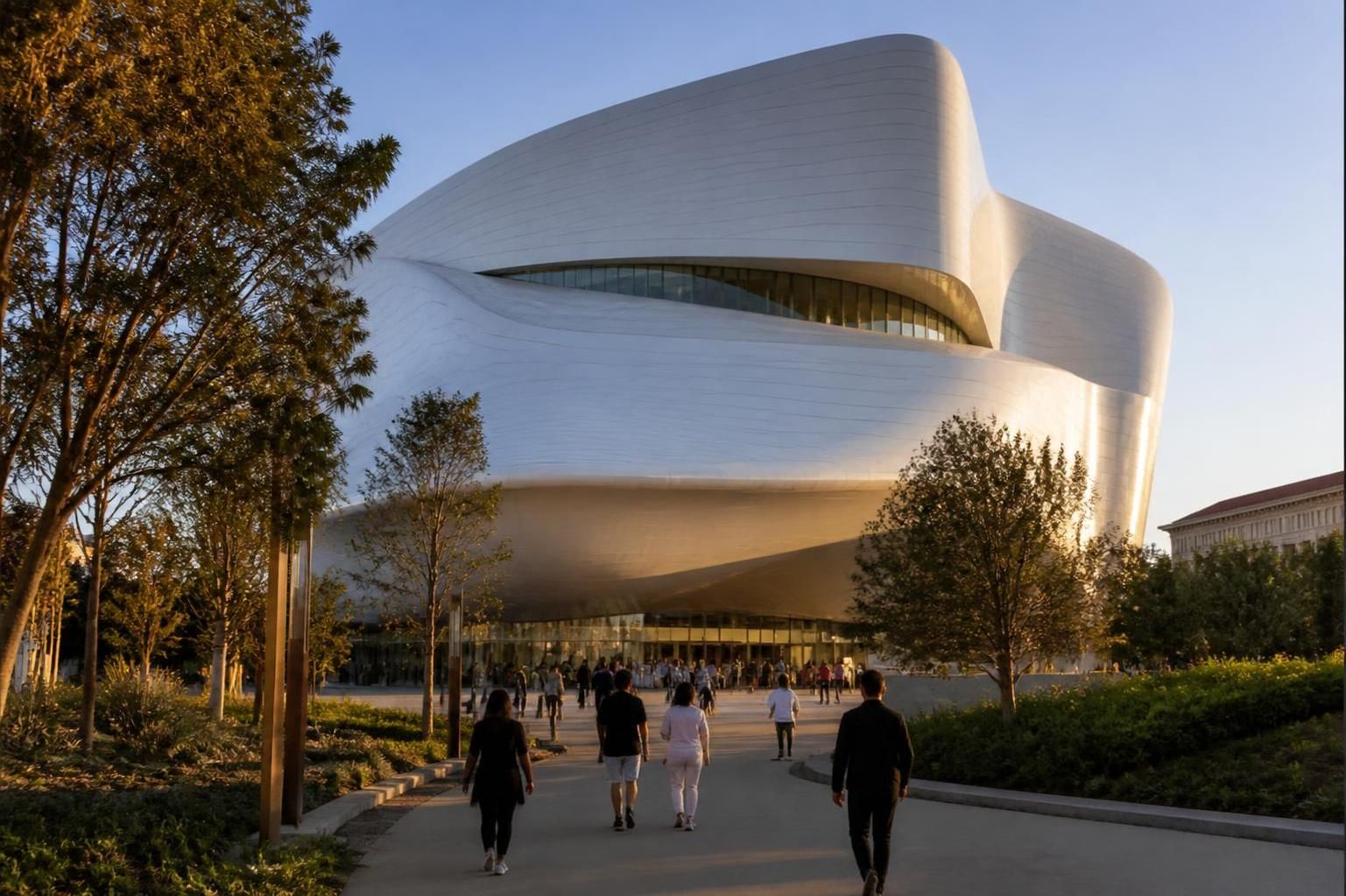
How the Lucas Museum Architecture Turns Film Art into a Visitor Experience
The Lucas Museum building is part of the story visitors encounter before they see a single artwork. Designed with architect Ma Yansong, the approximately 300,000-square-foot structure has an organic, sculptural profile that has frequently been compared with a spacecraft. Yet the architect’s stated intention was not to reproduce science-fiction imagery. The concept focused on light, clouds, tree canopies and the relationship between the structure and the surrounding park.
That distinction is useful for museum and tourism professionals. A visually striking building can easily become a photo opportunity disconnected from the collection. At the Lucas Museum, the architectural form can instead act as a narrative threshold. It creates anticipation, makes the arrival memorable and frames the visitor’s transition from the city into a space dedicated to imagination. Good cultural design does not simply impress; it helps prepare audiences for the type of encounter ahead.
Ma Yansong described George Lucas as someone interested in making seemingly impossible ideas real. This shared approach is visible in the museum’s form. Its curves avoid the rigid, monumental language often associated with major cultural venues. In an area visited by families, students, tourists and local residents, that softer visual language can reduce the psychological barrier sometimes created by museums that appear formal or exclusive.
🌿 The building’s relationship with the park is a functional visitor feature, not only an aesthetic choice. Outdoor space supports pauses before and after a visit, makes school-group logistics easier and gives families a place to reset between gallery experiences. For guided tours, a landscaped arrival area can also become a useful briefing zone: the guide can establish meeting points, explain the route and check that every participant can hear the audio before entering the galleries.
Imagine a cultural tour operator called Horizon Routes bringing a mixed group to Exposition Park. Some visitors arrive for Film Art and cinematic memorabilia; others are interested in illustration, social history or Los Angeles architecture. Instead of beginning with a list of rules at the entrance, the guide can use the exterior setting to establish a shared question: how does a building designed around clouds and trees shape expectations for a museum about storytelling? This creates a simple interpretive hook before the group reaches the first display.
The same principle applies to digital mediation. Groups often lose time because the leader must repeat practical instructions in a busy lobby. A smartphone-based audio solution lets organizers share clear orientation messages before entering: where to meet, which galleries are included, how long the route lasts and when participants should reconnect. This does not replace a guide’s expertise. It protects that expertise by reducing repetitive logistics and allowing more time for interpretation.
Practical visitor planning for a large cultural campus
The scale of the site means that a good visit should be planned as a sequence rather than an open-ended walk. Ticket holders should allow enough time for arrival, security procedures, restrooms, café breaks and movement between galleries. Groups should also decide in advance whether the goal is a broad discovery tour or a focused route around illustration, comics, murals or cinematic production.
| Visitor moment | Useful action | Experience benefit |
|---|---|---|
| 🚶 Arrival at Exposition Park | Confirm meeting point and ticket time | Reduces late arrivals and fragmented groups |
| 🏛️ Exterior approach | Provide a short architectural context | Connects the building to the museum’s narrative mission |
| 🎧 Gallery entry | Test audio and distribute route information | Improves listening comfort in busy spaces |
| 🖼️ Collection viewing | Use themed stops rather than covering everything | Creates a more memorable and manageable visit |
| 🌳 Post-visit pause | Use park space for discussion or feedback | Helps visitors process what they have seen |
The museum’s architectural identity also carries an important message for destination managers. A landmark building can increase visibility, but the visitor journey must remain legible from street level to final gallery. Signage, timed access, accessible routes and reliable mobile information are therefore as important as the visual impact of the facade. A complex cultural experience feels effortless when these details have been planned well.
For further context on the venue’s design and cultural role, visitors can consult this guide to George Lucas’s futuristic museum project. The most effective museum architecture does not compete with the collection; it gives visitors a meaningful way into it.
Why Narrative Art Extends Far Beyond Star Wars Memorabilia
The association between George Lucas and Star Wars is unavoidable, but it is not the museum’s full story. Mellody Hobson has explained that Star Wars material represents only about seven percent of the Lucas Museum collection. That figure is essential for managing expectations. Visitors will find recognizable objects connected to one of cinema’s most influential franchises, but the institution’s central purpose is much wider: to place many forms of image-making into dialogue.
The collection reaches from prehistoric cave paintings and ancient sculpture to comics, editorial illustration, photography, murals and motion pictures. It includes artists and illustrators such as Norman Rockwell, Jessie Willcox Smith and Maxfield Parrish, as well as comic innovators including Jack Kirby and Winsor McCay. Works by Diego Rivera, Judith F. Baca, Frida Kahlo and Charles White expand the conversation toward public art, Mexican modernism, social realism and representations of identity.
This mix challenges a familiar divide between “high art” and popular images. A painting shown in a major museum and a comic panel printed for mass readership may use different formats, audiences and distribution systems, but both can create emotion, communicate character and influence public memory. George Lucas’s position is direct: viewers have a right to decide what art means to them. That argument may be debated, but it is a productive starting point for visitors who feel excluded by traditional art vocabulary.
🖼️ Narrative Art gives museums a practical way to welcome different levels of prior knowledge. A child may connect immediately with a comic character. A film student may examine framing or editing. A local resident may recognize social history in a mural. An art historian may study technique, patronage or circulation. These entry points can coexist in the same gallery without lowering intellectual standards.
For guides and educators, this is a valuable model. Rather than beginning with a list of dates and artist biographies, a tour can start with observation. What happens first in this image? Where does the eye go next? Which detail creates tension, humor or sympathy? These questions are accessible, yet they naturally lead into deeper discussions about composition, politics, technology and representation.
- 🎨 Illustration: examine how line, color and gesture create an immediate story.
- 💬 Comic art: explore how panels, captions and page layout control time and suspense.
- 🎥 Film Art: compare a storyboard, costume or still image with the final moving sequence.
- 🏙️ Murals: discuss how large public images address community memory and civic space.
- 📷 Photography: consider how one framed moment can suggest a larger unseen narrative.
A useful example is a group visiting with different motivations. One participant wants to see the Millennium Falcon, another has come for Frida Kahlo, and a third is drawn to contemporary murals. Instead of treating these interests as competing requests, an audio route can connect them through one theme: how images create worlds. The spacecraft, portrait and public wall painting all invite viewers to imagine a place, identity or conflict beyond the frame.
This approach supports a more inclusive visitor experience. It also offers a strong educational advantage: guests leave with a method they can reuse in other museums, streetscapes, cinemas and digital environments. They learn to recognize that images are constructed choices, not neutral surfaces.
A detailed report on the Los Angeles opening celebration underscores the institution’s commitment to visual storytelling across periods and formats. The important point is not that every object belongs to the same tradition. It is that each object can contribute to a larger conversation about why humans make and share images. That conversation is the museum’s real collection strategy.
The Star-Studded Museum Opening as a Cultural Event, Not a Substitute for Access
The opening-night celebration gave the Lucas Museum extraordinary visibility. Guests included Oprah Winfrey, Samuel L. Jackson, Harrison Ford, Katy Perry, Justin Trudeau, Orlando Bloom, Keke Palmer, Cynthia Erivo, Jon M. Chu, Meg Ryan and many others. Such attendance naturally generated headlines, photographs and social media attention, turning the event into one of Los Angeles’s most prominent cultural gatherings of the season.
Its entertainment program reinforced that high-profile atmosphere. Pharrell Williams and the Voices of Fire choir opened the evening, while the program concluded with a surprise performance by the Black Eyed Peas. Nova Sky Stories presented a drone show narrated by Oprah Winfrey and Samuel L. Jackson, using imagery connected to the collection. The sequence included references to the Millennium Falcon and Banksy’s Girl with Balloon, bringing together mass-media iconography and contemporary art imagery in the night sky.
Queen Latifah described the museum as a venue with the potential to reshape the way audiences look at art, placing it in conversation with landmark institutions in Paris and New York. The comparison is ambitious, but the underlying point is credible: Los Angeles has long been central to Cinematic History and popular visual culture. A museum focused on narrative imagery gives the city a permanent institution that reflects that role.
Still, a Star-Studded opening should be understood as a launch mechanism rather than the final measure of success. Celebrity interest can introduce a museum to audiences who might not otherwise hear about it. It cannot, by itself, guarantee clear interpretation, fair access, inclusive programming or a positive experience for first-time visitors. The real test begins when the doors open to the public and guests navigate the galleries without gala lighting, event staff and red-carpet momentum.
✨ Visibility creates the first visit; accessibility creates the return visit. This is particularly relevant for institutions working in large metropolitan destinations. Visitors will compare the museum with many competing activities, from theme parks and studio tours to historic districts and beach destinations. The venue must therefore make its value easy to understand before arrival and easy to experience once inside.
For organizers, the launch offers several practical lessons:
- 📣 Use major moments to communicate a clear public purpose, not only celebrity attendance.
- 🎧 Convert media attention into usable visitor information, including ticketing, access and route guidance.
- 👥 Offer different levels of interpretation for families, experts, schools and international guests.
- ♿ Make accessibility visible in the booking journey rather than treating it as a separate service.
- 📱 Ensure that digital tools support the visit instead of forcing visitors to search for basic answers.
Consider the difference between two hypothetical visitors. Maya sees photographs from the gala and decides to book a ticket because she recognizes actors and musicians. David reads about the comic art collection and comes specifically for illustration. If both leave with a coherent understanding of the museum’s purpose, the launch has worked. If they only remember a celebrity guest list or a single franchise display, the interpretive promise has not been fully delivered.
This is where smart tourism tools become relevant. A well-designed mobile audio journey can offer routes based on time available, age group, language or interest. It can also help visitors move independently without turning every experience into a screen-focused activity. The best audio guidance directs attention back toward objects, architecture and conversation rather than asking users to stare at their phones.
For a closer look at the opening-night atmosphere, this inside account of the Lucas Museum gala captures the breadth of Hollywood support surrounding the event. The lasting legacy of this Cultural Event will depend on what happens after the cameras leave: attentive programming, practical access and stories that visitors can make their own.
Building Better Audio-Guided Visits at the Lucas Museum and Beyond
The Lucas Museum offers an ideal setting for modern visitor mediation because its subject is already built around storytelling. A conventional audio guide that delivers long blocks of information would miss that opportunity. Guests need short, well-paced prompts that help them look, compare and interpret. They should feel guided, not controlled.
For a venue presenting cave art, comic books, photography, murals and Film Art, the audio journey should not use a single tone for every object. A stop on a Diego Rivera mural can invite visitors to read social scale, public space and collective identity. A stop on a Jack Kirby page can focus on movement, visual rhythm and serialized storytelling. A cinematic artifact can explain how a fragment becomes part of a wider fictional world. The technology should adapt to the object, not flatten every object into the same script.
🎧 Clear sound is a basic condition of cultural access. This is particularly true in a popular museum where galleries may be busy and groups may include visitors with different mobility, hearing or language needs. Smartphone-based systems can be useful because participants already carry familiar hardware. With the right setup, a guide can speak through a microphone while attendees listen through their own devices and headphones, reducing the need to crowd closely around a speaker.
For cultural professionals, a practical visit workflow can look like this:
- 📲 Share the route link before the group arrives, with an estimated duration and meeting instructions.
- 🔊 Run a short sound check outdoors or in a quiet arrival area before the first gallery stop.
- 🧭 Divide the experience into clear narrative themes rather than attempting to cover every room.
- ⏸️ Build in silent viewing time after major audio segments so guests can form their own responses.
- 💬 Use one question per stop to encourage discussion without slowing the group excessively.
Imagine Horizon Routes returning to the museum with an international group of 20 people. The guide begins outside with a two-minute orientation, then sends a private audio channel to each participant’s phone. In the galleries, visitors can hear the guide without forming a tight semicircle around each artwork. This protects sightlines, reduces noise and gives the group more flexibility when galleries are busy.
The guide does not need to abandon personal storytelling. On the contrary, digital audio can make that storytelling more effective. Instead of repeating “please come closer” or raising their voice over ambient sound, the guide can devote energy to meaningful interpretation: why a composition matters, how an illustrator shaped visual language, or what a mural reveals about a community’s history.
Audio design also matters for independent visitors. A self-guided route should state its purpose early: for example, “Discover five works that show how artists use images to create movement.” Each stop should include a concise observation, a contextual detail and a question. The result is a coherent journey that can be completed in 30, 60 or 90 minutes, depending on the visitor’s schedule.
Visitors interested in planning their experience can explore this practical Lucas Museum visitor resource, while organizers can use the museum as a case study in how narrative-based interpretation supports engagement. The point is not to add technology for its own sake. The goal is to remove friction: fewer missed details, less crowding, clearer instructions and more time for art.
As the Lucas Museum begins welcoming the public, it can demonstrate how a major institution connects broad collections with broad audiences. From George Lucas’s long-term vision to the Grand Launch in Exposition Park, the project is rooted in one powerful premise: visual stories belong to everyone. 🎯 A strong museum visit begins when every visitor can hear the story, follow the route and respond in their own way.
When does the Lucas Museum of Narrative Art open to the public?
The Lucas Museum of Narrative Art opens to the public on September 22, 2026. Tickets and current visitor information are available through the museum’s official website.
Where is the Lucas Museum located?
The museum is located in Exposition Park in South Los Angeles, on a 13-acre campus near other major cultural and visitor attractions.
Is the Lucas Museum only about Star Wars?
No. Star Wars artifacts and memorabilia represent about seven percent of the collection. The museum also presents illustration, comics, photography, murals, sculpture, painting and other forms of narrative imagery.
Who designed the Lucas Museum building?
The building was designed with architect Ma Yansong. Its organic form was conceived in relation to light, clouds, trees and the surrounding park landscape.
How can groups improve their museum visit experience?
Groups should book timed tickets, set a clear meeting point, choose a focused route and use reliable audio guidance so participants can hear interpretation without crowding around the guide.
