
The Lucas Museum of Narrative Art opens in Los Angeles on September 22, 2026, after a complex 16-year development process that moved through San Francisco, Chicago, and finally Exposition Park. Its arrival matters not only for its scale, but for the way it places comics, film props, illustration, photography, classical sculpture, and painting within the same cultural conversation.
Little time? Here are the essentials to retain:
- ✅ A $1 Billion Dollar Cultural Project: George Lucas financed a museum that reportedly cost around $1 billion to construct, following two abandoned location plans.
- 🎧 Narrative Art is the central idea: the institution treats any work that communicates a story as worthy of museum attention, from cave-painting reproductions to contemporary comics.
- 🏛️ The visitor journey needs context: with more than 1,300 objects across 30 galleries, clear interpretation, accessible audio, and thoughtful wayfinding will be essential to help audiences connect the collection.
- ⚠️ Star Wars is not the whole experience: material related to the franchise represents roughly 7% of the displayed holdings, despite its strong public appeal.
The Lucas Museum Journey Across Three Cities and Sixteen Years
The Lucas Museum represents one of the most prolonged and expensive museum-development stories in recent American cultural history. First announced in 2010, the project travelled through Three Cities before reaching its final destination in Los Angeles. That route is central to understanding the building now rising in Exposition Park: its form, public role, governance questions, and unusually high expectations were shaped by years of debate rather than by a straightforward construction timeline.
The first proposal focused on San Francisco, a city closely associated with George Lucas through Lucasfilm and the Bay Area’s creative industries. A site in the Presidio was considered, but the proposal did not secure the support required for the project to move forward. The next major option was Chicago, where Lucas and Mellody Hobson explored a lakefront location. That plan attracted serious opposition, including legal action from Friends of the Parks, a nonprofit organisation that argued the development would compromise public land. The Chicago scheme was ultimately withdrawn.
Los Angeles became the third and successful location. Exposition Park offered a different civic setting: it is already home to cultural and sporting destinations including the California Science Center, the Natural History Museum of Los Angeles County, the Los Angeles Memorial Coliseum, and major university facilities. Instead of creating an isolated cultural enclave, the Lucas Museum is positioned within an active public district. This context changes the visitor experience. A guest might combine a museum visit with a sports event, a family outing, a science-centre programme, or a walk through the park.
For tourism professionals, this long Museum Journey is a useful reminder that landmark projects depend on more than architecture or private funding. They require public trust, land-use alignment, transport planning, local partnerships, operational resilience, and a convincing explanation of public value. A museum may contain a remarkable Art Collection, but visitors and residents still ask practical questions: Who can access it? How does it improve the district? What does it add that existing institutions do not provide?
The cost also places the museum in a notable category. Lucas reportedly spent about $1 billion of his own money on construction, exceeding the approximately $850 million cost cited for the Obama Presidential Center. Comparing budgets does not determine cultural quality, but it does reveal the extraordinary financial commitment behind the project. A Billion Dollar museum must sustain equally high standards in maintenance, staffing, collection care, education, accessibility, digital interpretation, and audience services long after opening week.
| Stage | Location | What happened | Visitor and cultural implication |
|---|---|---|---|
| 📍 First proposal | San Francisco | The project did not obtain a final path to construction. | Shows that a major collection requires local consensus, not only global recognition. |
| ⚖️ Second proposal | Chicago | Lakefront plans faced public opposition and legal challenge. | Public-space questions can define the future of a Cultural Project. |
| 🏛️ Final location | Los Angeles | The museum was developed in Exposition Park. | Creates opportunities for multi-stop cultural itineraries and group visits. |
| 🎟️ Public opening | September 22, 2026 | The Lucas Museum begins welcoming visitors. | Marks the transition from construction story to ongoing visitor experience. |
The official opening announcement from the Lucas Museum confirms September 22 as the public launch date. For guided-tour operators, schools, destination managers, and cultural programmers, this date should be treated as the beginning of a new planning cycle rather than the end of the story. Demand will likely be strongest around high-profile objects and architecture, while repeat visitation will depend on programming, changing displays, and practical visitor comfort.
Consider a fictional group organiser, Maya, planning a two-day Los Angeles itinerary for an international arts association. The museum’s 16-year history gives her more than a scheduling detail: it provides a narrative thread. She can frame the visit as an example of how cultural institutions emerge through negotiation, civic pressure, private philanthropy, and urban planning. That story helps visitors see the building as part of Los Angeles rather than merely as a futuristic object placed within it.
The key insight is simple: the Lucas Museum is not just a new attraction; it is the outcome of a long public and institutional process that will shape how visitors interpret every gallery inside it.
How Narrative Art Redefines the Lucas Museum Art Collection
The Lucas Museum of Narrative Art is built around a deliberately expansive definition: Narrative Art is any art that tells a story. That principle may sound straightforward, yet it challenges long-standing museum hierarchies. In many art institutions, oil paintings, marble sculptures, and recognised modern masters have historically received more attention than comic panels, movie concept drawings, children’s-book illustrations, or popular photography. The Lucas Museum argues that storytelling value is not determined by medium alone.
This approach is visible from the gardens onward. A nineteenth-century cast of Antonin Mercié’s David, depicting David’s victory over Goliath, stands near a bronze representation of Princess Leia confronting Jabba the Hutt. Rosie the Riveter is also part of this unusual outdoor assembly. The works originate in radically different periods and cultural systems, but each presents a recognisable narrative about courage, power, conflict, resistance, or identity. The juxtaposition is not accidental. It is a curatorial statement that myths can move from religious sculpture to wartime imagery to science-fiction cinema without losing their social function.
Inside, the scale is considerable: more than 1,300 objects are displayed across 30 galleries. Visitors encounter works associated with Frida Kahlo, Norman Rockwell, Gordon Parks, Frank Miller, and fantasy artist Frank Frazetta, alongside film costumes, memorabilia, animation, and production material. The inclusion of Cowboy Bebop broadens the conversation further by recognising Japanese animation as a major narrative language rather than a niche category. Two theatres add a moving-image dimension, with screenings expected to include early silent cinema, student work by Lucas, and films connected to historical creative figures such as Man Ray.
Star Wars will undoubtedly attract many first-time visitors. Yet the museum has indicated that Star Wars concept art accounts for only around 7% of the displayed material. This is strategically important. If the venue were interpreted primarily as a franchise museum, it would narrow the meaning of the collection and limit its educational potential. The stronger visitor pathway begins with familiar references—Yoda, Grogu, vehicles, or concept paintings—and then creates informed bridges toward American illustration, documentary photography, civic imagery, and global visual culture.
Building meaningful connections between familiar and unfamiliar works
Good cultural mediation does not assume that every visitor arrives with the same art-historical knowledge. A family may recognise Luke Skywalker’s X-34 Landspeeder immediately but have little prior familiarity with Rockwell’s The Problem We All Live With, an iconic work related to school desegregation and civil rights. The museum’s opportunity lies in connecting the two through themes rather than forcing a rigid academic sequence. Both can be discussed through journeys, social structures, individual courage, or the construction of national myths.
For museum teams and guides, this type of comparison needs precision. A Star Wars prop and a civil-rights painting are not equivalent in historical circumstance, material history, or political consequence. They can, however, be placed in dialogue when the interpretation clearly explains their differences. The goal is not to flatten culture into a single category of entertainment. It is to show visitors how visual stories influence values, empathy, memory, and shared reference points.
Digital audio can support this approach especially well. Instead of delivering one long generic narration, a museum could offer short themed routes: “Rebels and Resisters,” “How Heroes Are Drawn,” “Stories of Civic Life,” or “From Sketch to Screen.” Visitors could choose a route according to their interests while still receiving consistent historical context. A smartphone-based audio system can also serve multilingual guests, visitors with visual impairments, and groups moving at different paces without creating congestion around a single guide.
For example, Maya’s arts association could begin with the outdoor sculptures, then use an audio prompt asking: “What makes a figure heroic: physical strength, moral conviction, or the story a society tells about them?” That question can lead naturally from David to Leia, from Rosie the Riveter to Rockwell, and later to cinematic heroes. It is a practical way to transform an eclectic display into an active learning experience.
The museum’s philosophy aligns with wider shifts in cultural institutions, including the rethinking of established canons by organisations such as the Museum of Modern Art and Tate Britain. The difference is that the Lucas Museum makes popular visual culture a foundational principle rather than an occasional corrective. Its success will depend on whether it can make these connections clear without turning complexity into spectacle.
The lasting value of this Art Collection will come from context: visitors should leave understanding not only what they saw, but why a comic strip, a photograph, a painting, and a film object can all carry serious cultural meaning.
Architectural Design and Visitor Flow at the Billion Dollar Lucas Museum
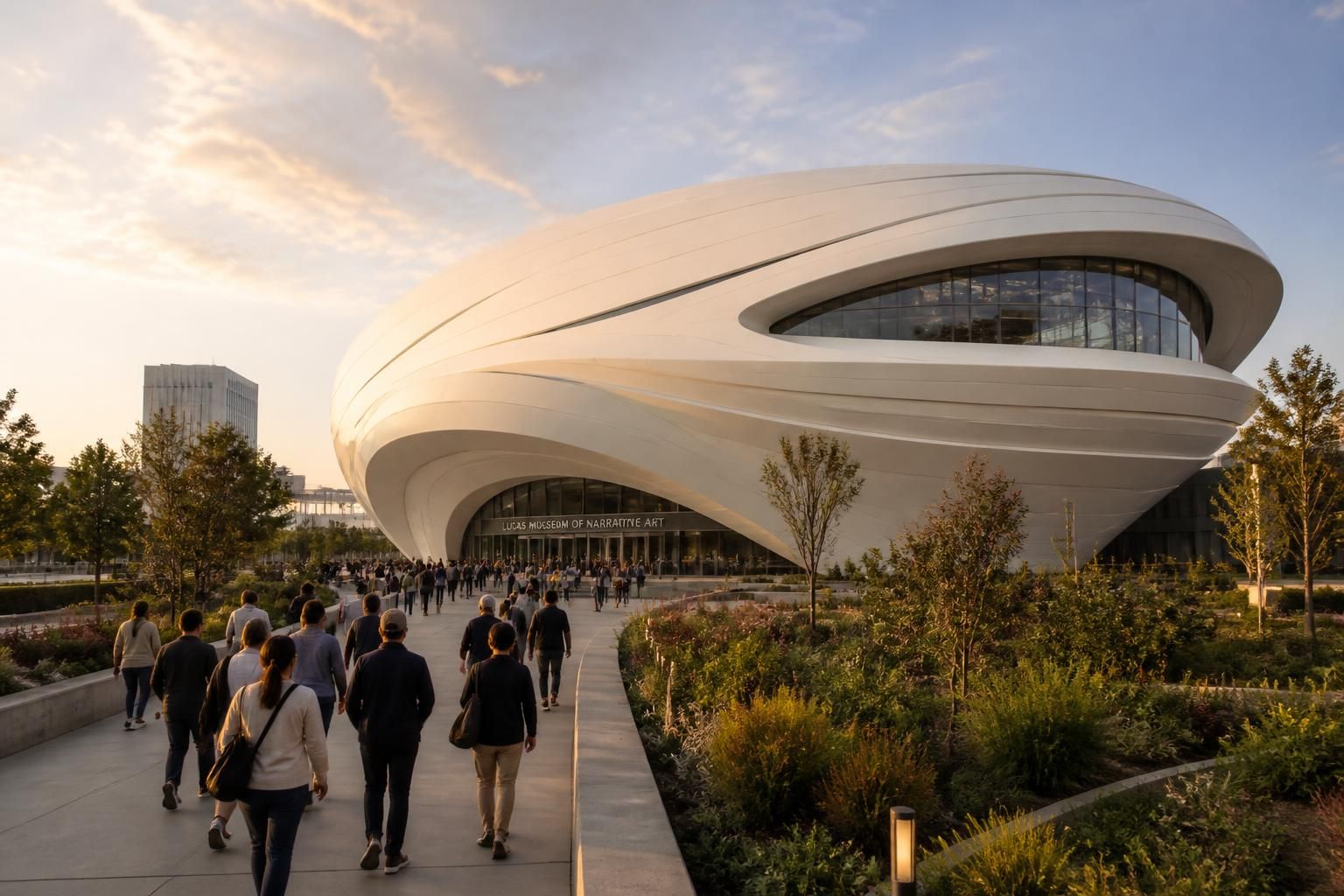
The Lucas Museum’s Architectural Design is impossible to separate from its public identity. Created by Ma Yansong of MAD Architects, with Stantec involved in the project and gardens by Mia Lehrer of Studio-MLA, the building appears to hover above Exposition Park. Its smooth, white, curving envelope has been compared to a spacecraft, an association that is understandable given Lucas’s cinematic legacy. Yet Ma Yansong has described clouds as a key source of inspiration, shifting attention from science-fiction symbolism toward movement, softness, and spatial imagination.
The museum contains roughly 300,000 square feet, making it a major cultural destination rather than a small private-collection venue. Scale can be impressive, but it can also overwhelm visitors. Large museums often create fatigue when guests cannot easily understand where they are, what they have missed, or how long a visit may take. The Lucas Museum’s open, curvilinear galleries and tube-like elevators create visual drama, but they also increase the importance of effective orientation.
One of the building’s central spaces is a plaza intended to feel open to interpretation. This is a valuable ambition. Museums increasingly need transitional spaces where visitors can pause, meet, reorient themselves, and decide what to do next. A central plaza should not be treated merely as circulation infrastructure. It can host accessible meeting points, short audio welcome messages, family instructions, group rendezvous locations, and real-time information about theatre schedules or crowded zones.
For visitors, architecture is experienced through a sequence of moments rather than through a single aerial photograph. The arrival from the park, security and ticketing, entry into the plaza, elevator movement, gallery thresholds, rest areas, theatres, gardens, and food service all affect perception. A visually striking building can still create friction if its routes are unclear, its signage is too discreet, or its digital information is difficult to access. Conversely, intuitive wayfinding can make a complex building feel calm and welcoming.
A detailed look inside the museum’s bold architecture highlights why visitors will likely treat the building itself as part of the Art Exhibition. That expectation requires operations teams to think like experience designers. Photography points, quiet zones, accessible paths, group entrances, and staff visibility all become part of the cultural offer.
Practical audio and accessibility measures for a complex museum layout
Audio interpretation should respond to place. In an open-plan gallery, visitors may see several themes at once: adventure, romance, civic life, illustration, cinema, and fine art. A location-aware audio guide can provide a short orientation at each threshold, followed by optional deeper content. The first layer might take 45 seconds and explain the curatorial idea. A second layer can provide artist background, object details, or critical perspectives for guests who want more depth.
This model avoids a common audio-guide problem: forcing every visitor into the same linear route. A school group, an accessibility-focused tour, and a film-history enthusiast do not need identical information at identical speed. With a platform such as Grupem, cultural organisations can distribute clear audio directly to visitors’ own smartphones, reducing the need for specialised receiver hardware while allowing a guide or educator to preserve a shared live experience.
- 🎧 Start with a one-minute welcome: explain the building’s levels, estimated visit time, toilets, lifts, theatres, and garden access before guests enter the first gallery.
- 🧭 Use clear route labels: offer a 60-minute highlights route, a 90-minute storytelling route, and a family-focused route instead of assuming every visitor wants the full circuit.
- ♿ Provide accessible alternatives: include transcripts, adjustable text sizes, captioned video content, and audio descriptions for selected works and architectural features.
- 👥 Support group pacing: send the same guide commentary to each participant’s phone so guests can hear clearly without gathering in a tight circle.
- 🌿 Extend interpretation outdoors: use the gardens to introduce the museum’s theme before visitors encounter the larger indoor collection.
Imagine Maya arriving with 25 visitors during a busy weekend. Without a shared listening solution, her group may cluster around her in a corridor, block another route, and miss the visual connections between nearby objects. With live audio sent to personal headphones, the group can spread out safely while she explains why the spatial arrangement matters. This is not technology for its own sake; it is a practical way to preserve comfort, audibility, and attention.
The strongest Architectural Design becomes more accessible when the visitor journey is equally well designed: landmark form should be matched by calm navigation, intelligible interpretation, and inclusive listening.
From Star Wars to Rockwell: Designing a Coherent Lucas Museum Art Exhibition
The opening galleries of the Lucas Museum must manage a difficult curatorial task. The collection’s richness is also its main operational challenge. Visitors can move from historical reproductions of cave paintings and the Sistine Chapel to a portrait of Henry VIII, a representation of the Capitoline Wolf, Norman Rockwell paintings, photography, comic art, film objects, and contemporary murals. Such variety has the potential to be energising. It can also feel fragmented if there is no clear interpretive logic connecting one space to the next.
The “History of Narrative Art” display is especially ambitious. It uses recreations, projections, and alternative display techniques to present works that cannot be transported to Los Angeles. This is a sensible solution when the original object is immovable, fragile, or held elsewhere. Yet reproductions must be labelled honestly and interpreted carefully. Visitors should understand whether they are viewing an original, a cast, a facsimile, a digital projection, or a contextual reconstruction—and why that format has been selected.
Transparency does not reduce the impact of a reproduction. It can strengthen learning. A projected Sistine Chapel ceiling, for instance, cannot replace the architectural and spiritual experience of Vatican City. However, it can help visitors examine composition, scale, symbolism, restoration history, and influence in ways that are difficult during a crowded visit to the original site. The key is to state clearly what the display can do and what it cannot claim to replicate.
On the fourth floor, the core holdings bring the museum’s proposition into sharper focus. Rooms may be dedicated to individual figures such as Rockwell or Frazetta, while others use themes including adventure, romance, and civic life. The thematic model is promising because it encourages cross-media comparison. A visitor might examine how an illustrator constructs suspense, how a photograph documents social tension, and how a film sketch anticipates movement and emotion.
However, thematic curation requires disciplined writing. Labels should avoid broad claims such as “all cultures tell the same stories,” which can erase important differences. A better approach identifies specific shared devices—heroic framing, visual contrast, sequential imagery, costume, gesture, or point of view—then explains how each work uses those devices within its own historical context. This gives audiences a reliable method for looking rather than simply asking them to admire diversity.
The museum’s surprise addition of original Banksy murals signals another dimension of its broad collecting logic. Banksy’s work comes with questions around anonymity, street context, ownership, removal, and market value. Presenting murals inside a formal museum can prompt useful debate: does relocation preserve a work, transform it, or detach it from the public setting that gave it force? This kind of question is exactly where guided interpretation adds value. A guide can invite visitors to compare a museum wall, a city wall, and a cinema screen as different platforms for public storytelling.
Current management history also makes the opening exhibition noteworthy. Former director and CEO Sandra Jackson-Dumont left in April before the opening, after which Lucas took responsibility for content direction. The institution later reduced staff, and chief curator Pilar Tompkins Rivas resigned in December, with no replacement announced at that stage. Current CEO Tracey Bates has stated that Lucas always had a leading curatorial role. For visitors, these internal changes should not be treated as gossip; they are relevant because museum leadership influences exhibition continuity, scholarly voice, and the capacity to develop future programmes.
Professionals monitoring the institution’s development can consult reporting on leadership changes at the Lucas Museum to understand why clear operational communication matters in the period following a major opening. A strong permanent collection can support many years of display, but works on paper, comics, photography, and children’s-book illustration must rotate for conservation reasons. Rotation is not a weakness. It is a practical opportunity to give returning audiences a reason to revisit.
A coherent Art Exhibition does not require every object to look alike: it requires visitors to understand the question that brings different objects into the same room.
What the Lucas Museum Means for Smart Tourism and Cultural Access
The Lucas Museum will be judged by its collection and architecture, but its broader influence will depend on how easily different publics can use it. This includes tourists who have only two hours in Los Angeles, families managing varied attention spans, school groups, local residents, film enthusiasts, visitors with disabilities, and international guests who may not speak English fluently. A contemporary cultural institution must treat access as an operating system, not a side programme.
Its location in Exposition Park creates a particularly strong case for connected tourism. The district already supports multi-generational audiences and diverse types of visit. A visitor may arrive for the California Science Center and discover the Lucas Museum; another may attend a match or event at the Coliseum and add the gardens to an evening plan. This creates a challenge for ticketing and information design: the museum should communicate what is possible for a short visit, a full-day cultural itinerary, or a repeat local visit.
The reported $25 adult ticket price and higher membership options have drawn criticism from some observers. Pricing is always part of cultural accessibility. However, affordability also includes the hidden costs of a visit: travel time, parking, food, language barriers, uncertainty about queues, and the anxiety of entering a large unfamiliar building. Digital tools can reduce these frictions when they provide practical information before arrival and simple support during the visit.
Turning a large museum visit into an accessible audio experience
Smart tourism does not mean replacing human interpretation with screens. It means using technology where it removes unnecessary friction. A well-designed mobile audio experience can provide pre-visit orientation, timed prompts, accessible descriptions, multilingual summaries, and a post-visit route to related content. The visitor remains in control: they can listen, pause, replay, or select a shorter route according to their needs.
For group organisers, smartphone audio is particularly effective in busy public environments. A guide can speak naturally into a microphone while participants listen through their own devices and headphones. This reduces voice strain, avoids distributing and collecting dedicated receivers, and allows guests to maintain comfortable spacing. It is valuable in gardens, large atriums, galleries with ambient sound, and crowded exhibition areas where a conventional spoken tour becomes difficult to hear.
The museum’s content provides ideal material for layered audio formats. A basic track can explain why a particular work belongs in the collection. An advanced track can discuss art history, visual language, conservation, or social context. A family version can invite observation through questions: “Which character seems powerful? What clues tell you who is the hero? How would this story change if the image were shown from another point of view?” These prompts make narrative art immediately actionable for educators.
- 📱 Before arrival: share a mobile route with meeting point, access information, estimated duration, and a short explanation of the museum’s storytelling theme.
- 🎙️ During the visit: combine live guide commentary with concise pre-recorded tracks for complex objects, fragile works, or spaces where the guide needs to manage group movement.
- 🗺️ At transition points: use audio prompts to help visitors choose between galleries, theatre screenings, gardens, restaurant breaks, or nearby Exposition Park destinations.
- 🔁 After the visit: provide a short replayable route or suggested reading list, encouraging visitors to return when paper-based works rotate.
Maya’s group illustrates the value of this approach. Some participants want to spend time with comics and concept art; others want to focus on Kahlo, Parks, or Rockwell. Rather than splitting the visit into disconnected experiences, she can offer a shared opening route and then let participants choose themed audio modules. At a scheduled time, everyone reconvenes in the plaza to discuss one question: which visual story felt most relevant to contemporary life? The group remains cohesive without forcing identical behaviour.
Future programming will determine whether the venue evolves from a high-profile opening into a durable civic resource. Senior curator and head of film Ryan Linkof has indicated that the institution is still developing ideas for what follows. That is realistic. Museums refine their visitor operations after real audiences begin using the space. The important standard is not instant perfection; it is a willingness to measure visitor needs, protect fragile works, refresh interpretation, and make improvements visible.
For cultural organisations observing this launch, the most useful lesson is practical. A major building and famous founder can generate attention, but sustained value comes from clear routes, humane pricing policies, well-trained staff, rotating displays, and audio that helps people listen without being told what to think. A memorable museum visit begins when every visitor can find their place in the story.
When does the Lucas Museum of Narrative Art open?
The Lucas Museum of Narrative Art opens to the public in Los Angeles on September 22, 2026. It is located in Exposition Park, alongside several major cultural and public venues.
How much of the Lucas Museum is dedicated to Star Wars?
Star Wars concept art represents roughly 7% of the objects currently displayed. The broader collection includes painting, photography, comics, illustration, animation, film materials, sculpture, and historical reproductions.
What does the Lucas Museum mean by Narrative Art?
The museum uses Narrative Art to describe art that communicates a story. This broad definition includes works from classical sculpture and painting to comic strips, photographs, movie props, animation, and popular illustration.
How many objects and galleries are included at opening?
The museum presents more than 1,300 objects across 30 galleries. Some works on paper, including comics, photography, and illustrations, will need to rotate over time for conservation reasons.
Why are mobile audio guides useful in a museum of this size?
Mobile audio guides help visitors navigate large spaces, access multilingual and accessible interpretation, and follow live group commentary through their own smartphones and headphones. They can improve audibility without crowding galleries or requiring dedicated receiver equipment.
