
CBTECH and Museum of Flight Expand Aviation Education Through a Practical Collaboration
⏱️ Short on time? Here is what matters:
✅ CBTECH’s Aviation Pathways program connects classroom learning with career-focused aviation experiences.
✅ The Museum of Flight brings an established Aeronautical Science Pathway model, STEM expertise, and educational resources.
✅ For schools and cultural institutions, the key lesson is clear: partnerships work best when they combine local industry access, structured learning, and accessible technology.
The collaboration between CBTECH and the Museum of Flight offers a concrete example of how regional education providers can widen access to aviation careers. CBTECH’s newly rebranded Aviation Pathways program, formerly known as Flight Technology, is designed to introduce students to multiple professions rather than presenting aviation as a field limited to airline pilots.
This approach matters because the modern aerospace ecosystem needs far more than cockpit skills. It relies on drone operators, airport managers, air traffic professionals, maintenance technicians, engineers, logistics specialists, software teams, and customer-facing staff. Effective Education must therefore help students understand how these roles connect, what qualifications they require, and where local opportunities exist.
The partnership integrates CBTECH’s local learning environment in the Columbia Basin with the Museum of Flight’s Aeronautical Science Pathway, a dual-credit career and technical education program. According to coverage of the CBTECH and Museum of Flight education partnership, the initiative is intended to provide students with broader exposure to aviation instruction and career routes.
For students, the benefit is not simply more information. It is a more coherent route from secondary school to further study, certification, or employment. A learner who enjoys the science of lift may discover engineering. Another who is interested in maps, weather, and operational decision-making may explore air traffic control. A student who prefers visual technology may find a future in unmanned aircraft systems or digital aviation communications.
From a renamed program to a clearer career signal
Renaming Flight Technology as Aviation Pathways is significant because the new title describes an educational promise rather than a single activity. “Flight Technology” can sound narrow, while “Aviation Pathways” suggests several entry points and a progression toward real careers. For schools, names influence participation: students and families are more likely to investigate a program when its purpose is understandable from the outset.
Consider a fictional CBTECH student, Maya, who is fascinated by aircraft but has never considered becoming a pilot. In a conventional program, she might assume aviation does not fit her interests. In a pathway-based format, she can see options related to airport planning, drone imaging, environmental monitoring, aviation safety, and aerospace manufacturing. That visibility supports better course choices before students commit time and money to post-secondary education.
🛩️ A strong pathway should make the following connections visible:
- 🧭 Academic learning: mathematics, physics, geography, communication, and digital literacy.
- 🔧 Technical practice: aircraft systems, simulation, drone operations, safety procedures, and data interpretation.
- 🏢 Professional context: local airports, employers, community colleges, industry mentors, and public agencies.
- 🎓 Next steps: dual credit, certifications, apprenticeships, internships, and degree programs.
The Museum of Flight has long positioned its education offer around hands-on air and space learning. Its aviation and aerospace education programs show how formal learning can be strengthened through experiences that make scientific principles more tangible. An aircraft artifact, a simulator, or a guided analysis of a historic mission can turn an abstract lesson into something memorable and discussable.
That model is particularly useful for regional technical programs. CBTECH does not need to replicate every museum resource on site. Instead, the collaboration can bring curriculum frameworks, teaching practices, professional networks, and subject expertise into a local setting where students can relate learning to their own community.
The most valuable outcome is not a single aviation lesson; it is a clearer map between student curiosity and a viable professional future.
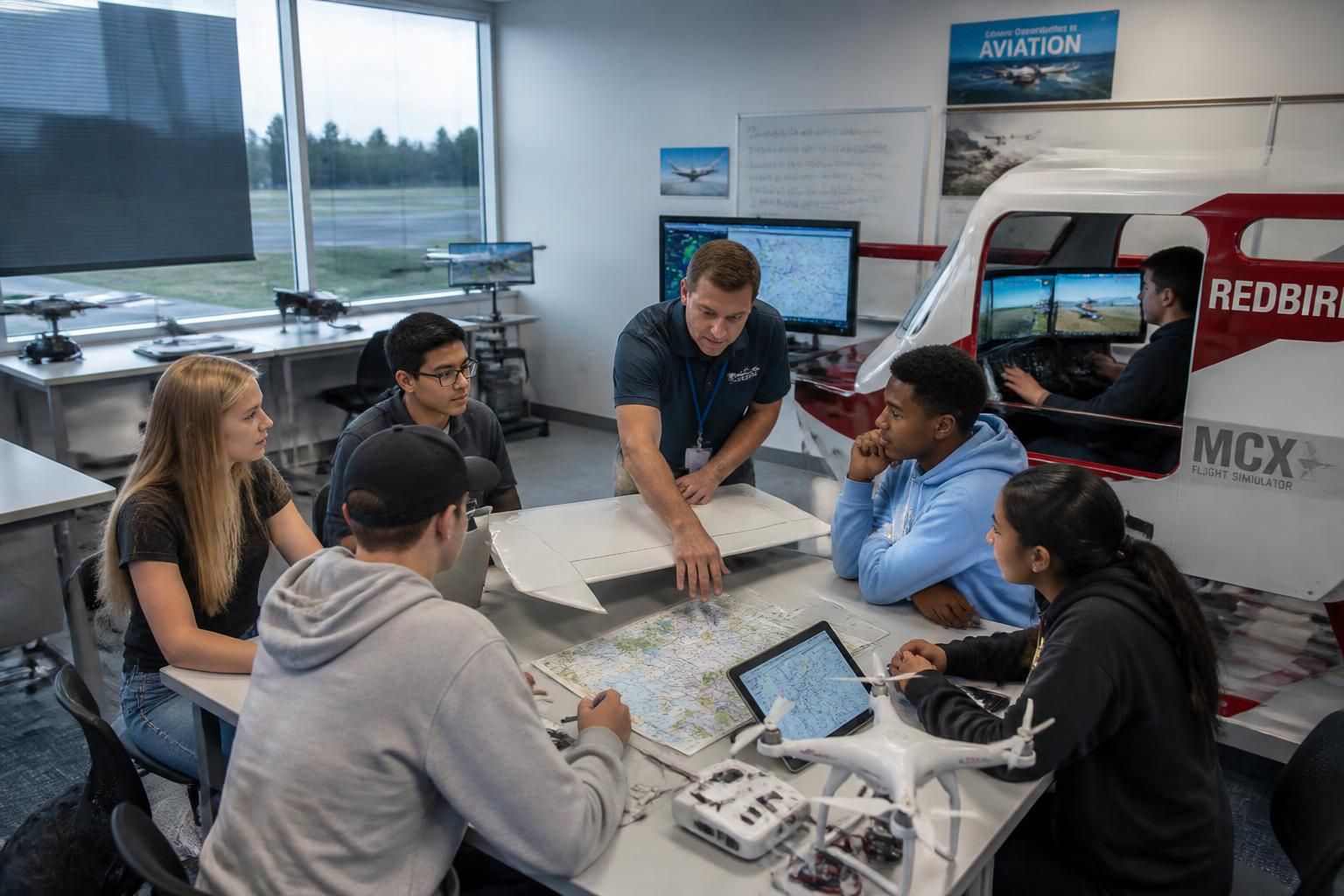
Aviation Pathways Bring STEM Learning Closer to Local Workforce Needs
Effective STEM education becomes more relevant when learners can connect science and technology with visible occupations. The CBTECH and Museum of Flight collaboration creates that connection by placing aviation within the practical realities of the Columbia Basin. Students do not only study principles; they can consider how those principles appear in airports, agricultural drone operations, maintenance facilities, logistics systems, and aerospace-related organizations.
STEM is sometimes presented as a broad label, but its usefulness depends on application. Physics explains thrust, lift, drag, and weight. Mathematics supports navigation, fuel planning, performance calculations, and data analysis. Engineering helps learners understand materials, structural design, and systems reliability. Technology introduces simulation, geographic tools, drones, and operational software. A well-designed Aviation Pathways program gives each subject an understandable purpose.
The partnership also reinforces an important point for education leaders: learners do not need to choose between theory and practice. They need both. Without technical grounding, practical activities can become superficial demonstrations. Without real-world examples, theory can feel disconnected from career choices. The strongest programs alternate between explanation, observation, simulation, discussion, and structured reflection.
Turning a flight concept into a complete learning experience
A lesson on weather provides a useful example. A teacher can begin with the scientific concepts of pressure, temperature, moisture, and wind. Students can then review a sample aviation weather briefing and identify which conditions might affect a departure, landing, drone mission, or airport operation. The activity becomes richer when learners must explain their reasoning rather than simply memorize weather terms.
A student team might receive a scenario involving a small unmanned aircraft mission to inspect irrigation infrastructure. One learner interprets wind conditions, another checks airspace constraints, another plans the route, and another prepares a communication plan. This kind of exercise develops technical knowledge alongside teamwork, decision-making, and professional communication.
| Learning area | Aviation application | Career relevance |
|---|---|---|
| 📐 Mathematics | Distance, speed, fuel, weight and balance calculations | 🧑✈️ Piloting, dispatch, airport operations |
| 🌦️ Science | Weather systems, aerodynamics, materials, propulsion | 🔬 Engineering, meteorology, maintenance |
| 💻 Technology | Simulation platforms, drone controls, mapping tools | 📡 UAS operations, data services, aviation software |
| 🗣️ Communication | Briefings, checklists, team coordination, visitor interpretation | 🎧 Safety management, tourism, customer operations |
For museums, technical schools, and tourism organizations, this table highlights an overlooked opportunity. Aviation content does not belong only in a specialist classroom. It can support interdisciplinary projects, public programs, field visits, and career discovery events. The Museum of Flight’s educational model is valuable precisely because it can make aerospace history, technical literacy, and future workforce needs part of the same learning conversation.
🎓 Dual-credit structures can add another layer of value. When a learner earns recognized credit while still at school, the pathway becomes more efficient and more credible. Families can see that the program is not merely an extracurricular interest; it is connected to further education. Schools can also use this structure to improve transitions to colleges and training providers.
However, a dual-credit offer must remain understandable. Students should receive clear information on eligibility, workload, assessment methods, transferability, and support services. A program that uses complex language or unclear enrollment steps may unintentionally exclude capable students. Accessible program design is therefore as important as academic rigor.
The broader Innovation lies in building a local ecosystem rather than operating isolated courses. A teacher can introduce theory, a museum can supply specialist educational methods, an employer can explain current practice, and a student can test interest through a project. That shared model gives aviation learning a practical destination.
When STEM lessons are tied to visible roles and real decisions, students can understand not only what they are learning, but why it matters.
Flight Training and Aerospace Exploration Need More Than Pilot-Centred Messaging
Public interest in aviation often begins with pilots, aircraft, and dramatic flight stories. Those elements are valuable, but a modern education program should avoid making them the only focus. The aviation sector includes a wide range of careers with different entry requirements, working environments, and levels of technical specialization. CBTECH’s Aviation Pathways framing helps create room for that full picture.
Flight training remains an important part of the sector, especially for students who aim for professional piloting, recreational flight, or operational roles requiring aviation knowledge. Yet learners need honest guidance about the process. Flight instruction involves medical requirements, licensing standards, regular practice, cost planning, safety discipline, and continuous learning. It should be presented as a serious progression, not as a fast route to an idealized career.
At the same time, students who do not plan to fly should not feel like secondary participants. Airport management, dispatch, aerospace engineering, maintenance, drone operations, aviation law, safety systems, and tourism interpretation all contribute to the industry. A broad program makes these roles visible early, before students decide that aviation is “not for them.”
Showing students the complete aviation ecosystem
A useful teaching method is to follow a single flight from planning to arrival. Before takeoff, teams consider weather, fuel, airworthiness, passenger service, airport coordination, ramp work, and flight planning. During the journey, air traffic services, operations control, maintenance monitoring, and weather updates all matter. After landing, the aircraft enters another network involving ground handling, inspections, scheduling, baggage systems, and customer communication.
This exercise changes how students see the word “aviation.” Instead of imagining one person in a cockpit, they see an interconnected system of people, data, equipment, procedures, and infrastructure. It is also a practical way to discuss accountability. Aviation safety depends on many small, disciplined actions performed consistently by different professionals.
The Aerospace dimension expands this perspective further. Aerospace learning can include satellites, space communications, advanced materials, propulsion, robotics, and Earth observation. These topics are relevant for students interested in coding, environmental science, design, or advanced manufacturing. They also create links between aviation heritage and emerging technologies.
A museum setting is especially effective for this work because objects can anchor complex ideas. A historic aircraft is not merely an exhibit. It can support discussions about material choices, navigation methods, production history, wartime logistics, accessibility, and the changing role of women and underrepresented groups in aviation. The Museum of Flight blog is one example of how stories, collections, and industry context can keep aviation education connected to real people and historical developments.
For visitor-facing institutions, this is also where audio technology can improve access. Guided experiences work better when every participant can hear the interpretation clearly, including those standing at the edge of a group or navigating a noisy hangar. Smartphone-based audio guide systems can distribute a guide’s voice directly to visitors’ own devices, reducing crowding around a speaker and supporting a more flexible pace.
A museum educator leading a group around a large aircraft could use an audio solution to share a narrative, pause for discussion, and direct participants toward a detail on the airframe. The same approach can support school visits, technical open days, and airport heritage tours. It does not replace a skilled educator; it helps the educator reach the group more consistently.
For institutions reviewing their visitor tools, resources such as this overview of aviation museums worth studying can provide useful comparisons in programming, interpretation, and audience engagement. The practical question is not whether technology looks modern. It is whether it removes a real barrier for visitors and staff.
Aviation education becomes more inclusive when flight is presented as one meaningful route within a much larger professional ecosystem.
Museum of Flight Educational Methods Can Strengthen CBTECH Student Engagement
The Museum of Flight brings more than aviation subject matter to this collaboration. It brings an educational approach shaped by hands-on learning, artifacts, guided inquiry, and career awareness. For CBTECH students, that can turn a technical topic into an experience with context. Instead of only asking how an aircraft works, students can ask why a design changed, who operated it, what problem it solved, and which modern careers use related skills.
Engagement is often misunderstood as entertainment. A successful program does not need constant spectacle. It needs learners to participate actively, understand the relevance of a task, and receive feedback that helps them progress. In aviation, this can mean diagnosing a scenario, completing a safety checklist, comparing routes, interpreting weather, or explaining a technical decision to peers.
Using heritage and technology to make learning memorable
Historic collections offer a powerful starting point because they provide evidence of how aviation has evolved. Students can compare a mechanical instrument panel with a contemporary digital flight display and discuss what changed. They can explore how navigation depended on paper charts, radio signals, and visual references before satellite systems became routine. These comparisons are useful because they reveal that technological progress also changes training, procedures, and human responsibilities.
A guided group activity can be organized around one question: “What information does a crew need to make a safe decision?” Students might observe an aircraft exhibit, identify instruments, then review a modern digital interface. The educator can show that even when technology changes, core needs remain: accurate information, clear communication, disciplined processes, and situational awareness.
📌 Practical design principles for a museum-school learning day include:
- 🗓️ Set one measurable objective: for example, identify three aviation careers connected to a chosen exhibit.
- 🎧 Plan the listening experience: use clear spoken guidance, quiet stopping points, and accessible audio where needed.
- 🧩 Alternate formats: combine observation, short instruction, group tasks, and student questions.
- 📝 Capture learning evidence: ask learners to produce a route plan, reflection, mini-presentation, or career map.
- 🔁 Connect the visit to follow-up work: a museum visit should inform later classroom projects rather than stand alone.
These principles apply beyond large institutions. A local airport visit, a virtual session with an industry specialist, or a school-hosted drone demonstration can use the same structure. The essential factor is continuity. If students know why they are taking part and how the activity connects to their next assignment or career decision, engagement becomes easier to sustain.
Digital tools can also help educators prepare before a visit and continue afterward. A short audio briefing can provide essential vocabulary, safety expectations, and orientation. During a visit, mobile audio can make narration easier to follow around noisy exhibits. Afterward, students can revisit selected explanations and use them as sources for a project. This is particularly useful when educators work with large groups or mixed levels of prior knowledge.
Accessibility should be considered from the beginning, not added at the end. Clear language helps students new to technical subjects. Captions or transcripts support varied learning preferences. Personal-device audio can assist visitors who need to control volume or stay close to a support person. Physical routes should account for mobility needs, and activities should not depend solely on rapid verbal response.
For aviation organizations seeking to improve public interpretation, the example of supporting aviation museum volunteers with clear visitor guidance shows why consistent messaging matters. Volunteers often hold deep knowledge, but they need practical tools and a shared visitor experience framework to make that expertise accessible to every audience.
The strongest learning experiences combine authentic objects, structured participation, and communication tools that let every student follow the story.
Career Development Requires Regional Connections, Clear Information, and Repeated Exposure
Career development rarely happens through one inspiring event. Students need repeated exposure to different jobs, visible examples of progression, and practical information about their next steps. The CBTECH and Museum of Flight collaboration has value because it can create a continuing relationship between learners, educators, cultural resources, and aviation-related industries.
In the Columbia Basin, local context is a major advantage. When students can connect aviation learning to nearby airports, training organizations, regional employers, and infrastructure, career options become more realistic. They can ask practical questions: Which skills are employers seeking? Which certifications matter? Is a two-year course appropriate? What does a typical workday look like? Which roles combine technology with outdoor work, public service, or project management?
Those questions deserve specific answers. Vague encouragement does not help a student choose a course or prepare an application. Schools can improve guidance by maintaining current pathway maps, arranging employer conversations, and making entry requirements transparent. Cultural partners can contribute by showing how aviation history links to current workforce needs and by providing credible educational content that reaches families as well as students.
Building a pathway that students can actually use
A practical pathway map should show more than a list of career titles. It should identify recommended school subjects, introductory experiences, required qualifications, possible local partners, and alternative routes. For example, a learner interested in drone operations may need to understand regulations, safety, mapping tools, weather, and client communication. A learner interested in airport operations may need strong organizational skills, customer service awareness, emergency procedures, and an understanding of logistics.
Schools should also avoid treating career exploration as a final-year activity. Early exposure gives students time to build confidence in mathematics, communication, and technical problem-solving. It can also help them recognize that an initial interest may evolve. A student who begins with drones may later choose engineering; another who joins for aircraft history may discover an aptitude for operations planning.
🤝 A local partnership plan can include:
- ✈️ Site visits that show airport and aviation operations beyond public passenger areas.
- 🧑🔧 Career panels featuring maintenance, safety, operations, engineering, and drone professionals.
- 📱 Short mobile-friendly learning modules students can revisit before and after events.
- 🛰️ Project briefs based on local needs, such as mapping, heritage interpretation, or environmental observation.
- 🎓 Guidance sessions explaining college credit, certifications, scholarships, and entry-level roles.
Audio technology can support this ecosystem in an efficient way. During a site visit, a guide may need to communicate around machinery, in open outdoor areas, or near active operations. A smartphone audio system allows participants to listen through their own headphones, reducing the need for expensive receiver fleets while helping groups remain spread out safely. It can also make multilingual or recorded content easier to provide when appropriate.
For a school or museum, implementation should be simple. Staff need a clear process for joining a session, basic device checks, a short backup plan, and a defined speaker role. Technology should not create another administrative burden. It should solve an existing issue, such as poor audibility, uneven group movement, or the need to provide consistent explanations across several sessions.
The educational significance of this collaboration therefore extends beyond one program name or one partner announcement. It demonstrates how aviation-focused institutions can pool their strengths: a technical school offers local student access and applied teaching; a museum provides specialist educational resources and heritage context; local employers make the workforce dimension tangible; accessible digital tools help keep the experience coherent for participants.
Students can explore further opportunities through the Museum of Flight programs for individual students, while schools can follow CBTECH’s own Aviation Pathways program information for local details and enrollment guidance. Clear access to these resources is essential because interest only becomes progress when learners know what to do next.
Career-ready aviation education is built through consistent exposure, transparent routes, and partnerships that make local opportunities visible.
What is the CBTECH Aviation Pathways program?
Aviation Pathways is CBTECH’s rebranded aviation-focused career and technical education program. It introduces students to multiple aviation and aerospace careers, including piloting, drone operations, air traffic services, airport management, and related technical fields.
How does the Museum of Flight support the collaboration?
The Museum of Flight contributes experience from its Aeronautical Science Pathway, aviation and STEM education resources, and a learning approach that links technical concepts with hands-on activities, collections, and career exploration.
Is flight training the only career route covered by aviation education?
No. Flight training is one route, but aviation education can also support interest in maintenance, engineering, airport operations, safety management, drones, dispatch, logistics, digital systems, and aerospace technologies.
Why are museum visits useful for aviation students?
Museum visits can connect classroom knowledge with real aircraft, historical evidence, specialist educators, and structured activities. When followed by classroom work, they help students understand both technical concepts and the people behind aviation careers.
