
Little time? Here is what matters:
- 🔊 Signia MaX is presented as an AI-driven hearing solution designed to assess speech, noise, surroundings, and the wearer’s own voice at the same time.
- 🧠 Acoustic Intelligence™ combines four Deep Neural Networks to make sound enhancement decisions from the complete listening situation rather than from noise level alone.
- 🏛️ For museums, guided tours, and visitor-facing venues, clearer personal listening can support more inclusive participation when paired with good audio planning.
- ✅ The practical priority remains unchanged: test the hearing aid in real environments, verify comfort, and work with a hearing-care professional for fitting and follow-up.
How Signia MaX Uses Acoustic Intelligence™ for Multi-Dimensional Hearing
Signia has introduced MaX as a new hearing innovation powered by Acoustic Intelligence™, described as the world’s first multi-dimensional AI hearing aid platform. The central idea is straightforward: difficult listening is rarely just a “noise problem.” In a crowded restaurant, at a station, or during a guided visit, speech, environmental activity, movement, and the wearer’s own voice occur together.
Traditional sound processing can focus heavily on reducing background noise. That remains useful, but it does not always reflect what people actually need in a busy moment. A visitor listening to a guide in a historic square, for example, may want to hear the guide’s narration while staying aware of approaching bicycles, fellow participants, and street signals. Useful audio technology should preserve that context instead of treating all non-speech sound as unwanted interference.
According to Signia, MaX continuously evaluates four dimensions: speech, noise, environmental conditions, and the wearer’s own voice. Four Deep Neural Networks, or DNNs, work together within the Acoustic Intelligence system. Their purpose is not simply to apply one fixed setting, but to help the hearing solution respond to changing listening demands as they happen.
| Listening dimension | What the system evaluates | Practical example |
|---|---|---|
| 🗣️ Speech | Voices and conversational cues | Following a guide’s explanation beside a busy monument |
| 🔉 Noise | Competing background sound | Managing café chatter, traffic, or an exhibition hall crowd |
| 🌍 Environment | Acoustic setting and surrounding activity | Moving from a quiet museum room to an open public square |
| 🎙️ Own voice | The wearer’s spoken voice and vocal comfort | Responding naturally during a group discussion |
This approach matters because sound is dynamic. Consider a fictional visitor named Daniel during a food-and-heritage tour in Lisbon. Inside a small bakery, he needs to hear the host explain a recipe over the hum of refrigerators and customer conversations. Outside, the group crosses a narrow street where traffic becomes more relevant. At lunch, the discussion shifts across a noisy table. Each setting asks for a different balance, and manual adjustments can be distracting or impractical.
The stated ambition behind MaX is to reduce that burden by interpreting the whole listening moment. This does not mean that every user will experience identical results. Hearing profiles, fitting quality, ear anatomy, expectations, and environments all affect performance. Still, the move toward multi-dimensional processing reflects a useful change in design: better listening is not only about making a signal louder.
For readers comparing the platform with the manufacturer’s earlier developments, Signia’s Xperience technology overview provides useful context on how movement and acoustic awareness have shaped the company’s approach. MaX extends that direction by placing coordinated neural-network processing at the centre of the listening experience.
The key point is practical: a modern hearing aid should help the wearer remain involved in the moment, not isolate them from it. That principle becomes especially important where voices, public spaces, and changing soundscapes overlap.
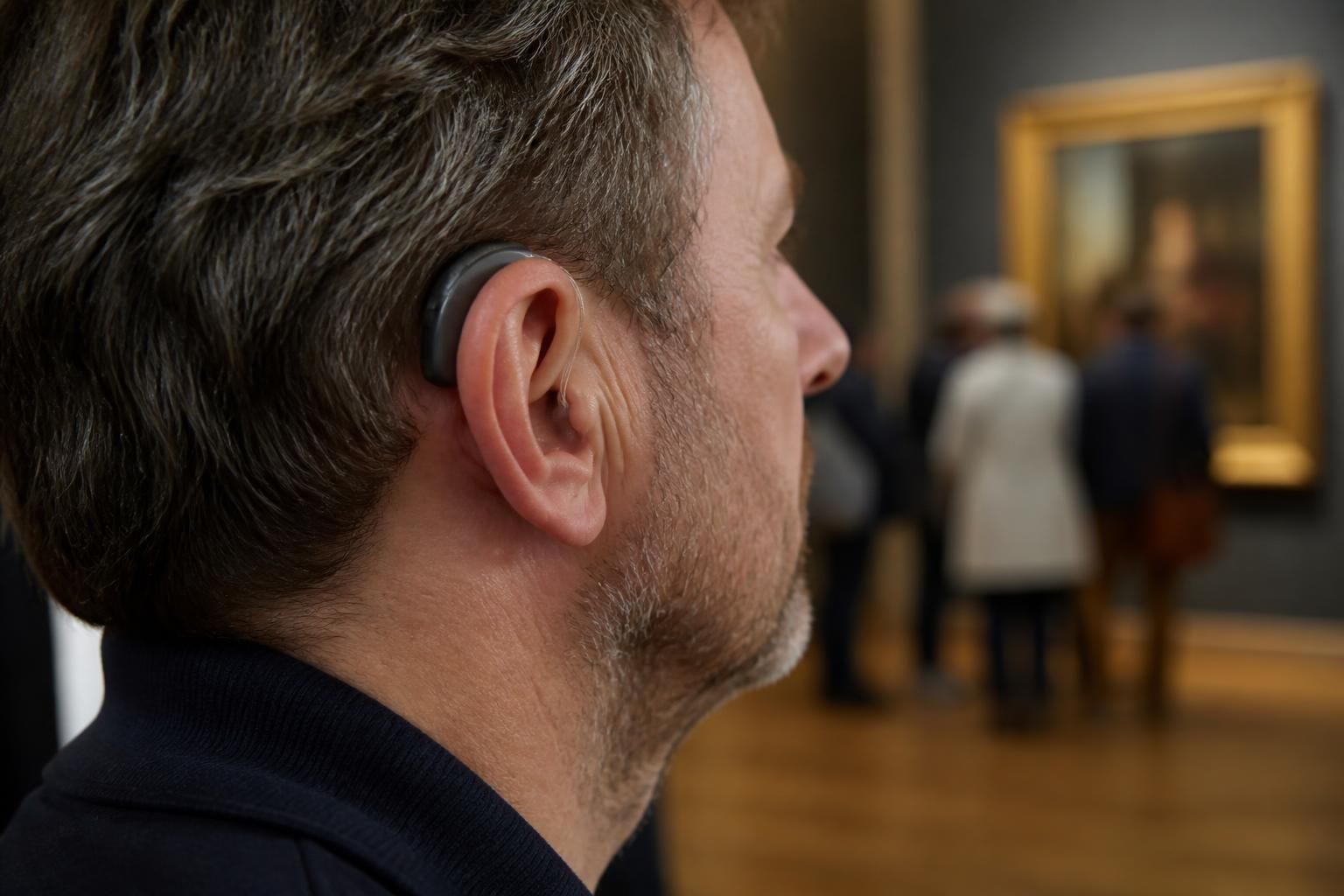
Why an AI-Driven Hearing Solution Must Go Beyond Noise Reduction
Noise reduction is an important capability, but it is only one part of a useful hearing solution. Human listening involves prioritising, interpreting, and shifting attention. A person may focus on one speaker, briefly monitor a public announcement, then turn to answer a question. In everyday life, the value of artificial intelligence lies in supporting these transitions without forcing the user to constantly manage controls.
Signia positions Acoustic Intelligence as a “super brain” that keeps several DNNs in sync. In practical terms, this framing suggests a coordinated decision process: one element identifies speech, another evaluates disruptive sound, another considers the listening environment, and another accounts for the wearer’s voice. The system can then shape amplification and sound enhancement based on their combined signals.
This is significant in places where acoustic conditions change quickly. A guided tour often begins outdoors, continues through a lobby, enters galleries with hard surfaces, and finishes in a café or shop. Each shift changes reverberation, competing voices, distance from the speaker, and overall comfort. Visitors with hearing loss can find these transitions particularly tiring, even when they have a well-fitted device.
From “quieter” sound to more usable sound
A quieter environment is not necessarily a clearer one. Excessive suppression can remove cues that help a person feel oriented: footsteps behind them, a companion starting to speak, or the sound of a door opening. Conversely, too much ambient sound can mask key words and create fatigue. The goal is not silence; it is an appropriate balance.
Imagine a museum educator presenting a fragile medieval manuscript to a group of twelve. Several people react quietly, a ventilation system runs in the background, and visitors occasionally pass nearby. A hearing aid that treats every secondary sound in the same way may not support the wearer’s attention effectively. A multi-dimensional system aims to determine which parts of the sound scene should be enhanced, moderated, or kept available as context.
That distinction is relevant beyond cultural venues. Family meals, meetings, railway platforms, markets, sports events, and professional conferences all involve competing audio layers. Hearing technology has increasingly moved from simple volume control toward contextual processing because the real problem is often not audibility alone. It is access to conversation without losing awareness of the surroundings.
For professionals in visitor experience, the lesson is equally useful. Personal devices can improve individual access, but they cannot compensate for weak source audio. A guide who faces away from the group, speaks across traffic, or uses a poorly positioned microphone creates avoidable barriers. Mobile audio systems such as Grupem can provide direct, controlled audio to participants’ own smartphones and headphones, reducing dependence on physical proximity.
There is also a wider connection between hearing accessibility and voice technology. Organisations exploring synthetic narration, multilingual content, or speech interfaces can review how voice AI is evolving in cultural and service contexts. The important issue is not novelty. It is whether a tool makes spoken information easier to access, understand, and control for real people.
Effective sound enhancement is therefore measured by participation: can the wearer follow the conversation, respond comfortably, and stay connected to the setting around them?
Signia MaX in Real Listening Environments: Tourism, Culture, and Public Spaces
Tourism and cultural activities create some of the most demanding everyday listening situations. They combine movement, unpredictable noise, changing distances, accents, public announcements, and information-rich speech. A hearing aid that performs well in a quiet consultation room still needs to be evaluated in the places where its wearer spends time.
Signia MaX is relevant in this context because its AI-driven model is built around continuously changing listening scenes. A visitor may begin at a hotel reception, take a coach through traffic, join a walking tour, and attend an evening performance. Each environment has different acoustic priorities. Speech clarity matters, but so do comfort, awareness, and the ability to take part without becoming exhausted.
Supporting inclusion without overpromising technology
It would be misleading to suggest that any device removes every hearing challenge. Strong wind, long distance from a speaker, severe reverberation, or multiple simultaneous conversations remain difficult for everyone, including experienced hearing-aid wearers. Technology can improve access, yet accessible experiences still depend on thoughtful planning by organisers.
A practical cultural venue can improve outcomes through several low-cost decisions:
- 🎤 Use a close microphone for guides instead of relying on projected voice alone.
- 📍 Position speakers away from loud entrances, HVAC outlets, and reflective corners when possible.
- 📝 Offer written highlights, captions, or transcripts for key information.
- 🎧 Provide smartphone-based audio options so participants can listen through compatible personal equipment.
- 👥 Keep groups at a manageable size and pause before delivering essential details.
Consider an outdoor archaeology tour. The guide stops near an excavation area, but wind and road noise rise unexpectedly. A participant wearing MaX may benefit from adaptive processing, yet the guide can still improve intelligibility by bringing the microphone closer, facing the group, and sharing a brief visual reference. Accessibility works best when personal hearing technology and clear communication practices reinforce each other.
For destination managers, this is not a niche concern. Older travellers form an important part of many visitor economies, while people of all ages may experience temporary or permanent hearing difficulties. An inclusive approach helps families, international visitors processing a second language, and guests in crowded environments. The benefits extend beyond one audience.
Signia’s published description of Acoustic Intelligence and its four-network architecture is useful for understanding the product’s intended role. It highlights that speech is considered alongside the acoustic environment and the wearer’s own voice, rather than as an isolated signal.
Venue teams should also consider the user journey before and after the activity. Is booking information readable? Can visitors request assistive listening support discreetly? Are staff able to explain available options without making assumptions? A high-quality service experience begins before the first spoken word and continues after the tour has ended.
The most inclusive visitor experience does not rely on one device: it combines adaptable hearing technology, reliable source audio, considerate staff, and information offered in more than one format.
What the Four Deep Neural Networks Mean for Everyday Hearing Aid Users
The phrase “four Deep Neural Networks” may sound technical, but its user value can be explained without unnecessary jargon. A neural network is a form of artificial intelligence trained to recognise patterns. In hearing care, the objective is to identify characteristics of sound and make rapid processing choices that can support listening comfort and clarity.
Signia states that MaX combines four DNNs through Acoustic Intelligence. Instead of assigning the full task to a single model, the platform separates major listening dimensions and coordinates them. This can be compared to a skilled event team: one person monitors the speaker, another watches crowd flow, another checks the room conditions, and another ensures communication between staff. A coordinated response is more useful than four isolated reactions.
Speech, surrounding sound, setting, and self-voice
Speech recognition is central because conversation is often the information users most want to access. Yet voice clarity cannot be evaluated independently from noise and direction. In a restaurant, a nearby speaker and distant music may overlap. In a train station, announcements can compete with a companion’s voice. The hearing aid needs to manage those competing elements in a way that feels coherent rather than abrupt.
Environmental recognition adds context. A quiet home office, a marble lobby, a car, and a public garden all have different acoustic signatures. Reflective surfaces create reverberation, open air changes speech propagation, and vehicles introduce steady low-frequency sound. Recognising a setting can help the platform avoid treating every situation as though it were the same generic noisy room.
Own-voice handling is often overlooked in public discussions of hearing aids, although it strongly influences acceptance. If users hear their own speech as boomy, unnatural, or disconnected, they may speak less freely or remove their devices. A system that considers self-voice aims to support a more natural conversational experience, particularly when moving between quiet and busy settings.
| User situation | Potential listening challenge | Useful fitting discussion |
|---|---|---|
| 🏛️ Museum visit | Reverberant galleries and soft-spoken guides | Ask to test speech clarity at varying distances |
| 🍽️ Restaurant meal | Multiple voices, clatter, background music | Discuss comfort and conversation effort over time |
| 🚉 Transport hub | Announcements, crowd movement, sudden sounds | Check environmental awareness and alert audibility |
| 💼 Work meeting | Turn-taking, remote voices, own-voice comfort | Explore streaming and microphone options if relevant |
The right question is not “Does AI make the device perfect?” No hearing innovation should be assessed through that lens. A better question is: “Does this processing improve the situations that matter most to the wearer?” A person who regularly attends theatre performances may have different priorities from someone who works in a noisy café or travels with family.
This is why professional fitting remains essential. Hearing tests establish a clinical baseline, while real-world feedback reveals where adjustments are needed. Users should keep notes for the first few weeks: where did listening feel easier, where did it remain tiring, and did their own voice feel natural? Specific examples give hearing-care professionals better information than a simple “it is fine” or “it is not working.”
AI processing is most valuable when it is personalised through fitting, feedback, and daily use. The technology supplies adaptive capability; the wearer’s real experience determines whether that capability is being used well.
How to Assess Signia MaX and Build a Better Audio Accessibility Strategy
Choosing a hearing aid is a personal health and communication decision, not a product comparison exercise based only on technical claims. Signia MaX may be of interest to users seeking an AI-driven hearing solution for complex environments, but a responsible evaluation should combine clinical advice, practical demonstrations, comfort checks, and realistic expectations.
Begin by identifying the situations that create the greatest listening effort. These may include meals with family, client meetings, cultural events, group travel, or conversations in the car. Rank them by frequency and importance. This list becomes a useful briefing for the hearing-care professional and prevents a trial from focusing only on a quiet showroom conversation.
A practical evaluation process for users and organisations
- 🧭 Map priority environments. Write down the three to five places where communication matters most and describe the main difficulty in each one.
- 👂 Arrange a professional assessment. A hearing test and consultation can clarify suitable styles, features, and fitting requirements.
- 🗣️ Test real conversations. If a trial is available, evaluate dialogue in a café, public space, or family setting rather than in silence alone.
- 📱 Check connectivity and controls. Confirm whether app controls, streaming, remote support, and accessories fit the user’s daily devices and routines.
- 📝 Record feedback precisely. Note comfort, clarity, fatigue, self-voice, and any situations where sound feels unnatural or insufficient.
Organisations should apply a parallel process to their own audio accessibility plans. A museum, tourism office, or event organiser cannot prescribe personal hearing devices, but it can reduce barriers. Start with an audio audit: identify where visitors struggle to hear, where announcements are unclear, and where staff give essential information in noisy areas.
Next, improve the source. Smartphone guide platforms can distribute a speaker’s voice more consistently than unaided speech. Grupem is designed to turn a smartphone into a professional audio-guide tool, which can help guides maintain a direct audio channel while participants follow at a comfortable distance. This is useful for large groups, outdoor visits, and locations where amplified speakers would disturb residents or other visitors.
The broader audio technology landscape is also changing quickly. Tools such as voice synthesis, automatic transcription, and intelligent call handling can support service access when implemented transparently and with human review. For an adjacent example of how voice interfaces are being deployed operationally, see this overview of voice AI scheduling applications. The same principle applies in tourism: automation should remove friction, not create a new obstacle.
Signia’s MaX announcement signals an important direction for hearing innovation: processing that seeks to understand more of the real listening scene. Its value will be determined not by the phrase “artificial intelligence” alone, but by how well wearers can participate in conversations that previously required too much effort.
A clear audio strategy begins with one action: test every important message in the same conditions where visitors and listeners will actually receive it.
What is Signia MaX?
Signia MaX is a hearing aid platform presented by Signia as a multi-dimensional AI-driven hearing solution. It uses Acoustic Intelligence™ to evaluate speech, noise, environmental conditions, and the wearer’s own voice simultaneously.
What does Acoustic Intelligence™ do?
Acoustic Intelligence™ coordinates four Deep Neural Networks intended to analyse different aspects of a listening situation. The goal is to support sound enhancement based on the full acoustic moment, rather than focusing only on reducing background noise.
Can a hearing aid make guided tours easier to follow?
A well-fitted hearing aid can support speech access in difficult environments, but the tour design also matters. Guides should use close microphones, manage group position, reduce avoidable noise, and offer written or smartphone-based audio alternatives.
Should users test MaX only in a clinic?
No. A clinical fitting is essential, but real-world testing is equally important. Users should assess comfort and clarity in the environments that matter most, such as restaurants, workplaces, public transport, family gatherings, or cultural venues.
