
Short on time? Here is what matters:
- ✅ Automated Quality Assurance can review every interaction, not only a small sample of calls.
- ✅ Multi-Agent Support lets specialist AI agents collaborate during one voice conversation without forcing customers to repeat information.
- ✅ Advanced Knowledge Management keeps voice, chat, SMS, email, and live-agent guidance connected to the same trusted Knowledge Base.
- ⚠️ The priority is not to automate every case. It is to resolve routine requests efficiently and escalate complex situations with full context.
Capacity Automated Quality Assurance Makes Every Voice Interaction Measurable
Voice remains the channel customers choose when a situation is urgent, confusing, or unresolved. A traveller may call because a booking confirmation is missing, a museum visitor may need immediate accessibility information, or a customer may be disputing a payment after self-service options have failed. These calls carry more emotion and more context than a simple chat request, which makes their quality especially important.
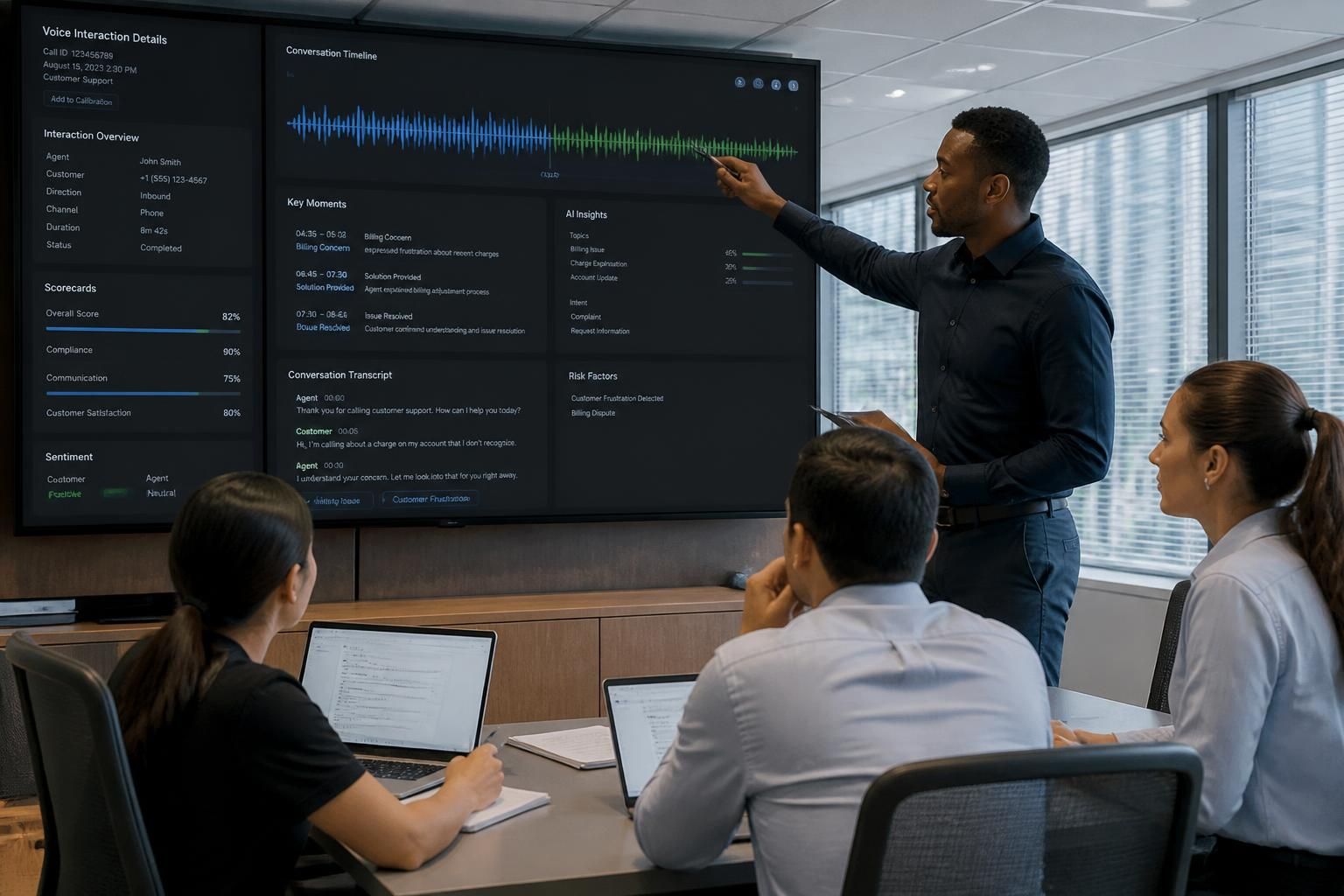
Capacity addresses this challenge by combining conversation intelligence with Automated Quality Assurance. Instead of relying solely on supervisors to manually review a limited selection of calls, the platform can analyze interactions systematically. This creates a broader picture of service quality, recurring pain points, compliance risks, and opportunities to improve both AI-driven Solutions and human support workflows.
Traditional Quality Assurance processes are often constrained by time. A contact-center manager may have hundreds or thousands of calls each week but only enough resources to assess a small proportion. As a result, a recurring issue can remain invisible until complaints escalate. Automated analysis changes the operating model: the organization can identify patterns across every relevant interaction and focus human reviewers on the cases that actually need expert attention.
Consider a fictional regional tourism office, “Northline Visitors.” Its support team receives calls about attraction opening times, mobility access, ticket changes, and transport disruptions. If callers repeatedly ask whether a shuttle accepts wheelchairs, the issue might not be individual agent performance. It may reveal an incomplete Knowledge Base, unclear website information, or a missing answer in the voice workflow. Automated Quality Assurance helps distinguish between these causes.
| Service signal | What Capacity can help identify | Operational response |
|---|---|---|
| 📞 Repeated caller questions | Missing or unclear knowledge articles | Update the shared Knowledge Base and test the answer across channels. |
| ⏱️ Long call duration | Complex steps, poor routing, or difficult system access | Simplify the workflow or provide live guidance to agents. |
| 🔁 Frequent escalations | Requests that exceed automation boundaries | Define clearer escalation triggers and specialist handoffs. |
| 😊 Positive resolution language | Successful language, workflows, and knowledge paths | Reuse effective patterns in training and automation design. |
For organizations, this is not simply about scoring calls. The practical value lies in creating a learning cycle. After an interaction, conversation analysis can surface knowledge gaps, performance opportunities, and recurring customer friction. Those findings can then inform better content, improved routing rules, and more useful coaching for human teams.
Quality Assurance also matters for accessibility and consistency. A visitor should receive the same accurate information whether they call, message through SMS, or contact a support desk by email. When answers drift between channels, trust falls quickly. A connected platform reduces that fragmentation by giving virtual agents and staff access to the same knowledge layer.
The financial context is equally relevant. Live voice interactions can cost approximately $7 to $13 each, while an AI agent interaction may range from roughly $0.50 to $2. These figures do not mean that human support should disappear. They show why organizations need to reserve specialist time for cases requiring judgment, empathy, exceptions, or sensitive decisions. The strongest quality model improves automation while protecting the moments where human expertise is essential.
Multi-Agent Support Keeps Complex Customer Support Calls Connected
A single customer request rarely stays within one department. A caller might begin with a billing question, then discover that an order is delayed, and finally request a refund. In a conventional contact center, this can mean transfers, repeated security checks, long pauses, and frustration. Each handoff creates a risk that the customer will need to explain the situation again.
Multi-Agent Support is designed to reduce that friction. Capacity’s approach allows several customizable AI specialists to work behind the scenes on one conversation. A front-door agent identifies the first intent, then routes the dialogue to the appropriate specialist. If the subject changes, another agent can take over while retaining the conversation history and relevant customer context.
The key distinction is that the customer should not experience the transition as a traditional transfer. The interaction remains continuous. For example, a voice agent handling a payment query can recognize that the caller’s real issue concerns delivery status. A logistics-focused agent can then access the existing context and continue the conversation without the caller repeating account details, previous steps, or the original complaint.
This form of Agent Collaboration is especially useful for tourism, culture, and event services. A large festival may need to answer questions about tickets, entry times, safety rules, transport, refunds, and accessibility. Those subjects often belong to different internal teams, but customers should not have to understand the organizer’s internal structure before receiving help.
From intent detection to a human escalation path
Capacity’s voice workflow begins with an agent that identifies why the caller is contacting the organization. It can then select a specialist based on the need. If the automation resolves the request, the call ends naturally. If the issue requires judgment or cannot be completed through connected systems, the interaction escalates to a human representative.
That escalation is where many automation programs fail. Passing a call to an employee without the previous history simply moves the burden from the bot to the customer. Capacity’s shared orchestration layer supports Real-Time Agent Assist, allowing the live representative to receive interaction history and timely guidance when the call reaches their queue. The employee can begin from the current state of the case rather than reconstructing it.
- 🎯 Intent recognition: identify the caller’s first objective quickly and route it appropriately.
- 🔄 Specialist handoff: move between billing, delivery, booking, or refund expertise without losing conversational context.
- 👤 Human intervention: escalate cases involving exceptions, disputes, vulnerability, or high-value decisions.
- 🧠 Context continuity: provide the human agent with the customer’s history and relevant next steps.
A practical example is a guided-tour operator managing last-minute changes. A customer calls because a tour has been moved due to weather. The first AI agent verifies the booking. A second specialist checks alternative schedules and transport. If the caller requires a medical accommodation that falls outside standard policy, a staff member receives the complete record and can make an informed decision. This is more efficient than treating every request as identical, while avoiding the cold experience of an automation dead end.
Capacity offers more than 100 voice options across 30 languages, along with speech recognition in 21 languages. Language coverage is not a decorative feature for visitor-facing organizations. It directly affects whether international guests can understand instructions, modify bookings, or reach assistance under pressure. Still, language selection should be tested against actual audience needs, regional accents, and the vocabulary used in the organization’s services.
For a broader overview of the release, the report on AI Quality Assurance and multi-agent voice support outlines how the platform connects specialist agents with conversational analysis. A seamless handoff is not only a technical benefit; it is a visible sign that an organization respects the customer’s time.
Advanced Knowledge Management Creates One Reliable Source Across Channels
Many organizations have accumulated information in separate places: a help center, internal PDFs, CRM notes, policy folders, team inboxes, booking systems, and informal staff documents. This creates a familiar problem. A customer receives one answer in chat, another by phone, and a third from a human representative. The issue is not necessarily poor effort from the team; it is disconnected knowledge.
Advanced Knowledge Management provides a more coherent alternative. Capacity’s AI Knowledge Orchestration connects enterprise knowledge once and makes it available across voice, chat, SMS, email, and live-agent assistance. Rather than training each channel independently, organizations can develop a shared knowledge layer that supports consistent responses and coordinated Automation.
This model is particularly relevant when information changes frequently. A museum may update exhibition opening hours. A travel operator may adjust cancellation conditions. A venue may change entrance procedures after a safety review. If every team has to update a separate script, chatbot, email template, and staff briefing, inconsistencies are likely. A central knowledge approach helps reduce repetitive maintenance work while strengthening response reliability.
Train knowledge once, then govern how it is used
A shared layer does not mean publishing every internal document to every customer-facing agent. Effective knowledge orchestration requires permissions, source selection, editorial ownership, and regular review. Public visitors may need opening times and booking policies, while staff need operational instructions and escalation rules. The platform should make relevant knowledge accessible while maintaining appropriate boundaries.
For example, Northline Visitors could organize its Knowledge Base around clear content types: visitor information, booking conditions, accessibility guidance, partner service details, and internal escalation procedures. Each entry should have an owner, a review date, a source reference, and language suitable for the intended audience. The AI agent can then draw answers from controlled material instead of improvising from outdated fragments.
Capacity’s platform is designed to connect company knowledge and live systems in real time. This matters because static answers are often insufficient. A caller asking whether a tour has spaces available needs current booking data, not a general explanation of how availability normally works. A customer asking about a refund needs the relevant policy and, where authorized, the current status of the transaction.
The operational advantage is consistency across the full customer journey. Someone might first browse a website, then send an SMS while travelling, then call from outside a venue. If each channel uses the same validated information, the customer does not need to restart the process. For staff, the same foundation can support agent assist, CRM workflows, analytics, and helpdesk automation.
Organizations evaluating this approach can review Capacity’s AI Knowledge Orchestration to understand how a centralized layer can support multiple AI agents and service channels. The platform perspective is important: knowledge should be treated as an operational asset, not merely as a collection of documents.
There is also a useful lesson for audio-first visitor experiences. Clear information is not only written well; it must be easy to hear, understand, and act on. Teams deploying spoken interfaces should use short sentences, define local terms, avoid dense policy language, and test the flow with real users. An accurate answer that is difficult to follow on a phone call still creates friction.
For teams exploring the wider evolution of synthetic speech and conversational interfaces, this analysis of voice AI developments offers useful context on why natural, intelligible audio design matters. A shared knowledge layer only creates value when its information remains current, governed, and understandable in every channel.
Capacity Voice AI Balances Natural Conversation With Controlled Automation
Voice automation has to solve two problems at once. It needs to be efficient enough to handle routine demand, but natural enough that customers do not feel trapped in a rigid menu. Customers calling with a delayed order, a billing concern, or an inaccessible venue entrance do not want to navigate a long sequence of keypad prompts. They want to explain what happened and move toward a resolution.
Capacity uses neural text-to-speech technology to support more conversational voice interactions. A human-like voice can improve clarity and reduce the mechanical feel associated with older interactive voice response systems. However, realistic audio alone is not the measure of success. The voice agent must understand intent, preserve context, access relevant knowledge, and know when it should stop automating.
This is where connected AI-driven Solutions become more useful than isolated voice bots. A standalone system may answer simple questions but struggle as soon as a customer’s request spans departments or requires current business data. Capacity positions voice within a broader CX Automation Platform, linking it with chat, SMS, email, CRM processes, analytics, and agent assistance. The result is a more unified service design rather than a separate voice experiment.
Designing voice experiences for real customer pressure
When calls reach a support line, the easy answer has often already failed. A visitor may have checked the website. A customer may have tried a chatbot. A traveller may be standing outside a venue with poor connectivity and limited time. Voice design should therefore begin with the high-friction moments rather than generic FAQs.
A practical deployment plan starts by mapping the most common intents and separating them into three groups: requests that can be fully automated, requests that need assisted automation, and requests that should reach a human quickly. Password resets, booking confirmations, and opening-hour queries may be appropriate for self-service. Refund disputes, safeguarding concerns, and complex accessibility needs usually require a defined human route.
- 📌 Identify the top call reasons using existing contact data and staff feedback.
- 🗣️ Write voice responses for listening, using concise language and clear next actions.
- 🔗 Connect approved knowledge and live systems before activating transactional workflows.
- 🚦 Define escalation rules for sensitive, ambiguous, or failed interactions.
- 📊 Review Automated Quality Assurance findings regularly and refine the experience.
For a cultural venue, this might mean using voice AI to confirm timed-entry tickets, explain how to access audio-guide content, and direct callers to transport information. If a guest says they are unable to use stairs or need a companion ticket, the system should not force them through generic scripts. It should recognize the request, retrieve the relevant policy, and connect them with a trained person where necessary.
Natural conversation also depends on pacing. Voice agents should avoid long, multi-clause explanations and should offer customers a chance to interrupt, correct, or ask for repetition. They should confirm important details such as dates, reservation numbers, and payment-related information. These design decisions may appear minor, but they have a major effect on perceived control and trust.
The broader Capacity CX Automation Platform illustrates the value of connecting virtual agents, real-time guidance, post-interaction workflows, and outbound engagement within one operational environment. This reduces the need to build different infrastructures for each channel and makes service governance easier as use cases expand.
Automation should also be evaluated in terms of customer effort, not only containment rate. A system that closes a call quickly but leaves the problem unresolved shifts the cost to a second call, a complaint, or a frustrated staff member. Good voice Automation is measured by accurate resolution, clear escalation, and a customer who does not need to start over.
Using the Learning Loop to Improve Human and AI Customer Support Over Time
The most durable benefit of Capacity’s approach is the learning loop created after each interaction. Every call can provide evidence about what customers are trying to do, where they become confused, which answers are effective, and when an agent needs more support. Conversation intelligence and Quality Assurance turn that evidence into material for continuous improvement.
This matters because support environments do not stay still. Policies change, products evolve, seasonal demand shifts, and new customer behaviours emerge. In tourism, a major event, transport disruption, weather incident, or exhibition launch can produce unfamiliar questions overnight. A static automation project becomes outdated quickly. A learning process gives teams a way to identify what needs attention before the issue becomes widespread.
Capacity can analyze calls for recurring subjects, knowledge gaps, and performance opportunities across both virtual and live agents. The insights can be fed back into the central knowledge layer. That does not eliminate the need for editorial review. It makes review more targeted: instead of guessing which article to update, teams can see where actual interactions reveal ambiguity or failure.
Turning interaction data into operational improvements
Northline Visitors could use this process after launching a new digital pass. During the first two weeks, the system might detect an increase in callers asking whether the pass works offline. The team could then update the booking confirmation, improve the voice answer, add a concise SMS response, and prepare frontline staff with the same approved explanation. One signal becomes an improvement across the entire service ecosystem.
Similarly, a support manager may notice that human agents frequently override the suggested answer for a particular refund scenario. This could mean the guidance is incomplete, the policy is unclear, or the workflow needs a new exception route. Rather than treating overrides as failures, a mature Quality Assurance process treats them as useful feedback.
| Learning-loop stage | Example finding | Recommended action |
|---|---|---|
| 🔎 Analyze | Callers repeatedly ask for the same clarification. | Review the relevant article and customer-facing wording. |
| 🧩 Diagnose | AI routing sends complex cases to the wrong specialist. | Refine intents, example phrases, and escalation criteria. |
| 🛠️ Improve | Live agents need more context at handoff. | Enhance Real-Time Agent Assist prompts and case summaries. |
| ✅ Validate | Resolution quality improves after changes. | Monitor repeat contact rate, satisfaction signals, and escalation outcomes. |
Governance is essential. Teams should define who owns knowledge updates, who validates high-risk answers, and how performance is reviewed. A weekly operational review may be suitable for fast-moving support areas, while a monthly content audit may cover stable information. The objective is not to change content constantly; it is to make changes based on credible evidence.
It is also important to maintain a balanced scorecard. Cost reduction matters, particularly when voice is expensive, but it should not be the sole metric. Track repeat contacts, successful transfers, customer effort, escalation accuracy, agent confidence, and the clarity of spoken answers. These measures reveal whether the experience is genuinely improving for customers and employees.
For organizations considering independent user feedback as part of their evaluation, Capacity customer reviews on G2 can complement a technical assessment. Vendor demonstrations are useful, but real implementation questions should focus on knowledge governance, integration priorities, language needs, privacy requirements, and the exact cases where human judgment remains indispensable.
The practical next step is simple: select one high-volume voice issue, map its current journey from first question to final resolution, and identify where context is lost. When knowledge, Agent Collaboration, and post-call learning work together, customer support becomes easier to improve without making the experience harder for the people who need help.
What is Automated Quality Assurance in Capacity?
Automated Quality Assurance uses conversation intelligence to review and analyze customer interactions at scale. It can identify recurring topics, knowledge gaps, performance patterns, and opportunities to improve both AI agents and human support teams.
How does Multi-Agent Support improve voice customer support?
Multi-Agent Support allows specialized AI agents to collaborate during the same call. When a request shifts from one topic to another, the appropriate specialist can continue the conversation while preserving the caller’s context.
Can Capacity transfer a caller to a human agent?
Yes. When an issue requires human judgment, complex exception handling, or additional expertise, the call can be escalated. Real-Time Agent Assist can provide the representative with interaction history and relevant guidance.
Why is a shared Knowledge Base important for voice AI?
A shared Knowledge Base helps keep responses consistent across voice, chat, SMS, email, and agent assist. It reduces duplicated training effort and makes it easier to update information when policies, schedules, or services change.
