
Texas creativity turned a free museum program into a practical Downtown Beaumont attraction: families moved between art tables, gallery spaces, live animal encounters, and a simple ice-cream-truck stop without facing an admission barrier. 🎨
Key takeaway: the strongest Family Arts Day format combines hands-on making, accessible cultural learning, and clear visitor flow so that parents, children, and first-time museum guests can participate at their own pace.
Texas Family Arts Day Creates Real Downtown Buzz in Beaumont
At the Art Museum of Southeast Texas, Family Arts Day showed how a well-designed cultural Event can shift the mood of Downtown Beaumont in only four hours. From 10 a.m. to 2 p.m., the museum became more than a place to view artwork. It became an active meeting point where families could make, touch, talk, observe, and leave with something they created themselves.
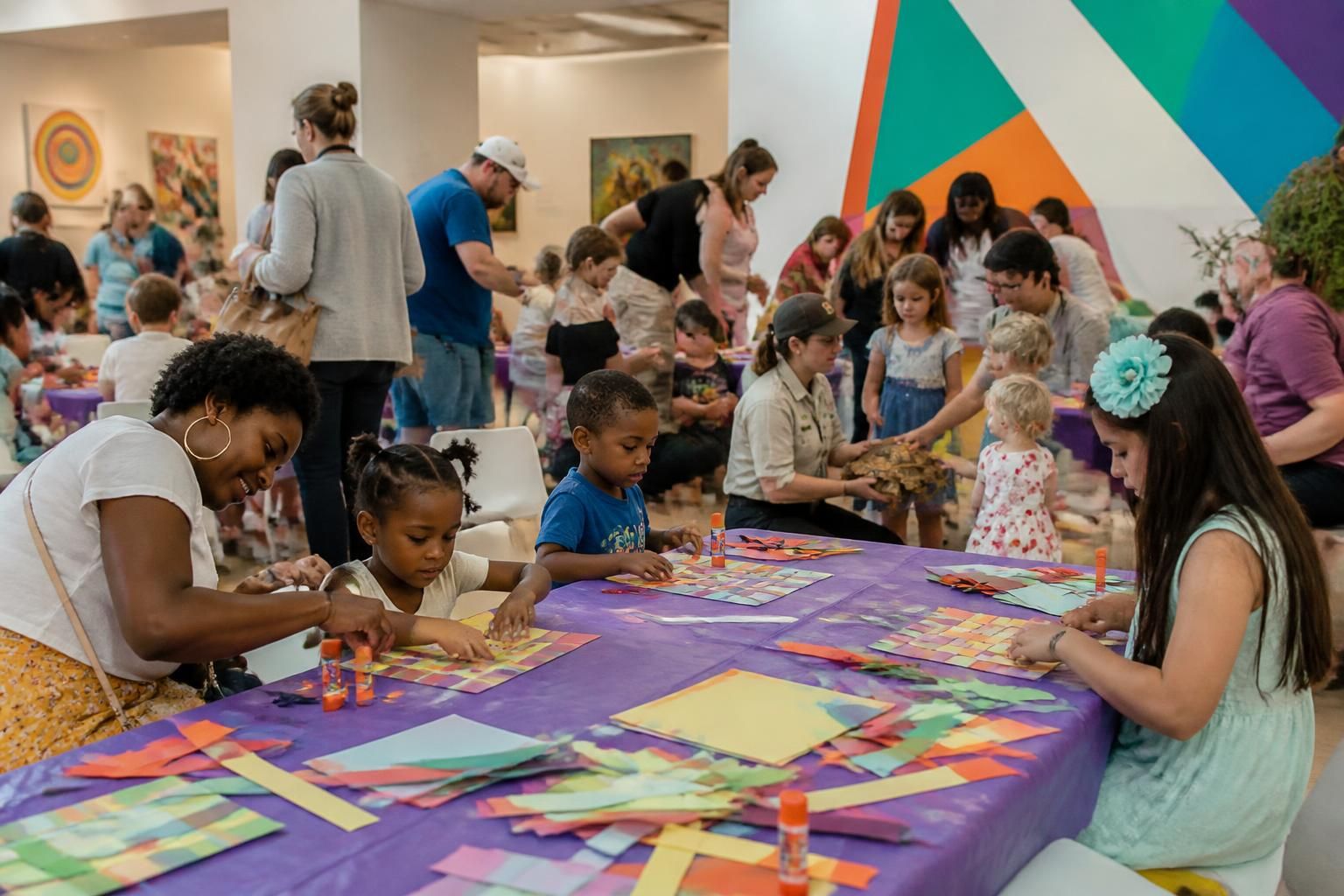
The theme, “Don’t Mess with Texas, Mess with Art,” gave the day a recognizable local identity while keeping the activity accessible. Rather than requiring advanced materials or prior museum knowledge, the program focused on familiar supplies and creative reuse. Paper weaving, clay sculpture, and collage bookmark stations offered different entry points for different ages and attention spans.
This approach matters because a Family audience is not one uniform group. A preschool child may want immediate tactile play, while an older sibling may prefer arranging collage elements or shaping a more detailed clay piece. Parents often look for an activity where they can join rather than simply supervise. By placing creative stations alongside open galleries, the museum created a flexible route instead of a rigid workshop schedule.
The presence of Gator Country added a distinctly Texas dimension. Alligators, snakes, and a tortoise drew visitors toward observation and conversation, turning wildlife into an informal learning opportunity. For many children, seeing a reptile up close creates the memorable moment that brings them through the door. The art-making component then gives that attention a productive outlet: a child can look at texture, shape, color, or movement and translate those impressions into a project.
That combination explains the Downtown buzz. It was not based on a single attraction or a complicated production. It came from several modest elements working together: free entry, visible activity, approachable staff, take-home projects, and the chance to explore galleries without pressure. Families could arrive for the animals, stay for the Arts, and discover the museum collection along the way.
For local tourism and cultural organizations, this is a useful model. A free event can support long-term visitation when it removes the uncertainty that sometimes prevents first-time guests from entering a museum. Parents who know that the environment is relaxed, welcoming, and manageable are more likely to return on another weekend. The museum’s year-round free admission strengthens that relationship, because the first visit does not need to be treated as a one-time occasion.
Visitors planning similar outings can compare the museum’s offering with other free-access cultural opportunities, including this guide to free Sunday museum visits in Austin. The locations differ, but the visitor principle is the same: clear access information and family-friendly programming help transform interest into attendance.
Family Arts Day demonstrates that Downtown energy does not always require a large festival footprint; it can begin with a welcoming cultural space where creativity is easy to try.
How Hands-On Creativity Makes a Family Arts Event More Accessible
The practical strength of this Texas Celebration lies in its choice of activities. Paper weaving, clay work, and collage bookmarks are easy to understand without lengthy instructions. A participant can begin within seconds: select paper strips, press clay into a shape, or layer images onto a bookmark. That low threshold is important in a busy Family setting, where visitors may arrive at different times and stay for different lengths of time.
Hands-on Arts programming also gives adults a meaningful role. The best family events avoid dividing the room into “children creating” and “parents waiting.” At the museum, parents could sit beside children, make their own work, help with a difficult step, or discuss what they saw in the galleries. That shared activity creates conversation naturally, particularly for visitors who may not usually see a museum as a place for participation.
The projects were deliberately connected to materials that households already have. This is a strong Community engagement choice. When a child takes home a paper weaving or collage bookmark, the experience does not end at the exit. Families can repeat a version of the activity using magazines, cardboard, packaging, scrap paper, and other everyday items. The museum’s role becomes less about providing a one-off craft and more about showing that creativity is available in ordinary life.
Practical ingredients for an inclusive creative station
- 🎨 Offer a clear starting action: one visible sample and a short verbal prompt prevent visitors from feeling unsure about where to begin.
- ✂️ Use materials with different difficulty levels: pre-cut pieces support younger children, while open-ended tools let older participants develop more complex work.
- 🧺 Provide a take-home bag: it protects projects, improves the exit experience, and keeps the memory of the Event tangible.
- 🪑 Plan seating for mixed-age groups: tables should allow a caregiver, child, sibling, or grandparent to create together.
- 📍 Keep gallery access visible: activity stations should invite discovery of the collection rather than block it.
Consider a fictional Beaumont family: Maya, age seven, begins by weaving colored strips into a simple square. Her older cousin, Eli, turns the same materials into a layered pattern. Their grandmother notices similar geometric forms in a nearby artwork and suggests they look more closely. In one visit, the museum has supported fine-motor activity, intergenerational conversation, visual observation, and a connection to the collection.
This is why activity design should not be treated as a minor operational detail. The project is often the visitor’s first contact point with the institution. If instructions are confusing, materials are scarce, or the table feels crowded, the experience becomes frustrating. If the station is intuitive and well supplied, it signals that the museum understands real family needs.
Program organizers can also draw useful ideas from a broader family museum visit planning resource, particularly when shaping routes that work for short attention spans and multigenerational groups. The objective is not to make every visit identical; it is to ensure that each visitor can choose a comfortable way to engage.
Accessible Creativity works best when families can begin immediately, adapt the activity to their ability, and carry the experience beyond the museum walls.
Downtown Beaumont Community Engagement Beyond the Gallery Walls
Family Arts Day is valuable because it changes how a museum functions within its Downtown environment. Instead of waiting for audiences already interested in contemporary art or regional collections, the Art Museum of Southeast Texas uses a free quarterly program to invite a broader Community inside. The result is a softer first encounter: visitors can come for a craft table, animal education, or a family outing and then decide to explore the galleries.
This is particularly relevant for cultural venues located in central business districts. Downtown spaces often compete with practical concerns: parking, travel time, weather, children’s routines, and the belief that museums require specialist knowledge. A four-hour, no-cost Saturday Event reduces those barriers. It gives residents a simple answer to the question, “What can we do together today?”
The museum’s open-gallery policy during the event is essential. It avoids separating “fun activities” from “serious art.” Families can move naturally from a clay table to a permanent exhibition, then return to finish a project. That circulation is a quiet but effective form of cultural mediation. It allows visitors to build confidence through movement and choice rather than being directed through a formal lecture.
Local partners strengthen the effect. Gator Country’s animal presentation brought another layer of regional interest, while an ice cream truck created the relaxed, social atmosphere often associated with a block party. These elements were not substitutes for the museum’s mission. They were bridges into it. A child who arrives excited about reptiles can still encounter the visual Arts. A parent who comes for a free family activity can leave aware that admission remains free throughout the year.
| Visitor touchpoint | What it supports | Practical value for Downtown |
|---|---|---|
| 🎟️ Free admission | Lower-risk first visits | Encourages spontaneous local attendance |
| 🖍️ Art-making tables | Active participation | Extends visitor dwell time |
| 🐊 Wildlife encounters | Curiosity and conversation | Creates a visible event draw |
| 🛍️ Take-home project bags | Lasting memory of the visit | Encourages word-of-mouth sharing |
| 🏛️ Open galleries | Connection to the collection | Builds familiarity with the venue |
The model also supports local tourism communication. When a museum can accurately say it is open seven days a week with free admission, that information is useful for visitors and residents alike. It gives hotel staff, visitor-center teams, school coordinators, and local businesses a dependable cultural recommendation. Clear practical details frequently matter more than promotional language.
Those looking for background on the local program can review the official Beaumont visitor listing for Free Family Arts Day. A clear event page should always include time, location, accessibility information, cost, activity expectations, and a simple contact route. These details prevent disappointment and help families plan with confidence.
When Downtown cultural programming is easy to enter and easy to understand, it becomes part of everyday community life rather than an occasional destination.
Smart Audio Tools Can Extend the Texas Family Arts Day Experience
A lively Family Arts Day does not need to become a screen-heavy experience. However, well-planned audio can help a museum provide context without adding queues, printed handouts, or repeated staff explanations. Smart audio tools are most useful when they remain optional, brief, and connected to what visitors are already doing.
For example, a QR code placed near a paper-weaving table could open a 60-second audio prompt explaining how weaving appears across crafts, design, and textile traditions. Near a reptile encounter, a short audio clip could connect textures and patterns found in animals to visual observation in art. In the galleries, another optional stop could invite families to find a color, line, or shape that resembles their own project.
The key is to avoid turning a free-flowing Celebration into a compulsory digital trail. Families should be able to use their own smartphones and headphones if they wish, while others continue with the tactile experience. A platform such as Grupem supports this type of lightweight approach by allowing cultural organizations to publish guided audio content through visitors’ phones, without the cost and cleaning requirements of dedicated audio devices.
Audio also supports access needs. A caregiver with a stroller may not be able to read every wall label comfortably. A visitor with low vision may benefit from a concise verbal description. A child who is still learning to read can listen to a simple instruction or story. For bilingual audiences, multiple language tracks can make welcome information more inclusive when the organization has the capacity to produce and review them properly.
A useful audio route for a four-hour Family Arts Day
- 📱 Welcome clip: a 30-second message covering activity locations, galleries, restrooms, and the fact that all ages can participate.
- 🎨 Creative prompt: a short explanation of the day’s theme and an invitation to reuse household materials.
- 🐢 Observation stop: a child-friendly audio cue encouraging visitors to notice texture, scale, color, or pattern during the animal encounter.
- 🖼️ Gallery connection: two or three highlighted works with simple questions rather than academic interpretation.
- 🏠 Take-home idea: one practical project extension families can try after the Event.
For organizers, the operational benefit is consistency. A well-recorded message gives every visitor the same essential information, even during busy periods when staff are supporting materials, cleaning tables, or answering individual questions. It can also be updated for a future quarterly edition without redesigning a printed guide.
A free museum outing can still feel carefully curated. The relevant lesson from free-admission museum programs in Southern California is that access and interpretation should work together. Admission may open the door, but a clear visitor journey gives people a reason to look, listen, and return.
Useful audio does not compete with hands-on making; it adds optional guidance precisely where families benefit from a clearer story.
Planning the Next Downtown Family Arts Day for Stronger Visitor Flow
The next quarterly Family Arts Day is expected to align with the museum’s October Museum Madness programming, described as a larger edition. That timing creates an opportunity to retain the best elements of the previous Texas Event while preparing for higher footfall. Bigger does not automatically mean better; the visitor experience depends on whether families can still find activities, move through the building, and understand what is available.
Start with the arrival moment. A family entering with children should see a clear welcome point within seconds. One volunteer or staff member can explain where creative stations are located, whether animal encounters follow timed sessions, where projects can dry, and how to enter the galleries. A simple verbal greeting is often more effective than a dense printed schedule, especially when visitors are carrying bags, managing strollers, or arriving mid-program.
Next, use the building deliberately. Popular attractions such as reptiles or performances can create crowd clusters. Place quieter activities, gallery prompts, and seating in nearby but separate areas so that visitors have alternatives when one station is busy. This does not require extensive technology. It requires observation, visible wayfinding, and a team ready to redirect visitors politely.
Organizers should also plan for project completion. Clay, paint, glue, and collage materials need clear drying or packing guidance. The project bag is a small feature, but it solves an important practical problem: families can leave with their work without worrying about damage. It also makes the visit feel complete, even if a child only spent a short time at the table.
Event communication should remain direct. “Free,” “all ages,” “10 a.m. to 2 p.m.,” “500 Main Street,” and “galleries open” are the details that families need before they decide to attend. Social posts can add atmosphere, but core information should be consistent across the museum website, local event calendars, tourism channels, and partner pages. For additional local context, readers can consult this report on a previous AMSET Family Arts Day, which reflects the event’s ongoing emphasis on accessible activities and gallery exploration.
After the event, the museum should review what happened while the details are fresh. Which station had the longest waiting time? Did families locate the galleries? Were supplies matched to attendance? Did visitors use the audio prompts, if available? Brief staff notes and a short visitor survey can produce practical improvements for the next quarter.
The most durable Downtown buzz comes from a repeatable system: easy arrival, varied participation, clear information, and a reason for families to return after the celebration ends.
When is Family Arts Day held at the Art Museum of Southeast Texas?
The museum runs free Family Arts Day programs quarterly. The referenced event operated from 10 a.m. to 2 p.m., and the next larger edition is planned around October Museum Madness. Visitors should confirm the current date and activities before traveling.
Is admission to the Art Museum of Southeast Texas free?
Yes. The museum offers free admission year round and is open seven days a week, making it accessible for both planned family trips and spontaneous Downtown visits.
What can families do during the event?
Activities have included paper weaving, clay sculpture, collage bookmark making, gallery exploration, and educational animal encounters with reptiles such as alligators, snakes, and a tortoise.
How can museums make a Family Arts Day easier to navigate?
Use a visible welcome point, short activity instructions, clearly marked zones, take-home bags for projects, and optional smartphone audio guidance for visitors who want more context.
