
Short on time? Here is what matters:
- ✅ Text-to-speech tools can reduce recording and retake time when scripts are prepared for listening, not simply copied from a webpage.
- 🎙️ Studio-quality voiceovers depend on voice selection, pacing, pronunciation, and audio mastering, not on a single “generate” button.
- 🌍 Multilingual narration makes content more accessible for tourism, training, video, and cultural communication without multiplying production workflows.
- ⚠️ Never publish generated narration without a human review, especially for place names, safety information, branded terms, or emotional stories.
Create Studio-Quality Voiceovers Faster with Text-to-Speech
Producing clear narration used to require a scriptwriter, a voice talent, a recording room, several retakes, and careful audio editing. That process still has value for high-profile campaigns and artistic productions, but it can slow down everyday content creation. For a museum updating an exhibition guide, a tour company preparing seasonal routes, or a small business launching a product video, waiting days for a recording session is often impractical.
Modern text-to-speech platforms change the production sequence. A team can write a script, choose a suitable synthetic speaker, generate a draft, review the result, and export an audio file within the same working session. This does not mean that every result will sound identical to a human studio performance. It means that professional teams can reserve human recording for the moments where it adds the greatest value, while handling repeatable and frequently updated narration more efficiently.
SpeakBreez, for example, positions its service around more than 800 realistic voices across 142 languages. A catalogue of this scale is useful when a project requires more than a generic English narration. A destination marketing office may need British English for one campaign, American English for another, French for visitor information, and Spanish for a social-media video. Rather than managing separate casting processes, it can test several options against the same approved script.
The most useful benefit is not simply speed. It is repeatability. Consider a fictional heritage site called Northbridge Fort. Its visitor team updates opening hours, accessibility notices, and route instructions several times during the year. With conventional recording, every change can create a new scheduling and editing task. With speech synthesis, the team updates the affected lines, keeps the same approved voice profile, and produces a revised file with consistent tone and loudness.
This workflow is particularly effective for:
- 🎧 Guided-tour commentary with regularly changing schedules or access conditions.
- 📚 E-learning modules where procedures, policies, or product information are revised often.
- 🎬 YouTube explainers requiring rapid publishing without sacrificing intelligibility.
- 📱 Mobile audio guides that need several language versions for international visitors.
- 🛍️ Product demonstrations, short ads, and internal announcements with limited production budgets.
Speed should not be confused with rushing. A poorly written script remains poor when converted into audio. Long sentences, unexplained abbreviations, crowded numbers, and complex directions become harder to follow when listeners cannot scan backward with their eyes. Before generating voiceovers, the script should be edited for the ear: one idea per sentence, natural pauses, active verbs, and numbers written in the way they should be spoken.
A useful test is to ask whether a visitor walking outdoors could understand the sentence only once. If the answer is no, the copy needs simplifying before any voice technology is involved. This approach is especially important for smart tourism services, where people may be navigating a historic district, managing a group, or listening through headphones in a noisy environment.
Platforms such as AI voiceover tools for video narration illustrate how quickly a script can move from written copy to an editable audio draft. The operational gain comes from keeping writing, voice choice, revisions, and exports close together. Fewer handovers usually mean fewer delays and fewer opportunities for outdated versions to circulate.
Key takeaway: fast narration becomes genuinely valuable when it combines rapid generation with a script that has been designed for real listeners.
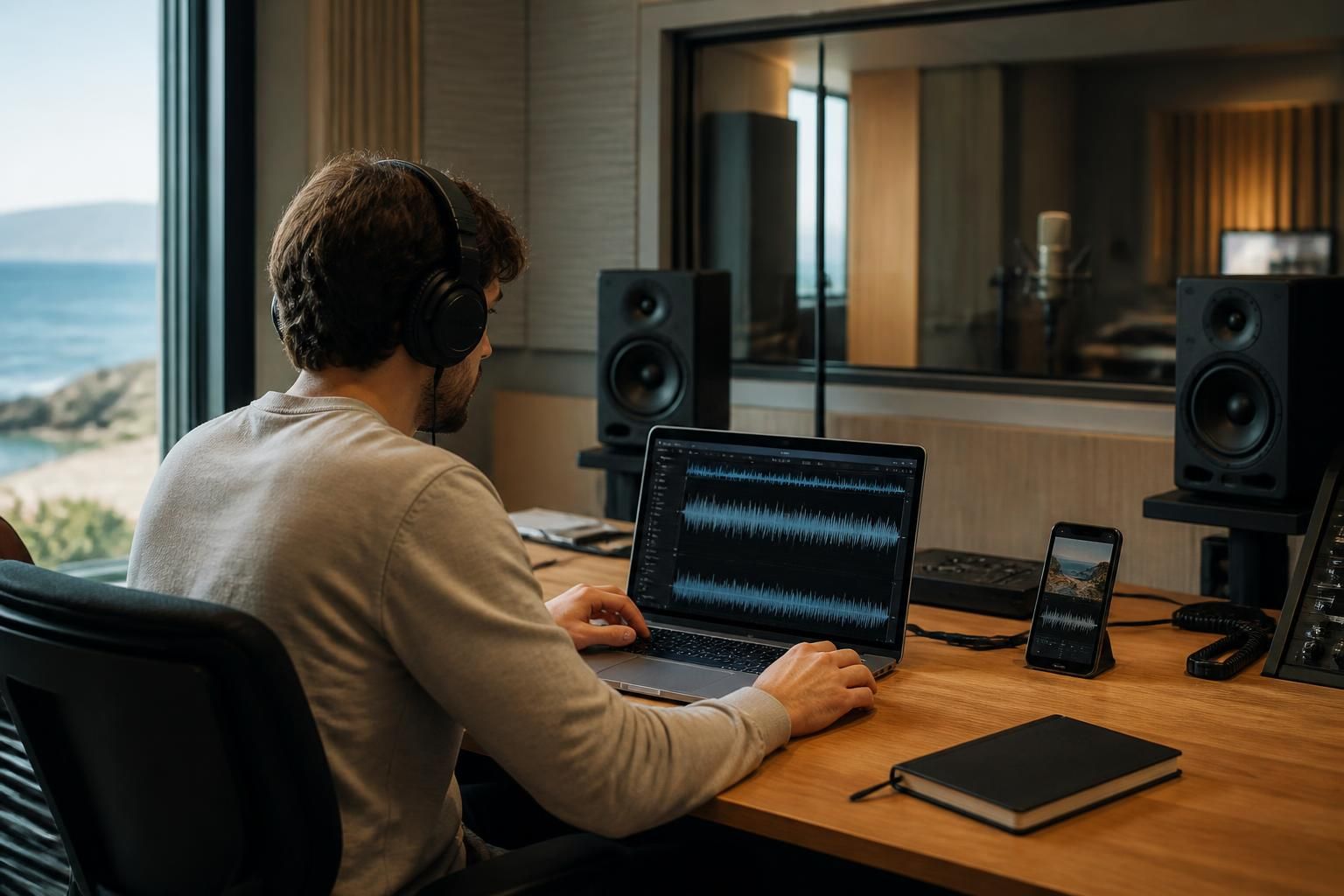
Choose Realistic AI Voices for Clear and Consistent Audio Production
A realistic voice is not automatically the right voice. In audio production, the best choice depends on the listener, the setting, the message, and the emotional weight of the content. A warm, unhurried speaker may work well for an audio guide about a medieval abbey, while a crisp and energetic delivery may better suit a 30-second promotional video. Selecting a voice without considering the use case can create friction even when the underlying technology sounds impressive.
Start with audience expectations. An international visitor listening to directions needs calm diction and a moderate speed. A trainee following a compliance module needs articulation, predictable pauses, and enough contrast between headings and instructions. A podcast advertisement may need more energy, but it still needs to feel credible. The objective is not to choose the most theatrical synthetic speaker. It is to choose the voice that helps people understand and trust the message.
Match voice characteristics to the listening environment
Northbridge Fort provides a useful example. The site offers a 45-minute outdoor route, with sections exposed to wind and passing traffic. The team initially chooses a dramatic, low-pitched narrator because it appears cinematic in a quiet office. During an on-site test, however, softer consonants disappear beneath ambient noise. The team switches to a brighter voice with clearer articulation, reduces sentence length, and inserts slightly longer pauses between directions.
The revised result feels less theatrical but performs far better in real conditions. This is a practical reminder that studio-quality does not only describe sonic polish. It also describes fitness for purpose. A voiceover is successful when its audience can hear, understand, and follow it in the actual place where it will be used.
| Use case | Recommended voice profile | Production check |
|---|---|---|
| 🏛️ Museum or city audio guide | Warm, clear, moderate pace | Test names, dates, and outdoor audibility |
| 🎓 E-learning lesson | Neutral, steady, highly articulated | Check pauses after key instructions |
| 📺 Social video | Expressive, concise, energetic | Synchronise wording with visual cuts |
| 📢 Promotional ad | Confident, brand-aligned, dynamic | Verify claims and licensed music balance |
| 📱 Visitor safety notice | Direct, calm, easy to understand | Review every location and emergency term |
Accent is equally important. An accent can make narration feel locally relevant, but it should never reduce comprehension for the intended audience. For a global campaign, a broadly understandable accent is usually the safest choice. For a regional tourism route, a carefully selected local inflection can add authenticity when it remains intelligible. The decision should be made through listening tests, not assumptions.
Many services now offer controls for speed, pitch, intensity, and delivery style. These controls are useful, but excessive adjustment can create artificial results. If a voice requires extreme changes to suit the script, choosing a different base voice is often more effective. Small refinements are preferable: slowing down directions, slightly increasing emphasis on a call to action, or adding pauses before a historical quotation.
Voice consistency matters across a complete visitor journey. If a mobile guide uses one calm narrator for the welcome, a very different voice for route instructions, and a third voice for accessibility guidance, listeners may experience the service as fragmented. A defined voice palette solves this problem. One principal narrator can carry the route, while one secondary profile is reserved for quotations, children’s content, or short alerts.
For teams evaluating options, a realistic AI text-to-speech workspace can be useful for previewing narration before committing it to video. Previewing several voices against the same 20-second extract reveals more than reading feature lists. It shows whether the pacing supports your visual material and whether the voice suits your brand.
Key takeaway: the most convincing voice is the one that remains clear, appropriate, and consistent in the listener’s real environment.
Transform Text into Speech Without Losing Human Rhythm
Voice transformation begins with writing. A text intended for reading on a screen can contain long sentences, parenthetical details, dense lists, and visual cues such as headings or bold text. Speech synthesis processes language differently because it needs to create rhythm from punctuation, wording, and instruction. If the script does not provide useful signals, even a sophisticated voice engine may produce a flat or awkward delivery.
The simplest improvement is to write aloud before generating anything. If a sentence feels difficult to say in one breath, it is usually too long for listeners as well. This is particularly relevant in cultural mediation, where scripts can become overloaded with dates, architectural terminology, and historical context. Listeners do not need every fact at once. They need a logical path through the story.
Prepare scripts for natural speech synthesis
A practical script includes spoken forms rather than visual shorthand. “Meet at 2:30 p.m. near Gate 4” is generally easier to understand than “Meet 14:30, G4.” Acronyms should be written as they are pronounced or expanded on first use. Names of streets, artists, and local landmarks should be tested carefully, because the consequences of a pronunciation mistake are more noticeable in a guided experience than in a private draft.
Northbridge Fort’s team uses a simple review process. The writer prepares the route copy. A local staff member checks place names and historical terms. The guide checks whether timing and directions work on foot. Only then does the team generate the narration. This sequence prevents the common error of treating AI audio as the first draft rather than the final production layer.
- 📝 Write for listening: use shorter sentences and place essential information first.
- 🔤 Add pronunciation notes for names, loanwords, initials, and unusual numbers.
- ⏸️ Use punctuation deliberately to create pauses between ideas.
- 🎧 Generate a short test segment before producing the whole script.
- 👥 Listen on the intended device with people who did not write the content.
- ✅ Correct wording first, then adjust the voice settings only where necessary.
Pauses deserve special attention. A comma suggests a light break, while a full stop gives the listener more time to process information. Short standalone sentences can create useful emphasis. For example, “The bridge is over 400 years old. Look at the stone markings near the arch.” This phrasing gives the listener time to look up before the next detail arrives.
Emotion should be handled with restraint. Not every sentence needs excitement, suspense, or sadness. In a memorial site, an overly dramatic generated delivery can feel inappropriate. In a family attraction, a totally neutral voice can sound detached. The right balance comes from the script’s vocabulary, the selected speaker, and a limited number of delivery adjustments. A well-written line often needs less technical manipulation than a vague or overloaded one.
This is also where responsible practice matters. Voice cloning and highly realistic synthesis can be useful when explicit consent, documented rights, and clear editorial purpose are in place. They should not be used to imitate public figures, colleagues, or partners without authorization. Teams working with branded voices should maintain a record of consent, approved use cases, and access controls. For a broader perspective on this distinction, see this guide to voice AI and conversational AI.
Text preparation also supports accessibility. Clear narration benefits blind and low-vision visitors, people listening in a second language, and users who simply prefer audio while walking. When a script explains what can be seen, provides directional context, and avoids unexplained visual references such as “over there,” it becomes more inclusive without becoming longer than necessary.
Key takeaway: natural-sounding speech is created on the page first, then refined through the voice engine.
Reduce Production Delays with a Reliable Voiceover Workflow
A time-saving workflow is not one that removes every review step. It is one that removes unnecessary repetition. Teams often lose time because scripts are stored in several locations, audio files have vague names, or feedback arrives after video editing is already complete. A well-organised system makes text-to-speech generation faster because the source copy, voice settings, and approved exports are easy to trace.
For a small tourism organisation, the workflow can be straightforward. Keep one approved script document per route or campaign. Assign version numbers. Store pronunciation rules in the same project folder. Name exports according to language, route, section, and version. A file called “fort_route_en_stop03_v4” is more useful than “final_new_audio_reallyfinal.” This may sound basic, but reliable naming prevents mistakes when multiple team members work under deadline.
Build review points into audio production
Northbridge Fort creates three checkpoints. The first is a content review: are facts, access instructions, and opening details correct? The second is a voice review: does the selected narrator fit the location and audience? The third is a playback review: does the file remain clear through the smartphone and headphones visitors will actually use? Each checkpoint is brief because it has a clear purpose.
Working this way can reduce wasted effort. It is far quicker to correct a sentence before generating ten language versions than to identify the same issue after every file has been exported and uploaded. It also protects visitor trust. A wrong date in a social video may be inconvenient; a wrong safety direction in an audio guide can cause genuine confusion.
Integration with the final channel should shape decisions early. A voiceover for a vertical social video may require short phrases that align with captions and cuts. An audiobook needs steadier long-form pacing. A mobile guide needs compact files, stable volume, and clean transitions between stops. The narration format should therefore be planned alongside distribution, rather than handed over at the end.
Tools such as a text-to-speech editor for visual content can help teams check narration against on-screen elements. This is useful when captions, archival images, maps, or subtitles must align precisely with the spoken line. The goal is not to make every workflow complex. It is to ensure that the voice, picture, and visitor action reinforce each other.
Audio editing remains relevant even when the voice is generated. Basic finishing may include removing unwanted silence, standardising loudness between clips, adding gentle fades, and checking that music never masks important words. Background music should support the atmosphere, not compete with the narrator. If users need to increase volume repeatedly to understand the guide, the mix needs work.
For multilingual projects, avoid assuming that translations will match the original duration. A German or French version can be longer than an English version, while other languages may need different sentence structures to sound natural. Build flexible visual timing into videos and allow each language version to be reviewed independently. Direct word-for-word translation may preserve facts but lose clarity and rhythm.
By 2026, voice technology is widely accessible enough that workflow discipline has become a stronger differentiator than access alone. Most teams can generate a voice. Fewer teams can maintain a consistent library of approved scripts, languages, pronunciation notes, voice profiles, and listening tests. That operational maturity is what turns fast generation into dependable publishing.
Key takeaway: reducing production time comes from a controlled sequence of writing, testing, approval, export, and distribution.
Use AI Voiceovers for Accessible Tourism, Video, and Learning Content
Audio is increasingly part of the visitor experience rather than an optional extra. A smartphone can become a personal guide, a multilingual interpreter, or an accessibility tool when content is structured properly. For cultural venues and tour operators, this creates an opportunity to deliver more flexible information without forcing every visitor into the same timetable or group format.
Imagine Northbridge Fort serving three audiences on the same afternoon: a school group accompanied by a guide, independent international visitors, and a local resident with low vision. The school group may prefer short interactive explanations. International visitors may need language choice and simple navigation. The local resident may benefit from descriptive detail about terrain, objects, and viewpoints. One traditional script cannot meet all these needs equally well, but a modular audio library can.
Create reusable narration modules instead of one rigid recording
Modular content divides a route into manageable pieces: welcome, orientation, stop narration, optional deep dive, accessibility information, and practical notice. With a synthetic narration workflow, these modules can be assembled into different experiences without recording an entire programme again. A museum can create a 20-minute highlights version, a 45-minute detailed route, and a family version using shared factual content but adapted pacing and vocabulary.
This does not remove the need for curatorial judgement. In fact, it makes editorial decisions more visible. Teams must decide which stories belong in the core route, which details should be optional, and where users need a prompt to look, walk, or pause. The strongest audio guides do not overwhelm people with information. They create a clear sequence of attention.
Accessibility should be designed into the script, not added as an afterthought. Instead of saying, “Look at the statue on your left,” say, “On your left is a bronze statue, about two metres high, showing the fort’s nineteenth-century architect holding a rolled plan.” The second version helps more people form a useful mental image. It also adds context for every listener.
Multilingual voiceovers require the same care. Each version should be translated by someone who understands the cultural context, not merely the words. A local joke, an idiom, or a reference to a historical conflict may need adaptation. The selected voice should be checked by native or fluent listeners before publication. A large language and voice catalogue makes scale possible, but quality still comes from review.
For organisations exploring mobile delivery, text-to-speech for modern audio-guide experiences can support a practical approach to narration that is easy to update and distribute. The central principle is simple: technology should reduce operational burden while keeping the visitor experience clear, respectful, and engaging.
There is also a sustainability benefit in avoiding unnecessary re-recordings. When a route changes because of restoration work, weather procedures, or a temporary exhibition, updated voiceovers can be produced without a new studio session and physical travel for every revision. This does not make digital production impact-free, but it can reduce avoidable logistical steps for routine content updates.
The future of content creation will not be defined by replacing every human voice. It will be defined by choosing the right method for each message. Human presenters, guides, actors, curators, and interpreters remain essential where personal presence, artistic interpretation, or live interaction matters most. Speech synthesis is strongest where consistency, speed, multilingual reach, and updateability create measurable user benefits.
Key takeaway: effective AI narration expands access when it is modular, reviewed, culturally accurate, and built around how people actually listen.
Can text-to-speech really sound studio-quality?
It can produce polished, consistent narration when the script is written for listening, the voice suits the audience, and the final file is reviewed for pronunciation, pace, loudness, and playback quality. Studio-quality is a production standard, not merely a platform feature.
How can a team make AI voiceovers sound less robotic?
Use shorter sentences, clear punctuation, natural spoken wording, pronunciation guidance, and small pacing adjustments. Test a short extract with several voices before generating the complete script.
Are AI voiceovers suitable for multilingual tourist audio guides?
Yes, particularly when routes and practical information require regular updates. Each language version should still be translated and reviewed by fluent speakers who understand local names, cultural references, and visitor expectations.
What should be checked before publishing a generated voiceover?
Check factual accuracy, consent and usage rights, pronunciation of names, listening comfort on the final device, volume consistency, music balance, and the clarity of all safety or directional instructions.
