
Key points at a glance: ✅ Complimentary Educational Field Trips are available for eligible South Georgia Schools from September through May. ✅ Each visit combines gallery exploration, facilitated discussion, and a take-home creative activity. ✅ Teachers should reserve early, as Tuesday-to-Friday time slots are assigned on a first-come, first-served basis.
Complimentary Educational Field Trips at Albany Museum of Art Expand Access for South Georgia Schools
The Albany Museum of Art is making Art Education more accessible to classrooms across South Georgia through Complimentary Educational Field Trips during the 2026–27 school year. Schools can arrange visits from Tuesday through Friday, with available arrival times running from 9:45 a.m. to 2 p.m. The program is designed for learners from prekindergarten upward, providing a structured museum experience without an admission cost for participating school groups.
This access matters at a time when many schools must make difficult decisions about specialist programs, transportation, enrichment resources, and arts provision. A no-cost museum visit does not remove every logistical obstacle, but it substantially lowers one of the most immediate barriers for educators planning cultural learning beyond the classroom. Teachers can explore the museum’s educator resources and learning materials before arranging a visit.
During the 2025–26 academic year, the museum welcomed 2,887 students through its free school-visit initiative. That participation figure illustrates both sustained demand and the museum’s practical role in regional learning. For the new school year, the institution aims to welcome an even broader range of student groups, including classes from metro Albany and surrounding communities in Southwest Georgia.
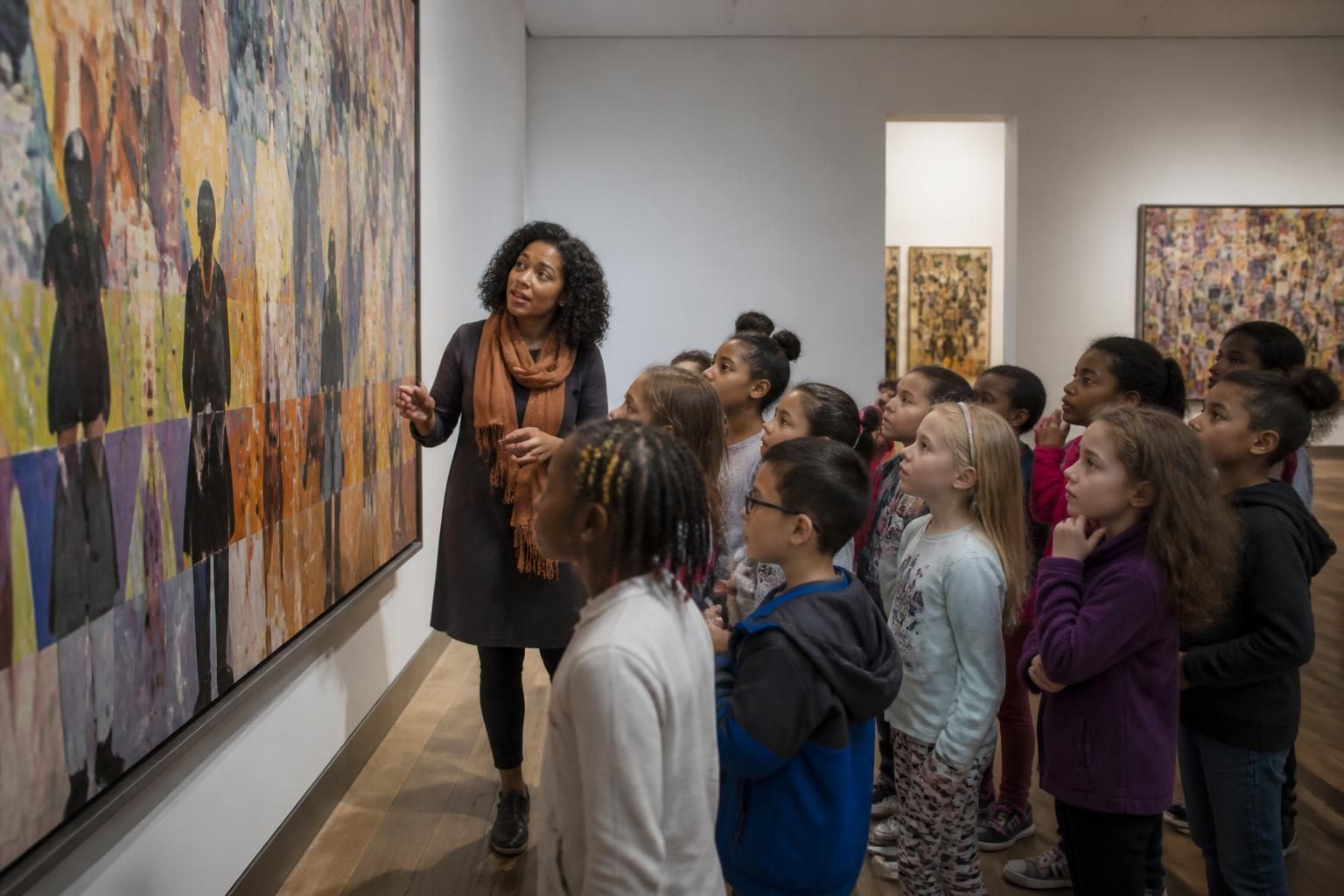
A typical visit is not limited to walking through exhibition rooms. Students are encouraged to observe closely, discuss what they see, make connections with classroom topics, and complete an art project they can take home. This combination gives teachers a clear educational structure: visual discovery in the galleries, guided interpretation with museum staff, and hands-on learning that allows pupils to respond in their own way.
What schools receive during a museum visit
The format is intentionally adaptable. A younger group may focus on colors, shapes, materials, emotions, and storytelling through images. An older class can examine artistic choices, historical contexts, perspective, symbolism, or the relationship between a work of art and a wider social issue. Rather than treating the gallery as a silent display space, the program makes it a setting for questions, observation, and evidence-based discussion.
- 🎨 Gallery exploration guided by educational objectives rather than passive viewing.
- 💬 Facilitated discussion that helps students describe, compare, interpret, and question artworks.
- ✂️ A practical art activity that gives learners a tangible record of the visit.
- 📚 Curriculum connections adapted to age level, subject area, and classroom goals.
- 🗓️ Flexible booking windows from September through May, subject to availability.
For example, a second-grade teacher preparing a unit about community might ask students to look for visual details that communicate place, family, work, or celebration. Back in class, students could write a short description of an artwork and create a picture representing a meaningful location in their own neighborhood. The museum visit becomes a source of material for literacy, social learning, and creative expression rather than a one-off outing.
The same principle applies to secondary students. A high-school English class can use a painting, photograph, or sculpture as the basis for a descriptive paragraph, monologue, or comparative essay. The value comes from asking students to support their ideas with visible evidence: What detail creates a particular mood? Which materials influence the viewer’s response? What changes when they compare two works from different periods or regions?
Community-funded Museum Programs make these learning opportunities possible. Support from local individuals and businesses, particularly the Wayne and Alicia Gregory Family Foundation Paddle Raise connected to the museum’s annual Art Ball fundraiser, helps place cultural experiences within reach of thousands of young people. This is Community Outreach with a direct classroom outcome: students gain access to works, conversations, and creative practices they may not encounter elsewhere.
The essential point is practical: a well-planned museum day can extend classroom learning without imposing an admission expense on the school.
How Albany Museum of Art Connects Art Education With Core Classroom Subjects
Strong Art Education does not sit apart from the rest of a school timetable. At the Albany Museum of Art, Educational Field Trips can be tailored to complement subjects including history, mathematics, science, geography, English, and foreign language arts. This cross-curricular approach gives teachers a practical reason to include the museum in their yearly planning: the experience can reinforce an existing unit instead of adding an unrelated activity.
Art is particularly useful because it gives abstract concepts a visible form. A student may struggle to understand balance, scale, sequence, migration, chemical change, or point of view when those ideas exist only in a worksheet. A carefully selected artwork can create a concrete starting point. Students can identify evidence, make predictions, test interpretations, and explain why a detail supports their response.
Examples of curriculum links that work in the gallery
In science, sculpture offers an accessible route into discussions about gravity, balance, force, structure, and material properties. Students might consider why a heavy form appears stable, how an artist prevents an object from tipping, or what changes when metal, clay, wood, and found objects are used. Photography can also support learning about light and chemical processes, especially when students compare historical and contemporary image-making techniques.
Mathematics has equally clear connections. Proportion, symmetry, geometry, scale, patterns, and the Golden Ratio can all be observed in artistic practice. A teacher preparing a geometry lesson could ask students to locate repeated shapes or lines in a composition. The important educational move is not simply naming a triangle or a spiral; it is discussing how that structure affects the artwork’s balance, movement, or visual impact.
| Classroom area | Museum-based learning prompt | Practical outcome |
|---|---|---|
| 📐 Mathematics | Where can students identify proportion, repetition, symmetry, or geometric form? | 📊 A visual pattern or measurement activity. |
| 🔬 Science | How do materials, light, weight, and balance affect the artwork? | 🧪 A discussion of forces, processes, or material change. |
| 🗺️ Geography | What maps, regions, routes, or cultural contexts relate to a work? | 📍 A location-based research task. |
| ✍️ English | What story, voice, mood, or conflict does the image suggest? | 📖 A short essay, poem, or character response. |
| 🌍 Languages | Which words describe the image, setting, people, and emotions? | 💬 Vocabulary practice in context. |
Geography becomes more meaningful when maps are used to locate where artworks were made, where artists lived, or how objects travelled between cultures. Students can consider distance, environment, language, trade, and migration. A map is no longer just a diagram in a textbook; it becomes a tool for understanding how a work arrived in a museum collection and what cultural context may shape its imagery.
For language arts, gallery discussion provides a useful alternative to the familiar text-only prompt. A middle-school student who is hesitant to begin an essay may find it easier to start with a photograph or painting. What happened before the depicted moment? Whose voice is missing? What sensory details are visible? From there, the teacher can guide the class from observation to vocabulary, structure, and written argument.
Consider a hypothetical eighth-grade class studying persuasion. Instead of asking students only to analyse advertisements, the teacher could select portraits and public artworks that present status, identity, or power. Students might debate how posture, scale, color, clothing, or setting influence the viewer. This exercise develops visual literacy while supporting the same critical-reading habits used for speeches, articles, and media.
All activities and lessons are aligned with national and Georgia performance standards. That alignment helps teachers justify the time spent outside school and makes follow-up work easier to plan. The museum’s curriculum is expected to be refreshed in early September to reflect fall exhibitions opening on September 17, allowing returning groups to encounter new content.
The strongest field trips begin with a classroom goal: when teachers identify the concept students should explore, the gallery becomes an active learning environment rather than a change of scenery.
Planning Free Field Trips for South Georgia Schools With Clear Logistics
Effective Student Engagement depends on preparation before a bus arrives at the Albany Museum of Art. The booking process is straightforward, but educators benefit from treating the outing as a scheduled learning event with clear timing, class expectations, and follow-up activities. Visits are available Tuesday through Friday between September and May, and groups should be booked at least one week before the requested date.
Because places are allocated in the order requests are received, early planning is especially useful for schools coordinating transportation, permission forms, lunch schedules, and multiple classes. Waiting until the final weeks of a semester can limit available options. Teachers who know that a history, literacy, science, or creative unit will take place later in the term should contact the museum as soon as their internal school calendar is confirmed.
A practical booking workflow for teachers and school coordinators
- 🗓️ Identify the curriculum topic the visit should support, such as storytelling, materials, geography, or visual analysis.
- 👥 Confirm the likely student count, grade levels, adult supervision needs, and possible transportation arrangements.
- ⏰ Select several preferred Tuesday-to-Friday dates and suitable start times between 9:45 a.m. and 2 p.m.
- 📩 Contact Director of Education and Public Programming Annie Van Oteghem at [email protected] with the relevant details.
- 📝 Prepare students in advance with a short discussion about museum behavior, observation, and respectful dialogue.
- 🎒 Plan one follow-up task so the visit informs subsequent classroom learning.
This workflow is useful because it prevents a common issue: treating the trip as complete once students return to school. A simple follow-up can preserve the value of the experience. For a first-grade class, this could be a drawing based on a favorite shape or color seen in the galleries. For older learners, it could be a five-minute reflection identifying one work, one question, and one connection to classroom study.
Teachers also benefit from communicating the purpose of the visit to students before departure. Rather than saying only that the class is going to a museum, staff can give a focused prompt: “Look for how artists show movement,” or “Find an artwork that makes you curious and be ready to explain why.” A single question gives learners permission to investigate. It also improves the quality of guided conversation when they arrive.
Technology can support this preparation without making the visit screen-led. A teacher may share a short vocabulary list, show students how to formulate open questions, or ask them to record a spoken reflection after returning to school. For groups using personal devices, an audio-based approach can be particularly inclusive for students who process information more effectively through listening. The priority should remain clear audio, short segments, and simple instructions rather than unnecessary digital complexity.
Museums and educators planning their own accessible audio experiences can learn from solutions designed for guided visits, where a smartphone becomes a practical listening device. The challenge is not to add technology for its own sake. It is to ensure every student can hear the key message, follow the group, and remain engaged with the object in front of them.
Budget pressure is another reason planning matters. Transportation, substitute coverage, and staff availability can still affect a school’s ability to travel, even where admission is free. The broader challenge is explored in this resource on funding challenges for school trips. By booking early and connecting the day to measurable learning outcomes, educators can make a stronger case for the time and logistics involved.
A complimentary visit delivers its best value when booking, preparation, and classroom follow-up are treated as one connected process.
Student Engagement in Museum Programs Through Discussion, Making, and Reflection
Student Engagement is often described as participation, but meaningful participation involves more than students being present in a gallery. It means learners are invited to look carefully, share ideas, hear different viewpoints, and create a response. The Albany Museum of Art builds these opportunities into its Museum Programs through guided discussions and take-home art activities.
This approach is valuable because art does not always have one fixed answer. Students can learn that interpretation should be supported by evidence without being reduced to a test of guessing what an artist “meant.” A museum educator might ask what students notice first, what makes them say that, and whether another detail changes their initial view. Those questions develop reasoning skills that carry into reading, scientific inquiry, and social studies.
Why guided conversation supports confidence and critical thinking
For some children, the gallery can be one of the few educational spaces where personal observation is a legitimate starting point. A student who rarely volunteers during a factual lesson may feel more able to say that a painting looks lonely, energetic, confusing, or celebratory. The educator’s role is then to help transform that first reaction into analysis: Which colors create that impression? Is it the figure’s expression, the empty space, the light, or the composition?
That progression matters. It teaches students that their voice is welcome while showing them how to explain an idea clearly. The result is not simply confidence; it is disciplined observation. A learner begins to understand that a thoughtful interpretation has a visible basis, and that another person may reach a different conclusion by noticing different evidence.
Hands-on making extends that learning. When students create an artwork after exploring the galleries, they face artistic decisions themselves. They choose colors, shapes, materials, layouts, or subjects. Even a short activity can reveal how difficult it is to communicate an idea visually. A child who has made a collage about movement may look differently at a professional artist’s layered composition afterward.
A useful example is a class studying environmental systems. After examining landscape works, students could discuss natural features, signs of human activity, weather, and atmosphere. Their take-home activity might ask them to create a landscape using only warm and cool colors to represent two different conditions. Back at school, the science teacher can connect the images to climate, habitats, or the ways people change environments.
The program is also relevant for at-risk students, who can benefit from learning situations that combine language, movement, making, and group discussion. Arts experiences do not replace specialist support or solve complex educational inequalities. They can, however, provide another route into learning for students who may not thrive in a narrowly text-based environment. Creative work can make space for focus, collaboration, and achievement.
Families benefit indirectly as well. A take-home activity can prompt a conversation after school: What did you see? Which artwork did you remember? What did you make and why? This small bridge between school and home reinforces the idea that cultural participation is not reserved for experts. It belongs in everyday community life.
The museum’s approach reflects a wider need for accessible cultural learning. Institutions across the sector are developing programs that lower cost barriers and create more welcoming experiences for young visitors. For educators seeking further ideas about family-centred cultural spaces, this overview of children’s museums and visitor-focused learning offers useful points of comparison.
The key educational gain is not memorizing every artwork: it is helping students learn how to notice, question, explain, and create.
Community Outreach Keeps Albany Museum of Art Field Trips Available to Learners
Community Outreach is central to the continued availability of free school visits at the Albany Museum of Art. The program is supported by contributions from individuals and businesses in the local area, with significant help generated through the Wayne and Alicia Gregory Family Foundation Paddle Raise at Art Ball, the museum’s principal annual fundraising event. This support allows the institution to provide Educational Field Trips without placing an admission charge on schools.
The impact of this model is broader than one day in a gallery. A supported visit creates access to cultural resources, professional education staff, creative materials, and a learning environment that may otherwise be unavailable to some students. It also signals that a community values young people’s ability to explore ideas, encounter different perspectives, and develop confidence through art.
How local support becomes a measurable educational resource
When donors support school access, their contribution is translated into real experiences: a class can enter galleries, participate in discussion, make an artwork, and return to school with new material for learning. The 2,887 students welcomed during the previous school year represent individual learners, but they also represent teachers able to enrich their curriculum and families whose children can share a cultural experience at home.
This local investment is especially meaningful in regions where school arts budgets may be under pressure. Arts instruction is sometimes treated as an optional extra when financial resources are tight. Yet visual learning supports communication, problem-solving, collaboration, and social connection. Free Museum Programs provide a practical partnership model: schools retain their core educational role, while a cultural institution contributes specialist spaces, collections, and learning expertise.
There is also a regional dimension. By welcoming groups from Albany and across South Georgia, the museum functions as more than a city attraction. It becomes a shared educational asset for surrounding communities. A rural school that has fewer nearby cultural venues can use the same program as an urban school, provided it can coordinate the transport and timetable required for the journey.
For museums, maintaining this type of initiative requires clear communication. Teachers need to understand that visits are free, what is included, when dates are available, and how far ahead they should book. Donors and community partners need to see that their support produces meaningful access rather than vague goodwill. Reporting participation, describing curriculum links, and sharing educator feedback are all practical ways to demonstrate value.
Schools can also help sustain the relationship by communicating outcomes after their visit. A teacher might send a short note about how students responded to a particular activity, share anonymized samples of classroom work where appropriate, or explain how the trip supported a learning target. Such feedback helps museum staff refine delivery and gives community supporters a clearer picture of what their investment enables.
For current updates about exhibitions, booking opportunities, and future programs, educators can consult the museum’s fall field trip information and follow the institution’s public announcements. Teachers should remember that dates can fill quickly, particularly when new exhibitions create strong interest among returning classes.
The wider lesson for cultural organizations is clear. Accessibility is not only about a ramp, a ticket price, or a digital tool; it is also about whether a child can realistically take part in the experience. Complimentary school access turns that principle into an operational commitment.
When community funding, thoughtful programming, and school planning work together, art becomes a reachable part of education rather than an occasional privilege.
Are Albany Museum of Art school field trips free?
Yes. The Albany Museum of Art offers complimentary field trips for schools and organizations, subject to scheduling availability. Each visit includes gallery exploration, guided discussion, and a take-home art activity.
When can South Georgia Schools schedule an Educational Field Trip?
Visits for the 2026–27 school year are offered Tuesday through Friday from September through May. Available start times range from 9:45 a.m. to 2 p.m.
How far ahead should teachers book a museum visit?
Schools should request their preferred date at least one week in advance. Since bookings are handled on a first-come, first-served basis, earlier requests are advisable.
Which grade levels can participate in Albany Museum of Art Museum Programs?
Programs are suitable for students from prekindergarten and above. Activities and lessons are aligned with national and Georgia performance standards and can be adapted to different age groups.
Who should schools contact to arrange a field trip?
Teachers and school officials can contact Annie Van Oteghem, Director of Education and Public Programming, at [email protected] for details and scheduling.
