
Short on time? Here is what matters most:
- 🌌 Star Lab turns astronomy into an intimate, educator-led dome experience suitable for family audiences.
- 🦴 Revolutionary Tales, fossils, bird voices, and botanical art create multiple routes into Natural History and local heritage.
- 🎧 A well-planned visit becomes more accessible when visitors can follow clear themes, timed sessions, and digital audio guidance.
Discover Revolutionary Tales at the Delaware Museum of Nature & Science
The Delaware Museum of Nature & Science offers more than a conventional gallery visit. Its current programming connects objects, images, sound, and local history so that visitors can move from a single specimen to a wider question: how does a natural object become part of a community’s story? This approach gives the Museum of Nature a strong role in Delaware’s 250th-anniversary period, when historic interpretation is especially visible across the state.
Revolutionary Stories & Evolutionary Specimens is designed around this connection. The installation looks at Delaware’s official state symbols and shows that they are not simply decorative emblems printed on signs or documents. They carry ecological, cultural, and historical meaning. A specimen can point toward changing habitats, a community tradition, a public decision, or a figure from Delaware’s past. For visitors, that makes the exhibition an effective starting point for discussing how science and civic identity can overlap.
Rather than treating history as a sequence of dates, the presentation encourages observation. A family might begin by examining the details of an object, then ask why it was chosen as a state symbol, who encountered it in daily life, and what has changed in the landscape since that period. This is a practical model for Educational museum interpretation: visitors are not asked to memorise isolated facts before they can participate. They are invited to notice, compare, and question.
Turning state symbols into active stories
For a school group, the exhibition can support a useful activity: each learner selects one symbol or specimen and identifies three layers of meaning. The first layer is scientific, such as anatomy, habitat, classification, or life cycle. The second is historical, including how the object appears in Delaware’s story. The third is contemporary, asking whether climate, urban development, conservation, or public awareness affects it today. This method links Natural History with current concerns without forcing a simplistic message.
Consider a group of visitors following a fictional guide called Maya through the galleries. Maya starts at a fossil, then points out that fossil evidence is not a static relic of “the past.” It is data that helps researchers reconstruct former environments. From there, the group can connect the object to present-day coastlines, species survival, and changing ecosystems. The same interpretive habit works with shells, birds, plants, and other collection objects.
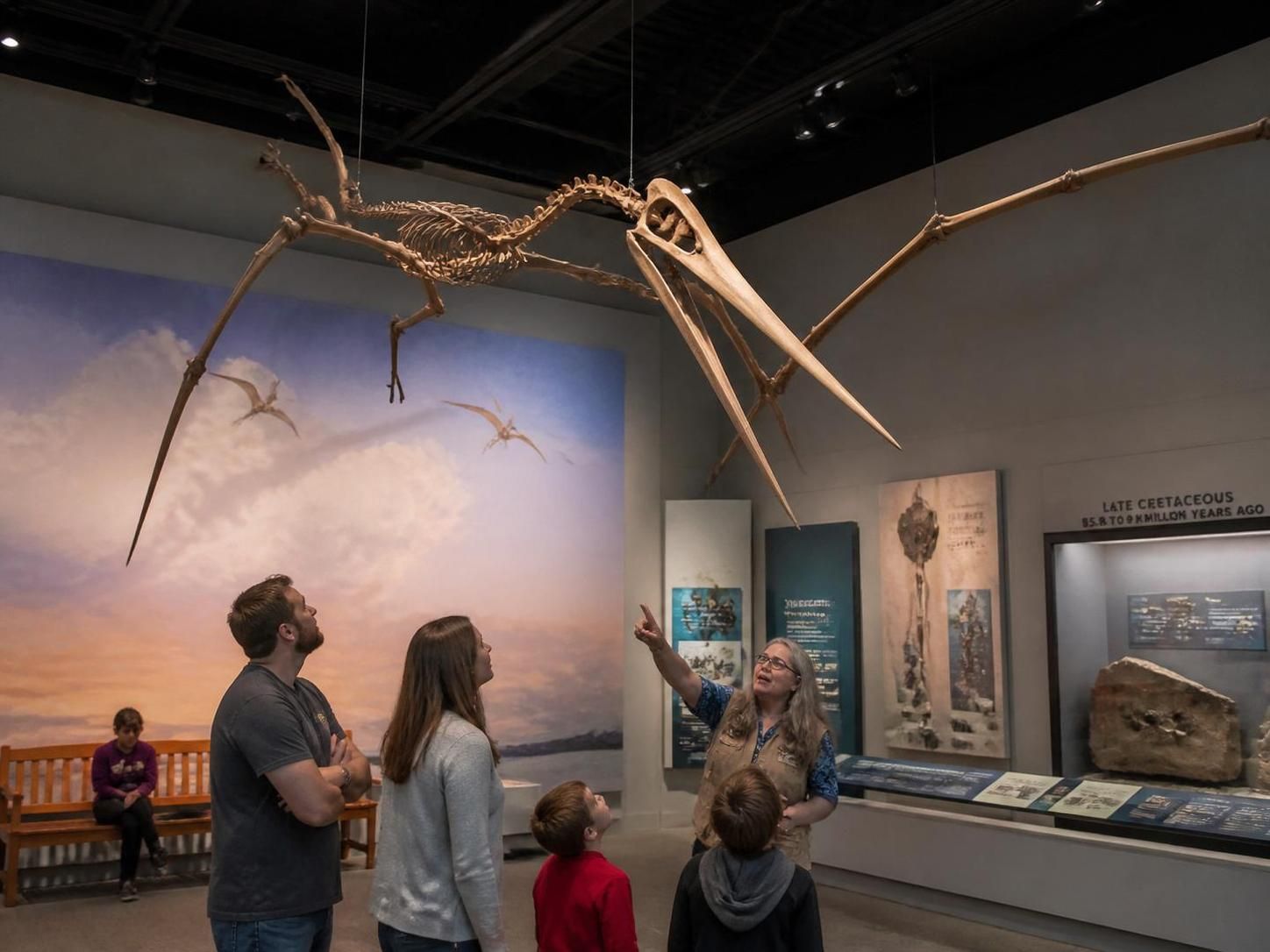
The museum’s PaleoZone remains an important complement to this perspective. A suspended Nyctosaurus pterosaur skeleton creates an immediate visual impact, especially for younger audiences. Yet the value lies beyond the spectacle. Its anatomy opens a discussion about adaptation, flight, extinction, and how scientists form hypotheses from incomplete evidence. A Science Museum is most effective when a dramatic object leads to a precise question rather than ending with a photograph.
Visitors who wish to compare regional institutions can also explore this overview of the Museum of Nature and Science in Dallas. The comparison is useful because it highlights a shared challenge for major science venues: how to make large-scale themes understandable without losing the detail that makes research meaningful.
The practical takeaway is simple: Revolutionary Tales work best when visitors treat each display as evidence, not merely as decoration. That habit prepares them for the museum’s next major route of discovery: a journey through the sky.
Experience Star Lab Astronomy in an Immersive 360-Degree Dome
Star Lab brings the night sky indoors through an inflatable 360-degree planetarium guided by museum educators. The format is deliberately intimate. Instead of looking at a flat screen from a distance, participants sit inside a dome where celestial visuals surround the group. This changes the way learners relate to astronomy: positions, movement, and scale become easier to discuss when the sky appears overhead rather than in a textbook diagram.
Weekend presentations are scheduled at 10:30 a.m., 11:30 a.m., and 1:30 p.m. on Saturdays and Sundays as an add-on to general admission. Because session capacity and themes can vary, visitors should check the current Star Lab programme schedule before travelling. Booking around a fixed session time is particularly useful for families balancing gallery visits, lunch, and younger children’s attention spans.
Why an educator-led dome creates stronger Astronomy learning
A planetarium does not need to rely on jargon to be rigorous. In Star Lab, a museum educator can pause on a visible planet, trace the apparent movement of constellations, or show why the same sky looks different from one season to another. Upcoming themes include finding one’s way around the sky, solar and lunar eclipses, and seasonal constellations. Each theme gives visitors a practical way to interpret what they may later see outside their own homes.
“Location, Location, Location” is especially valuable for first-time skywatchers. It explains that observing the sky depends on where and when you look. Latitude, horizon visibility, the season, and light pollution all shape what can be seen. A participant who understands these variables leaves with more than a list of constellations. They gain a method for planning an evening of observation.
Eclipse sessions also offer a strong example of scientific explanation linked to real-world safety. Visitors can see how the Sun, Moon, and Earth align, why eclipses do not occur every month, and why proper solar viewing equipment matters. The dome makes the geometry visible. A clear visual model is particularly helpful for children who may otherwise struggle to translate two-dimensional diagrams into orbital relationships.
From an accessibility perspective, the small-group setting has advantages. Educators can adjust pace, repeat a key idea, and respond directly to questions. Cultural venues can learn from this model: immersive technology is useful when it supports conversation rather than replacing it. A smartphone audio solution can extend the same principle in a larger gallery, allowing visitors to choose an explanation at their own pace while preserving the human voice of the institution.
For organisers, the key planning question is not “Is the technology impressive?” It is “Does it help visitors understand where to look and what to notice?” Star Lab succeeds because its Innovation remains tied to an immediate learning outcome: participants can recognise patterns in the sky and understand why those patterns change.
A dome becomes memorable when the experience gives visitors a usable observation skill, not only an impressive projection.
Use Interactive Exhibits to Connect Plants, Birds, and Living Landscapes
The museum’s seasonal and gallery-based activities show how a broad Science Museum can make complex environmental ideas approachable. The Art of Plant Families, featuring botanical paintings by Wendy Hollender, is a strong example. The works reveal the shared traits that place plants within families: square stems, coiling tendrils, distinctive flowers, fruits, fragrances, and other observable characteristics. The exhibition gives visitors a reason to slow down and examine details that are often missed in a garden or park.
Hollender’s practice is rooted in close study of real specimens rather than generic plant imagery. That matters because botanical illustration can act as a bridge between art and science. A visitor may first be attracted by colour and precision, then begin noticing the structural features that help identify a plant. Related activities in the Discovery Gallery turn that observation into a hands-on exercise, allowing children and adults to compare forms, textures, and family traits.
Listen to Voices in Flight instead of only looking at birds
Voices in Flight shifts the focus from the visible bird to its sound. It combines bird photographs by Lew Scharpf, Ph.D., sonograms developed by Matthew Halley, Ph.D., and audio recordings, many captured by Halley during fieldwork. The result is an exhibition where a song can be seen, heard, and interpreted. A sonogram translates pitch and duration into a visual trace, helping visitors understand that calls differ in rhythm, frequency, and structure.
This is an excellent case for inclusive interpretation. Not every visitor processes information through the same channel. A photograph may attract visual learners, an audio recording can engage listeners, and the sonogram offers an analytical route for visitors who enjoy patterns and data. When a museum offers several ways into the same idea, it reduces the pressure to learn through one “correct” format.
| Experience 🧭 | What visitors can observe 🔎 | Practical learning outcome ✅ |
|---|---|---|
| The Art of Plant Families 🌿 | Stems, tendrils, flowers, fruits, and botanical structures | Recognise that plant identification begins with careful comparison |
| Voices in Flight 🐦 | Bird portraits, recordings, and sonograms | Understand song as communication linked to territory, courtship, and identity |
| Discovery Gallery ✋ | Related hands-on activities and specimens | Turn visual observation into active Exploration |
| Backyard Club 🌳 | Insects, animal traces, meadow and woodland habitats | Apply museum curiosity outdoors in a local setting |
The Backyard Club extends this work beyond indoor rooms. During the seasonal programme, families explore meadow, woodland, and other outdoor spaces at the museum. They may inspect insects, look for tracks or signs left by animals, and observe small changes in nearby habitats. This kind of activity is valuable because it replaces the vague instruction to “appreciate nature” with concrete observation tasks.
A family could use a simple sequence: look closely, describe without guessing, compare with another specimen, then ask an educator for context. This is the same basic process used in scientific field observation. It can be repeated in a backyard, community garden, or local trail after the visit. For further ideas on designing a varied cultural outing, see this guide to must-see museum attractions.
The most durable museum learning often begins with one small detail: a curling tendril, a repeated bird call, or an insect track in damp soil.
Go Behind the Scenes with Natural History Collections and Research
Galleries are only one part of the Delaware Museum of Nature & Science. Behind them, collections and research spaces preserve objects that represent millions of years of Natural History. Shells, fossils, birds, and many other specimens are carefully catalogued, stored, studied, and used to answer evolving scientific questions. For older children and adults, small-group monthly tours offer an unusual opportunity to see this work directly.
Hosted by Robbie Mueller, director of interpretation and exhibits management, these visits take participants into an area normally closed to the public. That restricted access is not simply a “behind-the-scenes” novelty. It reveals why museums need collection protocols, controlled environments, accurate records, and expert stewardship. A specimen’s scientific value depends partly on what is known about it: where it was collected, when it was found, how it was identified, and how it has been preserved.
Collections are evidence libraries, not storage rooms
Imagine two shells that appear almost identical. One has a precise collection label stating the shoreline, date, habitat conditions, and collector; the other has no associated information. The first can help researchers trace change over time. The second may still be visually interesting, but its research usefulness is far more limited. This distinction helps visitors understand why documentation is a core part of museum work.
Bird collections provide another clear example. Researchers may compare specimens gathered across decades to examine changes in range, plumage, diet indicators, or environmental exposure. Fossils, meanwhile, help scientists investigate ancient forms of life and the environments they occupied. No single object provides every answer, but collections make long-term comparison possible. This is the quiet infrastructure behind many public displays.
For museum teams, these tours also demonstrate a useful communication strategy. The public does not need an advanced degree to understand collections care, but the explanation should be specific. Show the label. Explain the cabinet. Describe why gloves may or may not be appropriate for a certain object. Let visitors see the difference between a specimen prepared for research and an object selected for exhibition. Concrete details build trust more effectively than abstract claims about expertise.
Digital tools can make collections interpretation more flexible without compromising the physical experience. A QR code, web page, or app-based audio stop can provide longer stories for visitors who want them, while keeping gallery labels concise. Audio content should describe not only what an object looks like but also why its data matters. This is where smart tourism tools can support a more personal Exploration route, especially for multilingual audiences or visitors who prefer listening while moving.
Institutions across the United States use similar approaches to turn research into public engagement. The Denver Museum of Nature & Science, for example, also presents natural-world themes through exhibitions, research, and planetarium-style learning environments. The shared lesson is that public access becomes stronger when collections knowledge is translated clearly, not diluted.
Seeing a collection room changes the visitor’s perspective: every displayed object represents research, records, care, and decisions that continue long after the gallery lights are switched off.
Plan Museum of Nature Events, Access Options, and Adult Experiences
A strong visitor experience starts before arrival. The museum’s events range from family-focused day programming to quieter evening sessions and adult social formats. This variety matters because audience needs are not identical. A parent bringing children may prioritise timed Star Lab sessions and outdoor activity. An adult visitor may prefer a discussion-based event, an after-hours programme, or a food-and-drink gathering that supports the museum’s educational mission.
Nerd Nite is one of the recurring adult options. Held on the fourth Wednesday of each month at Wilmington Brew Works, this 21-and-over gathering combines three concise talks with an informal social setting. Each presentation lasts around 20 minutes, creating a pace that suits visitors who want substance without committing to a long lecture. The format works because it makes specialist subjects approachable while preserving the value of expert voices.
Choose the right event format for each audience
On August 16, 2026, Sound Bath in Nature offers a contrasting atmosphere. The evening programme lowers the usual intensity of a museum visit through meditative sound therapy. It is designed for guests seeking a reflective experience rather than a busy schedule of displays and talks. For cultural programmers, it is a reminder that Innovation does not always mean adding more screens or interactions. Sometimes it means shaping a calmer sensory environment with a clear purpose.
Wine & Dinosaurs, presented by M&T Bank, returns on September 27 with a 1920s theme. The adult tasting festival includes wines selected by Kreston Wine & Spirits, alongside beer, cider, food from local breweries and caterers, and a silent auction. Its proceeds support exhibits, collections, and educational programmes. This direct connection between ticketed entertainment and museum stewardship should be communicated clearly: visitors can enjoy a social event while understanding what their attendance helps fund.
- 🗓️ Check timed sessions first, especially Star Lab presentations and ticketed evening events.
- 🎟️ Confirm whether an activity is included with general admission or requires an additional booking.
- ♿ Review access needs before arrival, including sensory preferences, mobility considerations, and group pacing.
- 🎧 Prepare a simple audio route for groups so that essential context remains available without crowding around one label.
- 🌦️ For outdoor activities such as Backyard Club, choose practical footwear and check weather conditions.
Affordability measures make planning more inclusive. Through Labor Day, active military personnel and their families can receive free general admission through the Blue Star programme. Families using EBT or ACCESS cards can access $5 general admission year-round through Museums for All. Bank of America cardholders can receive free admission for the cardholder during the first full weekend of each month through Museums on Us. These options can make repeat visits more realistic for local households.
Membership remains the most useful choice for frequent visitors, offering free general admission during the year, discounts on events and programmes, and access to reciprocal museums nationwide. With two visits, the membership cost is reported to be covered. For tourism professionals, this is an important principle: loyalty programmes work when the benefit is easy to understand and relevant to actual visitor behaviour, not hidden behind complex conditions.
Whether visitors come for stargazing, collections research, quiet reflection, or an adult event, a clear plan protects the time needed for genuine discovery.
What is Star Lab at the Delaware Museum of Nature & Science?
Star Lab is an inflatable 360-degree dome planetarium led by museum educators. It presents astronomy and Earth science themes in a small-group, immersive setting.
When are Star Lab presentations offered?
Weekend sessions are scheduled on Saturdays and Sundays at 10:30 a.m., 11:30 a.m., and 1:30 p.m. They are an add-on to general admission, so checking the current programme before visiting is recommended.
Which exhibits connect art and Natural History?
The Art of Plant Families uses Wendy Hollender’s botanical paintings to explore shared plant traits, while Voices in Flight combines bird photographs, audio recordings, and sonograms to interpret bird song.
Are there affordable admission options?
Yes. Eligible active military families can use Blue Star benefits through Labor Day, EBT or ACCESS cardholders can use Museums for All pricing, and Bank of America cardholders can access Museums on Us during the first full weekend of each month.
