
Short on time? Here is what matters:
✅ A one-star review became a recognisable product line because the New Bedford Whaling Museum responded with humour rather than defensiveness.
✅ The “Worst Aquarium Ever” message works because it corrects a misunderstanding: the institution is a whaling-history museum, not an aquarium with live animals.
✅ For museums, customer feedback can become useful content when the response remains accurate, respectful and connected to the visitor experience.
How the New Bedford Whaling Museum Turned a One-Star Review Into Unique Merchandise
A one-star review normally triggers a familiar sequence: internal concern, a careful reply, and an attempt to limit damage. The New Bedford Whaling Museum took another route. A Google review posted in 2020 called it the “worst aquarium ever,” despite the fact that the museum is not an aquarium. That mismatch became the core of a sharply executed creative response.
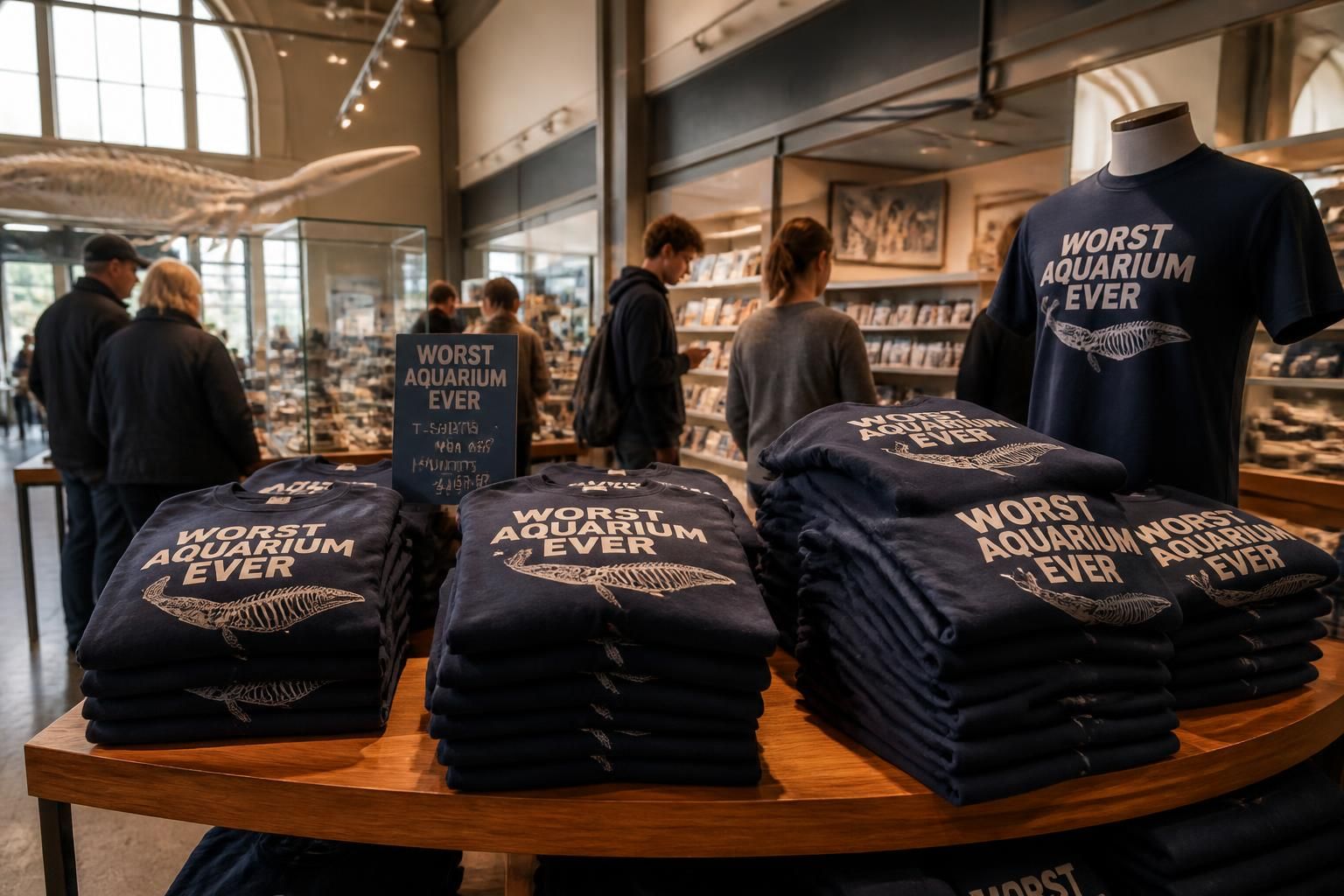
Instead of presenting the review as an insult to be erased, the museum treated it as a misunderstanding with comic potential. Its merchandise now features the phrase alongside visual references to the museum’s collections, including a whale skeleton. The result is a line of shirts, sweatshirts, crewnecks and bags that turns an unhelpful comment into unique merchandise with a clear local identity.
The key detail is not merely that the wording is funny. It is that the joke is grounded in truth. The museum does not claim to offer live whales, tanks or aquatic-animal encounters. As the institution’s engagement leadership has pointed out publicly, it can therefore accept the absurd label with a straight face: by aquarium standards, it would indeed be a terrible aquarium. This creates a rare situation where a bad comment becomes an effective piece of public education.
That distinction matters for cultural organisations. A response to criticism should never mock a visitor’s genuine frustration, especially where accessibility, service, ticketing, safety or inclusion are concerned. Here, the review was based on a category error rather than a documented failure in the exhibition experience. The museum’s humour directs attention to the error while preserving a welcoming tone for future visitors.
Why the “Worst Aquarium Ever” phrase became memorable
Most reviews use generic language: “disappointing,” “overpriced,” or “not worth it.” Those comments may be important operational signals, but they are rarely memorable. “Worst Aquarium Ever” has a compact, visual and highly shareable quality. It creates immediate curiosity: why would a whaling museum be reviewed as an aquarium at all?
That curiosity is valuable because it opens a path toward the actual story of New Bedford. The museum represents a place where art, maritime science, regional history and cultural interpretation meet. Visitors can encounter the history of American whaling, models, artefacts, art and the complex human stories surrounding an industry that shaped the city. The slogan does not replace that context; it becomes a doorway to it.
Local reaction also suggests why the idea travelled. Residents quoted in coverage described the approach as funny and appropriate, while noting that young relatives would happily wear the design. The merchandise has moved beyond conventional souvenir purchasing: people who do not appear to have a direct museum connection have been seen wearing it. That is a strong sign that the object functions as a local conversation piece, not only as a retail item.
A regional report on the museum’s merchandise launch noted that the products sold through the gift-shop ecosystem, with shirts listed around $32 and hoodies around $60. Online availability has at times shown items as sold out. Demand alone does not prove a permanent retail model, but it does demonstrate that a well-framed joke can create attention that standard logo merchandise may not generate.
Useful lesson: a negative phrase becomes usable only when it reveals an amusing gap between public expectation and an institution’s real purpose. The next step is understanding how this small retail decision became a wider brand transformation.
Why This Brand Transformation Worked Without Dismissing Customer Feedback
The New Bedford Whaling Museum example is effective because it does not treat every negative rating as identical. Reputation management begins with classification. A complaint about inaccurate opening hours needs a correction. A report of poor audio, inaccessible signage or unhelpful staff deserves investigation. A review that confuses a museum with an aquarium requires a different kind of answer: clear information, delivered with proportionate humour.
This is where many organisations make an avoidable mistake. They either respond defensively to all criticism or turn all criticism into social-media entertainment. Neither approach is sustainable. A museum that makes light of a complaint about a broken lift, discriminatory treatment or misleading ticket conditions can weaken trust. In contrast, the “Worst Aquarium Ever” review offered no evidence of an operational failure. The museum could safely transform the premise while reminding the public what it actually offers.
For tourism teams, customer feedback is not a single category. It contains requests, warnings, misunderstandings, compliments, discoverability problems and evidence of changing visitor expectations. A structured review process helps separate comments that demand action from comments that can inspire communication.
A practical decision filter for a creative response
| Feedback type | Best organisational response | Merchandise or content potential |
|---|---|---|
| ⚠️ Service failure: long queues, inaccessible spaces, poor sound | Investigate, apologise where appropriate, explain the remedy | ❌ Do not turn into a joke |
| 🧭 Visitor misunderstanding: incorrect venue category or expectation | Clarify the offer through concise, friendly information | ✅ Possible if the message is harmless and factual |
| 💬 Distinctive praise: a quote about a memorable experience | Thank the visitor and preserve the quote with permission where needed | ✅ Useful for campaigns and shop products |
| 🔍 Repeated confusion: parking, entrance, duration or booking process | Improve wayfinding, website copy and pre-visit communication | 🛠️ Fix the journey before promoting it |
The museum’s campaign sits firmly in the second row. It does not deny the review existed, nor does it overstate its meaning. It uses the phrase to frame a simple clarification: this is a multifaceted cultural venue rather than an animal attraction. That is an important public relations distinction. The laugh is directed at the premise, not at the person who left the comment.
Consider a fictional local-history venue, Harbor Signal Museum. If several visitors say they expected a lighthouse climb but the building has no public tower access, the organisation should first correct its map listings and booking descriptions. If one review then calls it “the least climbable lighthouse in town,” the team might share the line lightly only after the practical information is clear. The order matters: fix discoverability first, then consider humour.
Online platforms also shape the stakes. Review snippets often appear before official descriptions in search results. A museum’s website, knowledge panel, event pages and social channels must consistently explain what visitors will see, hear and do. This is especially relevant for exhibitions with terms that can mean different things to different audiences: maritime museum, heritage centre, immersive experience, digital trail or family attraction.
An analysis of how reviews interact with AI voice assistants is relevant here: spoken search and summary tools may compress visitor opinions into a few short phrases. Cultural venues need precise information that can withstand that compression. The New Bedford phrase gained traction precisely because it is short. The institution’s own contextual explanation must be just as easy to find.
Key insight: the strongest brand transformation does not hide a negative comment; it places it in the correct context and ensures the underlying visitor information is stronger than the joke.
What the Marketing Strategy Teaches Museums About Consumer Engagement
The “Worst Aquarium Ever” collection demonstrates a useful principle: consumer engagement is stronger when audiences can participate in a story rather than simply receive a message. A standard museum tote bag may show a logo. A tote carrying an unexpected review invites the owner to explain it, photograph it or give it as a gift. The product becomes a portable piece of storytelling.
This is not accidental virality. The museum had reportedly joked for years that the review should be printed on a shirt, then tested the idea before expanding it. That progression is important. A small test run limits financial risk and gives a cultural organisation time to assess visitor reaction, product quality, staff comfort and actual demand.
For a museum shop, the practical question is not “Can a meme sell?” It is “Does this item express something distinctive about the place?” In New Bedford, the answer is yes because the wording is inseparable from a whaling museum. A generic internet joke would be easy to copy and quickly forgettable. This phrase points directly to the city’s maritime identity and to the improbable expectation of finding live whales inside a history museum.
Turning an online moment into a product people want to keep
Effective cultural merchandise usually combines three elements: a story, an object with everyday utility, and a design that remains understandable outside the building. The New Bedford apparel works because the slogan can be read in seconds. The whale-skeleton imagery gives the phrase a visual anchor, while shirts, crewnecks and bags are objects visitors can use repeatedly.
- 🧠 Choose a phrase with context: it should be amusing, but also explain something real about the venue.
- 🧪 Start with a limited run: test one or two formats before committing to a broad inventory.
- 🎧 Connect the item to interpretation: use a QR code, shelf label or short audio clip to explain the story behind it.
- 🛍️ Price according to product value: do not assume attention alone justifies premium pricing.
- 📊 Track more than sales: record shares, newsletter sign-ups, website visits and first-time visitor questions.
Audio can add particular value here. Imagine a small QR code on a shelf card leading to a 45-second explanation from a curator: “No live whales here, but this skeleton reveals the scale of the animal and the history of the port.” That short piece of interpretation turns a humorous retail moment into an accessible learning opportunity. It also serves visitors who may not have time for a full gallery tour.
Smart tourism tools make that workflow manageable without requiring dedicated hardware. With a smartphone-based audio platform such as Grupem, a guide, museum educator or visitor-services team can publish concise audio content and direct audiences to it through signage or a shared link. The goal is not to digitise every shelf. It is to place sound where it resolves a question, makes an object more meaningful or helps people navigate the site.
There is also a community dimension. Residents interviewed about the New Bedford products recognised the humour because they understood the museum’s role in the city. Local buyers often become informal ambassadors when a product reflects a shared reference. A visitor wearing the shirt elsewhere may prompt a conversation about New Bedford, maritime heritage and the museum’s collections. That kind of organic reach is more credible than a slogan that tries too hard to sound viral.
The campaign’s coverage expanded beyond local audiences because the premise is instantly legible. A national video story about the free marketing effect captured that wider appeal. Still, visibility should not be confused with a complete strategy. The organisation needs stock planning, clear product pages, fulfilment capacity and a way to guide newly curious users toward the museum itself.
Key insight: distinctive merchandise earns attention when it carries an authentic local story and gives the buyer a simple reason to retell it.
Using Public Relations Humour While Protecting Museum Reputation Management
Humour can be powerful in public relations, but it needs boundaries. The New Bedford Whaling Museum case is often described as turning a bad review into marketing gold. That description is understandable, yet it can lead other organisations to copy the surface tactic rather than the careful judgement beneath it. The actual strength of the campaign is its restraint.
The museum did not invent a fictional complaint or manufacture a conflict. It used a real review that had already become a recurring internal and public reference. It also did not claim that a one-star rating is beneficial in every circumstance. The joke succeeds because it is clearly exceptional: the criticism accidentally reinforces the museum’s identity as a place devoted to whales without being an aquarium.
Public relations teams should establish a review-response policy before an unexpected post gains traction. That policy should identify who verifies the source, who approves a response, how staff raise concerns, and which types of comments must remain outside any campaign. This protects both the organisation and the people whose work supports daily visitor experience.
A responsible workflow for turning feedback into content
- 🔎 Verify the original context. Confirm that the review is authentic, publicly visible and not connected to a serious unresolved complaint.
- 🧩 Identify the misunderstanding. State plainly what visitors should expect, without relying on irony alone.
- 👥 Check internal perspectives. Include visitor services, education, retail and accessibility staff before publishing.
- 🎨 Prototype the creative asset. Test a mock-up with a small, diverse group of staff or local supporters.
- 📣 Publish with useful context. Pair humour with a clear invitation to explore the actual collections, programme or tour.
- 📈 Measure sentiment and operational impact. Watch whether attention increases qualified visits or merely produces confused clicks.
Consider the difference between two hypothetical reactions. A science centre receives “No dinosaurs, one star” from a visitor who thought it was a natural-history museum. A playful post could explain that the venue focuses on robotics and physics, perhaps using “Still no dinosaurs” on a limited sticker. By contrast, if the same venue receives “Audio captions did not work during the show,” the appropriate response is not comic. It is a prompt repair, a direct apology and an update for future audiences.
This separation is central to ethical reputation management. Reviews can reveal barriers that managers do not observe from inside the organisation. Visitors may struggle with entry instructions, unclear terminology, poor acoustics or digital booking friction. The staff response should show that those experiences are being heard. Humour must never become a shield against improvement.
At New Bedford, the campaign can also support better expectation-setting. Social posts and shop pages can include language such as “Explore art, science, history and culture connected to whaling.” That statement tells prospective visitors what the museum is, while the merchandise supplies the memorable twist. The two messages should work together.
It is worth noting the value of tone in this exchange. A sharp or sarcastic response might have made the visitor look foolish and prompted backlash. A warm, self-aware design lets the museum share the joke with the public. That distinction is what turns a social-media reaction into sustainable public relations.
For teams planning a campaign, the strongest question is not “Will this go viral?” It is “Would this still reflect our values if the audience were standing in the gallery?” If the answer is yes, the idea may have a place. Key insight: humour protects a reputation only when it is paired with accountability, accurate information and respect for visitors.
How Smart Tourism Tools Can Extend the New Bedford Whaling Museum Merchandise Story
The New Bedford Whaling Museum campaign creates an opportunity that reaches beyond retail: it can help convert curiosity into a better visit. Someone may first encounter the phrase on a shirt, in a video or through a shared post. The next question is predictable: what is actually inside the museum? Smart tourism tools can answer that question before, during and after the visit without making the experience feel overly technical.
A practical visitor journey starts with expectation-setting. On the ticket page, a short audio preview could introduce the museum as a place for maritime history, art, science and culture. In the gift shop, a QR code beside the apparel could open a short story about the original review, the reason the museum embraced it and the real whale-related objects visitors can see. This creates a consistent bridge from joke to interpretation.
Audio is especially suitable because it does not force visitors to read a long panel while standing in a busy retail area. A 30- to 60-second clip can explain the museum’s response in a human voice, then direct the listener to a specific gallery or object. Visitors using their own phones can choose whether to listen, making the experience flexible for families, independent travellers and groups.
Designing a connected journey from social post to museum floor
Imagine Maya, a fictional visitor from Providence. She sees the “Worst Aquarium Ever” crewneck on a friend’s social feed and clicks through because the phrase is unusual. The product page tells her that the venue is a whaling museum, lists basic opening information and offers a short audio sample about a whale skeleton. She books a visit because she now understands the proposition.
When Maya arrives, the same visual motif appears on a discreet sign near the entrance: “Still no live whales. Start the 90-second museum orientation.” The audio provides clear directions, establishes respectful historical context and helps her choose an itinerary. A family-friendly version might explain the difference between aquariums, natural-history collections and maritime museums in plain language. That is consumer engagement with a purpose: fewer misunderstandings and more confident visitors.
For guided groups, smartphone audio also helps the guide maintain clear sound without handing out complex equipment. Visitors can follow a live guide through their phones and headphones, while the guide can refer to the merchandise story as a light opening anecdote. The audio channel should support the interpretation, not compete with it. Clear sound remains more important than novelty.
Digital content must remain accessible. Provide a text transcript for every audio clip, keep instructions brief, avoid mandatory app downloads for essential information and make sure QR destinations load well on mobile connections. Visitors who prefer not to use a phone should receive the same core orientation from staff or printed material. Smart tourism works when it adds a choice, not a barrier.
Measurement should connect the campaign to practical outcomes. Retail teams can track which products lead users to QR codes. Visitor-services teams can note whether fewer people ask if there are live animals. Education teams can assess whether the short audio prompts exploration of relevant galleries. These signals are more useful than a raw view count because they show whether communication is improving the real experience.
Organisations looking for comparable ideas can also examine how digital interpretation is reshaping cultural spaces, including this discussion of the museum-management game trend and visitor expectations. Fictional museums may exaggerate operational challenges, but they reflect a real public appetite for places that are clear, playful and well organised.
The New Bedford Whaling Museum did not need an elaborate campaign to make its point. It found a truthful joke, created a product people wanted, and gave the public a reason to learn what the institution actually is. Key insight: the most useful technology extends that clarity, turning a viral phrase into an informed and accessible cultural visit.
What did the one-star review say?
The 2020 review described the New Bedford Whaling Museum as the “worst aquarium ever.” The humour comes from the fact that the institution is a whaling-history museum, not an aquarium with live animals.
What products were created from the review?
The museum developed apparel and gift items using the phrase, including T-shirts, hoodies, crewnecks and bags. Reported pricing placed T-shirts at about $32 and hoodies at about $60, with online stock sometimes selling out.
Should every museum turn negative customer feedback into a joke?
No. Humour is appropriate only when the comment is harmless, clearly based on a misunderstanding and does not conceal a genuine service, accessibility or safety issue. Serious complaints require investigation and practical improvements.
How can audio technology support a museum merchandise campaign?
A QR code or mobile audio link can explain the story behind a product, introduce relevant objects and help visitors understand what the museum offers before they enter a gallery. Transcripts and non-digital alternatives should remain available.
