
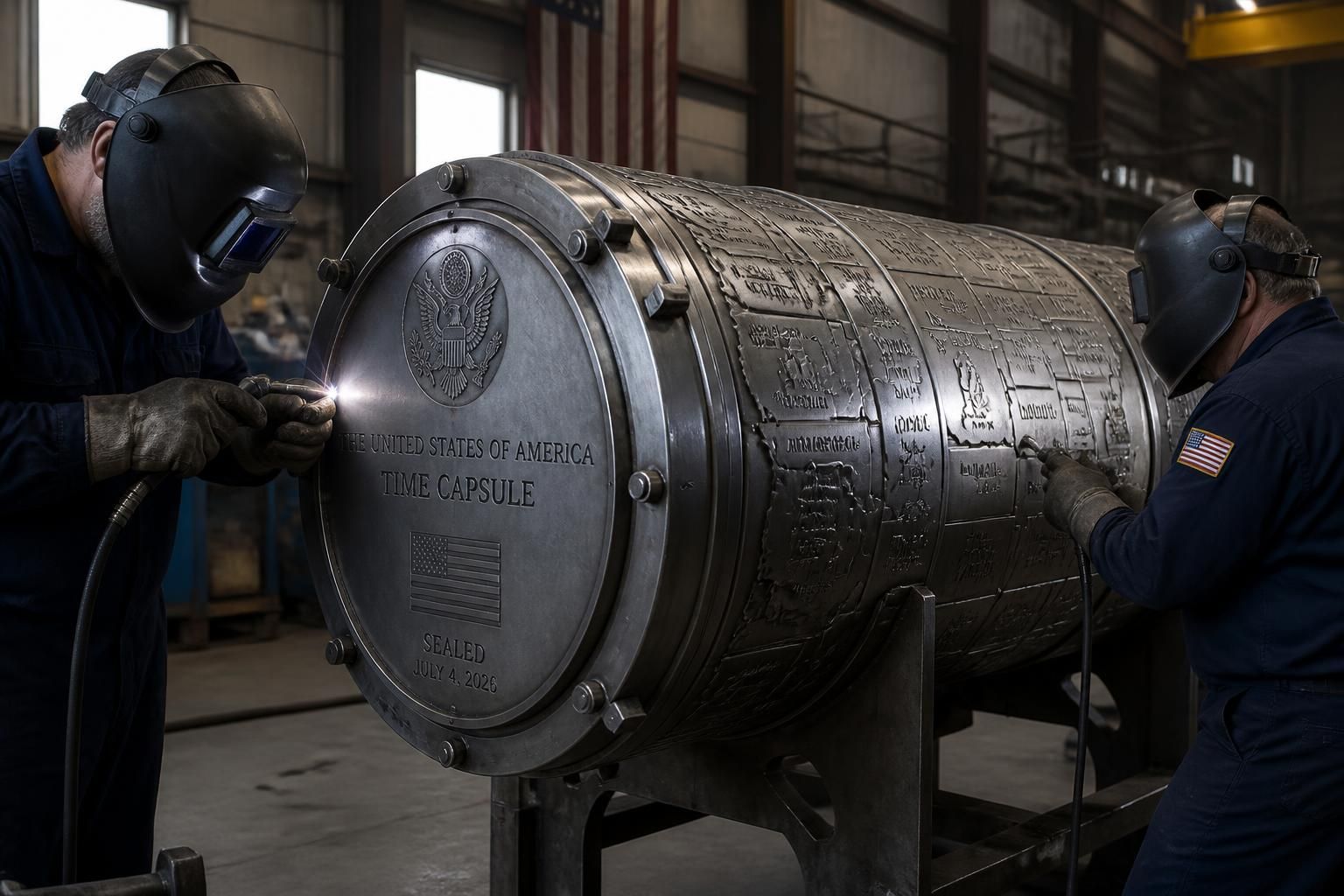
America250’s bicentennial celebration has taken a monumental step with the unveiling and sealing of the national time capsule, designed to preserve historic artifacts and cultural heritage from every corner of the United States. This 900-pound steel cylinder symbolizes a comprehensive snapshot of American history as it stands in 2026, capturing unique state contributions intended to be discovered by future generations in 2276.
Peu de temps ? Voici l’essentiel à retenir :
✅ The capsule contains over 200 carefully selected items representing all 50 states, Washington, DC, and five US territories.
✅ Each item was chosen to reflect the unique historical, cultural, or technological significance of its state or territory.
✅ The capsule embodies a national legacy meant to inspire and inform people 250 years from now, bolstered by modern archival methods, including synthetic DNA data storage.
How the America250 Time Capsule Preserves State Treasures for 250 Years
The America250 Time Capsule stands as an unprecedented effort in the realm of national legacy preservation. Engineered to last two and a half centuries, this vessel is not only a tribute to the past but a message to the future, set to be buried at Independence National Historical Park in Philadelphia on July 4. The capsule’s design reflects a commitment to safeguarding historic artifacts through innovative materials and technologies, securing items in a climate-controlled, stainless-steel enclosure.
Coordinated by the congressionally appointed America250 Commission, collaboration spanned across every state, territory, and numerous national institutions, including the Library of Congress and the Smithsonian Institution. Each state’s contribution was carefully curated to represent its most definitive cultural or historical elements. This methodical selection process highlights the diversity and depth of American society, from native gemstones and handcrafted artworks to technological advancements and governmental records.
Notably, the capsule incorporates molecular data storage technology—a first for a national archive of this scale—to encode a digital backup of key documents, including Thomas Jefferson’s original rough draft of the Declaration of Independence and a rare 1898 audio recording of the national anthem. This ensures future retrieval capabilities even if physical artifacts deteriorate.
By blending tangible state treasures with cutting-edge preservation techniques, the America250 Time Capsule sets a new standard for long-term cultural heritage conservation. Entities involved in the project have stressed the importance of technological integration to ensure accessibility and education for centuries to come. This initiative aligns with the growing trend toward smart cultural tourism, wherein advanced storytelling methods increasingly complement traditional museum experiences, offering immersive insights to both present and future audiences.
For professionals in tourism and cultural event organization, understanding this fusion of preservation science and heritage documentation is essential to creating engaging, future-proofed experiences today.
A State-by-State Overview: Unique Contributions Reflecting America’s Diverse Heritage
Every state’s contribution tells a story that encapsulates not only local significance but broader national values. For example, California’s inclusion of a NASA photograph alongside an AI-generated prediction and a segment of fusion superconducting material epitomizes the state’s technological leadership and forward-looking mentality. Meanwhile, Maine’s donation of a whale bone from the critically endangered North Atlantic right whale highlights environmental conservation concerns intrinsic to its coastal identity.
Below is a curated selection demonstrating the wide spectrum of state treasures collected for the capsule:
- ✨ Arizona: A laser-etched coin featuring the Declaration of Independence and U.S. Constitution signatures—a fusion of art and history.
- ✨ Arkansas: A diamond from the Crater of Diamonds State Park, symbolizing natural heritage and public engagement.
- ✨ Idaho: A star garnet, highlighting unique geological identity.
- ✨ Texas: The chiseled glass paperweight engraved with the state seal, a nod to its storied independence and statehood origins.
- ✨ Washington: A personal letter from Lieutenant Governor Denny Heck, showing human connection and governance legacy.
- ✨ Puerto Rico: A rosary emphasizing faith’s pivotal role in cultural identity.
This array showcases the United States’ diverse tapestry—where natural wonders meet technological innovations and artistic heritage intertwines with political history.
Such documented variety serves as an invaluable resource and inspiration for immersive smart tourism applications that seek to convey rich, context-sensitive narratives. The full list of state and territory contributions is available on America250’s official website, providing a comprehensive archive for cultural educators and heritage professionals alike. Beyond simple collection, this encourages organizations to integrate multifaceted historical perspectives within their tours and exhibits, as seen in digital-guided museums or locations like the San Francisco Micro Museum.
Technological Innovations Embodied in the America250 Time Capsule Reveal
The time capsule is not only a repository of physical artifacts but also a showcase of contemporary archival technology. A molecular data storage device, barely the size of a grain of rice, contains synthetic DNA strands that digitally encode some of America’s most treasured documents. This includes the rough draft of the Declaration of Independence by Thomas Jefferson and a 3D rendering of Abraham Lincoln’s hand. Such technological foresight addresses the problem of data longevity in the face of environmental and temporal challenges.
These advances mark a significant departure from traditional archival storage, ensuring that critical components of American history survive with fidelity far beyond physical materials’ natural limits. For museum and cultural heritage professionals, these technologies offer new possibilities for data preservation, authenticity verification, and visitor engagement.
The capsule’s sealing ceremony, covered in detail by major media outlets, underscored its role as a bridge across centuries. This initiative also reflects the growing intersection of heritage and innovation, where digital tools enhance the reach and accessibility of cultural content. For example, integrating such technologies with smart tourism platforms can create dynamic, interactive experiences that bring history into the modern visitor’s hand.
The capsule thus exemplifies how cutting-edge tech can amplify cultural heritage presentation and preservation, guiding museum curators and event organizers towards smarter, more sustainable practices.
The National Significance of America250: A Collective Memory Enshrined
The America250 initiative embodies a nonpartisan, nationwide effort to commemorate 250 years since the Declaration of Independence. The time capsule is a physical manifestation of this collective memory, representing federal, state, and territorial narratives in one symbolically rich container. It participates in the bicentennial celebration as a tangible legacy meant to educate future generations through authentic, curated artifacts.
Beyond a mere symbolic act, the capsule consolidates a national record—inclusive of contributions from the executive, legislative, and judicial federal branches. For instance, an archival photo from the Vice Grip pliers, tied to Nebraska’s commerce history, finds its place alongside letters from state governors and poetry penned for the occasion, such as Mark Turcotte’s poem from Illinois or Joseph Bottum’s South Dakota poetry book celebrating nature and homestead heritage.
This collective effort reaffirms the importance of shared history in forging national identity. It also provides a model for future heritage projects, emphasizing inclusivity and comprehensive representation.
Professionals involved in event planning, heritage preservation, and public engagement should consider how such projects harness community narratives and technological innovation to foster connection across time. The integrated approach mirrors trends visible in modern museum exhibits, including notable upcoming presentations at the Smithsonian Institution, where immersive audio and multimedia play key roles in storytelling.
Essential Insights on Managing Historic Artifacts for Future Generations
Ensuring that the contents of a time capsule remain viable and meaningful across centuries involves meticulous curation, expert preservation, and thoughtful contextualization. The America250 initiative exemplifies best practices in managing this delicate balance between artifact conservation and narrative significance.
Key strategies demonstrated include:
- 🗂️ Selecting items with enduring symbolic meaning and clear provenance to enhance interpretive value.
- 🧬 Employing advanced preservation technologies — such as synthetic DNA data storage — to safeguard documentary heritage.
- 🛡️ Using durable materials like stainless steel for the container, designed to withstand environmental stresses underground.
- 📜 Including detailed documentation and reflections from state leaders that contextualize objects for future audiences.
- 🌍 Ensuring contributions cover a diverse range of cultural, technological, and natural heritage, providing a holistic narrative.
The following table summarizes some of the standout contributions by region, illustrating the wide thematic range optimally preserved for the 2276 reveal:
| 🗺️ Region | 🎁 Key Item | 🌟 Significance | 📍 State/Territory |
|---|---|---|---|
| West Coast | AI-generated future vision & NASA image | Technological innovation and space exploration | California |
| Midwest | International Space Station medallion | Leadership in space science via Peggy Whitson | Iowa |
| South | Mardi Gras necklace and glass beads | Cultural heritage and festival traditions | Louisiana |
| East Coast | Boston Massacre print and founding fathers’ letters | Colonial history and revolution memory | Massachusetts |
| Territories | Rosary and traditional pendants | Faith and indigenous cultural identity | Puerto Rico, Guam |
As custodians of cultural memory, professionals in tourism and museum sectors must appreciate and potentially incorporate these preservation principles to enhance visitor experience and interpretive depth.
What is the purpose of the America250 Time Capsule?
The time capsule aims to preserve a comprehensive record of American history, culture, and innovation from all 50 states and territories, to be opened in 2276, offering future generations a detailed snapshot of the nation in 2026.
How were items chosen for the time capsule?
Every state and territory selected artifacts that represent its unique cultural, historical, and technological significance, often including multiple items that reflect their identity, community values, and achievements.
What technological advances are used in preserving the time capsule contents?
The capsule incorporates molecular data storage using synthetic DNA strands to encode critical documents digitally, alongside durable physical encasements designed to endure for centuries.
Where and when will the America250 Time Capsule be opened?
The capsule will remain buried at Independence National Historical Park in Philadelphia and is intended to be opened on the nation’s 500th anniversary in 2276.
How can cultural institutions leverage the America250 Time Capsule project?
Museums and tourism organizations can use the project’s curated artifacts and preservation methods as a blueprint for innovative heritage exhibitions, embracing technology and diverse storytelling to engage modern audiences.
