
Plan Your Free Saturday Visit to Oak Ridge Museum on October 24
📅 Nuclear Energy Discovery Day takes place on Saturday, October 24, 2026, at the American Museum of Science and Energy, 115 Main St. East, Oak Ridge, Tennessee. The museum and the Oak Ridge Discovery Foundation are closing their October 19–24 Nuclear Science Week program with an all-ages event offering free admission.
The published program lists a 10:00 a.m. opening, with local nuclear and technical partners contributing activities throughout the event. Before setting out, consult the official Nuclear Science Week program for current hours, participation arrangements, and any schedule updates.
For visitors searching for an “Oak Ridge Museum” outing, the venue’s full name matters: the American Museum of Science and Energy, or AMSE. Using that name and the street address in your navigation app helps distinguish this destination from other historical attractions in the area.
| Planning detail | What to know | Practical action |
|---|---|---|
| 📅 Date | Saturday, October 24, 2026 | Save the exact date rather than relying on “this Saturday.” |
| 📍 Location | AMSE, 115 Main St. East, Oak Ridge | Check your route before departure. |
| 🎟️ Admission | Free during the event | Check whether any individual activity requires separate arrangements. |
| 🔬 Program | Hands-on activities, live demonstrations, and a campuswide scavenger hunt | Select priorities while leaving room to explore. |
| 🕙 Opening | Published start time: 10:00 a.m. | Verify closing time and demonstration schedules with AMSE. |
Make a Saturday Visit Easier for Different Ages
A successful museum event does not require seeing everything. Consider a hypothetical family visiting with an eight-year-old and a teenager: the younger child may prefer a short practical task, while the older student may want a longer conversation about engineering careers.
Instead of imposing one rigid route, identify a shared starting activity and agree on a meeting point before separating, where appropriate. Younger children should remain with their accompanying adult, particularly when moving between busy demonstration areas.
Allow time for arrival, orientation, and breaks rather than assigning every minute to exhibits. A flexible visit is especially useful when live presentations attract a crowd or an engaging discussion lasts longer than expected.
Free admission removes the museum entry charge; it does not automatically cover transport, meals, purchases, or unrelated attractions. Keeping those costs separate makes the outing easier to budget and avoids treating a promotional admission offer as an all-inclusive package.
Check Accessibility Before Leaving for AMSE
Visitors who need step-free routes, seating, communication support, or a quieter environment should contact the venue in advance. Ask specific questions about the event layout rather than assuming that arrangements for ordinary opening days cover every temporary activity.
For example, a person who uses a wheelchair may need information about access between activity locations, while a visitor with hearing loss may need written instructions for a demonstration. Clear questions give staff a better opportunity to offer relevant guidance.
The museum’s official website is the appropriate starting point for visitor information and contact details. Save essential information on your phone before traveling so that finding an address or checking an instruction does not depend on connectivity at the entrance.
A well-prepared visit leaves more attention available for discovery—and less for solving avoidable logistical problems.
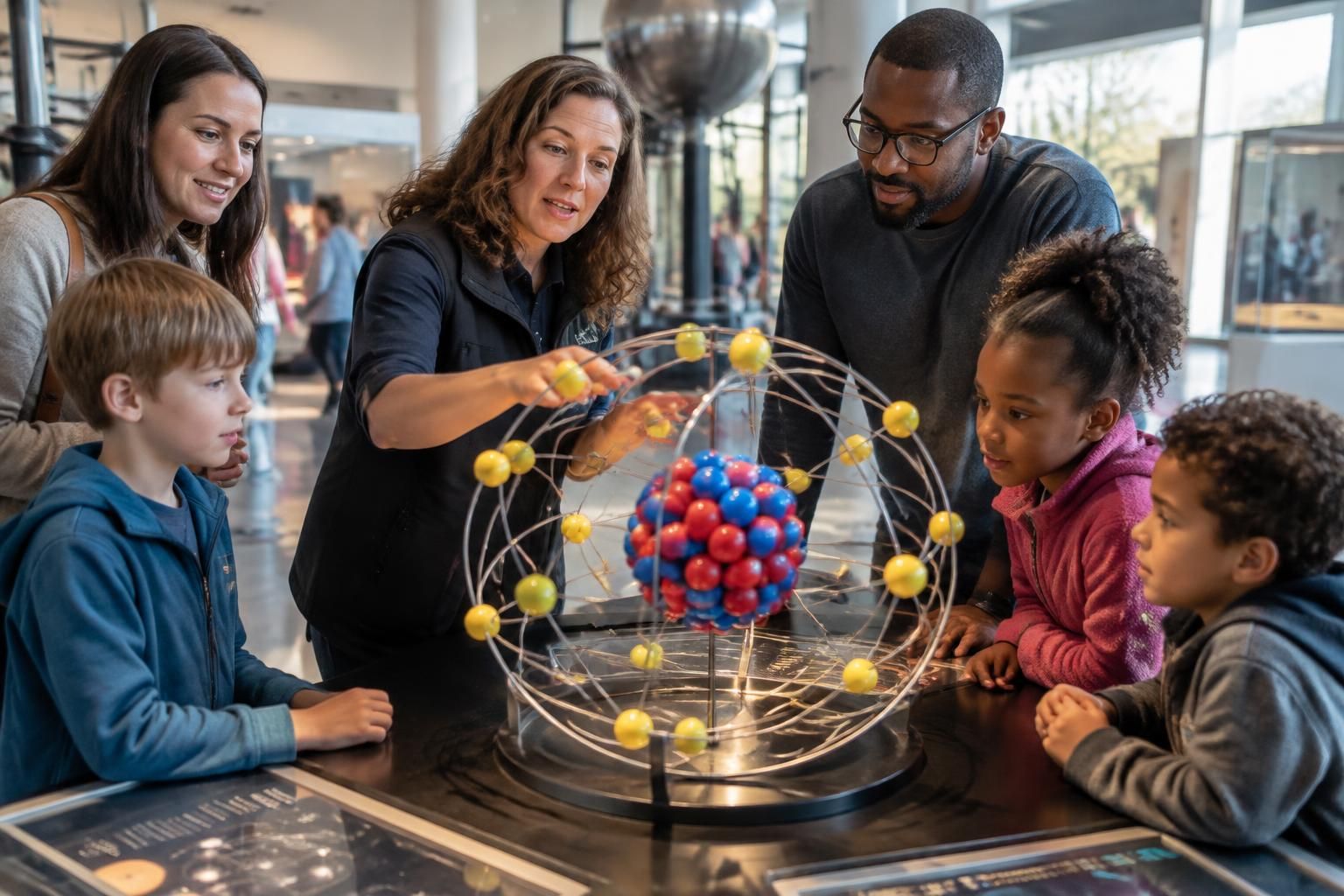
Turn Hands-On Exhibits into Meaningful Nuclear Science Learning
The advertised combination of practical activities, live demonstrations, and a campuswide scavenger hunt gives visitors several ways to engage with nuclear science. These formats serve different purposes: an activity invites experimentation, a demonstration makes a process visible, and a hunt encourages closer observation across the venue.
The most useful approach is to connect each experience to one question. Rather than asking a child to remember every explanation, try: “What changed?”, “What did the model show?”, or “What evidence supports that answer?”
Ask Better Questions at Nuclear Energy Discovery Day
Before touching an interactive element, read the instructions and identify what it represents. A model can explain an important relationship without reproducing the full conditions of a working reactor, laboratory, or industrial facility.
For example, an educator might use falling objects or a visual sequence to illustrate a chain reaction. The learning opportunity lies in understanding how one event can trigger others—not in assuming that the classroom materials behave exactly like atomic nuclei.
Distinguishing a model from the real system is a valuable scientific skill. Ask the presenter which features are accurate, which have been simplified, and what the demonstration leaves out.
- 🔎 Observe first: identify the objects, controls, or visual cues before beginning.
- 💡 Make a prediction: suggest what will happen and explain why.
- 🧪 Test carefully: follow the facilitator’s instructions and change only what is permitted.
- 🗣️ Explain the result: describe the outcome in everyday language before introducing technical vocabulary.
- 📝 Record one question: carry an unresolved point to the next relevant presenter.
This sequence works for adults as well as children. It shifts participation away from simply pressing a button and toward understanding the connection between an action and its result.
Use Family Activities Without Turning Them into a Race
A campuswide scavenger hunt can encourage visitors to notice details they would otherwise overlook. Its educational value increases when participants explain why a discovered object, answer, or location matters.
For the hypothetical family, the younger child could identify a visual clue while the teenager reads the surrounding explanation. Both then contribute to a shared answer, rather than having the fastest reader complete every task.
Avoid measuring success only by how quickly the hunt is finished. Spending several minutes discussing one surprising finding can be more valuable than collecting every answer without understanding it.
Live presentations deserve the same deliberate attention. Stand where everyone in your group can see, leave accessible routes clear, and wait for the presenter’s invitation before approaching equipment or materials.
Photography should support the experience rather than interrupt it. Check venue rules and ask permission before photographing identifiable participants, especially children; a short written observation may preserve the learning more effectively than a crowded camera roll.
For follow-up viewing, choose educational material that identifies its presenter and explains the limits of its examples. The strongest hands-on exhibits leave visitors able to explain an idea, not merely recall that something moved or flashed.
Explore Oak Ridge Nuclear History Beyond the Headline
Oak Ridge offers a distinctive setting for discussing atomic energy because its history connects wartime research, industrial production, scientific institutions, and community development. Understanding those connections gives practical demonstrations a deeper context without reducing the city to a single achievement or controversy.
During the Manhattan Project in the 1940s, Oak Ridge became a major center for uranium enrichment and related research. Its development involved engineers, scientists, construction workers, operators, support staff, and families whose experiences extended well beyond the laboratory.
Connect Nuclear History with the People Behind It
A productive historical question is not only “What was invented here?” but also “Who made this work possible?” Large technical programs depend on maintenance, logistics, administration, training, and everyday services as well as scientific breakthroughs.
This broader perspective helps younger visitors recognize that technological history is also social history. A technician’s routine, a worker’s commute, or a family’s experience of a rapidly developing community can make an industrial story more understandable.
Oak Ridge’s past also requires attention to secrecy, unequal experiences, and the consequences of wartime decisions. A responsible interpretation allows visitors to consider scientific achievement alongside ethical questions rather than presenting either as the whole story.
For the hypothetical teenager, a useful task is to identify one historical decision and ask what information its participants possessed at the time. That exercise encourages contextual thinking without requiring visitors to suspend critical judgment.
Historical explanation should clarify circumstances, not erase consequences. Museum educators can help distinguish documented events from later interpretation, particularly when a familiar story has become simplified through repetition.
Separate Atomic Energy Concepts from Common Misunderstandings
Scientific vocabulary also benefits from context. An atom contains a nucleus surrounded by electrons; nuclear processes involve changes in that nucleus, whereas ordinary chemical reactions primarily involve electrons and the rearrangement of chemical bonds.
In nuclear fission, certain heavy nuclei split, releasing energy and additional neutrons. In a power reactor, a controlled chain reaction produces heat that can be used to generate electricity through an engineered power-conversion system.
Fusion involves combining light nuclei under suitable conditions and presents a different set of engineering challenges. Fission and fusion should not be treated as interchangeable technologies, even when both appear within the same broad discussion of energy innovation.
Radiation is another term that deserves precision. Sources, radiation types, exposure pathways, dose, and protective measures all matter; a general label alone does not explain a particular situation’s risk.
Ask presenters to distinguish irradiation from radioactive contamination. Exposure to radiation does not automatically mean radioactive material has been deposited on a person or object, and confusing the two can distort an otherwise useful explanation.
A historical video can provide background before or after the outing, but it should not replace reading exhibit context or discussing difficult questions with knowledgeable staff. Notice who produced the material, which period it covers, and whether its claims are supported.
Oak Ridge’s story becomes more useful when visitors connect what happened, how the technology works, and why those choices still matter.
Use the Museum Event to Strengthen Science Education and Career Awareness
Nuclear Energy Discovery Day brings AMSE’s network of local nuclear and technical partners into a public learning environment. That makes the occasion useful not only for families but also for teachers, youth leaders, tourism professionals, and students exploring unfamiliar career paths.
According to the supplied event announcement, Kairos Power is the presenting sponsor. CNS/Y-12, Orano USA, and the East Tennessee Economic Council are day sponsors, with Type One Energy providing supporting sponsorship.
These acknowledgments explain how the wider week is supported; they do not establish that every named organization will operate a particular Saturday activity. Consult the current program before promising a group access to a specific representative, exhibit, or presentation.
Turn Partner Conversations into Practical Career Questions
Meeting people connected to technical work can make a broad subject more tangible. Instead of asking only whether someone enjoys their job, encourage students to ask what a typical task involves and which skills they use most often.
A productive conversation might explore how a team checks a measurement, documents a procedure, or responds when results differ from expectations. Such examples reveal that professional competence includes communication and disciplined decision-making, not just advanced mathematics.
Career pathways vary by role. Some positions require university degrees, while others may involve technical education, apprenticeships, certifications, or structured workplace training; visitors should ask about the requirements of a specific occupation rather than assuming one route fits all.
For the hypothetical teenager, a realistic goal is to leave with two unfamiliar job titles and one concrete learning step. That step might be researching a relevant course, asking a school adviser about technical programs, or practicing how to interpret a graph.
A useful career encounter produces a clearer next question, not an instant commitment to a profession. This keeps exploration open and avoids placing unnecessary pressure on younger visitors.
Build a Simple Learning Task Around the Free Event
Teachers and group leaders can prepare a compact observation sheet with three prompts: identify a process, describe supporting evidence, and record a question. Keeping the task short prevents paperwork from competing with the experience itself.
Before arrival, choose an age-appropriate theme such as energy conversion, measurement, or the relationship between technology and society. During the visit, allow learners to select different examples that address the same theme.
Afterward, compare explanations rather than scores. One student may describe an engineering model, while another may focus on a historical display; both can demonstrate understanding if they explain their evidence accurately.
Organizers should also establish supervision, meeting points, headcounts, and procedures for anyone separated from the group. Free public access does not replace the planning responsibilities of a school or organized tour.
For regional context, the Anderson County Nuclear Science Week listing offers another reference point for the broader program. Check individual arrangements separately rather than assuming that museum admission includes tours of other sites.
Some advertised weeklong activities may have different audiences, booking requirements, or access conditions. Treat the Saturday museum gathering as its own experience unless the organizer explicitly confirms a connection to another offering.
Good science education turns a public outing into a manageable sequence: notice something, question it, and investigate further.
Improve Your Oak Ridge Museum Experience with Accessible Audio and Digital Tools
Digital tools can make a busy cultural visit easier to follow, but only when they solve a real visitor problem. At an event with demonstrations and conversation, the priority is understanding the presenter—not adding more screens, notifications, or technical steps.
Begin with a charged phone, essential information saved locally, and a clear agreement about when devices are useful. A screenshot of the address or an accessible note containing meeting instructions can be more valuable than installing several unfamiliar applications at the entrance.
Use Smartphone Audio Without Assuming Venue Support
For an organized group, a smartphone-based guiding solution such as Grupem is worth evaluating where spoken commentary needs to reach listeners clearly. The relevant questions concern the actual setup: device compatibility, connection requirements, ease of joining, and the experience of participants who need an alternative.
No supplied event information establishes that AMSE uses Grupem or provides a dedicated event audio guide. A tour organizer should seek venue permission, test the intended arrangement, and avoid competing with official demonstrations.
Audio is not a substitute for every accessibility measure. Written instructions, readable meeting details, seating opportunities, and a clear view of the presenter remain important, particularly for visitors who cannot comfortably use headphones.
If personal listening equipment is permitted, keep volume at a level that preserves awareness of instructions and surrounding movement. Remove or pause it when crossing busy areas or speaking directly with an educator.
For the hypothetical family, the simplest arrangement may be to put phones away during a demonstration and record one shared voice note afterward. Each person contributes one discovery, producing a useful memory without recording staff or nearby visitors without permission.
Check Digital Explanations Before Treating Them as Science Education
Translation, transcription, and AI-generated explanations can help people approach unfamiliar terminology. However, an automatically produced summary can omit qualifications, misrecognize a technical word, or confuse related concepts such as fission and fusion.
Check consequential claims against museum interpretation or a clearly identified scientific source. If an explanation supplies a striking number, ask what it measures, which conditions apply, and where it originated before sharing it with a group.
The same discipline applies to wider technology coverage. Grupem’s articles addressing AI doomsday concerns and AI risks associated with Bill Gates commentary concern a different field, but offer starting points for examining how technological risks are discussed.
They should not be used as evidence for nuclear engineering claims. Instead, use cross-topic reading to practice separating a documented capability from a prediction, an opinion, or a dramatic headline.
For museums and guides, this distinction affects editorial quality. Any digital commentary prepared for visitors should identify its sources, distinguish historical facts from interpretation, and avoid presenting speculative developments as established outcomes.
A small pilot is more informative than an elaborate rollout: test one short commentary with a few listeners, ask what they understood, and correct unclear wording. Useful innovation reduces effort for visitors rather than transferring technical complexity to them.
The best digital layer makes the science easier to hear, question, and remember while keeping people connected to the experience around them.
When is the free nuclear science event at Oak Ridge?
Nuclear Energy Discovery Day is scheduled for Saturday, October 24, 2026, with a published opening time of 10:00 a.m. Check AMSE’s official program for closing time and schedule updates.
Where does Nuclear Energy Discovery Day take place?
The event takes place at the American Museum of Science and Energy, commonly called AMSE, at 115 Main St. East in Oak Ridge, Tennessee.
What does free admission include?
Admission to the museum during the event is free. Advertised programming includes hands-on activities, live demonstrations, and a campuswide scavenger hunt. Confirm any separate activity arrangements with the organizer.
Is the event suitable for children?
The event is advertised for all ages and includes family activities. Adults can adapt the experience by choosing shorter practical tasks for younger children and more detailed conversations for older learners.
Should visitors arrange accessibility support in advance?
Contact AMSE before traveling if you need information about step-free routes, seating, communication support, or quieter spaces. Ask about the specific event layout and available arrangements.
