
OKC National Memorial Museum Closure: Confirm October 19–25 Before Booking
⚠️ The Oklahoma City National Memorial Museum will close October 19–25, 2026, for construction connected with Foreword, its major expansion. The announced interruption runs from Monday through Sunday and affects access to the indoor exhibitions. For visitors arranging an autumn trip, these dates should be treated as a scheduling constraint before purchasing transportation or confirming a group itinerary.
The distinction between the building and the wider site matters. According to the published closure notice, the Memorial grounds and Memorial Store will remain open. An outdoor remembrance visit therefore remains possible, but it should not be presented as equivalent to the full indoor experience.
Use the Official Closure Window for Visitor Planning
Some coverage lists October 24 as the final affected day, while the supplied institutional notice specifies October 19–25. For practical visitor planning, reserve the entire seven-day period as unavailable for the galleries. This prevents an itinerary from depending on the shorter date range reproduced in another report.
Consult the official Oklahoma City National Memorial & Museum website before selecting a visit date. Its booking calendar and current operational notices should guide ticket decisions, rather than an older search preview or a saved screenshot. A ticketing restriction is useful information, not an invitation to try a different sales channel.
Consider a hypothetical tour coordinator, Morgan, organizing an Oklahoma City visit for 24 travelers. The original schedule places the indoor experience on October 22. Instead of leaving that stop unchanged and hoping access becomes available, Morgan separates the intended outcomes: historical interpretation, outdoor remembrance, and time for personal reflection.
That distinction creates workable choices. The group could move its indoor visit outside the announced interruption, retain a carefully described outdoor stop, or rearrange another attraction while discussing alternatives with the participants. Each option is clearer than advertising a “museum visit” that cannot include the galleries.
- 📅 Block October 19–25: do not schedule indoor admission during the announced shutdown.
- 🎟️ Review existing reservations: contact the issuing organization about any booking that overlaps the affected period.
- 🌳 Describe outdoor access accurately: the grounds remain available, but the exhibition experience does not.
- 📱 Recheck before departure: use current official information for access, ticketing, and operational changes.
Separate Confirmed Information From Assumptions
The stated reason for the museum closure is construction, not a change in the institution’s commemorative mission. Foreword is described as an addition intended to expand interpretation, provide new programming spaces, improve accessibility, and create a more welcoming visitor experience. Those objectives explain the project without establishing a guaranteed timetable for every new facility.
Likewise, an interruption ending October 25 should not be turned into an unconditional promise about admission on October 26. Anyone planning a visit immediately afterward should confirm that the desired date is available through the official booking system and check the applicable museum hours.
Morgan’s booking note should therefore record the source, the date checked, and the action taken. A brief entry such as “Indoor visit removed from October 22 itinerary; outdoor alternative awaiting group approval” gives colleagues a usable operational record.
Effective advance planning starts by identifying exactly which experience is unavailable, rather than treating the entire destination as closed. Once that distinction is established, an outdoor visit can be assessed on its own terms.
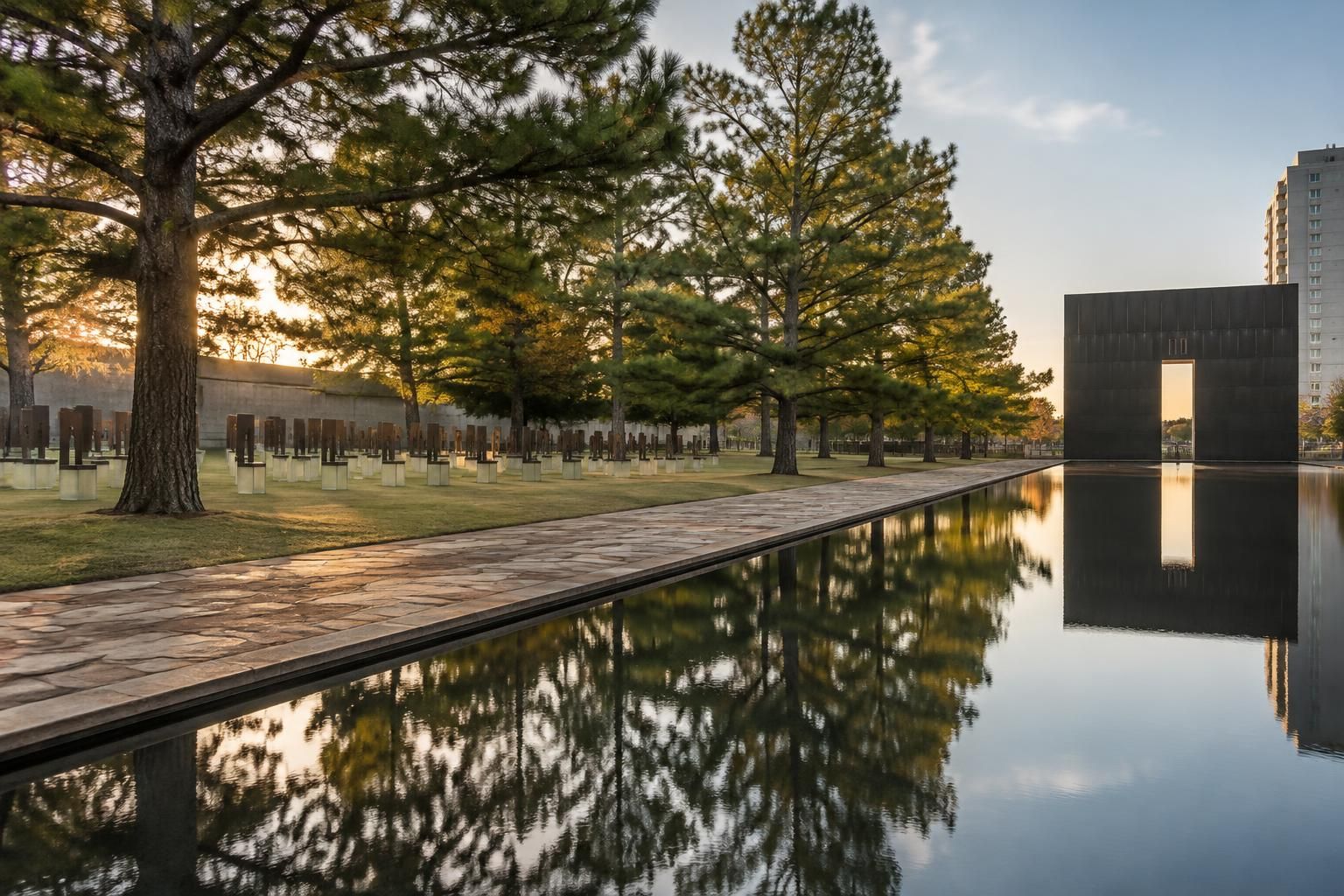
Visit the Outdoor Memorial Without Confusing It With the Indoor Museum
The outdoor setting offers a meaningful encounter with the events of April 19, 1995, when a domestic terrorist bombing killed 168 people in Oklahoma City. Its commemorative landscape supports remembrance through space, symbolism, and silence. The indoor institution provides a different form of engagement through exhibitions, historical evidence, and structured interpretation.
One experience should not be marketed as a substitute of equal scope for the other. Visitors deserve to know what they will encounter before arriving, especially when the subject carries personal or emotional significance. Clear descriptions also protect guides from having to explain a major change at the entrance.
Understand What Remains Accessible During October 19–25
The supplied announcement states that the grounds will remain open around the clock during the construction interruption. The store also remains open, but that does not establish identical operating hours for both. Travelers should check retail opening times separately and avoid assuming that all visitor services follow the outdoor schedule.
The following distinctions help convert a general travel advisory into practical decisions. They are particularly useful for reception teams, itinerary designers, and group leaders answering the same questions across multiple communication channels.
| Visitor component | Announced status | Planning response |
|---|---|---|
| 🏛️ Indoor galleries | Closed October 19–25 | Move the visit outside the closure window and verify admission availability. |
| 🌳 Outdoor Memorial | Grounds remain open | Plan a respectful outdoor visit and check current access guidance. |
| 🛍️ Memorial Store | Remains open | Confirm its own hours before making shopping part of the itinerary. |
| ♿ Arrival and circulation | Construction is taking place on site | Ask about current routes and any assistance required by your party. |
For Morgan’s group, the revised itinerary might say “guided outdoor remembrance visit, with independent reflection time.” That wording establishes the format without implying access to exhibitions. A separate note can explain that the indoor building is unavailable because of the expansion work.
Time allocation should follow the group’s needs rather than a promise that every visitor will respond in the same way. Some participants will want contextual explanation; others may prefer quiet observation. A schedule with breathing room accommodates both without turning remembrance into a sequence of rushed photo stops.
Build Respectful Interpretation Around the Setting
The Field of Empty Chairs, reflecting pool, Gates of Time, and Survivor Tree offer opportunities to discuss loss, survival, and collective responsibility. Guides should use verified interpretive information and avoid improvising personal stories about victims or survivors. Emotional force does not require dramatic embellishment.
Before starting, explain how the visit will work: where the group will gather, when commentary will pause, and where participants can step aside. For families, provide advance notice that the subject includes violence and death, allowing caregivers to decide how children participate.
Weather also changes the experience. An outdoor-only program needs a realistic response to rain, wind, heat, or cooler autumn conditions, including a clear decision about shortening or postponing the guided element. Do not promise indoor shelter unless its availability has been confirmed.
Photography guidance should respect other visitors’ privacy and the site’s commemorative purpose. Ask participants to keep pathways clear and avoid assembling large groups in places where others are reflecting.
A successful outdoor visit preserves the dignity of the setting while being honest about what the indoor closure removes. That same clarity should shape every message sent before arrival.
Update Oklahoma City Travel Plans Without Creating New Booking Problems
A temporary interruption can become a larger service problem when the information reaches different people at different times. A guide may know the galleries are unavailable while a hotel concierge continues recommending them, or a group leader may update a spreadsheet without changing the participant email. The result is avoidable disappointment rather than an unavoidable construction consequence.
Use one approved operational message across every customer-facing channel. It should state the affected dates, distinguish indoor and outdoor access, and explain the next step for anyone holding a reservation. Keep it short enough to reproduce accurately, but specific enough to prevent misleading shorthand.
Create a Travel Advisory That Answers Real Questions
A practical notice could read: “The National Memorial Museum is scheduled to close October 19–25 for Foreword construction. The outdoor grounds and Memorial Store remain open. Please check official information for ticket availability, service hours, and current access arrangements.”
This message avoids two common errors: announcing that the entire site is closed and suggesting that the indoor experience remains available in a reduced format. It also directs readers toward the source responsible for operational updates.
For travelers already booked, provide a direct contact route instead of assuming an automatic refund or transfer. Ticket conditions can differ between individual purchases, school arrangements, tour packages, and third-party reservations. The relevant seller or institution should explain the applicable options.
Morgan can manage the group change through a simple sequence. First, confirm whether the planned admission was actually purchased; next, contact the responsible booking office; then revise the schedule and communicate any confirmed financial consequences. This prevents a proposed alternative from being described as settled before the necessary arrangements exist.
Transport bookings deserve the same attention. A changed visit can affect coach standby time, driver schedules, meal reservations, and the sequence of other stops. Moving a single attraction without checking those dependencies may create a different operational failure later in the day.
Check Museum Hours and Accessibility Separately
Search results often display normal museum hours alongside a temporary closure announcement. These are not interchangeable pieces of information: regular opening times describe ordinary operations, while a dated interruption overrides them for the stated period. Saved itinerary templates should therefore carry both a visit date and a recent verification date.
Accessibility questions should be specific. Ask about the current step-free arrival route, distance from drop-off, available seating, accessible facilities, and whether construction affects the intended path. A general statement that a destination welcomes disabled visitors does not answer those route-level questions.
For a participant using a wheelchair, Morgan should verify the actual route rather than estimate suitability from an aerial map. For someone who finds prolonged standing difficult, identifying appropriate pauses may matter more than reducing the overall distance. Personalized questions lead to usable arrangements.
Digital communication should remain accessible as well. Put essential information in readable text rather than only inside an image, use descriptive links, and ensure that participants without a smartphone receive the same update. A printed departure sheet can provide a useful backup.
The Memorial’s official news updates offer a sensible reference point for checking institutional announcements. Assign one person to review updates before the trip and distribute changes, rather than relying on every traveler to interpret scattered reports.
The best disruption plan is a coordinated set of confirmed decisions, not simply a warning added to the itinerary. Audio technology can then support the revised experience without introducing another layer of uncertainty.
Use Smartphone Audio Respectfully During an Outdoor Memorial Visit
An outdoor group can struggle to hear a guide without the guide raising their voice. At a commemorative site, that creates a particular tension: interpretation should be understandable, yet the shared environment should remain calm. Smartphone-based audio can help address that problem when its use is permitted and the setup has been tested.
Technology should reduce friction, not dominate remembrance. A system is useful only if participants can connect easily, hear comfortably, and continue paying attention to their surroundings. An elaborate digital experience that requires constant troubleshooting is poorly matched to a reflective visit.
Match Audio Tools to the Actual Visitor Need
For a tour organizer, Grupem is one option to evaluate when considering a smartphone-based alternative to dedicated guiding equipment. The relevant decision is operational: does the proposed setup suit the group size, available devices, connectivity conditions, accessibility requirements, and site rules? Confirm the application’s current capabilities before building a paid service around them.
Do not imply that a guiding application is an official Memorial service or that it has a partnership with the institution unless that relationship is documented. Independent interpretation should be clearly identified as such. Participants should understand who prepared the content and where factual information originated.
Morgan could test the proposed setup with two colleagues before offering it to 24 travelers. One person speaks at a normal level while the others check intelligibility, connection stability, and the process for recovering after an interruption. This small rehearsal exposes problems more efficiently than troubleshooting them in front of the entire group.
Check device compatibility and battery readiness in advance. If the solution depends on a network connection, assess that dependency rather than assuming coverage will be adequate everywhere. A fallback might involve smaller groups, shorter spoken explanations in an appropriate location, or a printed interpretive sheet.
Headphone instructions should prioritize awareness. Participants need to hear safety guidance and notice people moving around them, especially near paths and construction-related diversions. Encourage a comfortable volume and pause commentary whenever the group needs to navigate.
Design Interpretation With Pauses, Choice, and Accessible Alternatives
Audio content should distinguish verified historical facts from interpretation. Brief explanations followed by intentional silence often serve this setting better than continuous narration. The guide can introduce a feature, offer essential context, and allow visitors to observe without filling every moment.
For example, Morgan might explain the commemorative role of the chairs before giving the group time to look independently. The purpose is not to prescribe an emotional response, but to provide enough understanding for a considered encounter. Visitors should be free to decline narration or leave the group temporarily under an agreed meeting arrangement.
Accessibility requires more than increasing volume. People who cannot use or comfortably hear an audio feed need an equivalent route to essential information, such as readable text or direct support. Where interpretation includes recorded speech, an accurate transcript is a practical companion.
Language choices also affect comprehension. Use clear sentences, explain unfamiliar references, and avoid sensational descriptions of the attack. Any translated material should be checked for historical accuracy and respectful terminology rather than accepted solely because it sounds fluent.
Finally, keep the screen interaction minimal. Participants should not have to stare at a device to understand where to stand or when to listen. The strongest audio experience makes the guide easier to hear while leaving the place itself at the center of attention. That principle also provides a useful lens for understanding the expansion.
Understand the Foreword Expansion Without Overstating What Comes Next
The temporary shutdown is linked to Foreword, described in the supplied announcements as a $12 million expansion of the Oklahoma City National Memorial & Museum. The project is intended to extend the telling of April 19, 1995, through new programming spaces, enhanced accessibility, and an improved welcome. These aims connect construction work with the institution’s long-term educational role.
For visitors, however, project ambition and immediate availability are separate questions. An addition can reach a construction milestone without all its spaces being ready for public use. Travel decisions should follow confirmed operational notices, not an assumption that visible progress means a new experience is already bookable.
Distinguish Construction Milestones From Public Opening Dates
Coverage of a structural milestone can explain how work is progressing, but it does not replace admission information. A report about framing, a roof, or another building stage concerns the construction sequence. Public access may depend on additional work, inspections, installation, staffing, and other preparations.
The News 9 coverage of the expansion’s construction milestone provides background on the project. Use such reporting to understand development, while relying on the institution itself for the conditions governing an actual visit.
This distinction is especially important for repeat travelers. Someone who has already visited may be interested specifically in the new addition rather than the existing galleries. Before purchasing a return trip, that person should verify which spaces will be accessible on the intended date and whether any newly announced activities require separate arrangements.
Morgan can apply the same approach to future group sales. Instead of advertising unspecified “new Foreword experiences,” the coordinator should describe only the facilities and programs that have been officially confirmed for the group’s arrival. Accurate scope is more valuable than an impressive but unverified promise.
Translate Accessibility Goals Into Practical Evaluation
Enhanced accessibility is a meaningful project objective, but the phrase needs to become observable in the visitor journey. Professionals evaluating a future visit should look at arrival, orientation, circulation, interpretation, rest opportunities, and departure. A strong experience connects these stages rather than improving one isolated feature.
For example, an easier entrance is most useful when travelers can also locate the correct check-in point and understand the available services. Clear pre-arrival information can reduce stress before anyone reaches the building. Consistent staff guidance then helps prevent conflicting instructions on site.
New programming spaces may support different forms of learning, but their existence alone does not establish the content, frequency, or eligibility of future activities. Schools and tour operators should ask about the specific program they need: intended age group, duration, booking requirements, capacity, and accessibility provisions. Those details determine whether an offering fits an itinerary.
The same discipline applies to digital interpretation. A new building does not automatically imply a particular audio platform, app integration, or device policy. Providers considering Grupem or another tool should coordinate with the venue and verify permissions rather than presenting their preferred technology as part of the official expansion.
After a future visit, feedback should be concrete. “The arrival instructions identified the correct entrance” or “the audio alternative needed clearer directions” gives an institution more actionable information than a broad rating of innovation.
Foreword’s relevance to travelers lies in the experiences it ultimately makes available, while the October interruption requires precise decisions today. The questions below address the practical points most likely to affect those decisions.
When will the OKC National Memorial Museum be closed?
The announced closure runs October 19–25, 2026, for construction associated with the Foreword expansion. Treat the full seven-day window as unavailable for indoor visits and check official information before booking surrounding dates.
Can you still visit the outdoor Memorial during the closure?
Yes. The supplied announcement states that the outdoor Memorial grounds remain open around the clock. The Memorial Store also remains open, but its operating hours should be checked separately.
Why do some reports mention October 24 instead of October 25?
Some coverage gives a shorter closure window, while the supplied institutional notice specifies October 19–25. Use the full announced period for planning and consult the official website for current access information.
What should you do if an existing reservation overlaps the shutdown?
Contact the institution or seller responsible for the reservation to confirm the available options. Do not assume that a refund, transfer, or replacement activity has been arranged automatically.
Does the end of the closure guarantee access to the Foreword addition?
No. The end of a temporary construction closure and the public opening of new facilities are separate operational matters. Confirm admission availability and which spaces will be accessible on your intended visit date.
