
Illinois Holocaust Museum Reopening: Plan Your November 11 Visit
The Illinois Holocaust Museum & Education Center will reopen its Skokie campus on Wednesday, November 11, 2026, according to its October 15 announcement. The date coincides with Veterans Day, and active military personnel, veterans, and their families will receive free admission that day.
The museum reopening follows an extensive renovation designed to expand visitor spaces, strengthen the permanent exhibition, and support additional educational programming. For returning guests, this means more than a refreshed building: the announcement describes changes to how people arrive, encounter historical testimony, gather for discussion, and find space for reflection.
Before making travel arrangements, consult the museum’s official reopening announcement and its current booking information. Opening-day admission benefits are confirmed, but reservation requirements, available time slots, and individual experience schedules should be checked separately.
November 11 Admission: What Visitors Should Check Before Traveling
📅 Treat admission, transportation, and exhibition access as separate planning decisions. A ticket establishes entry under its stated conditions; it should not be interpreted as confirmation that every theater, presentation, or guided activity is available at your preferred time. This distinction matters particularly when coordinating several households or a school group.
Consider a hypothetical school coordinator, Maya, preparing a visit for secondary-school students. Rather than building the itinerary around assumptions, she first checks group booking procedures, asks about the suitability of particular experiences, and confirms where her students should assemble upon arrival.
That approach also benefits independent travelers comparing Illinois attractions. A history museum dealing with persecution, genocide, and survival deserves an itinerary that allows sustained attention rather than a hurried stop between unrelated activities.
- 📅 Confirm the date and entry arrangements: check current hours, ticket availability, and any opening-day instructions.
- 🎖️ Check Veterans Day eligibility: ask how the complimentary admission offer applies to your party and whether advance booking is required.
- 👥 Coordinate group arrivals: establish a meeting point and ask about procedures for organized visits.
- ♿ Discuss access needs: request current information about mobility access, seating, captioning, and other relevant accommodations.
- 🕊️ Leave room for pauses: avoid scheduling every available minute around a presentation or exhibit.
Build a Realistic Illinois Holocaust Museum Itinerary
For Maya’s group, the practical question is not simply how much material can fit into a morning. It is which experiences will support the learning objective without overwhelming attention or leaving students without time to ask questions.
A workable plan might prioritize the core Holocaust exhibition, include one additional experience after confirming availability, and reserve a discussion period afterward. This is a planning example, not a published museum itinerary or a recommendation about the institution’s official visit duration.
Families can apply the same principle by discussing expectations beforehand. Explain that some material concerns severe persecution and mass murder, establish that anyone can request a pause, and avoid treating completion of every gallery as the measure of a worthwhile visit.
Keep the location distinction clear when booking. The reopening concerns the Skokie campus, while the downtown Experience360 satellite has its own operating timeline; confusing the two could create unnecessary travel and missed reservations.
For tour operators, written confirmation is especially useful. A short pre-visit message containing the correct venue, arrival instructions, confirmed activities, and a contact method reduces uncertainty without burdening guests with an oversized information pack.
A well-prepared visit begins with confirmed arrangements and enough flexibility to engage thoughtfully with the history. Those decisions become easier when you understand what has changed inside the building.
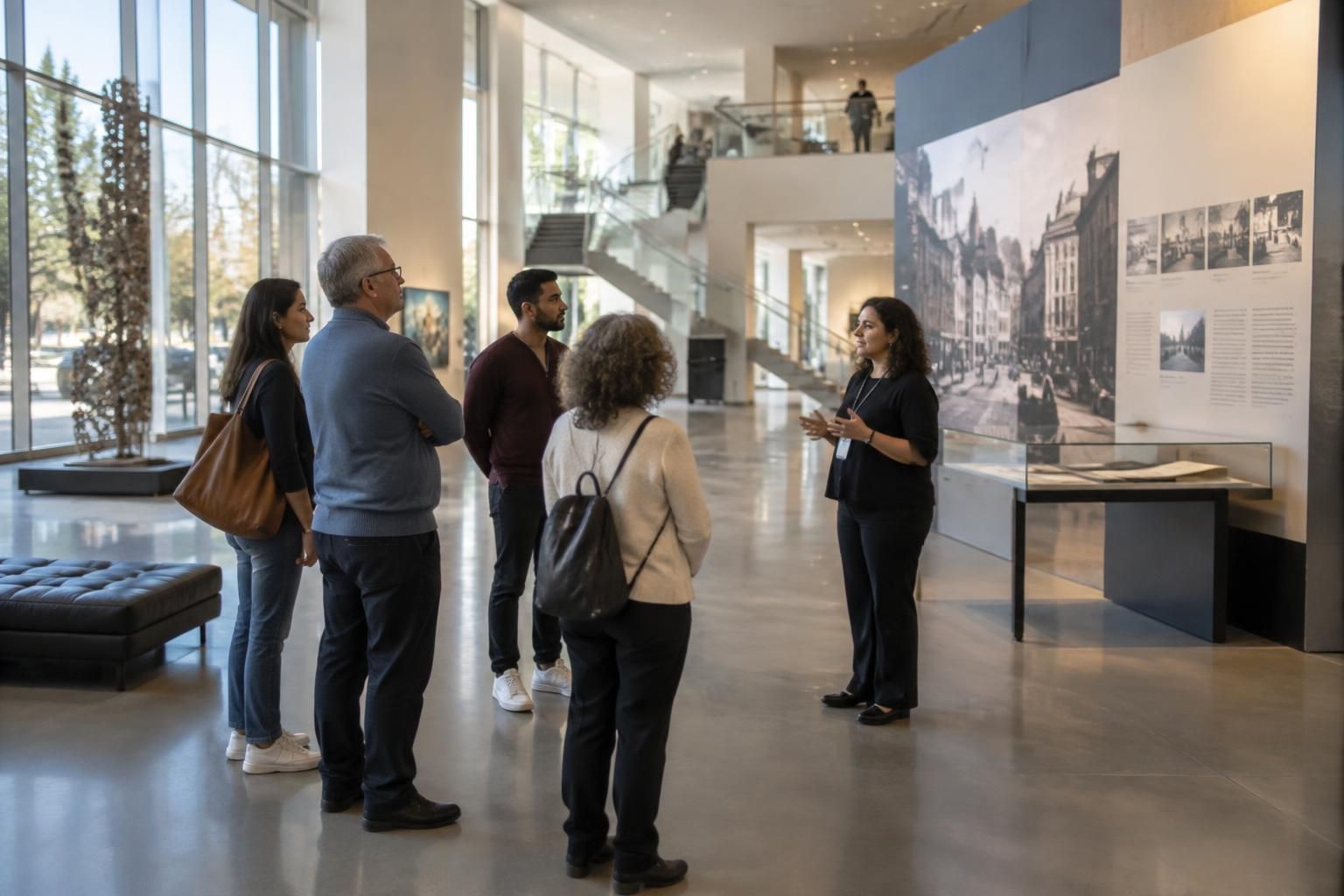
Renovated Illinois Holocaust Museum Spaces Improve the Visitor Welcome
The renovation connects several stages of the visit, from initial orientation to public discussion and quiet reflection. Its significance lies in how these functions work together: a welcoming entrance helps people settle, clear exhibition pathways support concentration, and spaces for conversation allow historical questions to be explored beyond display labels.
The Shapiro Family Foundation Welcome Center has an enlarged lobby intended to accommodate more guests. The announcement also identifies a reimagined Lillian & Larry Goodman Auditorium and Gallery, a new reflection gallery, and improvements to the lower-level Dr. Joy Erlichman Miller and John Miller Resilience Hall.
These are distinct improvements, not interchangeable descriptions of additional floor space. A lobby supports arrival and orientation, an auditorium accommodates collective listening, and a reflection area offers a different pace after demanding content.
How the Skokie Museum Renovation Supports Different Visitor Needs
For museum visitors, the practical benefit of a larger arrival area depends on how clearly the next steps are communicated. Guests need to understand where to check in, where their group should wait, and how to reach the first part of their planned experience.
In Maya’s hypothetical school visit, the coordinator handles the booking while another accompanying adult keeps students together. This simple division of responsibility prevents an administrative question from becoming a crowd-management problem and allows staff to provide instructions without competing conversations.
The expanded stage in Resilience Hall creates additional possibilities for presentations and public programs. Organizers should still confirm room configuration, equipment, and access arrangements for a specific event rather than assuming that a renovated venue automatically meets every technical requirement.
| Renovated space | Announced change | Practical planning point |
|---|---|---|
| 👋 Shapiro Family Foundation Welcome Center | Enlarged lobby and renewed arrival environment | Confirm check-in and group meeting procedures. |
| 🎤 Lillian & Larry Goodman Auditorium and Gallery | Reimagined setting for a broad range of programming | Check event schedules and access arrangements. |
| 🕊️ Reflection gallery | New quiet space accessible from the core exhibition | Allow time for an optional, unhurried pause. |
| 🎭 Resilience Hall | Refreshed lower-level venue with an expanded stage | Confirm presentation format and seating requirements. |
Why the New Reflection Gallery Matters for Holocaust Remembrance
The new reflection gallery is accessible from the Zev & Shifra Karkomi Holocaust Exhibition. Its purpose is particularly relevant in a setting where visitors may encounter difficult testimony, recognize connections to family histories, or need time to process unfamiliar information.
Silence should not be mistaken for disengagement. Someone who steps away from a discussion may be responding thoughtfully, and an educator should not require an immediate public reaction as proof that the material has been understood.
For Maya, this means distinguishing a quiet pause from a scheduled classroom exercise. Students can be offered time to sit or reflect without being asked to share personal feelings in front of peers.
The same care applies to organized adult tours. Guides can explain where a quieter space is available while avoiding assumptions about who will need it or why; individual responses cannot be predicted from age, background, or familiarity with the subject.
From an operational perspective, these changes demonstrate why visitor welcome is not merely a hospitality phrase. Arrival, orientation, listening, and recovery all affect whether people can remain attentive to the exhibition’s central purpose.
The strongest spatial improvement is one that gives people the conditions to engage, rather than simply the capacity to move through. At Skokie, that engagement remains grounded in historical evidence and individual lives.
Expanded Holocaust Education Connects Historical Context With Individual Stories
The renewed Zev & Shifra Karkomi Holocaust Exhibition will include expanded material on the roots of antisemitism, the story of Chicago resident Leo Edelman, and the experiences of other groups targeted by the Nazis. These additions extend the historical framework while preserving the importance of individual testimony.
Effective Holocaust education requires both scales of understanding. Visitors need to examine institutions, ideology, laws, and collective participation, but they also need to recognize the people whose lives cannot be reduced to dates or categories.
The museum’s announcement connects its reopening with concern about contemporary antisemitism and hatred. That relevance should encourage careful inquiry rather than rushed comparisons: present-day responsibilities are better understood when the historical record is explained accurately and in context.
Understanding Antisemitism Without Flattening Historical Differences
Material on the roots of antisemitism can help visitors recognize that Nazi persecution did not emerge without precedent. Long-standing prejudice provided ideas and stereotypes that could be adapted, intensified, and embedded within political institutions and state policy.
Yet continuity does not mean that every period was identical. Good interpretation distinguishes the setting, actors, and mechanisms involved, enabling learners to understand how discrimination developed into exclusion, dispossession, deportation, and genocide.
For Maya’s students, a useful preparation task is to identify the difference between a stereotype, a discriminatory rule, and an act of persecution. During the visit, they can then look for documented examples of how these mechanisms interacted, rather than searching only for a general message about kindness.
The expanded attention to other groups persecuted by the Nazis also requires precision. Different communities faced different policies, experiences, and forms of violence; explaining those distinctions strengthens understanding without diminishing the central history of the Holocaust.
Using Survivor Testimony Responsibly at the Illinois Holocaust Museum
The institution identifies the Abe & Ida Cooper Survivor Stories Experience holographic theater and the Richard & Jill Chaifetz Family Virtual Reality Theater among the experiences that remain part of its offering. The Take A Stand Center and Voices of Genocide Exhibition also continue within the broader educational environment.
These formats should be understood as ways to encounter curated historical material, not as substitutes for evidence or human relationships. Recorded testimony remains testimony presented through a technical system; it should not be described as unrestricted live conversation with a survivor.
A guide can make that distinction in one clear sentence before an experience begins. Doing so helps participants understand what they are hearing, how the presentation is mediated, and why the speaker’s original context matters.
Leo Edelman’s Chicago connection provides another route into the material. A local reference can help learners recognize that survivors’ lives continued in communities familiar to them, while keeping the individual’s documented biography—not a generalized inspirational narrative—at the center.
Afterward, Maya might ask students to identify one historical fact they learned, one source that supported it, and one question requiring further research. This separates knowledge from emotional response while allowing both to have a place in discussion.
Such an exercise is more constructive than asking participants to imagine that they fully understand a survivor’s experience. Empathy matters, but it should not erase the distance between witnessing testimony and having lived through the events described.
Holocaust remembrance gains depth when personal stories, reliable evidence, and historical distinctions remain connected. Digital interpretation is valuable when it protects those connections rather than competing with them.
Accessible Audio and Digital Interpretation Should Support the Museum Experience
The reopening also offers a useful case for tourism professionals assessing digital mediation. At a site devoted to persecution, survival, and responsibility, technology should make information easier to access without turning solemn material into a demonstration of technical novelty.
The announcement confirms the continued role of immersive and testimony-based experiences, but it does not establish a new smartphone audio service or a partnership with Grupem. The audio practices below are operational recommendations, not claims about services installed at the Skokie campus.
That distinction matters when planning guided visits. An organizer should ask what equipment and formats are permitted, what support is available, and whether personal devices can be used in the relevant spaces before promising a particular listening experience.
Improve Guided Listening Without Adding Unnecessary Complexity
Clear speech is the first requirement. A guide who speaks at a measured pace, pauses between ideas, and avoids talking over exhibition sound can often improve comprehension before any additional equipment is introduced.
For permitted group activities, smartphone-based audio tools such as Grupem can be considered alongside dedicated receiver systems. Selection should depend on the actual visit: device availability, connectivity requirements, battery needs, staff support, and compatibility with the venue’s rules all deserve attention.
The most useful comparison is not which option appears most modern. It is which arrangement enables participants to hear reliably while keeping setup, troubleshooting, and screen handling to a minimum.
For Maya’s group, a short test before departure would be more valuable than discovering a device problem at the gallery entrance. Students could check volume, headphone comfort, and basic controls in a neutral setting, leaving their attention available for the educational experience itself.
Any such plan also needs an alternative for people without a suitable phone or those who prefer not to use one. A personal-device approach becomes exclusionary when participation depends on owning compatible hardware or having sufficient battery capacity.
Make Illinois Holocaust Museum Visits Accessible Beyond Audio
Audibility and accessibility are related, but they are not identical. Increasing volume does not solve every listening barrier, while captions, readable text, seating, and clear orientation may be equally important for particular visitors.
Ask the venue about the specific provisions available for your planned activities. Do not assume that every presentation offers the same captioning, language support, sensory conditions, or access arrangements simply because another part of the institution does.
Content preparation matters too. Explaining that a segment includes testimony about persecution allows people to make informed decisions about participation, while a discreet way to request assistance preserves dignity.
Privacy deserves the same practical attention. Where an outside digital tool is being considered, assess whether it requires accounts, collects personal information, or introduces unnecessary steps; school groups may have additional organizational requirements for student devices and data.
Finally, evaluate the experience using concrete questions. Could participants understand the speaker? Did setup delay the visit? Were alternatives available? Did technical handling distract from testimony or interfere with nearby guests?
A modest tool that performs reliably is more useful than an elaborate system that demands constant intervention. This is especially true in a remembrance setting, where interruptions can break concentration and make a sensitive encounter feel procedural.
Useful innovation reduces barriers while keeping the historical voices—not the interface—at the center. That principle also helps organizers choose among the programs and venues available after reopening.
Illinois Holocaust Museum Programs After November 11: Exhibitions and Experience360
The reopening date does not mark the start of every announced exhibition. Blacklist: The Hollywood Red Scare opens on November 15, four days after the Skokie campus welcomes visitors back, and is scheduled to remain in the special exhibition gallery through March 2027.
Created by and on loan from Jewish Museum Milwaukee, the exhibition examines relationships among politics, antisemitism, freedom of speech, and national security during the Red Scare of the 1940s and 1950s. These themes offer a distinct historical focus alongside the institution’s core Holocaust exhibition.
Visitors interested specifically in this temporary presentation should therefore plan for November 15 or later. A November 11 reservation should not be treated as access to an exhibition whose announced opening falls on a different date.
Explore Blacklist: The Hollywood Red Scare With Historical Precision
The subject creates opportunities to examine how political pressure can affect employment, cultural production, and public expression. For educators, its value lies in asking how those pressures operated through particular institutions, decisions, and professional consequences.
It also calls for disciplined comparison. The Hollywood blacklist and the Holocaust are not equivalent events; placing their histories within one institution does not remove the need to distinguish their scale, aims, mechanisms, and consequences.
Maya could prepare an older student group by asking how evidence should be assessed when someone is accused of disloyalty. During a later discussion, students might consider the relationships among public allegations, professional exclusion, and freedom of expression without assuming that every historical dispute has a direct present-day counterpart.
A cultural tour organizer could take a different approach, connecting the presentation to film history and the working conditions of writers, performers, and other industry professionals. The strongest route would remain anchored in the exhibition’s documented material rather than speculative parallels.
Before attaching a talk or workshop to either itinerary, check the published calendar. The renovated auditorium and expanded presentation space create opportunities for programming, but they do not themselves confirm particular speakers, dates, or formats.
Experience360 Remains a Separate Chicago Option Through December 31
During the Skokie renovation, the institution operated Experience360 in Chicago’s River North neighborhood. According to the reopening announcement, this satellite location will remain open through December 31, 2026.
That creates a period when travelers can consider both locations, subject to their respective booking arrangements. They should not assume that the downtown site duplicates the full Skokie experience or that admission at one automatically includes the other.
For a downtown-based group with limited travel time, checking Experience360’s current offerings may be practical. For a visit centered on the renovated permanent exhibition, the new reflection gallery, or the reopened campus itself, the relevant destination is Skokie.
Communicate the address associated with each reservation clearly in confirmation messages. A venue name alone can be insufficient when an institution is operating more than one location during a transition period.
The Illinois Holocaust Museum’s official website is the appropriate starting point for current tickets, location details, and program schedules. The Chicago Gallery News reopening coverage also provides context on the campus changes and Veterans Day timing.
For professional planners, keep an updateable itinerary rather than circulating assumptions as settled details. Identify confirmed reservations, optional activities, and unanswered logistical questions separately so colleagues know what still requires attention.
The right booking is the one that matches your educational purpose, the correct location, and the exhibition’s actual opening date.
When does the Illinois Holocaust Museum reopen in Skokie?
The Skokie campus is scheduled to reopen on Wednesday, November 11, 2026, following an extensive renovation. Check the official website for current hours, reservations, and opening-day instructions.
Who receives free admission on November 11?
The announced Veterans Day offer provides free opening-day admission to active military personnel, veterans, and their families. Confirm reservation procedures and any eligibility requirements directly with the museum before traveling.
What has changed inside the renovated museum?
Announced improvements include an enlarged welcome center lobby, a reimagined auditorium and gallery, additions to the core Holocaust exhibition, a new reflection gallery, and a refreshed Resilience Hall with an expanded stage.
Will Blacklist: The Hollywood Red Scare be open on reopening day?
No. The temporary exhibition is scheduled to open on November 15, four days after the campus reopening, and remain on view through March 2027.
Will Experience360 close when the Skokie campus reopens?
The announcement states that Experience360 in Chicago’s River North neighborhood will remain open through December 31, 2026. Check its separate offerings, location details, and admission arrangements before booking.
