
Hays Foundation Matching Funds Give the Save Sternberg Campaign a Financial Bridge
The Bob and Pat Schmidt Foundation’s offer of up to $1 million in matching funds changes the immediate fundraising prospects for the Sternberg Museum of Natural History at Fort Hays State University. Rather than providing an unconditional payment, the Hays-based organization has pledged to match qualifying contributions dollar for dollar, giving individuals and businesses a stronger incentive to participate.
The distinction matters. A matching commitment becomes available as eligible gifts are secured, so the announcement creates an opportunity rather than confirming that the full amount has already reached the institution.
According to the supplied reporting, university officials announced in September 2026 that public access would end in December because the institution could no longer sustain the operating shortfall. The proposed closure followed a $2.4 million reduction in state appropriations to the university associated with the 2026 Kansas legislative budget.
The foundation’s intervention offers time to develop a different approach. Its stated purpose is to address near-term financial pressure while university leaders work toward a sustainable operating model, not to replace that planning with a single successful appeal.
How the $1 million donation match works for eligible supporters
Under the announced terms, contributions from individuals and businesses specifically designated for the Save Sternberg fundraising campaign through the FHSU Foundation qualify for the incentive. Gifts from other foundations do not qualify, although those organizations can still provide valuable support outside the matching arrangement.
For example, an eligible $250 contribution could generate another $250 from the pledged pool, producing $500 for the appeal. A qualifying $10,000 business gift could produce $20,000, provided the commitment remains available and the contribution meets the administrator’s requirements.
Fully using the offer would require $1 million in eligible contributions, potentially producing $2 million when combined with the foundation’s match. That is the maximum combined value of this mechanism, not a statement that the amount has already been raised.
The FHSU Foundation’s matching-gift announcement is the appropriate starting point for understanding the offer. Before arranging a substantial payment or pledge, supporters should confirm eligibility, designation instructions, applicable deadlines, and how their contribution will be credited.
Why community philanthropy needs accurate campaign language
The supplied account reported $237,000 already contributed when the initiative was announced. That figure represents a fundraising snapshot; it should not be treated as a live total, or automatically doubled without confirmation that every included contribution qualifies.
Consider a hypothetical Hays business owner, Morgan, who wants to encourage employees to participate. A clear message would explain that eligible gifts can be matched while funds remain available, rather than promising that every payment will always be doubled.
That precision protects confidence in charitable giving. If a supporter later discovers that an organizational gift falls outside the rules, the problem is not necessarily the arrangement itself; it may be the way the appeal was communicated.
The organization behind the pledge also has a strong local connection. Bob Schmidt worked in radio and owned the business that became Eagle Communications, which operates across Kansas, Nebraska, and Minnesota and was eventually purchased by its employees.
The family’s emphasis on community-building helps explain why this Hays Foundation initiative extends beyond a single attraction. Preserving a regional institution supports education, civic identity, and access to knowledge, while the conditional structure asks the wider community to share responsibility.
💡 The matching offer is most useful when supporters understand both its leverage and its limits. The next question is whether the money raised can address the underlying annual funding requirement.
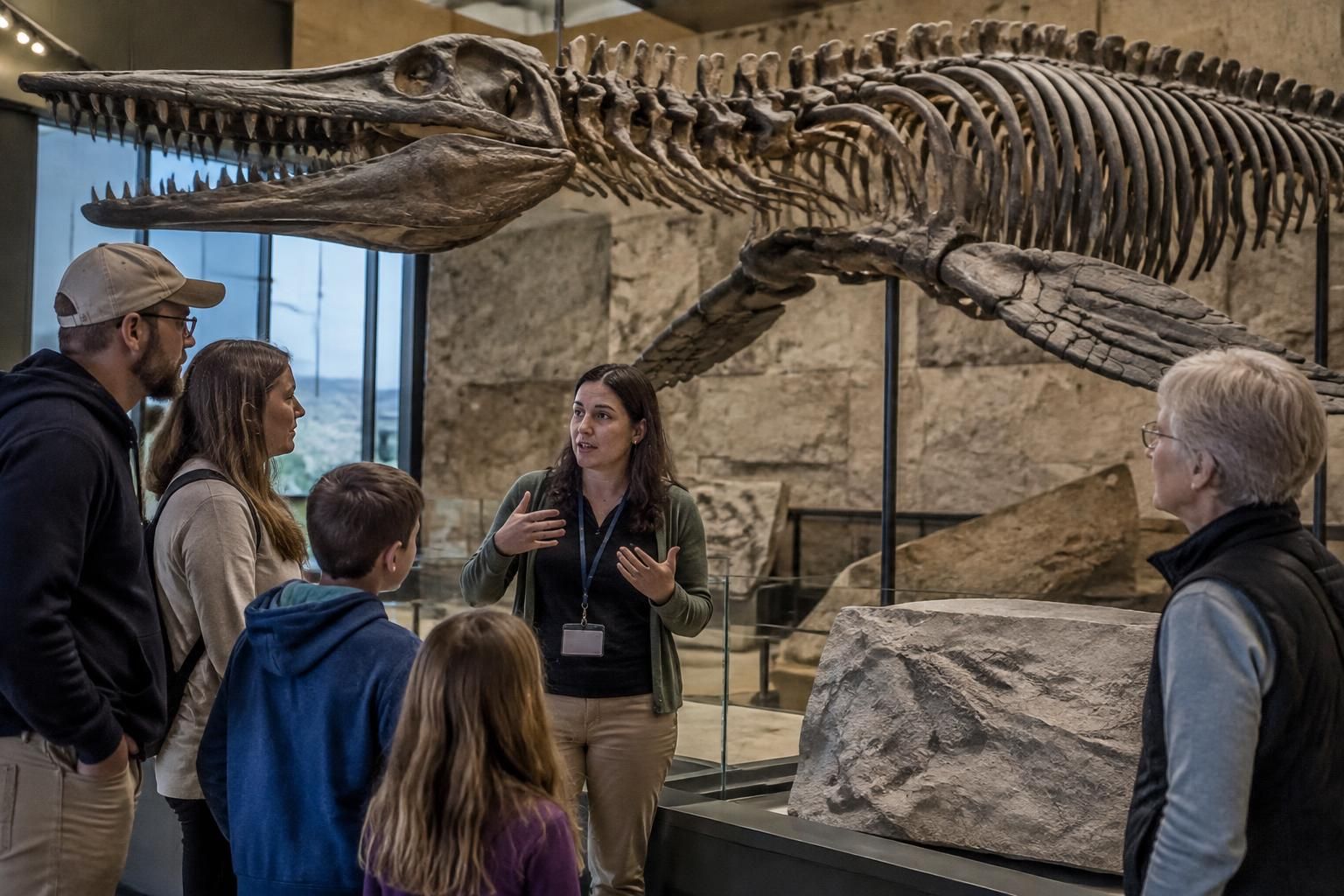
Why Saving the Sternberg Museum Requires Recurring Revenue
The financial challenge is larger than the immediate appeal. Fort Hays State University President Tisa Mason described a need for approximately $1 million in new revenue every year, making clear that a one-time payment cannot permanently resolve a recurring operating problem.
That requirement should guide how supporters interpret the announcement. A successful drive can protect continuity and create planning time, but it cannot establish long-term stability unless the institution also develops reliable income or changes its cost structure.
The supplied figures place average annual expenditure at approximately $1.3 million, against annual revenue of around $470,000. Subtracting those amounts produces an indicative gap of $830,000, which broadly aligns with the university’s estimate that closure would save approximately $850,000 annually.
Those numbers describe different measurements. The operating difference, estimated institutional savings, and leadership’s annual revenue target should not be presented as interchangeable accounting totals.
| Financial measure | Reported amount | Practical meaning |
|---|---|---|
| 📊 Average annual expenditure | Approximately $1.3 million | The reported cost of running the institution |
| 🎟️ Average annual revenue | Approximately $470,000 | Existing income does not cover expenditure |
| 🧮 Indicative annual difference | Approximately $830,000 | Arithmetic comparison of the two reported averages |
| 🏛️ Estimated annual closure savings | Approximately $850,000 | The university’s estimate, not a complete collections-care budget |
| 🔁 Stated recurring revenue need | Approximately $1 million annually | The planning requirement identified by university leadership |
| 🤝 Maximum matching commitment | $1 million | A conditional, one-time incentive rather than guaranteed annual income |
Separate the fiscal year 2027 bridge from the permanent operating plan
The campaign was described as a way to bridge the fiscal year 2027 budget gap. The supplied account also identified a December 31 fundraising target, placing the immediate appeal within the late-2026 effort to prevent the planned loss of public access.
A bridge and a permanent solution serve different purposes. The first buys time for decisions; the second determines how staffing, facilities, collections care, and public programming can be supported after emergency contributions are spent.
Suppose Morgan’s company offers a substantial gift this year but cannot repeat it annually. That contribution can still be valuable, provided the budget treats it as temporary support rather than assuming it will recur.
By contrast, a smaller three-year commitment can improve forecasting if its terms and payment schedule are clear. Financial resilience depends not only on the size of contributions but also on their timing, restrictions, and reliability.
Build several income streams without overstating their potential
A practical review could examine memberships, educational contracts, business sponsorships, admission income, grants, and recurring donations. Each option should be assessed against delivery costs and available staff capacity, rather than judged only by its gross receipts.
For example, a school workshop may generate revenue while also requiring educator time, preparation, materials, and scheduling support. Its financial contribution is what remains after those obligations, alongside its educational value.
An endowment could support a longer horizon, but its scale must be understood. At a hypothetical 4% annual distribution rate, generating $1 million a year would require approximately $25 million in invested principal; this is an illustration, not an announced institutional target or investment recommendation.
The reporting on a potential path forward provides context for the distinction between maintaining operations temporarily and redesigning them. Supporters should look for clear milestones connecting the appeal to that longer process.
🔎 Emergency funding should purchase measurable planning time, not obscure the recurring deficit. That planning must account for the collection’s scientific responsibilities as well as the visitor-facing experience.
Museum Preservation Protects Scientific Collections and Great Plains Cultural Heritage
The Sternberg Museum holds approximately three million geology, zoology, and paleontology specimens, according to the supplied reporting. That scale makes its financial position a matter of scientific stewardship as well as public access.
Visitors usually encounter selected displays, not the full holdings behind them. A fossil in a gallery may be memorable, but its research value also depends on its identification, collection location, documentation, and relationship to other specimens.
The institution began taking shape in the early 1900s and documents life in the Great Plains region. Its significance therefore rests on a long accumulation of knowledge, not simply on the number of objects available for exhibition.
Museum preservation includes records, expertise, and appropriate care alongside physical storage. Without these supporting systems, an object can survive while becoming harder to interpret, study, or responsibly use.
Distinguish closing public galleries from caring for specimens
A proposal to close public access does not, by itself, establish what would happen to every collection or research function. Those questions require separate decisions about custodianship, staffing, facilities, access policies, and continuing obligations.
Campaign communications should avoid presenting a public closure as proof that the holdings would immediately disappear or be discarded. Equally, keeping gallery doors open is not sufficient evidence that every behind-the-scenes responsibility has been funded.
Consider a hypothetical school group encountering a prehistoric marine fossil. An educator can explain how evidence from ancient environments helps students understand a landscape that now appears very different.
That encounter relies on more than a display label. It draws on accurate documentation, informed interpretation, appropriate presentation, and a person capable of translating scientific evidence into an accessible explanation.
Make collections care understandable to donors
Supporters respond more effectively when institutional needs are described in concrete terms. Rather than using only a broad phrase such as “protecting history,” communications can explain the work involved in maintaining specimen records, monitoring storage conditions, and supporting research access.
Different materials need different treatment. Geological specimens, prepared fossils, and zoological holdings do not necessarily share the same storage requirements, so any preservation plan should follow the collection’s actual composition and professional assessment.
A useful public-facing explanation could distinguish three areas of responsibility:
- 🦴 Physical stewardship: appropriate storage, handling procedures, condition monitoring, and necessary conservation.
- 🗂️ Information stewardship: dependable catalog records, associated documentation, and secure data management.
- 🎓 Public and research access: educational interpretation, scholarly use, and clear procedures for authorized access.
These categories help explain why a collection cannot simply be treated as inventory. Its value comes from the relationship between material evidence, reliable information, and the people who can make that evidence meaningful.
Digital interpretation can widen access to selected knowledge, but it does not replace the original material. A photograph may show a fossil’s surface clearly while leaving questions that require physical examination or specialist analysis.
The same principle applies to cultural heritage. Regional identity becomes more useful educationally when it is connected to evidence and explained carefully, rather than presented as a sentimental claim detached from the holdings.
For a business supporter such as Morgan, this provides a stronger case for involvement: the contribution helps sustain an educational and scientific resource, not merely a place to visit occasionally. Protecting the collection means preserving the chain from specimen to knowledge to public understanding.
Accessible Visitor Technology Can Support Sternberg Without Replacing Core Funding
Visitor technology belongs in the sustainability discussion, but its role should remain proportionate. Clearer interpretation, easier navigation, and better audio delivery can improve the public experience; none should be presented as a substitute for the recurring revenue requirement.
For a natural history institution, the useful question is not whether a tool appears innovative. It is whether that tool helps people understand exhibits, reduces avoidable friction, and can be maintained within realistic staff and financial limits.
A smartphone-based audio approach is one option worth evaluating. Grupem turns smartphones into audio guides for guided visits, offering a practical reference point for organizations reviewing how to deliver spoken interpretation without automatically investing in a dedicated fleet of receivers.
There is no claim here that the Sternberg Museum has adopted that application. Any proposed deployment would need to be tested against its actual spaces, visitor profiles, connectivity, accessibility requirements, and operating procedures.
Test audio interpretation against real visitor needs
Imagine Morgan visiting with an older relative and a teenager. The group may share an interest in prehistoric life, yet differ in hearing needs, familiarity with mobile interfaces, and tolerance for long explanations.
A useful pilot would assess whether each person can join the experience easily, hear clearly, and continue moving safely. The evaluation should also identify what happens when a battery runs low, a device is unsuitable, or a visitor prefers not to use a phone.
Accessibility requires alternatives, not a smartphone-only rule. Written information, clear signage, and a practical non-digital route should remain available, with any additional accommodations planned around the audience and the institution’s resources.
Audio content should be designed for the setting. A short explanation of a specimen’s significance may serve visitors better than a lengthy recording that repeats every word already displayed beside it.
For guided groups, the relevant measures include intelligibility, setup time, assistance requests, and whether participants can follow the educator comfortably. These observations are more useful than adopting a system solely because it offers a long feature list.
Calculate the full cost before claiming savings
A pilot budget should include software charges, content preparation, staff training, technical support, and any accessories or connectivity arrangements required. Existing equipment should be compared on the same basis, including maintenance, cleaning, charging, and replacement costs.
For example, if a proposed service costs less to license but requires substantial staff intervention on every visit, the apparent saving may disappear. Conversely, a reliable setup that reduces preparation time could offer a meaningful operational benefit.
Content maintenance also matters. Scientific information, opening arrangements, and visitor instructions need an identified owner so that recordings and supporting materials remain accurate rather than becoming abandoned digital assets.
The Grupem article on the Sternberg Museum’s future provides a complementary starting point for considering public experience alongside institutional sustainability. Those discussions should remain connected without confusing better interpretation with guaranteed financial recovery.
A narrowly scoped trial is more defensible than an immediate institution-wide purchase. One guided route or school session can reveal practical issues before staff commit time and money to a broader rollout.
🎧 Useful technology earns its place through clearer communication and manageable costs. Evidence from that kind of testing can then support honest conversations with sponsors about specific, deliverable improvements.
Turn Community Support Into Accountable Charitable Giving for Save Sternberg
A strong appeal gives supporters a clear route from interest to action. For the Save Sternberg effort, that means explaining where to contribute, what qualifies for the incentive, and how immediate financial relief connects to the institution’s longer-term responsibilities.
Individuals and businesses should use the authorized FHSU Foundation process and identify the intended designation clearly. Before sending a large payment, arranging an employee drive, or promising a future installment, they should obtain confirmation of how that transaction will be handled.
Community support becomes more dependable when expectations are documented. A written explanation of gift restrictions, acknowledgment procedures, and applicable matching conditions reduces misunderstandings for both contributors and administrators.
For Morgan’s hypothetical company, the first step would be to ask whether employee contributions should be made individually or collected through a single business payment. The correct arrangement depends on the administrator’s rules, not on assumptions about which method seems simpler.
Give supporters a practical checklist before they contribute
The appeal can make participation easier by answering routine questions consistently. A short checklist helps people move forward while preventing volunteers or partner organizations from inventing their own interpretations.
- ✅ Confirm the recipient: use the FHSU Foundation’s authorized contribution process.
- 🏷️ Specify the purpose: designate the gift for Save Sternberg as instructed.
- 🤝 Check matching eligibility: verify donor category, timing, and whether funds remain available.
- 📅 Clarify payment terms: distinguish an immediate contribution from a pledge or installment plan.
- 🧾 Keep documentation: retain the acknowledgment and seek appropriate advice for tax questions.
These steps also help local organizations coordinate responsibly. A retailer promoting a benefit event should explain what portion of proceeds will be donated and avoid suggesting that customer spending itself automatically qualifies for the foundation’s incentive.
Similarly, a company offering its own employee match should clarify how its program interacts with the external commitment. Multiple incentives can be helpful, but their combined treatment must be confirmed rather than advertised as automatic multiplication.
Report progress in ways that preserve trust
Public updates should distinguish money received, unpaid pledges, eligible gifts, matching amounts credited, and any restricted contributions. Combining all those categories into one headline number can make progress appear clearer while leaving the actual cash position difficult to understand.
The historical $237,000 figure should therefore be labeled by the date or stage of the appeal at which it was reported. A newer update should replace it only when an authoritative source supplies a revised total.
Donors also need evidence that the bridge is being used productively. Appropriate milestones could include a completed operating review, an approved revenue strategy, or documented decisions about educational services and collections responsibilities; these are recommended reporting categories, not announced achievements.
The Kansas Reflector account of the foundation pledge helps establish the reported financial context. For ongoing campaign administration, the official foundation remains the source to consult.
Tourism professionals considering group visits can also use the visitor-experience perspective on Sternberg’s future alongside direct confirmation of current opening and booking arrangements. Fundraising coverage alone should not be treated as a guarantee that a particular date or program is available.
For local employers, guides, schools, and cultural partners, effective involvement is specific: a verified contribution, a workable educational partnership, or a clearly defined service commitment. Accountable participation turns public enthusiasm into support the institution can actually plan around.
Which Hays foundation offered the $1 million match?
The Bob and Pat Schmidt Foundation pledged up to $1 million to match qualifying contributions to the FHSU Foundation’s Save Sternberg campaign. The offer is conditional on eligible gifts being secured.
Which donations qualify for matching funds?
The announced terms cover contributions from individuals and businesses designated for Save Sternberg through the FHSU Foundation. Gifts from other foundations are excluded from the incentive. Confirm current timing, payment, and eligibility requirements with the campaign administrator.
Could the offer generate $2 million for the campaign?
Yes. If the full $1 million commitment is unlocked by $1 million in eligible contributions, the combined amount would be $2 million. That potential total does not mean the money has already been received.
Would a successful campaign permanently solve the museum’s financial problems?
No. University leadership identified a recurring need of approximately $1 million in new annual revenue. The matching initiative is intended to bridge immediate needs while a sustainable operating plan is developed.
What should visitors check before planning a trip?
Confirm current opening arrangements, ticket availability, and group-booking conditions directly with the institution. A funding announcement or historical campaign update does not by itself confirm access for a particular visit date.
