
Donna Museum Time Capsule Opening: Date, Location, and What Visitors Should Know
The Donna Museum time capsule opening is scheduled for 10 a.m. on Friday, July 31, 2026, at 129 S 8th St in Donna, Texas. The container was sealed in 1976 during the United States Bicentennial, making this a fifty-year return to a moment when residents deliberately set aside part of their present for a future audience.
The venue appears in coverage under several shortened names, including Donna Fletcher Museum and Donna Historical Museum. The fuller name, Donna Hooks Fletcher Historical Museum, helps visitors distinguish the institution when checking directions or looking for official updates.
KRGV’s advance report on the scheduled opening identifies the ceremony’s time, address, and plans to collect contributions for a replacement capsule. The City of Donna’s event announcement also extends a particular invitation to the Class of 1976 while welcoming the wider community.
Plan a Donna Museum Visit Around the Confirmed Event Details
For visitors, the practical distinction is between witnessing the opening and viewing the recovered material afterward. A public ceremony does not automatically mean every object will immediately become available for close inspection, photography, or a permanent public exhibition.
Paper, photographs, textiles, and metal objects require different handling procedures. Organizers should explain any viewing restrictions clearly, so that protecting fragile material does not feel like an unexplained barrier between residents and their own history.
| Visitor question | Published detail | Practical action |
|---|---|---|
| 📅 When is the opening? | Friday, July 31, 2026, at 10 a.m. | Check municipal updates before traveling. |
| 📍 Where is it scheduled? | 129 S 8th St, Donna, Texas | Use the street address when planning your route. |
| 👥 Who is invited? | The community, with a special invitation to the Class of 1976 | Ask about seating and accessibility arrangements if needed. |
| 📦 Can residents contribute? | The museum plans to collect items for a new capsule | Confirm acceptance rules before bringing an object. |
The supplied coverage contains both advance announcements and retrospective reports describing an unveiling. These should be read according to their publication timing, rather than combined into a single account that treats the ceremony as simultaneously upcoming and completed.
There is also an isolated listing that calls the container a 1979 capsule. The consistent date in the principal event information is 1976, which matches the Bicentennial context and the fifty-year interval ending in 2026.
Make the Museum Unveiling Accessible Before Visitors Arrive
A useful planning example is a hypothetical family attending with a former student, a teenage grandchild, and a relative who has difficulty standing. Each person wants to experience the same ceremony, but their needs differ: the older visitor may need seating, while the teenager may benefit from a short explanation of why the Bicentennial mattered.
Organizers can serve all three through clear signage, an audible welcome, and a concise printed schedule. Any details about admission, parking, accessible entrances, livestreaming, or later display dates should be published only after they are confirmed.
Visitors bringing memorabilia should keep it protected and avoid handing it directly into a crowded opening area. A separate intake point would allow staff to record ownership and context without interrupting the ceremony or placing recovered objects beside unassessed donations.
A successful opening begins with reliable visitor information, not simply an announced date. Once the practical arrangements are clear, the significance of the original sealing becomes easier to appreciate.
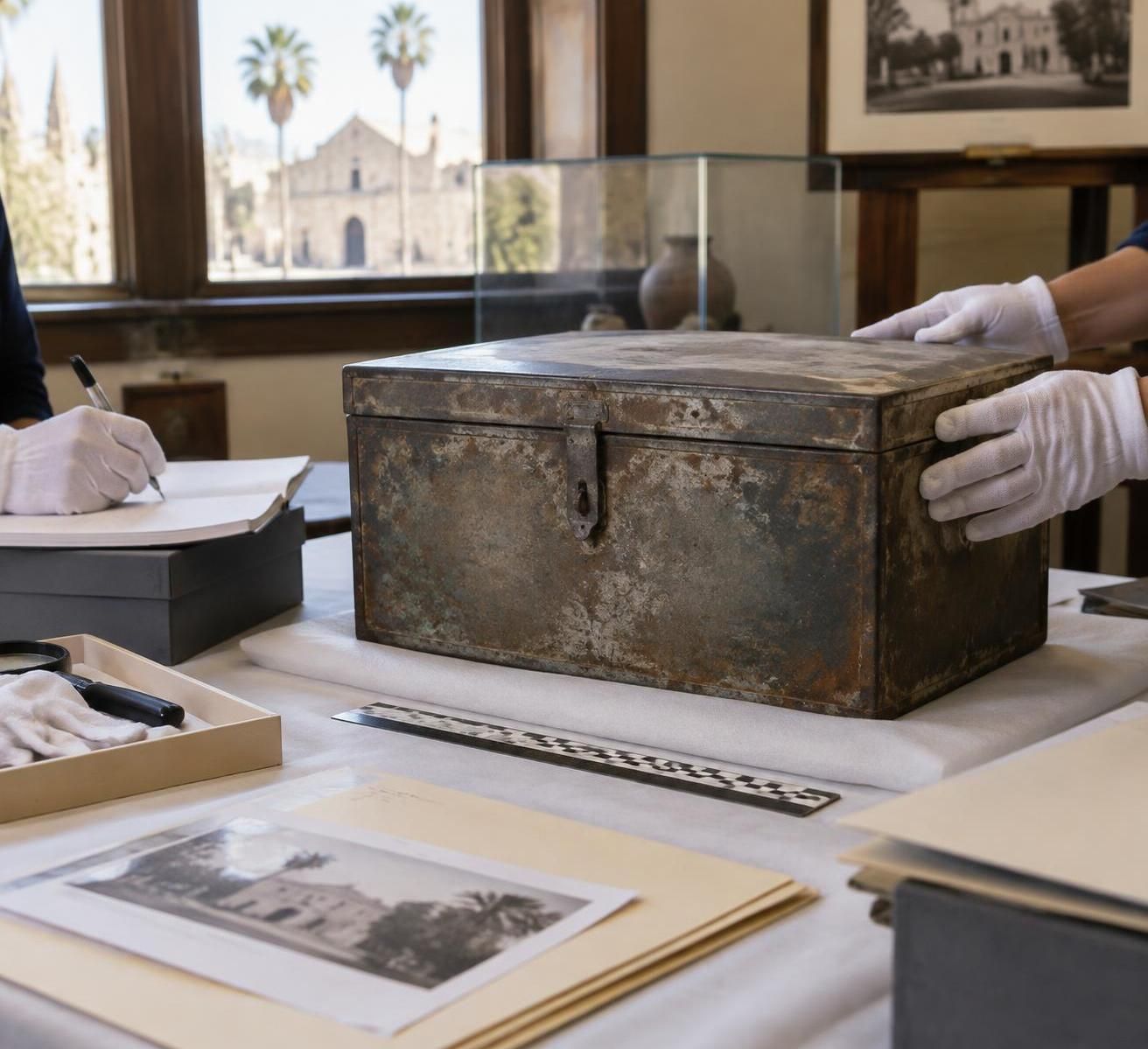
Why Donna’s 1976 Time Capsule Matters to Local History
The year 1976 provides more than a convenient anniversary. Across the United States, Bicentennial celebrations encouraged communities to think about national identity, civic achievement, and the records they wanted future generations to inherit.
Donna’s sealed collection belongs within that wider commemorative setting, but its strongest interpretive value is local. National history supplies the backdrop; residents’ choices, relationships, and everyday experiences give the material its distinctive meaning.
In 2026, the United States reaches the 250th anniversary of independence. That creates a useful comparison between two commemorative moments fifty years apart, without requiring the museum to turn a community event into a broad national-history lecture.
Connect the Bicentennial Capsule With the People Who Remember It
Museum director Elvira De La Garza Tovar graduated in 1976, giving the opening a personal connection to her own school years. According to the supplied reporting, seeing the container at the museum prompted her to investigate its background with help from friends.
That detail illustrates how local research often begins: someone recognizes a date, a surname, or an object and asks a question that an institutional record alone cannot answer. Personal familiarity becomes valuable when it leads to documents, corroborating witnesses, and carefully recorded explanations.
Consider the hypothetical family attending the ceremony. The former student might recognize an organization’s name that means little to the grandchild, while the younger visitor might notice an unfamiliar communication method or printing style.
The interpretive opportunity lies between those reactions. Rather than presenting an old item as merely quaint, a guide can explain what it allowed people to do, who used it, and what has changed since its creation.
Read Hidden Memories as Evidence, Not a Complete Portrait
A time capsule is a selection, not a complete record of a town. Its contents reflect decisions made by the people who assembled it, including what they considered important, what they could obtain, and what they believed would survive.
If a school program, newspaper, or photograph emerges, each would require its own questions. Who produced it? What audience did it address? Does it represent everyday life, an exceptional occasion, or an official version of events?
These are illustrative possibilities, not confirmed contents. Until an inventory is published, descriptions should avoid promising particular discoveries or implying that familiar Bicentennial objects must be inside.
The same discipline applies to absence. If certain neighborhoods, occupations, languages, or age groups are poorly represented, that does not mean they were unimportant to Donna; it may reveal the limits of the original collecting process.
A useful public exhibition can place the recovered selection alongside other records from the period. School yearbooks, municipal documents, family photographs, and oral testimony may help establish context, provided permissions and source information are recorded.
For tourism professionals developing anniversary programming, Grupem’s related America250 time capsule article offers an adjacent subject for exploring how commemorative collections can connect historical milestones with visitor interpretation.
The strongest storytelling does not flatten disagreement or treat every memory as equally verifiable. A resident’s recollection should remain identifiable as testimony, while a dated document should be described according to what it actually establishes.
Community heritage becomes more meaningful when the museum explains both what survives and how its meaning is established. That approach makes the next task—opening, recording, and caring for the material—central to the visitor experience rather than invisible backstage work.
Protect the Half-Century-Old Artifact Through Careful Documentation
Opening a container after fifty years is an archival discovery, but it is also a handling event with consequences. Once a seal is broken and objects move, evidence about their original arrangement can be lost unless staff document the process.
Historical preservation starts before the first item is removed. The exterior, closure, inscriptions, visible damage, and position of the container should be photographed, with a clear record of when and where the work occurs.
This is recommended practice, not a description of a confirmed Donna handling protocol. The appropriate procedure depends on the container’s condition, its materials, and the expertise available to the institution.
Document the Donna Museum Opening Without Rushing the Objects
A public audience creates understandable pressure for a quick reveal. Nevertheless, the person presenting the ceremony and the person responsible for handling the material should have distinct tasks, allowing commentary to continue while documentation proceeds at a safe pace.
If objects are damp, stuck together, brittle, or visibly affected by mold, staff should pause handling and seek appropriate conservation advice. Pulling apart pages or applying improvised cleaning products can permanently remove information.
A hypothetical folded letter demonstrates the problem. Its outer surface may appear stable, but a sharp crease could split when unfolded, separating words from their original sequence and making later interpretation more difficult.
The solution is not to conceal the discovery. It is to explain why assessment comes first and offer visitors photographs or later updates when direct display is not yet suitable.
- 📷 Record the starting condition: photograph the container and its arrangement before disturbing the contents.
- 🗂️ Assign identifiers: connect each item with its images, description, and handling notes.
- 📝 Preserve context: note inscriptions, envelopes, bundles, and relationships between objects.
- 🧤 Use material-appropriate handling: follow professional guidance rather than one universal rule for every surface.
- 🔒 Review sensitive information: assess personal details and permissions before publishing scans.
Turn the Museum Unveiling Into a Traceable Archive
Documentation needs to distinguish observation from interpretation. “Envelope bearing a handwritten date” is an observation; “message written specifically for the sealing ceremony” is an interpretation that requires supporting evidence.
That distinction matters when memories begin arriving from the audience. A resident may confidently identify a person in a photograph, but the record should still state who supplied the identification and when it was recorded.
For the hypothetical family, an identification offered by the former student could become a valuable research lead. Staff should preserve that contribution without silently turning it into an unquestioned catalogue fact.
Digital capture introduces another layer of responsibility. A scan intended for preservation should be retained separately from a compressed website image, and descriptive information should travel with the file rather than depend on a staff member remembering its origin.
File naming, duplicate storage, and periodic checks are less dramatic than the ceremony, yet they determine whether the resulting archive remains usable. A photograph that cannot be connected to an object number or an event date quickly loses research value.
Public-facing labels can make this work visible through a brief explanation of condition, identification, and any unresolved questions. Such transparency builds confidence without overstating what the institution knows.
The real achievement is not merely revealing a half-century-old artifact; it is preserving the evidence needed to understand it. Once that evidence is secure, interpretation can extend beyond the people standing closest to the opening table.
Use Clear Audio to Make Donna’s Museum Unveiling More Inclusive
A crowded ceremony can produce a familiar mismatch: people can see that something important is happening but cannot hear why it matters. Distance from the speaker, background conversation, and outdoor noise can all reduce access to the interpretation.
For Donna Museum programming, clear audio should support the historical content rather than compete with it. The objective is straightforward: help visitors understand the speaker, follow the handling process, and connect individual discoveries with the wider story.
A smartphone-based audio approach can be useful when it reduces equipment complexity without creating new barriers. Grupem is positioned around turning smartphones into professional audio-guide tools, making it relevant to museums evaluating modern approaches to guided interpretation.
Match Audio Technology to the Donna Time Capsule Visitor Journey
The right starting point is an audience test, not a product purchase. Organizers should establish whether visitors need live commentary, prerecorded object interpretation, or both, and then check the actual workflow with the devices and connectivity available at the venue.
No particular accessibility function, translation option, or offline capability should be assumed without checking current product specifications. A short technical rehearsal is more useful than a feature list that has not been tested under event conditions.
The hypothetical family again provides a practical scenario. The older visitor needs understandable speech at a comfortable level, the teenager wants concise explanations, and the relative without a suitable phone needs an alternative that does not require an unexpected purchase.
Possible alternatives include a printed transcript, clearly placed speakers, or institution-provided listening equipment where resources allow. The important principle is that digital access supplements participation rather than becoming the sole entrance to it.
Create Short, Accurate Audio Stories From the Recovered Collection
Audio scripts should be written after objects have been identified, not before. Otherwise, an appealing narrative can encourage staff to fit discoveries into a story that the evidence does not support.
A useful script has three elements: what the visitor is looking at, what is established about it, and why that information matters. For example, a verified school document could connect a named activity with the director’s graduation year, while clearly separating documentary evidence from personal recollection.
Short segments also help visitors control their attention. An initial track might explain the Bicentennial setting, followed by separate object stories and an optional recording about how the contents were documented.
Recorded memories require informed consent and a clear description of intended use. A resident agreeing to a brief event interview should not automatically be treated as granting unrestricted permission for promotional edits or permanent online publication.
Text versions remain important even when the spoken recording is excellent. They support people who cannot hear the audio, visitors who prefer reading, and staff checking names or dates before a guided session.
For institutions comparing different scales of interpretation, Grupem’s article on a San Francisco micro-museum provides a related museum topic for considering how focused collections can generate a visitor experience without relying on large exhibition spaces.
Evaluation can stay simple: ask whether visitors heard clearly, understood the central message, and could use the system without repeated assistance. These observations reveal more about practical success than the number of downloads alone.
Useful audio technology makes historical evidence easier to access; it does not substitute for accurate research. The same principle should guide the material Donna selects for its next fifty-year message.
Build Donna’s Next Time Capsule as a Record Future Residents Can Understand
The museum also plans to collect public contributions for a new container intended to be opened another fifty years later. If sealed in 2026 on that timetable, its intended opening year would be 2076.
The collection campaign creates a different challenge from the original unveiling. Staff must decide not only what is meaningful today, but also what can be stored safely and understood by people who cannot ask the contributor for clarification.
A successful selection process therefore needs explicit criteria. Historical relevance, physical suitability, available space, ownership, and the range of community perspectives should all influence acceptance decisions.
Select Community Heritage Items With Context and Consent
An ordinary object can carry considerable meaning when accompanied by a precise explanation. A local business flyer, for example, may document services, languages, prices, and neighborhood connections more effectively than an expensive commemorative souvenir.
That example is a proposed contribution type, not an announced museum request. Residents should confirm what the institution will accept before donating anything, especially original documents, fragile possessions, or material containing personal information.
For the hypothetical family, a copy of a photograph accompanied by names, location, date, and a short description may be more useful than an unlabeled original. It also allows the family to retain its own irreplaceable record while sharing the historical information.
Contributors should understand whether ownership transfers, whether the object can be reproduced, and whether staff may decline or return unsuitable material. Clear terms protect both the institution and residents from misunderstandings after a meaningful donation.
Selection should reach beyond those already comfortable approaching the museum. Invitations through schools, community organizations, neighborhood networks, and local businesses can broaden participation without claiming that any collection will represent every resident equally.
Protect Future Access Beyond the Sealed Container
Digital contributions need particular care. A storage device containing photographs or recordings may depend on software, hardware, or file formats that future staff cannot easily use.
A QR code is especially weak as the only route to a story because its destination can disappear long before the opening date. If one is included, its essential meaning should also be preserved in a readable form that does not depend on a working website.
For sound recordings, the museum should retain transcripts, speaker identification where permitted, recording dates, and descriptions of the circumstances. The spoken voice adds texture, but the supporting documentation makes it searchable and interpretable.
Sealing a digital copy is not a replacement for maintaining an active archive. Keeping an additional accessible record allows the institution to monitor files, migrate formats when necessary, and preserve knowledge about the collection during the waiting period.
Material compatibility also matters. Food, batteries, liquids, and unstable substances can threaten neighboring contents, so a qualified preservation review should guide what enters the container and how accepted objects are packed.
The future opening instructions should be kept outside the sealed collection as well as inside it. Records of the location, responsible institution, intended date, and handling guidance reduce the risk that an anniversary depends entirely on one person’s memory.
The replacement project can also generate present-day value through interviews, donor biographies, and a documented selection process. These resources allow residents to engage with the campaign now rather than waiting five decades for its meaning to emerge.
The best gift to future Donna residents is an understandable record, not simply a box of surviving objects. Clear labels, considered permissions, and continuing institutional stewardship make that distinction practical.
When and where is the Donna Museum time capsule opening scheduled?
The published event information schedules the opening for 10 a.m. on Friday, July 31, 2026, at the museum at 129 S 8th St in Donna, Texas. Check the City of Donna’s latest announcement before traveling.
Was the Donna time capsule sealed in 1976 or 1979?
The principal reporting and municipal announcement identify it as the 1976 Bicentennial capsule. That date matches the fifty-year anniversary in 2026; an isolated listing referring to 1979 conflicts with those details.
What objects are inside the original capsule?
The supplied advance information does not provide a verified inventory. Specific objects should be described only after the museum documents and identifies the recovered contents.
Can residents contribute to the next time capsule?
The museum plans to collect public contributions for a new capsule. Residents should confirm accepted materials, submission arrangements, and donation terms before bringing an item. A fifty-year timetable from 2026 points to 2076.
Will recovered items immediately go on public display?
An opening ceremony does not establish that every recovered object will be available for immediate viewing. Condition assessment, documentation, and privacy review may be needed before exhibition; confirm display arrangements with the museum.
