
QC Museum Month in October: Plan Visits Across the Quad Cities
October 1–31 is the window for exploring the Quad Cities’ museums through QC Museum Month. Presented by Visit Quad Cities and participating institutions, the celebration connects residents and visitors with science, art, inventions, historic homes, and regional history across this Mississippi River destination in Illinois and Iowa.
The supplied announcement for 2026 identifies this as the 11th year of the broader museum celebration, which previously operated as QC Museum Week. That anniversary refers to the continuing initiative, rather than eleven years under its current month-long format; the extended calendar gives households more opportunities to fit cultural outings around work, school, and other commitments.
More than 20 museums and historical sites are announced as participants, with individual venues offering combinations of discounts, special activities, exhibitions, or tours. These benefits are not necessarily identical everywhere: an admission offer at one institution does not establish the price, booking requirements, or opening arrangements at another.
Build an October museum itinerary around verified information
Start with the official QC Museum Month website, then consult each venue’s own visitor information. Check the date of any listing, because search results can surface previous editions alongside the current program, particularly when the initiative’s former name remains in website addresses.
A useful itinerary records more than a museum’s name. Include its address, opening hours, admission conditions, expected visit length, accessibility contact, and any timed-entry requirement; these details turn an appealing idea into a workable afternoon.
Consider the Rivera household, a hypothetical local family with one elementary-school child and a grandparent who prefers shorter walking distances. Rather than attempting four venues in one day, they could choose a morning collection visit, allow time for lunch, and reserve a second outing for a guided historic-property tour.
This approach protects attention as well as energy. A child who has time to investigate one scientific demonstration or examine a single object closely may retain more than someone hurried through multiple galleries to complete an ambitious route.
- 📅 Confirm the actual visiting date: October participation does not mean every venue opens daily.
- 🎟️ Check offer conditions: distinguish discounted admission from free entry or separately priced activities.
- 🚗 Allow realistic travel time: account for river crossings, parking, and the walk from the vehicle to the entrance.
- ♿ Ask about access before booking: historic buildings can have arrangements that differ from modern galleries.
- 🔋 Prepare your phone: save booking confirmations and charge the device if you intend to use digital check-ins.
Weather also changes the practical value of a route. An indoor gallery can suit a rainy afternoon, while a property visit involving outdoor paths may require different footwear, additional travel time, or a revised plan.
For tourism offices and front-desk teams, the equivalent task is maintaining a concise, dated information sheet. Staff should be able to distinguish confirmed program details from suggestions, especially when visitors ask whether a particular discount applies to children, accompanying carers, or existing members.
QC here means the Quad Cities, not Quebec. Making that distinction in search descriptions, booking information, and visitor communications helps people find the correct destination without confusing two different geographic contexts.
The calendar offers flexibility, but thoughtful selection makes that flexibility useful. Plan fewer stops with better information, then leave enough space for discovery inside each venue.
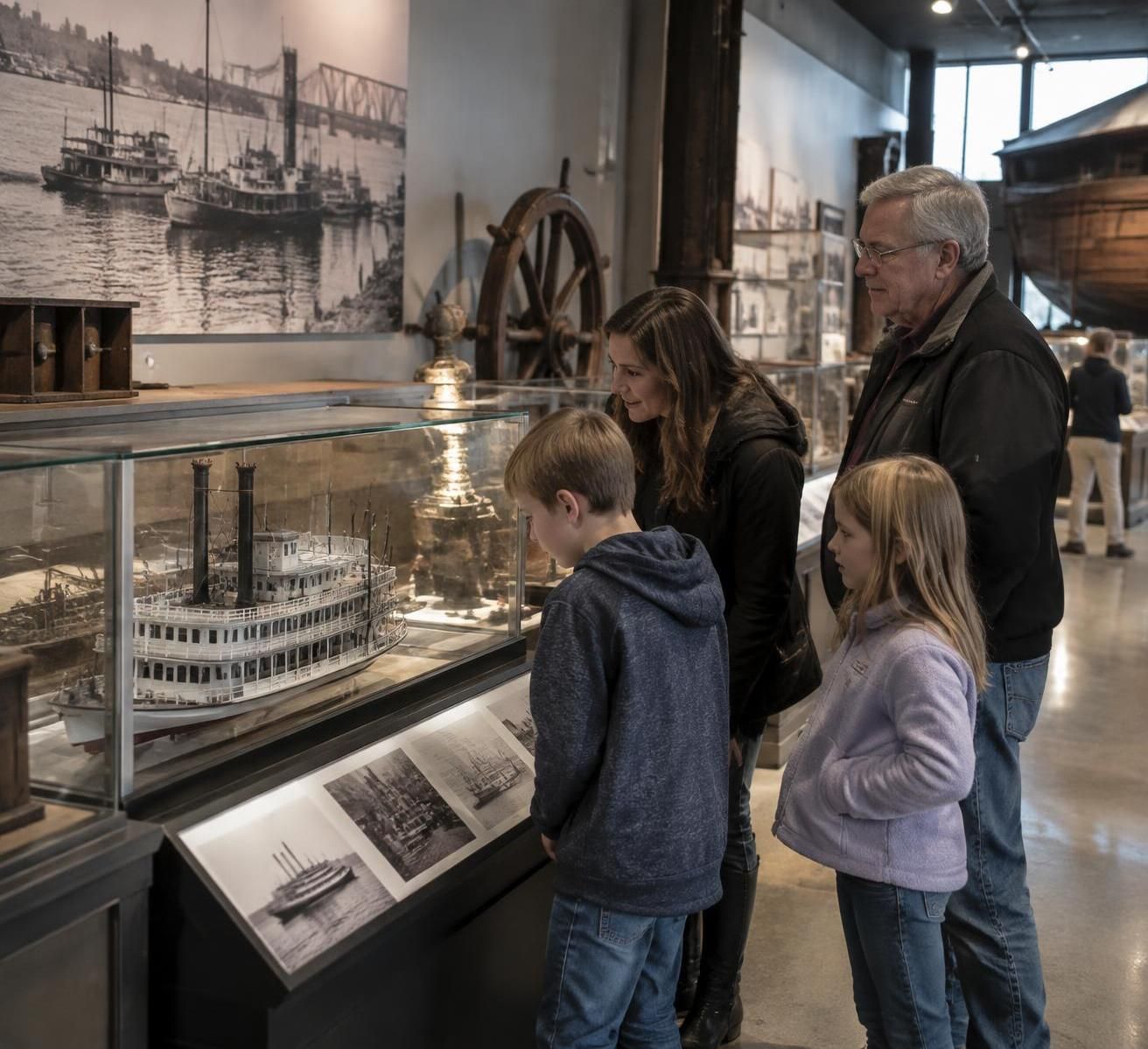
Explore Local Collections Through Science, Art, and Mississippi River History
Local collections become more meaningful when visitors connect individual objects to the place around them. The Quad Cities’ river setting provides a useful starting point: transportation, manufacturing, settlement, commerce, and everyday domestic life can all offer ways to interpret regional material, depending on what a participating institution actually displays.
The program’s breadth matters because there is no single correct way to enjoy a cultural outing. Someone interested in engineering may begin with inventions, while another visitor may prefer painting, architecture, household furnishings, or stories preserved through photographs and documents.
Turn museum exhibitions into focused discovery
Before entering a gallery, choose one question rather than trying to absorb every label. “How did this object change someone’s working day?” creates a different experience from “What is the oldest item here?” and both can guide useful conversations without requiring specialist knowledge.
For the Rivera family, a shared question might be how people moved goods before the transport systems familiar today. If a venue displays river-related material, the adults and child could compare an archival image, a model, and a written account, noticing how each source reveals different information.
Artifacts are evidence, not complete stories by themselves. A tool’s shape may suggest its purpose, but ownership, date, wear, and accompanying records help explain who used it and under what circumstances.
A professional guide can make that distinction accessible through three steps: describe what is visible, explain what documentation establishes, and identify the interpretation being offered. This method prevents a compelling narrative from blurring the boundary between historical evidence and imaginative reconstruction.
Art displays invite a similar discipline. Rather than telling visitors what they should feel, ask them to notice materials, composition, scale, or the relationship between a work and its setting; contextual information can then deepen the observation instead of replacing it.
Scientific exhibits often benefit from prediction before explanation. Asking what might happen when a mechanism moves encourages active participation, while a short follow-up connects the result to the underlying principle and an everyday application.
Historic homes require another interpretive lens because the building itself forms part of the collection. Room dimensions, circulation routes, storage areas, and decorative choices can reveal patterns of domestic life, although guides should avoid treating one household as representative of an entire community.
Give cultural heritage room for multiple perspectives
Cultural heritage includes both celebrated achievements and experiences that received less attention in older institutional narratives. Visitors can ask whose voices appear in the interpretation, which sources support those accounts, and whether the display acknowledges gaps in the surviving record.
This is particularly useful when examining labor, migration, family life, or changing neighborhoods. A photograph may document a workplace without identifying every person in it; recognizing that limitation helps visitors understand why oral histories, research, and community contributions remain important.
Small institutions can reward this close attention because their material often has a strong relationship to a specific place or topic. Grupem’s article on a San Francisco micro-museum offers a related reading direction for professionals interested in compact cultural spaces, without implying that the featured institution participates in the Quad Cities program.
Visitors can also use video to identify subjects they would like to explore, but filmed previews should support rather than replace a visit. A camera cannot fully convey the scale of an object, the arrangement of a room, or the opportunity to ask a knowledgeable staff member a question.
The most productive gallery visit follows a question, examines evidence, and leaves room for another perspective. That approach makes even a short stop substantial, regardless of the institution’s size.
Use Digital Check-Ins to Track QC Museum Month Visits and Prize Eligibility
The announced participation system allows visitors to register free at QCMuseumMonth.com and track their progress through eligible locations. The program connects multiple visits with opportunities to win prizes, adding an optional incentive to explore beyond a familiar institution.
The supplied event information identifies two prize types: a one-year membership to a participating institution of the winner’s choosing and a behind-the-scenes visit at a participating historic home. Availability, selection procedures, deadlines, and any restrictions should be checked in the published rules for the current edition.
The announcement states that visiting more locations increases opportunities to win. That should not be interpreted as a guaranteed reward, unlimited entries, or permission to record repeated visits unless the official terms expressly allow those arrangements.
Separate admission, registration, and check-in
Digital participation can become confusing when several actions happen on the same phone. A ticket purchase establishes admission, registration creates a program record, and a check-in records an eligible visit; completing one does not necessarily complete the others.
For the Rivera family, the practical sequence is straightforward: register before the outing, review the instructions, and confirm the appropriate action at each participating stop. If something fails, staff can explain the accepted procedure rather than the family guessing how the system recognizes attendance.
A historical report about mobile visit tracking during QC Museum Month provides background on the digital approach. Visitors should still follow the current edition’s instructions instead of assuming that an earlier interface, download requirement, or verification method remains unchanged.
| Visitor task | What to verify | Why it matters |
|---|---|---|
| 📱 Register | The current official signup route and participation terms | Avoids using an outdated campaign page |
| 🎟️ Arrange entry | Admission price, discount conditions, and reservations | Prevents confusing campaign registration with a ticket |
| 📍 Record a visit | The accepted check-in method for that location | Helps ensure an eligible stop is recorded correctly |
| 🏆 Review prizes | Entry rules, deadlines, and winner notification | Sets accurate expectations about participation |
| 🔒 Review data use | Required information and optional permissions | Supports an informed privacy choice |
Good preparation also includes a fallback. Keep essential addresses and booking confirmations available separately, because a weak signal or depleted battery should not prevent an otherwise planned visit.
Do not assume that storing a page or taking a screenshot completes a check-in. Those steps preserve useful information, but the program’s accepted verification process determines whether attendance counts toward prize eligibility.
For participating venues, clear instructions reduce queues and repeated questions. A short sign near the entrance can explain where to begin, whether staff assistance is available, and which action visitors should complete before leaving.
Privacy deserves equally practical treatment. If a system requests location access or contact details, visitors should review why those permissions are needed and whether optional marketing consent is separate from essential participation information.
Children’s participation also requires attention to the official terms. Families should not create accounts or submit personal details for younger visitors without checking age conditions and the role of a parent or guardian.
Finally, avoid allowing the incentive to dominate the itinerary. A recorded stop is useful administratively, but rushing through a collection simply to accumulate entries undermines the experience that the campaign is designed to encourage.
Digital tracking works best when it stays simple, transparent, and secondary to the visit itself. Once the practical steps are clear, attention can return to the objects, conversations, and activities inside.
Make October Museum Tours More Accessible With Clear Audio and Visitor Support
A larger audience is valuable only when people can comfortably take part. For museums, guides, and cultural organizers, October’s increased visibility creates an opportunity to examine the full visitor journey: finding information, arriving, hearing explanations, moving through spaces, and accessing content in an appropriate format.
Accessibility begins before the entrance. A visitor page should describe relevant arrangements specifically, including step-free routes, seating, accessible restrooms, sensory considerations, and how to request assistance; a broad statement that a venue is “accessible” may not answer an individual visitor’s needs.
Design audio around real listening conditions
Guided groups face familiar acoustic problems: background conversation, hard surfaces, distance from the speaker, and visitors standing behind one another. Speaking louder is not always the best solution, because it can increase fatigue and disturb nearby groups without improving clarity for everyone.
A smartphone-based audio approach can support guided interpretation where the selected system and venue conditions make it suitable. Grupem is designed to turn a smartphone into an audio guide for guided visits, making it relevant for organizations assessing alternatives to dedicated equipment.
That positioning does not establish a partnership with QC Museum Month or any participating institution. A venue considering the app should assess its current capabilities, operating requirements, accessibility provisions, and suitability for the intended group before deployment.
The first test should happen in the actual space, not only in a quiet office. Check the guide’s microphone placement, speech intelligibility, device compatibility, and any connectivity requirements in the rooms where the activity will take place.
For the Rivera household, useful audio support would let the grandparent hear without standing at the front throughout the tour. However, the family should also have an alternative if someone cannot comfortably use headphones or prefers written information.
Personal headphones can reduce shared-equipment handling, but they are not a universal solution. Museums should consider device availability, charging, hygiene arrangements for loaned items, and whether visitors can still hear safety instructions while listening.
Offer alternatives without creating a second-class experience
Written summaries, readable transcripts, and captioned video help people who cannot access spoken interpretation in its original form. These alternatives should communicate the substantive content, not merely provide a shortened promotional description.
For live visits, a guide can introduce a stopping point before moving, indicate where seating is available, and describe visually important details aloud. Such practices benefit a wider group than visitors who have formally requested accommodation.
Language support also needs realistic planning. A concise explanation accurately adapted into another language is often more useful than a long script translated mechanically without reviewing names, historical terminology, or local context.
Staff training should cover ordinary troubleshooting without expecting every employee to become a technician. A one-page procedure can explain how to start the experience, adjust volume, identify common problems, and switch to an alternative format when needed.
Content preparation matters as much as transmission. A clear audio segment introduces one idea, directs attention to a visible detail, and explains why that detail matters; long readings of gallery labels rarely justify the visitor’s additional listening effort.
Evaluation can remain lightweight. Ask whether visitors could hear clearly, whether instructions were easy to follow, and whether the technology distracted from the tour; those answers are more useful than measuring adoption alone.
Useful innovation removes friction rather than adding another task. The strongest deployment is one that visitors can understand quickly and that staff can support consistently during a busy cultural event.
Support Quad Cities Museums Through Community Participation and Meaningful Follow-Up
Museum Month can introduce a venue; sustained community relationships help keep it relevant. Residents who discover a collection in October may later become members, repeat visitors, volunteers, or participants in educational activities, depending on the opportunities each institution offers.
These outcomes should not be assumed from attendance alone. A busy promotional day can generate interest, but welcoming staff, understandable interpretation, and a clear next step are what make that interest easier to continue.
Choose support that matches your interests and circumstances
A membership can be worthwhile when its benefits align with realistic visiting habits. Review admission arrangements, guest privileges, event access, and any exclusions before comparing its cost with the visits your household expects to make.
For the Rivera family, a venue offering activities suited to their child might become a regular destination. Another institution could remain an occasional choice for adult tours; neither pattern is less valuable simply because the frequency differs.
Volunteering requires a different assessment. Ask about training, time commitments, safeguarding requirements where relevant, and available roles instead of assuming that enthusiasm alone qualifies someone to handle collections or lead interpretation.
Financial contributions are another option, but visitors can also support institutions by attending programs, recommending an experience accurately, or responding constructively to feedback requests. Staff benefit from knowing what worked and which practical obstacle prevented a fuller visit.
For a wider view of the relationship between institutions and local support, Grupem’s discussion of Detroit museum funding through a millage offers a separate topic to explore. That funding context should not be confused with admission offers or financial arrangements in the Quad Cities.
Share discoveries without compromising privacy or collections
Visit Quad Cities encourages participants to share experiences using #QCMuseumMonth. A useful post identifies the venue, explains what made the visit worthwhile, and distinguishes personal recommendations from official information about offers or opening times.
Photography requires permission even when social sharing is encouraged. Check restrictions around individual works, temporary displays, flash, tripods, and private tour areas; an event hashtag does not override a venue’s collection-care rules.
Be equally careful with people appearing in photographs. Obtain appropriate permission before posting identifiable companions, particularly children, and avoid capturing other visitors’ booking information, account screens, or contact details.
Organizations can make sharing easier by identifying suitable photo locations and providing accurate campaign wording. Clear guidance reduces misunderstandings while allowing visitors to describe their own experience rather than repeating a promotional script.
The best feedback also extends beyond visual appeal. A visitor might note that a staff member connected an object to a familiar neighborhood, that seating made a tour manageable, or that a written explanation clarified an unfamiliar scientific idea.
For institutions, campaign evaluation should examine these qualitative outcomes alongside attendance. Useful questions include whether newcomers felt welcome, whether families could navigate booking information, and whether digital participation caused avoidable frustration.
Repeated practical problems deserve operational changes rather than more publicity. If visitors consistently misunderstand a discount, revise its wording; if a tour fills quickly, clarify reservations; if check-in assistance creates congestion, move the support point away from the main entrance.
Partnerships can also become more effective when neighboring venues coordinate accurate recommendations without promising availability on one another’s behalf. A suggested second stop is helpful only when its schedule, access arrangements, and travel requirements fit the visitor’s situation.
Community support grows when an enjoyable visit leads to a specific, suitable relationship. Whether that means returning for another exhibition, buying membership, or sharing a thoughtful recommendation, the value lies in an informed choice rather than a one-time promotional response.
When does QC Museum Month take place?
The announced celebration runs from October 1 through October 31. Individual participating museums and historical sites maintain their own opening schedules, so check each venue before traveling.
Does QC refer to Quebec in this event?
No. QC Museum Month refers to the Quad Cities region in Illinois and Iowa, along the Mississippi River. It is a different destination from Quebec.
Are all participating museums free during October?
No universal free-admission offer is stated. Participating venues may provide discounts, special activities, exhibitions, or tours, with different prices and booking conditions. Confirm the offer directly with the institution.
How do visitors participate in the prize program?
The announcement directs visitors to register free at QCMuseumMonth.com and record eligible visits. Check the current rules for accepted check-in methods, deadlines, age conditions, and prize eligibility; participation does not guarantee a prize.
Is Grupem the official QC Museum Month check-in app?
No partnership or official check-in role is established in the supplied event information. Grupem is discussed here as an audio-guide option for cultural organizations, separate from the campaign’s visitor-registration and tracking system.
