
Tarnov’s 1943 Practice Bombing: How a Training Flight Reached the Town
Before dawn on August 16, 1943, residents of Tarnov, Nebraska, heard practice bombs fall where no bombs were expected. A contemporary newspaper report, preserved by the Nebraska State Historical Society, described aircraft dropping training devices over the village between 4 and 4:30 a.m. Today, the Tarnov Heritage Museum uses a surviving bomb to help visitors examine what happened—and how the story was remembered.
According to museum representatives Judy Hanzel and Mary Jane Rosenthal, an Army training flight was meant to identify lights marking a target in a pasture near Stanton. Tarnov had hosted a bazaar the previous evening, and lights remaining from that gathering were mistaken for the intended marker. In their account, seven practice bombs were dropped on or around the town.
That explanation makes the error understandable without making it inevitable. A nighttime crew searching for an illuminated target could misread another cluster of lights, especially if the crew did not recognize the town below. Yet the exact sequence of decisions inside the aircraft cannot be reconstructed from the object on display alone. The distinction matters: the mistaken identity of the lights is part of the museum’s community account, while a surviving contemporary report establishes that the drops were reported at the time.
Why “Practice Bomb” Does Not Mean “No Danger” in Tarnov
The training devices were filled with sand and fitted with small charges that helped observers locate their impact points, Hanzel and Rosenthal have explained. They were not conventional wartime explosives, but they could still damage a building or injure someone. ⚠️ The most serious reported near miss involved a home south of Tarnov: one bomb passed a bedroom window where two young girls were sleeping, traveled through a pantry, struck a flower bin and went out through a side wall.
Other reported landing places bring the scale of the mistake into focus. Museum representatives describe drops near a dance hall and across the street from the grain elevator, as well as a device later discovered in a potato patch during fieldwork. These are places of ordinary activity, not features of a bombing range. Mapping them against homes and gathering spaces would help a visitor understand why an incident involving training equipment became a lasting local story.
Fear was the first response, followed by a need to find out what had happened. Rosenthal recalled that her family, living six miles west of town, returned after reaching home to investigate the aircraft activity. A barn fire around the same time added to the confusion, although Hanzel and Rosenthal say it was unrelated to the bombing. Keeping those events separate prevents a dramatic detail from becoming a false explanation.
Authorities reportedly restricted movement into and out of Tarnov while officials responded. The recovered devices were later displayed at the sheriff’s office in Columbus, according to the museum representatives. For residents, that transfer would have turned an alarming object into something visible and discussable. For today’s visitors, the important question is not simply where the bombs landed, but how a military training error entered the daily life of a small Nebraska community.
That question leads directly to the artifact now held by the museum: one object with a particularly close connection to the house it struck.
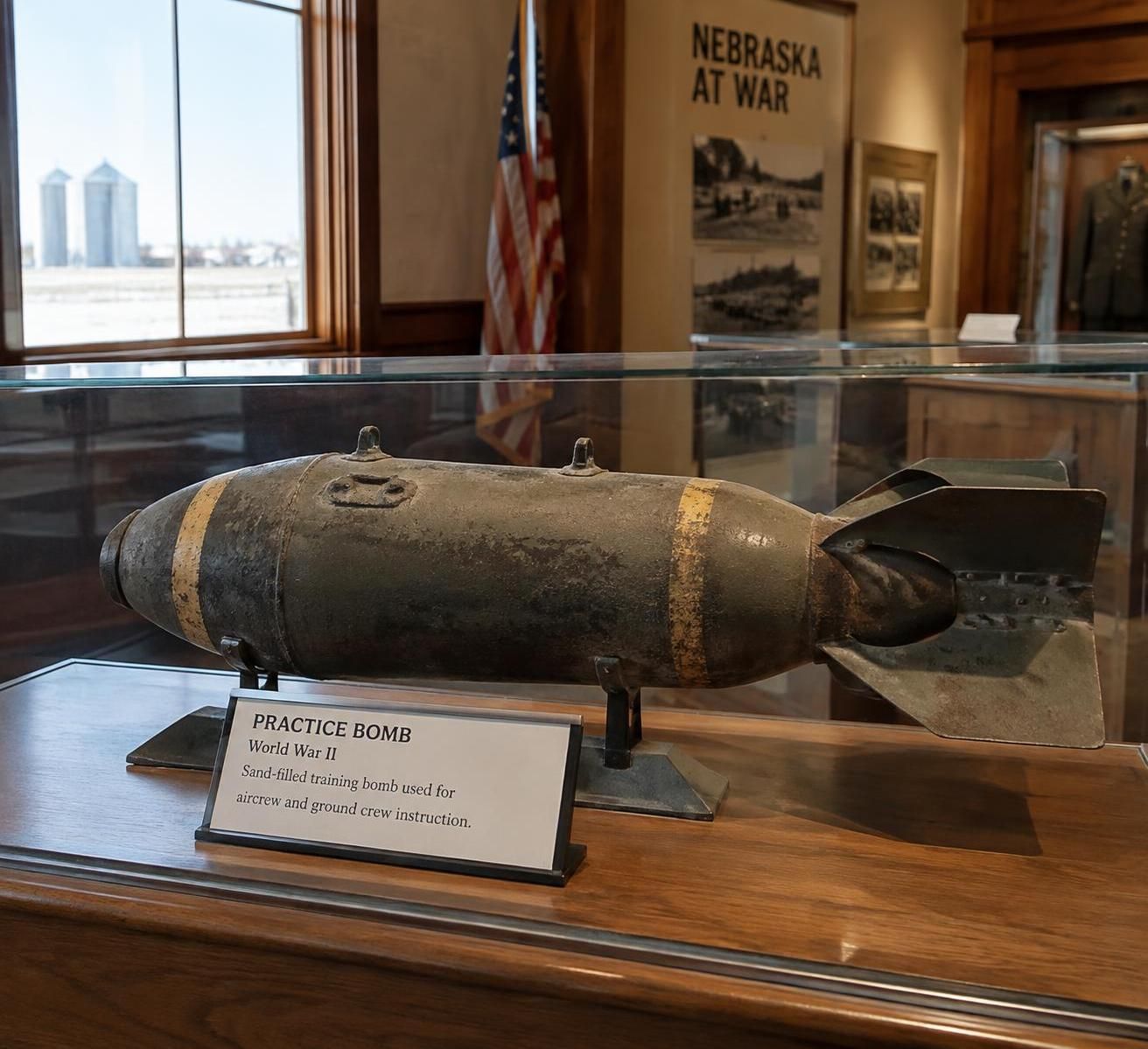
How the Tarnov Heritage Museum Acquired the Bomb That Struck a House
A museum object becomes more informative when its route into the collection is clear. The practice bomb displayed at the Tarnov Heritage Museum is identified by Hanzel and Rosenthal as the one that struck the house south of town. It did not arrive as an anonymous relic purchased decades later. According to Hanzel, a brother of a former owner contacted the heritage center after his sister died and asked whether it wanted the device the family had kept.
That family connection gives the exhibit a useful starting point for interpretation. Visitors can follow a chain from the training drop to the damaged home, from household custody to the museum. Each link answers a practical question: Which object is this? Why was it retained? Who connected it to the reported near miss? A label that explains those steps helps visitors distinguish this device from other bombs said to have landed elsewhere in Tarnov.
The object also needs careful physical context. A solid-looking casing can prompt two opposite but inaccurate assumptions: that it was a full wartime bomb, or that it was harmless because it was used for practice. Explaining the sand filling and spotting charge resolves that confusion. It also respects the experience of the family whose walls were damaged and whose children were asleep nearby. The visible artifact is compelling precisely because the account describes a narrow escape rather than a distant impact in an empty field.
What a Responsible Display Can Show Beyond the Object
An effective exhibit would place the device alongside a concise route through the house, clearly identified as the family and museum account. A simple diagram could show the bedroom window, pantry, flower bin and side wall without implying that every measurement has been independently verified. If photographs of the property or repair records are available, their dates and sources should be stated; if they are not, the display should not substitute a generic damaged-house image without labeling it as illustrative.
Provenance deserves space too. A short timeline could explain that recovered bombs were reportedly taken to the Columbus sheriff’s office and that the displayed example later remained with the affected family before its transfer to the heritage center. Such a timeline does not require an elaborate interactive installation. Clear text, legible type and an accessible audio description can make the information usable for visitors who cannot easily inspect a case or read a crowded label.
The museum’s broader setting strengthens this approach. It occupies a former Catholic boarding school built in 1911, maintained by the St. Michael’s Historical Society. Reporting on the school’s history and museum exhibits describes a room devoted to the bombing. The building places the object within a community institution rather than isolating it as a novelty. Visitors come away with a clearer understanding when they see that the same town had schools, families, celebrations and routines before the aircraft appeared.
For anyone designing a heritage display, the lesson is practical: identify what an artifact proves, state how it reached the collection and use nearby testimony to explain its human significance. Tarnov’s preserved bomb can do all three, provided the account remains as carefully labeled as the object itself.
Once the object’s history is established, the next task is to compare the different records that describe the flight.
Archival Research on the Tarnov Bombing: Separate Records From Recollection
A historical investigation works best when every source is asked a specific question. The Columbus Daily Telegram headline reported the incident on August 16, 1943, and described two unidentified planes dropping practice bombs over Tarnov early that morning. The museum account adds the bazaar lights, the intended training target, the number of devices and details of where they landed. These sources complement one another, but they do not have identical evidentiary roles.
Other retellings show why dates and aircraft details need particular care. A Nebraska State Historical Society account of the training mishap also places the event on August 16. Another retrospective account gives August 19 and proposes a particular bomber type. The dated newspaper report supports August 16 as the stronger date for the reported event; an aircraft identification remains a separate question unless a flight record or similarly direct evidence establishes it. Visitors should not be asked to treat a plausible reconstruction as a documented fact.
The same caution applies to the phrase “seven bombs.” Hanzel and Rosenthal give that number in the museum account. A later discovery in a potato patch does not automatically make the total eight; it may refer to one of the devices already counted. Without a complete recovery inventory, the responsible wording is that museum representatives report seven dropped and describe several locations where devices were found.
A Source Check That Museum Teams Can Reuse
For a small institution, source review can be organized without specialist software. A shared document or spreadsheet can record each claim, its source, the date of that source and the wording approved for visitors. The following distinctions keep the Tarnov account readable while preserving its limits:
- 🗞️ Contemporary report: Use the dated newspaper account to establish what was publicly reported immediately after the incident, including its early-morning timing.
- 👥 Community testimony: Attribute the bazaar-light explanation, near miss and reported landing places to the museum representatives who relay them.
- 🏠 Artifact provenance: Record the family-to-museum transfer separately from claims about the flight itself; one does not automatically verify the other.
- ✈️ Unconfirmed details: Treat aircraft model, crew identity and competing dates as research questions unless direct records resolve them.
This method is useful beyond Tarnov. Small museums often inherit a strong oral account, a few objects and scattered newspaper references. Publishing those materials together can enrich wartime history, but only if captions signal which details came from a contemporary document, which came from later testimony and which remain open. A visitor should be able to appreciate an account without having to guess how it was established.
Digital presentation can make these distinctions more visible rather than less. A short audio segment might say, “The newspaper reported the drops on August 16; museum representatives explain the mistaken lights.” That sentence gives listeners both the evidence and its attribution in ordinary language. A linked transcript can then provide the fuller source note for anyone who wants to pursue the archival research.
Accuracy need not flatten a memorable story. In Tarnov, the contrast between a documented early-morning report and detailed community memory gives the museum more to explain, not less. The remaining question is how to make that careful account accessible to people walking through the historic building.
Connecting Tarnov’s World War II Incident to Its Boarding School Heritage
The bombing room belongs to a larger place. The Tarnov Heritage Museum is housed in a Catholic boarding school dating from 1911, while St. Michael’s Church forms part of the town’s wider historic setting. A visitor drawn in by the unusual World War II story may therefore encounter another history: education, religious life and the institutions that helped shape Tarnov across generations. A guide should make that relationship explicit rather than treating the bomb as the whole identity of the site.
Consider a visitor standing first in the former school, then in front of the practice bomb. The building shows a long-established local community; the artifact records one abrupt event within it. That sequence changes the question from “Why is there a bomb here?” to “What happened to a town where people were already living, studying, worshipping and gathering?” It gives context to the bazaar lights as well. They were not abstract target markers to residents; they belonged to a community event held the night before.
Practical interpretation can connect the stories without overstating them. A room label could identify the school’s 1911 construction date and the society responsible for maintaining it. A second label could place the 1943 newspaper report next to the museum’s account of the training mistake. Visitors would then have two firm chronological anchors and a clear path between them. Anyone planning a trip can also consult an overview of St. Michael’s Church and the Tarnov museum for a sense of the historic setting before checking current access details directly with the site.
Build a Visit Around Places, Not Just the Most Dramatic Object
A short guided route could begin with the school building, move to the wartime exhibit and finish with an explanation of how the family preserved the bomb. This order takes little additional equipment. It does, however, require a guide or recorded narration to explain why each stop matters. Starting at the school prevents the incident from appearing detached from local heritage; ending at the artifact gives the story a specific, tangible point of return.
Interpretation should also account for different visitor needs. Someone may want a two-minute account of the incident, while another may want to compare newspaper wording with later testimony. Offering a brief label, a longer transcript and optional audio lets both visitors follow the same evidence at different depths. In a historic building, where rooms and circulation were not designed around modern screens, a smartphone-based option can provide detail without adding large equipment to the space.
Care is needed when placing audio in such a setting. Spoken directions should identify a stop by a visible exhibit name rather than assume that every visitor follows the same route. Transcripts should carry the same source distinctions as the recording. Volume should remain under the visitor’s control, especially where several people may listen in one room. These choices are modest, but they protect both the experience of the building and the clarity of the history.
Tarnov’s value as a museum visit lies in this combination: a preserved object, a historic home for the collection and a community account that can be examined against contemporary reporting. The boarding school supplies the setting that keeps the wartime episode from becoming a detached curiosity.
For museum teams, that setting also offers a useful test of any digital guide: does the technology help visitors notice the place, or distract them from it?
Use Clear Audio and Source Labels to Present Tarnov’s Bombing Story
Audio interpretation is well suited to an account with several kinds of evidence. It can guide a visitor from a newspaper report to an artifact label, then to the family story associated with the damaged house. The aim is not to dramatize falling bombs with sound effects. It is to let someone understand, in a few minutes, what is documented, what is attributed and why the distinction matters.
A useful recording could be divided into three optional stops. At the first, the visitor hears the date and the contemporary report. At the second, the narration explains the museum representatives’ account of the bazaar lights and the intended training target. At the third, it identifies the displayed device and recounts its transfer from the affected family. Each segment should work independently, because visitors may enter a room at different points or have limited time.
The table below turns that approach into a manageable production plan. It keeps evidence visible to the person writing the script and gives visitors a reason to listen at each stop.
| Visitor stop | Evidence to identify | Useful audio treatment |
|---|---|---|
| 🗞️ Newspaper account | Contemporary report dated August 16, 1943 | State the reported time, then explain what the article does and does not establish. |
| 💡 Mistaken lights | Museum account from Hanzel and Rosenthal | Attribute the explanation before describing the bazaar and intended target. |
| 🏠 House and artifact | Reported family experience and later object transfer | Explain the near miss without sensational effects; point listeners to the displayed device. |
| 🔎 Further research | Newspaper, museum testimony and differing retellings | Offer an optional transcript with source notes and unresolved questions. |
Keep the Technology Useful to Visitors and Staff
For a small heritage organization, the simplest effective setup may be a short, phone-accessible tour with text alternatives. A platform such as Grupem can make smartphones useful as audio guides without requiring a museum to hand a dedicated device to every visitor. The production work still matters: scripts need source checks, recordings need clear speech, and someone on staff needs a straightforward way to update a segment if new evidence appears.
Accessibility should be planned from the first script, not added after recording. Provide a transcript for visitors who cannot hear the audio or prefer to read; avoid directions that rely only on sight; and keep each segment short enough that people can pause without losing the argument. When a claim comes from oral history, say so aloud as well as in the written version. A source label is most valuable when every visitor can encounter it.
Digital interpretation can also help a museum resist the temptation to put every detail on one crowded wall. An exhibit label can identify the bomb and its provenance in a few sentences, while optional audio explains the difference between the newspaper account and later recollections. Readers interested in how unusual collections attract attention can explore Grupem’s look at presenting unusual museum curiosities; teams considering broader digital decisions may also find its discussion of museum technology and visitor experience useful.
Before publishing, a curator can test the route with someone unfamiliar with Tarnov. Ask that person where they believe the bombs were meant to land, which details come from the museum account and why the displayed device matters. If the answers are unclear, revise the wording before adding more features. Clear interpretation is the goal; audio is one practical way to deliver it.
When did the Tarnov practice bombing occur?
A contemporary newspaper report dated August 16, 1943, described practice bombs dropped over Tarnov between 4 and 4:30 a.m. Some later retellings give a different date, so the dated report is an important reference.
Were the bombs dropped on Tarnov live explosives?
Museum representatives describe them as sand-filled practice bombs with small charges used to mark impact locations. They were not conventional wartime bombs, but an impact could still cause serious damage or injury.
What can visitors see at the Tarnov Heritage Museum?
The museum displays the practice bomb identified as the one that struck a house south of town, along with information about the 1943 incident. The museum occupies a former Catholic boarding school built in 1911.
Why were the practice bombs reportedly dropped on the town?
According to museum representatives Judy Hanzel and Mary Jane Rosenthal, lights remaining after a Tarnov bazaar were mistaken during a nighttime training flight for lights marking the intended target in a pasture.
