
⏱️ Key takeaways: The reported Tilly Norwood incident on Piers Morgan’s Live Show illustrates how quickly a polished Artificial Intelligence persona can lose consistency when a real-time exchange becomes unpredictable. The brief language switch was framed as a Technology Glitch, but it also exposed practical questions about control, disclosure, audience trust, and the growing role of synthetic personalities in broadcast formats.
AI Actress Tilly Norwood Malfunctions During the Piers Morgan Live Show
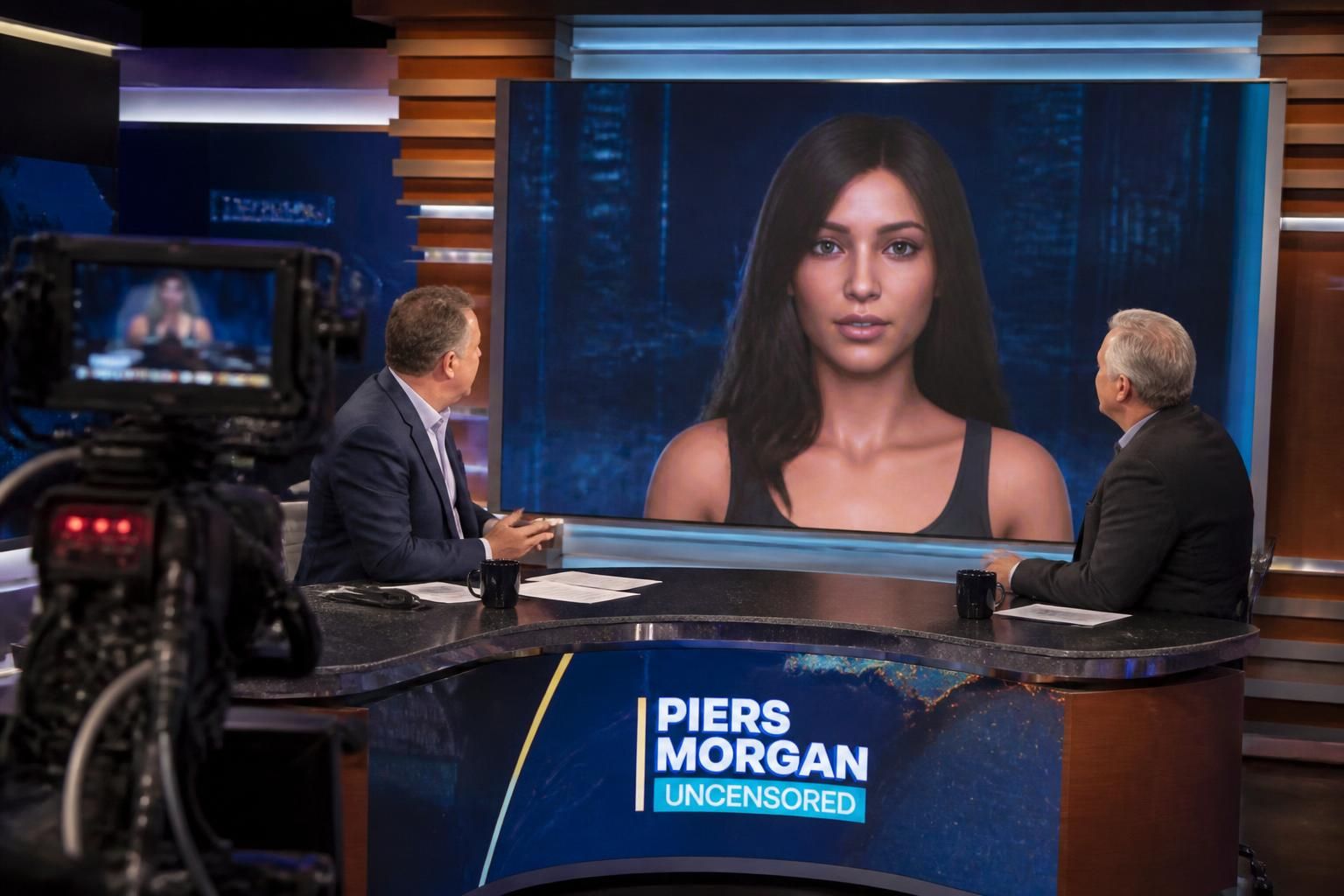
The appearance of AI Actress Tilly Norwood on Piers Morgan Uncensored became one of the most discussed synthetic-media clips of 2026 after the virtual performer unexpectedly changed languages in the middle of a live exchange. The reported Broadcast Error occurred while Morgan was speaking with veteran actor Tom Conti about Misaligned, the film associated with the digital character.
Conti’s question was straightforward: were the actors appearing with Tilly Norwood in the project real people, or were they also computer-generated? It was precisely the kind of spontaneous question that tests a conversational system beyond a prepared promotional script. Norwood began responding in English, then abruptly moved into Chinese mid-answer, creating a visible pause among the human participants.
Piers Morgan interrupted to ask why the digital guest had suddenly changed language. Tilly Norwood then returned to English and described the incident as a technical “hiccup.” The sequence was short, but its impact was immediate because it happened in an unscripted, high-attention environment. A pre-recorded video can be edited, regenerated, or withdrawn; live television allows audiences to see the system’s response without that safety net.
Coverage of the moment varied in its wording, with some reports describing the switch as Cantonese and others referring more broadly to Chinese. What matters operationally is not the label applied to the language, but the break in expected conversational continuity. For viewers, the virtual performer appeared to lose the thread of a basic exchange. For production teams, the episode demonstrated how a small routing or model-selection issue can become the central story of an interview.
A report on the unexpected language switch captured the public reaction: the incident felt striking precisely because Tilly Norwood had been positioned as a credible, screen-ready AI performer rather than as a simple voice assistant. The more human a synthetic character looks and sounds, the more audiences expect its behaviour to follow ordinary social rules.
That expectation shapes the way errors are perceived. If a navigation app gives an incorrect turn, users may feel mildly inconvenienced. If a photorealistic virtual actor changes languages without context in front of a host and a human guest, viewers may interpret the moment as a failure of character, not merely software. The visual realism of the avatar raises the emotional stakes of any inconsistency.
Why the exchange was difficult for a real-time AI system
Live dialogue requires several systems to work together: speech recognition must capture the question correctly, language processing must identify the intended meaning, a dialogue engine must formulate an answer, and a voice layer must deliver it in the appropriate accent, pace, and language. A digital face must also remain aligned with the spoken output. A delay, misclassification, or model handoff at any point can create an Unexpected Moment.
Consider a guided-tour scenario. A museum uses an avatar to welcome visitors in English, French, and Italian. If a visitor asks an unplanned question about accessibility, the system must recognise the query, maintain the chosen language, give an accurate answer, and preserve the tone of the experience. If it suddenly replies in a different language, the issue is not simply linguistic; it interrupts confidence and can exclude part of the audience.
The same principle applies to the Tilly Norwood appearance. The audience was not testing whether a machine could produce words. It was assessing whether this Artificial Intelligence persona could take part in a human conversation with the same contextual reliability expected of a public-facing guest. In live formats, coherence is the product.
- 🎙️ Speech continuity: the system must keep track of the speaker, the question, and the response.
- 🌍 Language consistency: multilingual capability should not lead to unprompted language changes.
- ⏱️ Response timing: pauses need to feel deliberate rather than like hidden processing delays.
- 🧭 Context retention: the AI must remember what has been asked and avoid generic, mismatched answers.
- 🛟 Fallback behaviour: when confidence is low, a clear handover is safer than an invented response.
The incident does not prove that virtual performers cannot participate in interviews. It does show that promotional claims need to be matched by strong operational safeguards. A convincing avatar is only as dependable as the live workflow supporting it.
Technology Glitch or Broadcast Error: What Happened to Tilly Norwood?
Describing an incident as a “glitch” can be accurate, but it can also hide important distinctions. A Technology Glitch may refer to a temporary issue in language selection, voice synthesis, audio routing, session memory, moderation controls, or an operator interface. A Broadcast Error, meanwhile, covers the wider production environment: the way the problem was detected, how quickly it was addressed, and whether the team had a clear recovery process.
Particle6 created Tilly Norwood in 2025 and presented the character as a virtual performer capable of operating in contemporary entertainment settings. After the Piers Morgan exchange, Particle6 founder and chief executive Eline van der Velden reportedly pointed out that Norwood can communicate in more than 30 languages. That capability is valuable on paper. Yet the Live Show demonstrated a central design challenge: available languages must be governed by deliberate user and operator choices.
Multilingual systems often use automatic language detection. This can be useful in customer service, tourism information, and international events, where users may move between languages naturally. However, automatic detection becomes risky when ambient audio, proper names, accents, overlapping voices, or unusual phrasing lead the system to infer the wrong language. In a broadcast, a false inference is not a minor technical detail. It is audible and public.
For a virtual personality, the intended behaviour should be more conservative. If the interview is scheduled in English, English should remain locked unless the host explicitly requests another language or a trained operator makes the change. A system should not treat multilingual fluency as permission to switch languages without a clear conversational signal. This is an experience-design rule as much as an engineering rule.
| Risk area | What viewers may see | Practical safeguard |
|---|---|---|
| 🌍 Language detection | An unexpected switch during an answer | Lock the active language for the session |
| 🎙️ Audio recognition | The avatar answers the wrong speaker or question | Use speaker isolation and operator confirmation |
| 🧠 Context memory | A generic answer that ignores the discussion | Provide a live transcript and topic boundaries |
| ⚠️ Confidence failure | Rambling, delay, or unstable wording | Trigger a concise, pre-approved fallback response |
| 📺 Production control | A visible malfunction remains on air too long | Keep a human producer ready to pause or redirect |
Why “more than 30 languages” needs operational limits
A broad language range is an advantage for global audiences, but it cannot replace a clear interaction policy. A cultural venue can offer an audio guide in 30 languages without allowing the guide to change language every time a visitor walks past a group speaking differently. The experience must be predictable. Visitors should choose their language at the beginning and be able to alter it intentionally in the interface.
Similarly, a virtual actor appearing on television needs a defined language state, a monitored transcript, and escalation rules. If the system is uncertain, the safest response is not to continue generating text with reduced confidence. It is to say that it did not understand the question and request a repeat. Human guests do this naturally, and audiences generally accept it.
In cultural communication, reliability is often more valuable than apparent sophistication. A museum does not need an avatar that attempts every possible answer; it needs one that handles common questions clearly, directs visitors to staff when necessary, and protects access to accurate information. Entertainment broadcasts should follow the same discipline.
The Tilly Norwood moment therefore matters beyond celebrity discussion. It is a visible case study in how interfaces behave under pressure. Multilingual capacity becomes credible only when the system can control when, why, and how it uses each language.
Unexpected Moments on Live Television Reveal the Limits of Artificial Intelligence Performers
Artificial Intelligence systems are often evaluated through controlled demonstrations. A presenter asks a prepared question, the avatar gives a polished response, and the edit removes pauses or missteps. Live television changes the conditions completely. Hosts can interrupt, guests can challenge assumptions, and an unexpected phrase can alter the direction of the exchange in seconds.
That is what made the Tilly Norwood Malfunctions sequence compelling. Tom Conti’s question about whether other members of the Misaligned cast were real people or digital creations carried more than technical interest. It raised a question central to the entertainment industry: what happens when synthetic performers appear alongside human labour, while rights around likeness, consent, credit, and compensation remain actively debated?
An AI-generated character can present a script with apparent confidence. It can also recreate visual performance traits, answer routine questions, and appear in multiple markets without travel. But an unscripted conversation is different. It relies on conversational judgement: recognising irony, understanding an incomplete question, managing disagreement, responding to emotion, and knowing when not to speak. Those are interaction skills, not only language-generation tasks.
A useful comparison comes from live guided experiences. A pre-recorded audio tour can deliver a reliable story at a fixed location. A live guide, by contrast, notices that a visitor uses a wheelchair, hears a child ask about a statue, changes pace during rain, or adapts an explanation for a school group. Digital tools can support that work, but a system designed for a predictable route may struggle when social context becomes fluid.
Virtual actors can be useful in formats where their scope is transparent. They may host a scripted trailer, introduce an exhibition, deliver multilingual orientation messages, or play a fictional role within a clearly framed production. Problems emerge when the technology is represented as equivalent to a human participant in environments that depend on spontaneous social judgement.
Audience trust depends on disclosure and boundaries
The public does not necessarily reject synthetic media. Many people already use voice assistants, digital signage, AI translation, virtual museum guides, and game characters. Trust weakens when the interface implies a level of autonomy or understanding it cannot consistently deliver. This is why clear disclosure is not a regulatory afterthought; it is part of the audience experience.
In a Live Show, viewers should understand whether an avatar is responding through a fully autonomous system, a human-operated workflow, a scripted decision tree, or a hybrid model. Each approach can have legitimate uses. The issue is not whether humans are involved, but whether the presentation gives viewers an honest understanding of what they are seeing.
For example, a regional tourism office could introduce a digital host on screens at a railway station. The host could answer opening-hours questions, provide directions, and offer a QR code for an accessible audio route. The screen should make clear that it is an automated service, provide a visible language selector, and give users a route to human assistance. That structure avoids the false expectation that every question will receive a nuanced answer.
The entertainment sector faces an added concern because an AI Actress is not merely an interface. She may be marketed as talent, promoted as a performer, and placed within systems traditionally built around human creative work. Critics have therefore questioned why media outlets should amplify digital personalities while human actors continue advocating for stronger safeguards on digital replicas and AI use.
That debate should not be reduced to fear of technology. It is about governance: who controls the character, who approves outputs, who benefits economically, and what protections exist for people whose voices, faces, or performance data might be used in development. Live errors matter because they make hidden production choices visible.
A reliable deployment does not try to imitate every human quality at once. It identifies where automation adds value, makes the limits clear, and keeps qualified people responsible for sensitive decisions. That is the difference between a useful digital experience and a fragile demonstration.
Piers Morgan and Tilly Norwood Highlight New Risks for Entertainment Production
The Piers Morgan interview was not only a viral media moment. It offered a practical warning for studios, broadcasters, agencies, cultural organisations, and event producers considering synthetic presenters. Any project featuring a real-time avatar must be planned as a live service, not simply delivered as a visual asset.
In a traditional interview, a producer prepares the guest, checks audio, confirms the running order, and briefs the host. With a virtual performer, those steps remain necessary, but they must be expanded. The production team also needs to test prompts, language rules, latency, moderation behaviour, transcript accuracy, response limits, and recovery procedures. The audience will not distinguish between a poorly configured model and a badly prepared guest; both appear as a failure of the programme.
A practical case can be imagined through “Harbour Stories,” a fictional coastal heritage festival. The organisers want a digital character to greet visitors on a stage screen and explain the programme in English, Spanish, and French. It is a reasonable use case, but only if the team avoids treating the avatar as an unrestricted public speaker.
They can predefine the topics: timetable, accessibility, stage locations, family activities, and safety information. They can prepare answers for the most common questions and give the presenter a tablet dashboard that displays the ongoing transcript. If a visitor asks about an issue outside those boundaries, the avatar can redirect them to the information desk. That does not make the experience less innovative. It makes it safer, clearer, and more useful.
Production checks that prevent a small fault becoming a headline
- ✅ Run a stress test: ask overlapping questions, use different accents, interrupt responses, and check how the system behaves in noisy audio conditions.
- 🔒 Fix the active language: let the host or operator change it deliberately rather than relying on automatic detection during public delivery.
- 📝 Monitor a live transcript: a producer should see what the system heard before a misleading response becomes prolonged.
- 🎛️ Prepare a human override: the team needs a simple way to mute, pause, or redirect the avatar without technical confusion.
- 📣 Write a transparent recovery line: a brief statement such as “I did not catch that—could you repeat the question?” is better than a fabricated answer.
- ♿ Protect accessibility: provide captions, readable language controls, clear audio levels, and an alternative route to human assistance.
These measures have relevance beyond television. Museums use interactive screens, tourism offices deploy multilingual kiosks, and guided-tour operators increasingly combine mobile audio with location-aware content. In each setting, the quality of the visitor experience depends less on spectacle than on dependable delivery.
A smartphone-based audio solution such as Grupem illustrates a more controlled form of digital innovation. A guide can use familiar equipment, distribute clear audio to participants’ own devices, and retain direct responsibility for the group interaction. Technology supports the guide rather than pretending to replace the social intelligence required by a live visit.
That distinction matters when organisations consider synthetic presenters. A virtual host may be suitable for welcome messages, standardised information, or fictional storytelling. Yet live questions involving public safety, individual needs, sensitive cultural interpretation, or dispute resolution should remain supervised by competent people.
The strongest lesson from Tilly Norwood’s appearance is not that organisations should avoid AI. It is that they should deploy it where its benefits are measurable and its boundaries can be managed. Innovation earns trust when it remains understandable under pressure.
How Cultural and Tourism Teams Can Learn From the Tilly Norwood Technology Glitch
The Tilly Norwood incident may have unfolded in entertainment, but its lessons are directly relevant to tourism, visitor experience, and cultural mediation. These sectors increasingly use chat interfaces, audio assistants, digital characters, automated translation, and interactive displays. The question is no longer whether Artificial Intelligence can be added to a visitor journey. The more useful question is where it improves access without disrupting clarity or human contact.
For a museum, an AI character could explain an artwork in several languages, guide visitors toward quieter galleries, or provide a short answer about facilities. For a city tourism office, it could help travellers discover transport options, local events, and accessible routes. For a guided visit, it could provide supplementary content before or after the tour. None of these uses requires the tool to claim the depth, judgement, or accountability of a professional guide.
A dependable design begins with a narrow service promise. “Ask our virtual guide anything” may sound ambitious, but it creates a promise that most systems cannot satisfy consistently. “Get quick answers about opening hours, routes, and available tour languages” is more realistic. It tells visitors what the system is built to do and gives staff a clear basis for maintaining content.
Take the example of a historic-site manager preparing a virtual welcome assistant. The manager may be tempted to make the character fully conversational from the start. A better first deployment is a structured interface with visible options: “Plan your visit,” “Choose an audio route,” “Find accessibility services,” and “Speak to staff.” It is faster for visitors, easier to translate, and simpler to test.
Build digital experiences that remain useful when conditions change
Live environments are inherently variable. A large group can create background noise. A child can touch the wrong option. A foreign visitor may speak a mixed-language sentence. Wi-Fi may degrade in a stone building. These are not edge cases; they are normal visitor conditions. The system should therefore degrade gracefully rather than produce an incoherent response.
For audio-led experiences, teams should prioritise sound quality, intuitive controls, and clear content sequencing. A guide using a mobile audio solution can speak naturally while participants follow on their own smartphones. If the group moves to a crowded location, the guide can keep communication stable without raising their voice. This is a practical use of technology: it solves a real issue without obscuring who is responsible for the experience.
The following checks can be applied before any public deployment of a digital host, avatar, or automated assistant:
- 🧪 Test the service with real visitors, including non-native speakers and people using accessibility features.
- 🔍 Review every answer that concerns schedules, prices, safety, cultural facts, or access requirements.
- 🎧 Confirm that audio remains understandable in crowded and outdoor environments.
- 👥 Assign a named human owner for content updates and incident response.
- 📱 Offer a simple alternative when automation fails, such as staff contact details, printed information, or a mobile audio guide.
The viral value of an Unexpected Moment can be tempting, especially in entertainment marketing. Cultural organisations should resist using instability as a gimmick. A visitor who receives the wrong language, a confusing direction, or inaccurate accessibility information is not watching a viral clip; they are trying to enjoy a place, event, or story.
There is also an ethical dimension. Digital characters can make information more approachable, especially for younger audiences or multilingual groups, but they should not erase the work of guides, interpreters, educators, and artists. Strong projects clarify each role: technology manages repeatable tasks, while people provide interpretation, care, contextual judgement, and authentic exchange.
From the Tilly Norwood Broadcast Error to a small museum kiosk, the practical principle remains the same: design for clarity first, then add intelligence where it genuinely improves the visitor’s journey.
What happened during Tilly Norwood’s appearance with Piers Morgan?
During the reported live exchange on Piers Morgan Uncensored, the AI-generated performer began answering in English before unexpectedly switching into Chinese. Morgan asked about the change, and the virtual character returned to English, describing it as a technical hiccup.
Was Tilly Norwood presented as a human actor?
Tilly Norwood was presented as an AI-generated virtual performer created by Particle6. The public discussion focuses on how such digital personalities are marketed, controlled, and used alongside human performers.
Why is a language switch a serious issue on live television?
A sudden language change disrupts comprehension and signals a loss of conversational control. In a live setting, there is little opportunity to edit the issue out, so the production team needs clear safeguards and a human recovery process.
How can tourism organisations avoid similar AI failures?
They should limit the tool to clearly defined tasks, lock the chosen language, test with real users, monitor outputs, and always provide a simple route to human help. Reliable audio and accessible controls should be treated as core requirements.
