
Key takeaways for busy readers: ✅ LG Electronics is presenting an expanded AI-powered home ecosystem at IFA in Berlin, built around ThinQ ON, ThinQ Claw, connected appliances and energy management. ✅ The concept responds to European lifestyles through space-saving Fit & Max products, practical automation and lower-consumption technologies. ✅ For homes, hospitality venues and visitor-facing spaces, the relevant question is not whether devices are smart, but whether they reduce friction without reducing user control.
LG Electronics and the AI-Powered Home Ecosystem at IFA 2026
At IFA 2026 in Berlin, LG Electronics is presenting a broad vision of the connected home: appliances, entertainment screens, climate systems, energy tools and digital services working through a shared intelligence layer. Under the theme “Innovation in tune with you,” the company is positioning its AI-powered home ecosystem as a practical response to routines rather than a collection of isolated gadgets.
The central element is LG ThinQ ON, an AI home hub designed to coordinate compatible products and services. It sits alongside the LG ThinQ platform, which has long acted as the control environment for the brand’s connected devices. The stated evolution is contextual: the system is intended to consider household preferences, room conditions and recurring habits before recommending or executing an action. This approach matters because useful automation is rarely about adding more notifications. It is about reducing the number of small decisions people need to make during a day.
One of the most visible demonstrations at the event is the LG AI Orchestra, a kinetic LED installation measuring 16 metres by 4 metres. In this display, the LG CLOiD robot takes the role of conductor, symbolically connecting appliances, HVAC equipment, televisions, robotic solutions and services. The staging is ambitious, but it also illustrates a clear product principle: interoperability is valuable only when it produces a coherent experience across the home.
Consider a hypothetical family arriving at a compact apartment after a late train journey. A fragmented smart home would require them to open several apps: one for heating, one for lights, another for the washing machine, and perhaps a separate platform for electricity use. A coordinated ecosystem could instead prepare a comfortable indoor temperature, suggest the best laundry cycle for travel clothes and avoid running high-consumption appliances during an expensive energy period. The relevant benefit is not the novelty of the interface; it is the removal of unnecessary steps.
LG describes this direction as part of its Zero Labor Home vision. The phrase should be interpreted carefully. No household system eliminates every task, and users still need visibility, consent and manual controls. However, technology can take over repetitive coordination: alerting residents when an appliance needs attention, adjusting settings based on patterns, or helping them avoid leaving energy-intensive processes running at the wrong time.
For professionals who manage accommodation, serviced apartments or cultural venues, the logic extends beyond domestic use. A connected environment can make guest-facing operations more consistent. A small museum residence, for example, may need to monitor humidity, cooling and appliance status across several rooms without requiring staff to inspect each device individually. The operational value lies in centralised oversight and reliable alerts, not in turning every room into a technology showcase.
ThinQ Claw brings text-based contextual assistance to smart home routines
ThinQ Claw is making its public debut at IFA as a text-chat-based AI agent integrated with ThinQ ON. Rather than requiring users to navigate a complex menu, it is designed to understand naturally phrased requests and respond according to context. A resident could ask for help with a noisy appliance, request a lower-energy wash option or ask which cooling mode is appropriate after filling a refrigerator with fresh groceries.
Voice and text interfaces are becoming increasingly relevant because they lower the barrier for people who do not want to learn a new dashboard. Yet accessibility depends on implementation. A conversational interface must use plain language, show what action it is about to take and provide a simple way to correct it. Professionals exploring speech-led interfaces can also examine how voice AI systems are shaping hands-free interactions in environments where screen access is inconvenient.
LG’s showcase therefore points to an important standard for the smart home market: intelligence should be visible in outcomes, not hidden behind technical claims. A successful connected home is one that helps people act faster while remaining understandable.
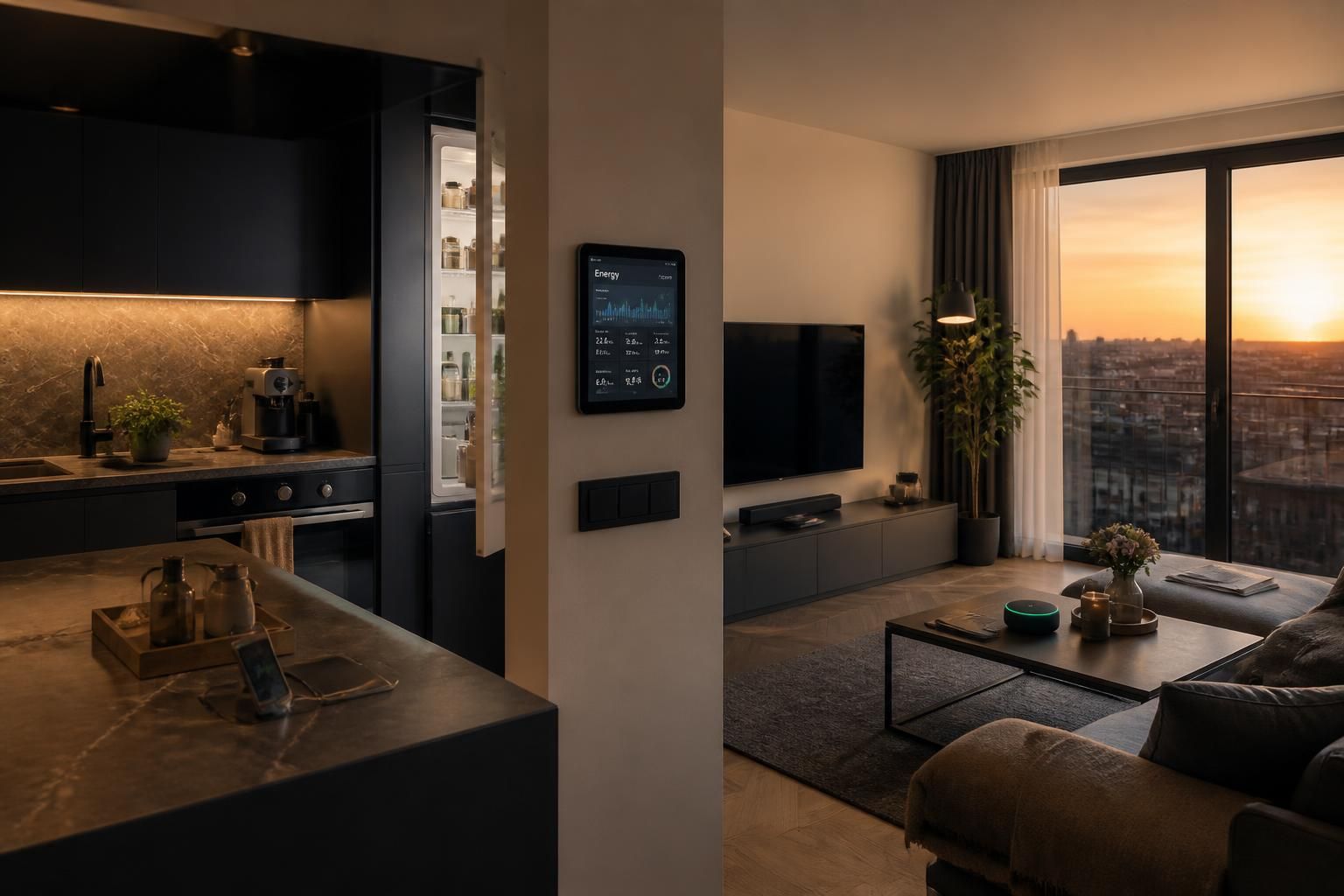
How LG ThinQ ON Connects Appliances, Spaces and Everyday Automation
The distinction between a connected appliance and a connected environment is central to LG Electronics’ IFA presentation. A Wi-Fi washing machine can report that a programme has finished. A coordinated home ecosystem can combine that information with electricity pricing, household schedules, climate conditions and user preferences. The latter is more demanding to design, but it is also where automation becomes useful in everyday life.
ThinQ ON is intended to become the coordination point for this wider environment. Its role is not merely to switch products on and off remotely. It is designed to create relationships between systems that normally operate independently: a dryer, air conditioning unit, refrigerator, television, robot and energy platform. For European households facing varied housing types, changing weather and increasing attention to utility costs, this type of orchestration can be more relevant than adding another standalone app.
A practical scenario helps clarify the difference. Imagine Marta, who operates two short-term rental flats near a historic city centre. During a changeover, she needs to prepare laundry, maintain a comfortable temperature and ensure that appliances are functioning before guests arrive. With separate connected devices, she receives multiple alerts and must interpret each one. With an integrated interface, she could monitor priority statuses from one place, identify an unusual energy spike and schedule selected functions around occupancy.
That model should not be confused with autonomous management without oversight. In hospitality and tourism settings, staff need clear permissions and easy fallback procedures. A housekeeping team should never have to search through an AI chat history to start a laundry programme. Good design preserves direct controls while making recommendations available when they add value.
From domestic convenience to facility management with ThinQ Pro
LG is also extending its approach to commercial settings through ThinQ Pro, a business-to-business management solution for centralised monitoring and control of appliances and HVAC installations. This is particularly relevant to boutique hotels, aparthotels, offices, student residences and cultural buildings where operational teams must manage many zones at once.
A venue manager could use a central system to identify equipment that is running outside planned hours, investigate recurring maintenance notifications or compare conditions between rooms. In a heritage building converted into visitor accommodation, this can support better control of comfort while respecting the constraints of older construction. Smart technology does not replace building expertise, but it can make data easier to act upon.
- 🏠 For households: prioritise routines that solve a recurring annoyance, such as laundry timing or temperature adjustments.
- 🏨 For accommodation providers: separate guest controls from staff-level monitoring to avoid confusion.
- ⚙️ For facility teams: define alert thresholds before deployment, otherwise dashboards quickly become background noise.
- 🔐 For every user: check account permissions, network security and manual-control options before connecting more products.
There is also a wider lesson for visitor experience technology. Guests increasingly expect services to be frictionless, whether they are checking into a hotel or joining an audio-guided tour. The same design principle applies: a service should anticipate reasonable needs without becoming intrusive. Tools such as AI voice assistants in customer-facing journeys show why context, privacy and clarity must advance together.
The commercial potential of LG’s platform depends less on how many devices can be connected than on whether managers can interpret the resulting information quickly. Automation earns trust when it gives people better control, rather than making processes opaque.
Fit & Max Appliances Designed for European Lifestyles and Compact Homes
European lifestyles are not defined by one housing model. They include dense city apartments, renovated historic buildings, suburban family homes and compact holiday properties. Yet limited floor space is a common constraint in many markets. LG’s Fit & Max Solution responds to this issue by expanding a built-in-style design approach beyond refrigerators to washing machines, dryers and dishwashers.
The promise is straightforward: preserve usable capacity while avoiding a larger external footprint. This matters because residents often make compromises when renovating kitchens or utility areas. A larger appliance may improve convenience, but it can block circulation, reduce storage or disrupt the visual balance of a small room. Built-in integration can address these concerns when dimensions, ventilation and service access are properly planned.
LG says some Fit & Max laundry appliances increase capacity compared with previous models of comparable external dimensions. The exact gain depends on the product, with cited comparisons of up to 3 kg against selected earlier 600 mm-deep models and up to 2 kg against certain 550 mm versions. These figures are useful as design indicators, not universal guarantees: actual capacity and suitability vary by model, programme and installation conditions.
For a family of four in a narrow urban apartment, a larger drum without a deeper machine can reduce the number of weekly cycles. For a holiday-rental operator, it may allow towels and bed linen to be processed more efficiently between stays. However, capacity is not the only selection criterion. Noise levels, installation clearance, maintenance access and programme duration are equally important, particularly where appliances operate close to bedrooms or shared living spaces.
One-hour washing and drying cycles require realistic expectations
LG is also highlighting Fit & Max dishwashers with a full wash-and-dry cycle that can be set to complete in approximately one hour. This can be useful for a small household, a studio flat or a property preparing for incoming visitors. However, the one-hour figure refers to an algorithm setting; actual duration depends on the environment, load and optional functions selected.
That nuance deserves attention. Fast cycles are most effective when users load appliances correctly and choose them for the right type of soil level. A heavily loaded dishwasher after a large family meal may need a more intensive setting. In contrast, lightly soiled breakfast dishes in a compact rental can be an appropriate use case for a shorter cycle.
| European living need | Fit & Max response | Operational point to verify |
|---|---|---|
| 🏙️ Limited apartment space | Built-in-style design with optimised capacity | 📏 Confirm depth, door clearance and ventilation |
| 🧺 Frequent laundry loads | Larger load potential within comparable dimensions | ⚖️ Match drum volume to real household use |
| 🍽️ Quick turnover in small properties | Dishwasher programme designed for wash and dry in around one hour | ⏱️ Allow for load and option-dependent timing |
| 🏡 Visual consistency in renovated rooms | Integrated appearance across kitchen and laundry areas | 🛠️ Keep maintenance access available |
Design choices are especially relevant in tourism accommodation, where guests judge a space quickly. A clean, calm and functional kitchen creates confidence, but technology should not dominate the room. Devices work best when they are intuitive enough that a visitor can use them without instructions that read like a technical manual.
LG’s strategy acknowledges that premium home technology is increasingly judged by spatial intelligence. In compact European homes, the best appliance is often the one that delivers capacity and comfort without demanding more room.
Energy Efficiency in LG’s Smart Home Technology: What the Claims Mean
Energy efficiency is one of the strongest practical reasons to consider a modern smart home system. It is also an area where marketing language needs to be read precisely. LG Electronics is displaying appliances based on its Dual Inverter Heat Pump and inverter compressor technologies, and it says one washing machine uses up to 70% less energy than the minimum requirement for an A rating under current European standards.
The claim is based on the Eco 40–60 programme and the Energy Efficiency Index framework under EU Regulation 2019/2014. It does not mean every programme, load or household will achieve the same result. Consumption changes with selected cycles, garment quantity, incoming water temperature and user behaviour. This is not a weakness in the claim; it is the normal reality of appliance testing. The useful question is how users can turn a high-efficiency design into a measurable reduction in real operation.
First, automation can help shift energy-demanding activities into more suitable time windows where a tariff supports this. Second, connected monitoring can reveal patterns that are easy to miss, such as a dryer routinely being started with very small loads. Third, coordination with heating, storage or local energy generation can make household consumption more deliberate.
LG’s Home Energy Management System demonstration uses Homey, the smart home platform developed by Athom, which LG acquired in 2024. The system is designed to coordinate electricity generation, storage and consumption. In a home with solar panels and a battery, this could mean using locally produced energy at a more appropriate time rather than drawing unnecessarily from the grid. The benefit depends on local infrastructure, tariffs and device compatibility, but the principle is increasingly relevant across Europe.
Energy management should start with visibility, not complex rules
Many people make energy dashboards too complicated. They add dozens of rules, notifications and data points, then stop checking the system because it creates more work than it saves. A better approach is to identify two or three high-impact actions. For example: run laundry when lower-cost electricity is available, receive an alert if an appliance is left running unusually long, and track cooling or heating use during periods of absence.
A small guesthouse provides a useful case. Its owner notices that energy use remains high during low-occupancy weeks. Rather than changing every setting, the owner compares HVAC schedules with booking data and finds that several rooms are being conditioned longer than necessary. Centralised monitoring can reveal that mismatch. Staff can then create a simple rule tied to real occupancy, while retaining manual overrides for early arrivals or accessibility needs.
- 🔎 Review which appliances consume the most energy in your actual space.
- 📱 Use connected controls to monitor patterns for at least several weeks before automating them.
- 🌡️ Prioritise heating, cooling, laundry and refrigeration because they often have meaningful operational impact.
- ✅ Test one automation at a time and keep a manual option available for exceptional situations.
Efficiency also has a cultural dimension. European consumers increasingly look beyond purchase price to noise, repairability, lifespan and operating costs. Smart features should support that evaluation, not distract from it. A lower consumption mode that is difficult to find or understand will deliver less value than a clear setting integrated into normal routines.
LG’s effort to bring core energy-saving technologies beyond flagship products is therefore significant. Energy efficiency becomes more accessible when it is embedded in familiar appliances and supported by clear, human-scale controls.
OLED evo AI, Sound Suite and Connected Entertainment for Shared Spaces
LG’s home ecosystem is not limited to kitchen, laundry and climate management. At IFA, the company is also demonstrating a media entertainment environment built around its 2026 OLED evo AI and Micro RGB evo AI displays, powered by the α11 AI Processor 4K Gen3. The visual presentation includes the Wallpaper OLED TV with True Wireless, identified as the LG OLED W6, arranged with screens of different sizes to form a gallery-style installation.
For users, the important point is not simply greater brightness or colour performance. Entertainment technology increasingly shapes how homes are used. A living room can be a cinema, gaming area, remote-work backdrop, family meeting point or temporary exhibition space. The most successful displays and sound systems adapt to this variety without demanding a technical setup before every activity.
LG says its Micro RGB evo AI uses a High Purity RGB Spectrum Display certified by TÜV Rheinland for colour purity. Certification can offer useful reassurance, but viewers should still consider the environment in which a screen will be used. Daylight, seating distance, room size, sound reflections and content type all influence the experience. A display that looks striking on an exhibition floor may need different placement and calibration in a bright apartment.
Audio quality is a usability issue, not a luxury feature
The IFA presentation includes a dedicated listening area for LG’s Sound Suite system, as well as lifestyle demonstrations featuring StanbyME 2 Max. These products reflect a broader shift toward flexible entertainment: movable screens, wireless designs and audio systems that can support films, music, gaming or guided content in shared environments.
Audio deserves particular attention because poor sound quickly undermines a premium visual setup. In a visitor centre, hotel lounge or cultural venue, intelligible speech is often more important than dramatic bass. This is why organisers should assess room acoustics, speaker positioning and accessibility before investing in advanced formats. A clear voice track can make an exhibition explanation or digital guide far more effective than a visually impressive screen with muddy audio.
Gaming is another area of emphasis. LG is introducing an UltraGear monitor it describes as the first to combine FHD resolution with a 1,000 Hz refresh rate, based on publicly available consumer-brand information as of May 19, 2026. Such specifications will interest competitive players, but they also show how display technology is diversifying. One household may need cinema-grade contrast in the living room, while another device is optimised for rapid response in a gaming space.
For tourism and cultural organisations, this ecosystem has a direct parallel. Visitors now move between physical rooms, mobile content, large displays and personal listening. The experience should remain coherent across each touchpoint. A venue might use a high-quality screen for archival footage, then let visitors continue with a smartphone audio route. The objective is continuity, not technology for its own sake.
Professionals comparing display options can also explore how Neo QLED displays are evaluated for modern viewing environments. The key criteria remain practical: image legibility, sound clarity, ease of operation and the suitability of the device for the room where it will be used.
LG SIGNATURE adds a premium layer to this vision. Its refrigerator uses AI voice recognition to understand conversational requests and suggest refrigeration modes for different foods. The LG SIGNATURE 30-inch wall oven combines an internal AI camera with AI Gourmet to identify dishes and recommend suitable cooking modes. These functions may be attractive in high-end kitchens, but they should be judged by accuracy, privacy handling and whether recommendations genuinely improve cooking decisions.
Connected entertainment works best when picture, sound and controls feel natural enough that people can focus on the shared experience rather than the equipment.
What is LG ThinQ ON?
LG ThinQ ON is an AI home hub intended to coordinate compatible appliances, services and connected devices through the LG ThinQ environment. Its purpose is to support contextual recommendations, monitoring and automation across a home.
What does the Fit & Max Solution address?
Fit & Max is LG’s approach to appliances designed for European living spaces. It focuses on built-in-style integration, efficient use of available room and increased capacity in selected product categories without enlarging the external footprint.
Does a 70% lower energy figure apply to every washing cycle?
No. The cited figure is based on the Eco 40–60 programme and the Energy Efficiency Index comparison under EU Regulation 2019/2014. Actual energy use changes according to load, programme, options and operating conditions.
How can a small hotel benefit from a connected home ecosystem?
A small hotel or serviced-apartment operator can use centralised monitoring to review appliance and HVAC status, identify unusual consumption patterns and support more consistent room preparation. Clear staff permissions and manual controls remain essential.
