
Key points at a glance: 🚨 Two ticket-holding visitors allegedly carried out a daring heist at Vienna’s Museum of Applied Arts (MAK), smashing a display case and taking a historic platinum and diamond necklace. 💎 The piece reportedly contains around 200 carats of diamonds, including 673 individual stones, and has been valued at more than $4 million. 🏛️ The case underlines a critical museum-security reality: a smooth visitor journey and robust protection must operate together, not in opposition.
Daring Vienna Museum Heist: How the Diamond Necklace Was Taken in Daylight
The reported theft at Vienna’s Museum of Applied Arts has drawn attention because of its apparent simplicity. According to accounts carried by international outlets, two men entered the MAK as regular paying visitors, using ordinary admission tickets rather than forced access or an after-hours breach. Once inside, they allegedly approached a gallery display containing a platinum and diamond necklace, struck the protective glass with a hammer, seized the jewel, and left the museum.
This sequence matters because it challenges the familiar public image of a museum heist. Many people picture elaborate night-time operations, hidden tunnels, technical hacks, or carefully coordinated teams. Here, the alleged method was far more direct: enter during opening hours, blend into the visitor flow, smash the display, take the object, and exploit the confusion created by a sudden violent act in a public cultural space.
The necklace was not an ordinary piece of jewellery. Reports describe a Van Cleef & Arpels creation associated with Egyptian royalty, made for the 1939 marriage of Princess Fawzia. It is said to feature 673 diamonds set in platinum, with a combined weight of roughly 200 carats. Its monetary estimate of more than $4 million only partly conveys the loss. Provenance, craftsmanship, royal history, and public access all contribute to its cultural value.
News coverage has stressed that the suspects were reportedly unmasked and captured by CCTV. That detail may prove important for investigators, but it also raises difficult operational questions. Were staff able to identify unusual behaviour before the attack? Did the display case incorporate vibration detection? How quickly did nearby teams receive an alert? In a busy gallery, even seconds matter. A guard responding after glass has already broken is responding to a loss event, not preventing one.
For museums, the incident is also a reminder that ticketing is not just an access mechanism. Admission data can help institutions understand visitor density, timed-entry patterns, and pressure points in galleries. It cannot predict criminal intent on its own, and it should never turn a museum visit into an intrusive surveillance experience. Yet it can support practical decisions: assigning staff during peak windows, regulating access to rooms with high-value loans, and identifying when a normal crowd becomes too dense for effective observation.
A report on the ticketed entry and museum smash-and-grab illustrates why the event has resonated beyond Austria. The alleged offenders did not need to defeat the front door. They reportedly used the institution’s most open and necessary feature—public accessibility—as part of their route into the gallery.
That does not mean museums should react by making every visitor feel suspected. Cultural venues need openness, welcome, and clear circulation. A family, school group, tourist, or independent visitor should be able to enter without unnecessary friction. The practical challenge is designing layered protection: visible staff, discreet sensors, resilient cases, clear incident roles, and visitor information that does not disrupt the cultural experience.
Consider a fictional institution, the Danube Design Gallery, preparing to show a borrowed jewellery collection. Its director could schedule timed tickets, place trained floor staff near the display, add a physical standoff distance around the case, and ensure that any impact alert reaches a designated response team instantly. None of these measures alone guarantees protection. Together, they reduce the opportunity for a fast grab-and-exit attack.
The key lesson is direct: when thieves can enter as visitors, museum security must be embedded throughout the visitor journey rather than concentrated only at entrances and control rooms.
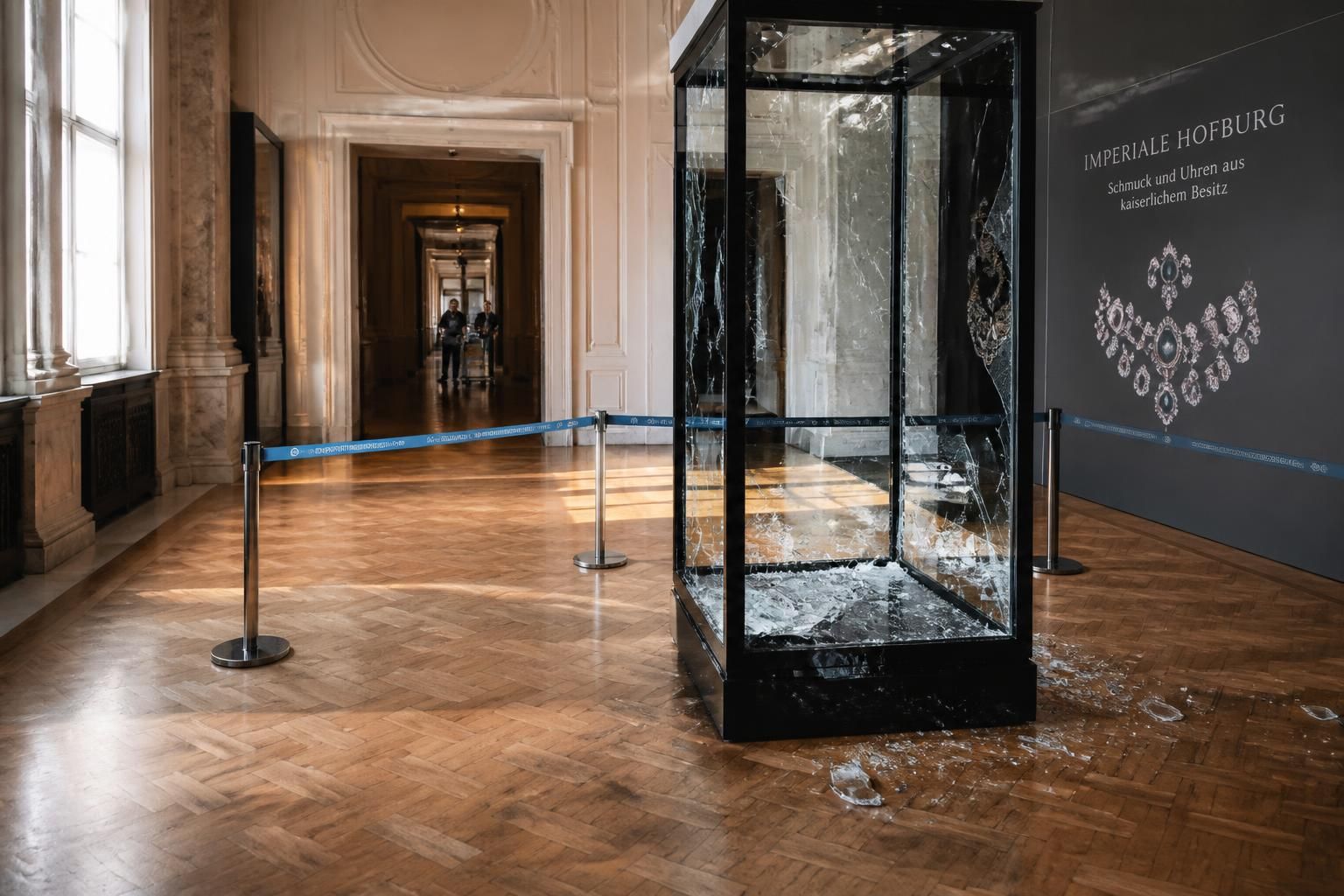
Why a Multi-Million Dollar Diamond Necklace Needs More Than a Glass Display
A display case has to solve several problems at once. It must protect an object from theft, dust, humidity shifts, accidental contact, vibration, and excessive light. At the same time, it must allow visitors to see the item clearly. Jewellery presents a particularly demanding case because its visual appeal depends on reflection, detail, and proximity. A necklace hidden behind opaque barriers may be safe from casual viewing, but it loses its exhibition purpose.
The Vienna case demonstrates why the word “glass” can be misleading. A museum-quality case should not be evaluated simply by whether it has transparent walls. Institutions need to assess the full system: the glazing material, frame anchoring, locks, alarm contacts, object mounts, sensors, room coverage, and the time required for an offender to remove the artefact after the case is compromised.
For a high-value diamond necklace, the mount is as important as the enclosure. If a thief breaks a panel but the jewel remains secured by a discreet, resistant fixture, the attacker needs more time. That delay can make the difference between an attempted theft and a successful escape. Security design often works through these small time gains. Ten extra seconds may allow an alert to reach staff; thirty can enable doors to be controlled or police to receive precise information.
| Security layer | Purpose in a jewellery display | Visitor experience benefit |
|---|---|---|
| 🛡️ Laminated or resistant glazing | Slows forced entry and limits shattering | Maintains a clear view of the diamond necklace |
| 🔔 Vibration and opening sensors | Detects impact or unauthorised movement immediately | Allows discreet protection without intrusive barriers |
| 🔩 Anchored object mount | Prevents instant removal after a breach | Supports accurate, elegant presentation |
| 🎥 Intelligent camera coverage | Documents approach, attack route, and exit direction | Reduces the need for excessive visible policing |
| 👥 Trained gallery staff | Provides human judgement and first response | Offers assistance as well as reassurance |
Security professionals increasingly use the term “delay and response.” The goal is not to imagine an unbreakable case; such a standard can be unrealistic, expensive, and visually unsuitable. The goal is to make forced access slow, loud, detectable, and difficult to complete. A hammer strike that creates noise without triggering a rapid operational response is a failure of the system, even if the glazing is technically strong.
Loan agreements deserve close attention as well. The stolen necklace was reportedly on loan, which means responsibility was shared through formal conditions between lender, insurer, borrower, and often specialist transport and security providers. Before an object arrives, museums should agree on case specifications, alarm testing, emergency contacts, photography rules, opening-hour procedures, and the exact process for removing the object in an emergency.
The same discipline applies to smaller venues. A local museum may not have the budget for a fortress-like gallery, but it can still improve protection. It can locate valuable objects away from exits, avoid predictable blind spots, use portable alarms where appropriate, and train all front-of-house personnel to recognise a suspiciously persistent interest in a case’s locks or construction.
Technology should serve this operational design rather than replace it. A smart sensor is valuable only if someone receives the signal, understands its priority, and knows what action to take. The most sophisticated security platform can become noise if alerts are poorly configured or staff roles are unclear. Museums should therefore run live drills, not merely install equipment and assume readiness.
A resilient display is not one object behind one barrier. It is a coordinated environment that buys time, supports staff decisions, and keeps the artwork visible for legitimate visitors.
How Vienna Museums Can Protect Visitors Without Turning Culture Into a Checkpoint
After a dramatic theft, public pressure often pushes institutions toward more visible control: more barriers, more bag searches, more guards, and stricter circulation rules. Some of these changes may be justified after a risk review. However, a museum’s response should remain proportionate. Visitors come to learn, observe, discuss, and spend time with collections. If the response feels punitive or chaotic, the venue may weaken the very accessibility that public museums are meant to provide.
For Vienna’s tourism ecosystem, that balance is especially important. The city’s museums are part of a broader cultural itinerary that includes architecture, music, design, cafés, and historic districts. International visitors often follow tightly planned schedules. Long, unexplained queues or confusing security instructions create frustration quickly, particularly for group tours, school visits, older visitors, and people with mobility or sensory needs.
A strong response begins with communication. If bags must be stored, tell visitors before arrival through booking confirmations and practical access pages. If a room is temporarily closed after an incident, provide a clear explanation at the entrance and offer alternative highlights. If security screening is necessary, use staff who can guide people courteously rather than simply enforce a rule. Clear wording protects both safety and the institution’s reputation.
Using visitor-flow data to reduce risk in high-value galleries
Smart tourism tools can help cultural organisations manage risk without creating a heavy-handed experience. Timed entry limits overcrowding. Live occupancy monitoring can show when galleries reach a density that prevents staff from seeing cases clearly. Digital maps can direct visitors toward quieter rooms and reduce bottlenecks around a single famous object.
Audio guidance also has a practical role. When visitors receive engaging interpretation on their own smartphones, they are less likely to cluster around a single wall label or staff member. A mobile audio guide can distribute attention across a room, provide accessibility options, and help tour leaders keep groups moving at a comfortable pace. The objective is not surveillance through technology; it is a calmer, more understandable visit that supports better supervision.
- 🎧 Provide short audio stops near high-value displays so visitors do not crowd signage.
- 🗺️ Use digital routes that guide groups away from narrow exit corridors.
- ⏱️ Set timed-entry intervals according to real gallery capacity, not only overall building capacity.
- 📣 Give staff a simple, rehearsed message for rerouting visitors during an incident.
- ♿ Make security instructions available in readable, multilingual, and accessible formats.
Imagine a guided group arriving at the fictional Danube Design Gallery shortly after an alarm sounds. The guide’s audio system sends a brief message asking participants to remain together and follow staff instructions. The guide does not need to shout over the crowd, and visitors do not need to guess whether the alert concerns them. This is a small example, but it shows how communication tools can reduce panic and preserve orderly movement.
Museums also need a clear distinction between visible hospitality roles and security responsibilities. A gallery host can welcome, answer questions, and observe behaviour without acting like a police officer. Security staff can remain approachable while being trained to escalate concerns. The public should see a competent institution, not an anxious one.
There is a wider commercial consideration. When museums make admission difficult without explaining why, attendance can suffer. A useful perspective comes from this discussion of museum admission fees and visitor expectations: perceived value is shaped by the full experience, from booking to departure. Safety measures should reinforce trust, not make a ticket feel like entry into an obstacle course.
Visitor-friendly security is achievable when information, staffing, and digital guidance are designed as one service. The next priority is ensuring that people know exactly what to do when prevention fails.
Emergency Response After a Museum Smash-and-Grab Theft: The First Critical Minutes
When thieves smash a display case, the first objective is not public relations. It is immediate safety. Broken glazing can injure visitors and staff, while an offender may still be inside the building or close to an exit. Staff must be able to trigger an alarm, protect the area, communicate clearly, and preserve evidence without creating further disorder.
A written emergency plan is essential, but it is only useful if it is short enough to be used under pressure. Teams should know who contacts police, who closes or monitors exits if authorised, who attends to injured people, who directs visitors, and who records the timeline. The plan should avoid vague wording such as “staff will respond appropriately.” A real procedure identifies roles by function and establishes a chain of command for each shift.
In the Vienna incident, the alleged suspects reportedly walked away after taking the necklace. That scenario highlights the importance of immediate, accurate observation. Staff should be trained to note clothing, direction of travel, objects carried, companions, and vehicle information only when it can be done safely. They should never attempt a physical confrontation over a cultural object. A theft investigation benefits from reliable observations; it is harmed by unnecessary risk to people.
Protecting evidence while restoring a calm museum environment
Once the immediate threat has passed, the damaged display becomes a crime scene. Staff should keep visitors away, avoid touching fragments, and ensure that relevant CCTV footage is preserved before routine systems overwrite it. Access logs, ticketing records, staff notes, and alarm timestamps should be secured quickly. A clear record can help investigators reconstruct not only the moment of the theft but also the suspects’ entry route and earlier movements through the museum.
Communication with visitors requires tact. A short message such as “A security incident has occurred; please follow staff directions and avoid this gallery” is more useful than speculation. Visitors should not be invited to photograph evidence or circulate unverified claims online. At the same time, silence can generate confusion. A nominated spokesperson should provide factual updates when authorities permit them.
The following operational sequence offers a practical model for a museum dealing with a similar event:
- 🚨 Activate the alarm and notify the designated incident lead.
- 🩹 Check for injuries and isolate shattered material without creating crowding.
- 📍 Share factual suspect descriptions and last-known direction with police and authorised staff.
- 🎥 Preserve CCTV, alarm data, ticket records, and witness accounts immediately.
- 📢 Redirect visitors through calm, accessible instructions in person and through digital channels.
- 🧾 Document every action, including exact times, decisions, and handovers.
A well-managed response also considers staff wellbeing. Front-of-house employees may witness a sudden violent act, hear glass shatter, or feel responsible for an event they could not have stopped. A short debrief should separate facts from assumptions, identify gaps in the procedure, and provide support where needed. Blaming individuals before evidence is reviewed damages learning and can discourage staff from reporting future concerns.
For group-tour operators, the event plan should be equally practical. A guide must know where to assemble participants, how to account for children or vulnerable visitors, and how to continue or reschedule the experience. Smartphone-based group communication is especially effective here: a concise audio or text notification can reach every participant without competing with alarms, crowd noise, or language barriers.
Lessons from other major art crimes show why evidence preservation matters for years, not days. The Gardner Museum theft and its long investigative aftermath remains a powerful illustration of how stolen cultural property can stay missing long after the initial event. Fast, disciplined action in the first hour cannot guarantee recovery, but it protects the best chance of identifying offenders and tracing an object through illicit markets.
The first minutes after a theft determine whether a museum has a controlled incident or a widening crisis. Preparation must therefore include people, data, communication, and visitor care—not only alarms.
What the Vienna Diamond Necklace Heist Means for Museum Security in 2026
The reported Vienna theft arrives at a time when museums are under pressure to do more with limited resources. They must maintain collections, welcome broader audiences, develop accessible interpretation, manage climate risks, and protect objects that may be internationally significant. High-profile incidents can trigger calls for expensive hardware, but the most effective improvements often start with a structured review of daily operations.
First, institutions should rank objects by more than insurance value. A multi-million dollar diamond necklace clearly requires exceptional safeguards, but a modest-looking manuscript, ceremonial object, or archaeological fragment may be impossible to replace. Risk assessment should consider cultural significance, portability, market demand, display location, loan conditions, and ease of concealment. Small, high-value objects often deserve special attention because they can be removed quickly and moved across borders.
Second, museums should test assumptions about normal visitor behaviour. The alleged Vienna thieves reportedly bought tickets, which means a standard admission transaction did not reveal the threat. That is not a failure of ticketing staff. It is a reminder that frontline teams need tools to report concerns without accusation: repeated probing of a case, attempts to distract personnel, unexplained lingering near exits, or coordinated movement by people who do not engage with the exhibition.
Third, leaders should connect security planning with exhibition design from the beginning. A security manager should not be asked to retrofit protection after curators have finalised lighting, sightlines, traffic flow, and case placement. Bringing curatorial, technical, visitor-services, and accessibility teams together early creates better results. A safe case placed where visitors can comfortably view it is more effective than a heavily protected object installed in a congested corner.
Practical priorities for museums, galleries, and loan exhibitions
There is no single technology that can eliminate theft. Camera analytics may flag unusual lingering, but false alerts need human judgement. Remote monitoring can help smaller museums outside opening hours, but it does not replace trained staff during peak times. Smartphone audio platforms can improve wayfinding and incident messages, but only if content is planned in advance and available in the languages visitors actually use.
Organisations should focus on realistic upgrades that fit their buildings and teams:
- 🔍 Review every high-risk display after changes in exhibitions, staffing, or visitor flow.
- 🧪 Test impact alarms and response times in live drills, not only through technical checklists.
- 📱 Prepare mobile visitor messages for closures, rerouting, and emergency assembly points.
- 🤝 Coordinate with local police before an incident, especially for major loans and jewellery exhibitions.
- 📚 Train guides and volunteers to support calm movement without interfering with evidence or responders.
The Vienna case also encourages museums to look at the full lifecycle of a loan. Protection begins before the object reaches the building, with route planning, condition reports, secure unpacking, and restricted access during installation. It continues after the public leaves, through inventory checks, alarm verification, and secure deinstallation. Public display is only one part of the object’s exposure.
Visitors, meanwhile, should not be excluded from the conversation. Public trust increases when museums explain that certain limits—such as no large bags, controlled photography in sensitive rooms, or temporary gallery closures—exist to protect shared heritage. The communication should be plain and specific. “Security reasons” says little; “This loan includes fragile jewellery displayed under special protection” helps visitors understand the purpose.
For cultural organisations looking for wider context, this analysis of museum security lessons after high-profile thefts shows that physical measures, operational routines, and visitor communication must reinforce one another. The Vienna event is not merely a dramatic headline. It is a working case study in how an open museum can reassess vulnerability without compromising the quality of the visit.
A museum remains welcoming when security is intelligent, rehearsed, and almost invisible until it is needed.
What was stolen from the Museum of Applied Arts in Vienna?
Reports identified the stolen item as a historic platinum and diamond necklace associated with Egyptian royalty. It reportedly contains around 200 carats of diamonds and 673 individual stones.
How did the alleged thieves enter the Vienna museum?
The suspects reportedly entered during public opening hours after purchasing regular museum admission tickets, then allegedly damaged a jewellery display case.
Why are ticketed-entry museum thefts difficult to prevent?
Museums must welcome legitimate visitors, so entry screening alone cannot identify every threat. Effective prevention combines secure displays, trained staff, sensible gallery flow, alerts, and rehearsed response procedures.
Can digital visitor tools improve museum security?
Yes. Timed booking, occupancy monitoring, mobile wayfinding, and audio communication can reduce crowding, support staff during incidents, and provide clear instructions without making the visit unnecessarily restrictive.
