
⏱️ Little time? Here is what matters:
- ✅ Recognition matters, but practical support matters more: veterans need clear access to care, work, housing, rehabilitation, and trusted local networks.
- 🎧 Museums can become active community platforms: oral history, accessible audio tours, peer-led sessions, and referral information can connect memory with real assistance.
- ⚠️ A common mistake is treating Veterans Day as a single annual gesture: well-being requires year-round action and services that remain easy to find.
Beyond Museums: Why Veterans Need Practical Support, Not Only Recognition
Museums, memorials, ceremonies, and honor walls perform an important civic role. They preserve military history, acknowledge sacrifice, and help the public understand the human cost of service. Yet a commemorative space, however carefully designed, cannot by itself answer the daily needs facing many veterans after they return to civilian life.
The central question is not whether communities should build museums. They should preserve stories, objects, and testimony with care. The real question is whether public recognition is matched by useful support: appointments that are understandable, mental health services without unnecessary obstacles, employment pathways that value military experience, rehabilitation that continues beyond discharge, and places where former service members can belong without having to explain every part of their background.
Public displays often communicate gratitude in a visible way. A veteran may be applauded at a sporting event, thanked during a ceremony, or invited to a museum opening. Those gestures can be meaningful, especially when they are respectful and not performative. Still, appreciation does not replace transportation to a medical appointment, a conversation with a trained counselor, or help translating military skills into civilian job language.
For a practical illustration, consider Marcus, a fictional former logistics specialist who leaves active service and moves back to his hometown. The town has a respected military collection, a Veterans Day parade, and a permanent monument in its central square. Marcus appreciates the recognition. However, he is also navigating interrupted sleep, uncertainty about work, and the complicated process of finding the right benefits. His most useful local contact is not a plaque or exhibition label. It is a community coordinator who can connect him to employment advisors, peer groups, and mental health resources.
This is where cultural institutions can sharpen their role. A museum can remain a place of remembrance while becoming a reliable access point for information. It can host referral days with local veteran service organizations, provide printed and digital directories, offer quiet listening spaces, and work with health and employment partners. The goal is not to turn curators into clinicians. It is to make sure visitors leave with routes toward practical help when they need it.
The scale of this responsibility is significant. The Institute of Museum and Library Services has emphasized services for veterans and military families through its veterans priority area, recognizing that libraries, archives, and museums can strengthen local capacity. Such institutions are often trusted, centrally located, and already equipped to welcome people of different ages and backgrounds. That makes them useful partners in a wider support network.
Respectful commemoration should also avoid presenting veterans as a single, uniform group. Their experiences differ by age, branch, era, role, injury status, family situation, gender, race, and transition pathway. Some may want to share stories publicly; others may prefer privacy. Some may seek a historical connection; others need immediate help with housing, education, or recovery. A thoughtful program does not assume that every visitor wants the same experience.
🧭 The strongest local approach treats commemoration as a doorway rather than a destination. It invites the public to remember service while giving veterans visible, simple routes toward assistance.
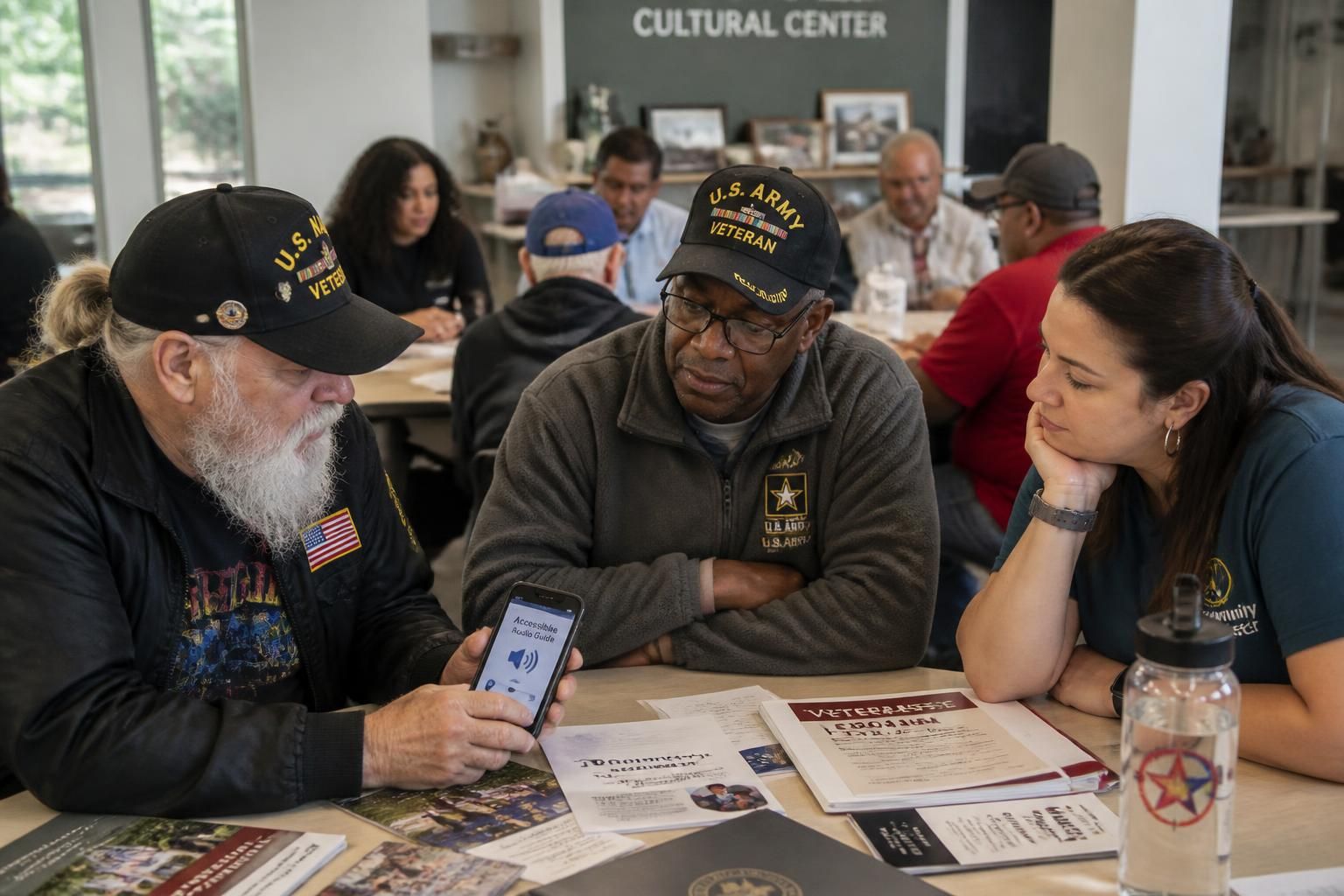
Improving Veterans’ Mental Health and Well-Being Through Trusted Community Spaces
Mental health is often discussed in broad terms, but effective support depends on details. Can a veteran find the right service quickly? Is the setting welcoming without being intrusive? Is there a clear distinction between peer conversation, crisis support, clinical care, and long-term follow-up? These questions matter because delays, confusion, and stigma can discourage people from seeking help at the point when support would be most valuable.
Community spaces can lower the threshold for engagement. A library workshop, a museum listening event, a neighborhood veterans breakfast, or a guided walking program may feel less formal than entering a clinical facility for the first time. These places should never claim to replace qualified treatment. Their value lies in connection: they can reduce isolation, share accurate resources, and direct people toward specialized services when needed.
For many former service members, the transition from a structured, mission-driven environment to civilian life can create a loss of routine and identity. The challenge may not appear immediately after discharge. It can emerge months or years later, after a move, a job loss, a family change, or an anniversary linked to service. A sustainable local network therefore needs to be available beyond a single holiday or awareness campaign.
Designing respectful spaces for listening and referral
A cultural venue can offer a practical model. Instead of organizing only a ceremonial panel, it can schedule small moderated listening sessions led by trained facilitators and veteran peer partners. Participation should be voluntary. Clear ground rules should protect privacy, and organizers should provide straightforward information on where to obtain professional care, emergency assistance, benefits advice, and family support.
Audio technology can improve this experience when it is used with restraint. A smartphone-based audio guide allows visitors to listen privately, choose their own pace, and avoid crowded group settings. Short recordings can feature veterans’ stories, historians’ context, and carefully verified information about local services. Accessibility features such as captions, adjustable volume, transcripts, plain-language navigation, and multilingual options make the experience more inclusive.
Grupem-style mobile audio delivery is particularly useful for sites that want professional sound without distributing costly dedicated devices. Visitors can use their own phones and headphones, while organizers retain a clear route for sharing content. The technology should remain invisible in the best sense: easy to access, easy to hear, and never a barrier between people and the message.
A well-designed program might include a short exhibition route on reintegration, followed by optional resource stations. At the end of each audio stop, visitors can receive a practical next step: “Speak with a local counselor,” “Find employment translation support,” or “Join a peer-led discussion on Thursday.” This is more actionable than leaving an audience with emotion alone.
| Local feature | Practical value for veterans | Implementation priority |
|---|---|---|
| 🎧 Private audio stories | Lets visitors engage at their own pace and protects personal space | Provide captions, transcripts, and simple QR access |
| 🤝 Peer-led sessions | Builds trust through shared experience and reduces isolation | Use trained facilitators and clear privacy guidelines |
| 🧠 Referral information | Connects awareness to mental health and rehabilitation services | Review contacts regularly with verified local partners |
| 🗺️ Accessible navigation | Helps people find services and events without digital friction | Use plain language, large text, and mobile-first pages |
Communities should also include families, caregivers, and friends. They often notice changes in well-being before a veteran decides to ask for help. Providing them with accurate information can improve early support without placing responsibility for care entirely on the household.
💡 The most useful cultural program does not attempt to diagnose distress. It creates a respectful bridge between personal experience, trusted community contact, and qualified help.
Turning Veterans Museums Into Active Hubs for Rehabilitation and Empowerment
Rehabilitation is broader than physical recovery. It can involve rebuilding confidence after injury, adapting to new work conditions, managing chronic pain, developing daily routines, reconnecting with family, or finding a renewed sense of purpose. A museum cannot deliver every part of this process, but it can help make rehabilitation visible as a continuing human journey rather than a private issue hidden behind patriotic imagery.
One effective change is to move from static interpretation toward participatory programming. Rather than asking veterans only to donate artifacts or attend commemorative events, institutions can invite them to shape workshops, collect oral histories, mentor young people, review accessibility, and advise on how their experiences are represented. This is not token consultation. It is a form of empowerment that recognizes lived experience as expertise.
Volunteer work can also be valuable when it is flexible and meaningful. Cataloguing objects, identifying photographs, recording testimony, or supporting visitor events can restore a sense of contribution for some participants. The contribution must be voluntary, appropriately supported, and never treated as a substitute for paid employment or professional care. When managed well, it offers social contact and an achievable mission.
Historical preservation remains a powerful entry point. The Veterans Museum model demonstrates how virtual storytelling can preserve the legacy of veterans and their families while making information accessible beyond a single building. Digital collections help people contribute from different locations, including those with mobility constraints, caregiving responsibilities, or limited access to transportation.
Building programs that create value after the visit
For a museum team, the operational question is simple: what happens after visitors leave? A strong program creates a pathway rather than a one-time experience. An oral history recording can lead to a skills workshop. A temporary exhibition about recovery can be paired with a local adaptive sports organization. A guided tour can finish with a handoff to a veteran employment counselor or community navigator.
Imagine a port-city museum running a monthly “Service to Civilian Skills” afternoon. Veterans bring a résumé or simply describe their previous roles. Local employers, educators, and veteran mentors help translate experience in logistics, engineering, medical support, leadership, communications, and operations into plain civilian language. A short audio tour of objects related to military supply chains can provide historical context, while the practical session focuses on current opportunities. The exhibition becomes useful without losing its educational integrity.
- 🛠️ Create project-based volunteer roles with defined hours and clear supervision.
- 📱 Add accessible digital storytelling so participants can contribute remotely.
- 🎓 Partner with colleges and employers for skills translation sessions.
- ♿ Audit entrances, seating, sound levels, captions, and rest areas for accessibility.
- 📞 Display verified referral contacts in physical spaces and on every event page.
Digital delivery deserves particular attention. Audio content should not be designed as a novelty. It should solve an actual visitor need: clearer interpretation, better access for people with visual impairments, quieter self-guided participation, or multilingual explanations for military families. A reliable platform can also help staff update information without reprinting brochures every time a service changes.
Representation is equally important. Exhibitions should not show only combat narratives or famous figures. They can document military families, medical personnel, reservists, veterans with disabilities, women who served, and the complex reality of return. For a relevant example of portrait-based remembrance, readers can explore James Gill’s veterans portraits, which highlights how visual interpretation can make individual stories more immediate.
🔑 A museum becomes more relevant when it gives veterans agency: the ability to contribute, choose how to participate, and access opportunities that extend into everyday life.
Creating Year-Round Community Resources Beyond Veterans Day Ceremonies
Veterans Day ceremonies can bring communities together, but the needs they spotlight do not disappear when the flags are packed away. Year-round support requires consistency. People should not have to wait for November to learn where to find benefits guidance, employment assistance, mental health care, family services, or local peer networks.
This calls for a shift in planning. Instead of treating veteran engagement as a seasonal communications task, organizations can create an annual calendar with recurring, manageable actions. A small monthly clinic, a quarterly listening event, a regular online directory review, and an accessible digital tour may be more valuable than one large event with no follow-up.
Public awareness also needs precision. Broad statements about “supporting veterans” can sound positive while offering no next step. A useful message identifies who is available, what the service does, when it operates, and how someone can reach it. The same principle applies to signage, websites, event announcements, and audio guides. Clear language is an accessibility measure.
Using partnerships to avoid duplicated effort
No single institution can provide all resources. A cultural organization should map the local ecosystem before creating a program. This may include veterans service officers, healthcare providers, rehabilitation specialists, housing groups, colleges, workforce agencies, legal aid, faith communities, adaptive recreation groups, and family support associations. Mapping prevents duplication and exposes gaps that no one organization has addressed.
For example, a museum might discover that a local clinic offers counseling but has limited public outreach, while a library has strong digital access support but little veteran-specific content. A joint program can combine those strengths. The museum provides historical context and a trusted venue; the library assists with online forms and device access; the clinic explains available care; a veteran peer volunteer helps participants navigate the conversation.
Technology can make partnerships easier to maintain. A single QR code placed at an exhibition exit can lead to a mobile page with current contacts, event dates, transportation guidance, and accessible audio information. Unlike a printed leaflet, it can be updated quickly. Staff should still offer an offline option because not every visitor will want or be able to use a smartphone.
Organizers must protect privacy. Resource pages should not collect personal data unless there is a clear reason, informed consent, and appropriate security. Anonymized feedback forms can reveal whether people found the information useful without forcing them to disclose sensitive experiences. Trust is not a decorative value; it is the condition that allows services to be used.
A recent discussion on commemoration with care reinforces the wider cultural challenge: patriotic occasions can lose depth when symbols are separated from real understanding. Museums and public institutions can correct that imbalance by connecting reflection with tangible routes toward care and civic responsibility.
Teams should measure practical outcomes, not merely attendance. A packed event may look successful, but its real impact is limited if visitors cannot find help afterward. Better indicators include the number of resource referrals completed, repeat participation in peer activities, accessibility improvements made, partner organizations involved, and feedback about clarity of information.
📌 A year-round plan succeeds when a veteran can find useful support on an ordinary Tuesday, not only during a ceremony.
Designing Accessible Audio Experiences That Connect Veterans With Support
Audio can make cultural and community information easier to access, but only if the experience is designed around real user behavior. Visitors do not want to install a complicated app, create an account, search through long menus, or stand in a noisy room trying to hear a recording. The best digital tools reduce effort and provide clear choices.
For veterans, accessible audio may offer several advantages. A self-guided format gives control over pace. Headphones can create a more comfortable environment in busy public spaces. Transcripts help people who prefer reading or need captions. Simple replay controls allow visitors to return to a detail without asking for assistance. These small decisions improve dignity and independence.
Audio stories should also be editorially responsible. A compelling testimony does not need dramatic music or sensational editing. It needs clear sound, consent from participants, accurate context, and respectful framing. When discussing trauma, injury, or loss, content should avoid unexpected graphic detail. Visitors should be able to choose whether to access sensitive material, with clear notices and alternative routes through the experience.
From historical storytelling to immediate action
A useful audio route can combine three layers. First, it explains the object, site, or story. Second, it connects the history to the wider reality of transition, service, and community. Third, where appropriate, it provides an optional practical prompt: a service directory, a support event, or a contact point. This structure respects the museum visit while acknowledging that visitors may arrive with different needs.
Consider an exhibition on military medicine. A standard guide might describe equipment and wartime conditions. A more thoughtful route could also include a short, carefully reviewed segment on how rehabilitation has changed, followed by an optional link to local adaptive programs and current health resources. The historical interpretation remains central, yet the visitor has a route toward contemporary relevance.
Organizations should test every experience with actual users. Invite veterans, caregivers, people with disabilities, older visitors, and staff members to try the route on their own phones. Watch where they hesitate. Ask whether the volume is sufficient, the language is clear, the QR code is easy to locate, and the resource link makes sense. This testing is more valuable than assuming a polished interface automatically delivers a good experience.
There is also a role for careful editorial context in a period when synthetic voices and automated content are expanding. Institutions should be transparent about how narration is produced and prioritize trust, intelligibility, and consent. The debate around AI voices in cultural media shows why audiences increasingly expect clarity about authenticity and respectful use of voices.
Accessibility should be treated as a baseline, not an optional upgrade. Provide captions and transcripts from the start. Use plain navigation labels. Keep each audio stop concise. Offer seating where possible, reduce unnecessary background sound, and ensure staff can explain how to access the content in less than a minute. These improvements benefit everyone, not only a specific group.
For museums, tour operators, local authorities, and community organizers, the immediate action is straightforward: review one existing veteran-related visitor experience and add a verified support pathway to it. Whether that is a QR-linked resource page, an audio stop with referral information, or a scheduled partner session, it turns awareness into something people can use.
🎧 Clear listening, credible resources, and user control are practical forms of respect. They allow museums to honor veterans while helping the wider community respond with more than symbolism.
Can museums provide mental health care for veterans?
Museums should not present themselves as clinical providers unless they are formally qualified to do so. They can offer trusted spaces, reduce isolation, share verified resources, host trained partners, and direct visitors toward appropriate mental health services.
What should a veterans resource page include?
It should use plain language and include current local contacts for benefits guidance, mental health care, rehabilitation, employment support, housing assistance, peer groups, transportation, and emergency services. It should also be checked regularly for accuracy.
How can audio guides improve accessibility for veterans?
Mobile audio guides let users control pace and volume, listen privately, replay information, and access transcripts or captions. They are especially useful when the navigation is simple and no complicated setup is required.
What is the most useful role for a community museum beyond remembrance?
A community museum can connect history with present-day action by partnering with local services, inviting veterans into program design, offering accurate referrals, and creating ongoing opportunities for participation and belonging.
