
🗳️ Key point: Wayne County and Oakland County Voters will consider a 10-year, 0.2-mill Tax Measure intended to provide steadier Funding for the Detroit Historical Society and the Charles H. Wright Museum of African American History.
🏛️ Visitor benefit: If approved, residents in both counties would receive free admission to the participating Detroit Museums, while proposed support would also extend to student and senior transportation, educator resources, and collection protection.
📱 Operational lesson: Long-term public support is most effective when museums pair access policies with clear, accessible visitor information, reliable audio interpretation, and practical Community Engagement.
Detroit Museums Millage Proposal: What Wayne County and Oakland County Voters Would Decide
The proposed Millage places two major cultural institutions at the center of a regional decision about public access, historic preservation, and sustainable museum operations. The Detroit Historical Society and the Charles H. Wright Museum of African American History have launched the “Yes to Our Story” campaign ahead of the November 3 election. Their request is direct: voters in Wayne County and Oakland County would be asked to approve a shared operating levy lasting 10 years.
The proposed rate is 0.2 mills. For the owner of a home valued at approximately $300,000, campaign representatives estimate an annual cost of about $30, or less than $3 each month. That calculation makes the proposal easier to evaluate in household terms, but the wider question is not solely financial. Voters are also deciding whether two institutions that interpret Detroit, Great Lakes, and African American history should have a more predictable local revenue base.
The Detroit Historical Society operates the Detroit Historical Museum in Midtown and the Dossin Great Lakes Museum on Belle Isle. The Wright Museum, founded in 1965, is widely recognized as the country’s second-largest African American history museum after the Smithsonian’s National Museum of African American History and Culture. Together, these organizations care for more than 300,000 artifacts, from documents and photographs to objects that explain the people, industries, migrations, movements, and waterways that shaped the region.
For visitors, the proposal’s most visible outcome would be free general admission for residents of the two counties. Today, free entry is generally limited to young children and members. Under the 10-Year Support plan, a family in Pontiac, a senior in Redford, or a school group from Detroit could enter without ticket cost becoming a barrier. This mirrors the public-access logic familiar in Southeast Michigan through regional support for institutions such as the Detroit Institute of Arts and the Detroit Zoo.
There is an important distinction between admission access and a complete visitor experience. Removing the ticket price can bring more people through the door, but museums must still help visitors understand what they are seeing. A first-time guest at the Wright Museum may need a clear route through exhibitions on Black history and contemporary culture. At the Detroit Historical Museum, a visitor exploring the Streets of Old Detroit installation may benefit from concise audio context, accessible text, or family-friendly explanations that connect the display to daily life in the city.
How the public authority makes the ballot question possible
The ballot proposal follows years of advocacy and legislative difficulty. The museums had pushed for a joint levy since 2019. A state bill known as the History Museum Authorities Act cleared both chambers of the Michigan Legislature, but a clerical process failure prevented it from reaching the governor’s desk at the required time. The legislation was ultimately vetoed with other delayed bills.
Rather than abandon the effort, county officials created the Southeast Michigan Public Historical Museum Authority. The joint authority gives Wayne County and Oakland County a route to present the measure to voters without waiting for a new state law. Reporting on the formation of the authority described how county leaders moved the proposal forward through this regional governance model.
This approach matters because the museums’ audiences, education partners, members, and donors extend far beyond Detroit city limits. A regional funding mechanism aligns more closely with that reality. It also requires a clear accountability framework: residents need to know what services are covered, how revenue will be governed, and whether outcomes match campaign commitments over the decade.
| Measure element | Practical meaning for residents | Visitor-experience value |
|---|---|---|
| 🗳️ 0.2-mill levy | About $30 yearly for an estimated $300,000 home | Creates a shared local Funding source |
| 🏛️ 10-year term | Longer planning period for both institutions | Supports continuity in exhibitions and public programs |
| 🎟️ Free admission | Available to Wayne and Oakland County residents if passed | Reduces an immediate cost barrier |
| 🚌 Proposed transport support | Free travel for students and seniors is planned | Addresses access beyond the museum entrance |
| 📚 Collections protection | Publicly owned objects would receive permanent safeguards | Preserves shared historical resources |
The measure therefore represents more than a request to maintain buildings. It is a decision about whether regional history should be treated as a public service with dependable access, rather than as a cultural resource reliant on unstable annual choices.
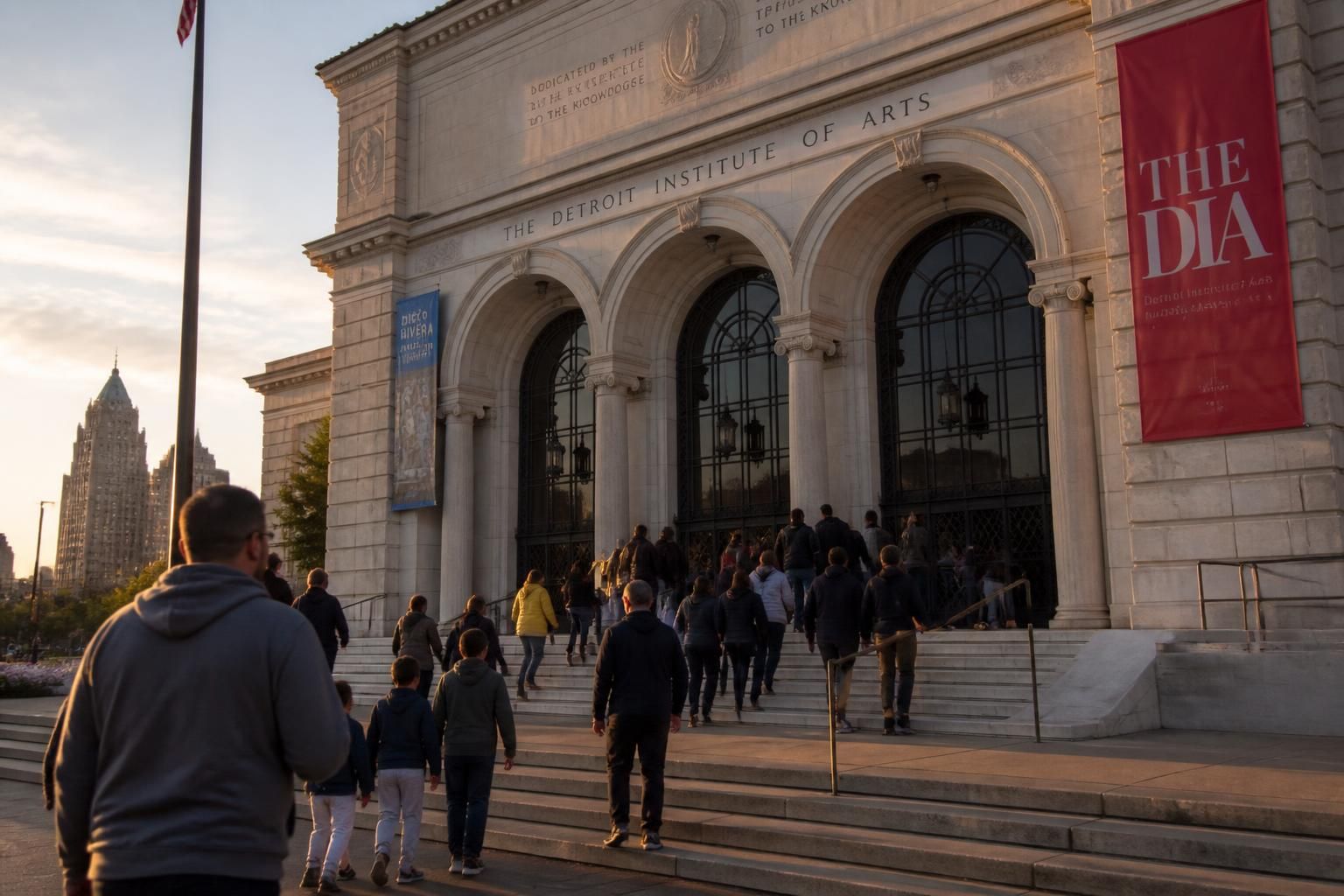
Why 10-Year Millage Funding Matters for Detroit Historical Collections
Museums rarely face only one budget challenge at a time. They must operate public buildings, retain specialized staff, preserve sensitive collections, develop exhibitions, support school visits, maintain digital systems, and create programming that remains relevant to local communities. When income fluctuates from year to year, managers often have to defer essential work. A leaking roof, aging electrical equipment, outdated storage, or a postponed education project may not make headlines immediately, yet each delay can increase future costs and weaken the public experience.
The Detroit Historical Society has described a small operating deficit despite receiving a $2 million allocation from the City of Detroit for the 2026 fiscal year and the same amount planned for 2027. It has also seen positive movement: earned revenue increased 26% over three years, and membership reached a record of around 5,000 people. Those gains demonstrate demand and effective relationship-building, but they do not eliminate the need for a stable operating base.
Grant volatility adds another pressure point. About $350,000 in grants was withdrawn as federal priorities shifted away from arts and culture, although part of that loss was later addressed through state support. The Historical Society also needs capital work across the three city-owned sites it operates. The 175-year-old Carriage House, where exhibitions are produced, maintained, and stored, needs upgrades including electrical improvements and repairs to its design studio.
At the Wright Museum, changes in government priorities have made dedicated grant opportunities harder to pursue, especially those explicitly designed to support Black communities and equity-focused initiatives. The institution has relied on lines of credit and operating reserves to honor contracted programs. The City of Detroit increased its allocation to $3.3 million for the fiscal year beginning July 1, compared with $2.6 million in the preceding fiscal year, while attendance has benefited from high-performing social-media content. These are valuable developments, yet neither public allocations nor viral posts are a substitute for a durable operating structure.
Predictable revenue supports better decisions, not simply larger budgets
A 10-year framework allows museum teams to plan responsibly. It can help them schedule conservation work before objects deteriorate, negotiate multi-year education partnerships, and retain experienced staff who understand collections and local audiences. Predictability also improves procurement. It is easier to budget for accessible signage, multilingual content, audio equipment, and exhibit maintenance when funding is not rebuilt from scratch each year.
Consider a practical example. A teacher from Oakland County may want to bring 60 students to the Detroit Historical Museum for a unit on industrialization, immigration, or civil rights. The value of that visit depends on more than a bus arriving on time. The museum needs enough educators to host the group, learning materials that match classroom needs, and exhibits that are kept functional and understandable. If the proposed transportation component is finalized and delivered effectively, it could reduce the logistical burden on schools. If schools also receive updated curriculum and teacher training, the visit can become part of a learning sequence rather than a one-off outing.
- 📌 Building maintenance: regular investment can prevent emergency repairs that interrupt public access.
- 📌 Collections care: stable resources strengthen storage, documentation, conservation, and risk management.
- 📌 Education delivery: multi-year commitments make teacher partnerships more realistic and useful.
- 📌 Digital accessibility: clear audio, transcripts, and mobile content can serve visitors before, during, and after a visit.
- 📌 Staff continuity: retaining skilled educators and collections professionals protects institutional knowledge.
For cultural organizations, the central issue is not whether technology can replace in-person history. It cannot. A screen can introduce an artifact, but standing in front of an object, a recreated street scene, or a gallery of community memory creates a different kind of attention. Digital tools are most useful when they prepare the visit, remove accessibility barriers, and help guests interpret what is physically in front of them.
Recent analysis of funding pressures affecting libraries and museums shows why institutions increasingly need diverse and dependable sources of support. The proposed millage would not remove the need for memberships, philanthropy, grants, and earned income. It would instead provide a steadier foundation on which those sources can have greater impact. Reliable Funding turns preservation from a recurring emergency into a managed public responsibility.
That distinction is crucial for voters evaluating the proposal: the measure is designed to finance continuity, allowing institutions to focus less on short-term survival and more on public value.
Free Admission and Accessibility Under the Wayne County and Oakland County Tax Measure
Free admission is one of the clearest promises attached to the proposed Tax Measure. It can change who feels entitled to visit. Families who may hesitate over multiple admission charges, students without spending money, older residents on fixed incomes, and first-time visitors who are unsure whether a museum is “for them” all gain a more open invitation when the entrance price is removed.
However, access should be assessed across the full visitor journey. A museum can be technically free and still be difficult to use. A resident may not know how to reach Belle Isle, may be uncertain about opening times, may need mobility guidance, or may worry that exhibition language will be too academic. This is why the proposal’s reference to transportation for students and seniors is significant. The responsible organizations are still discussing who would provide that transport, so this should be understood as a planned benefit rather than a fully defined service at this stage.
Effective implementation would begin with practical information. A single, plain-language web page should explain eligibility, identification requirements if any, opening hours, public transit details, parking, group booking, accessibility services, and school-visit procedures. The same information should be available on mobile devices because many people plan cultural activities while travelling, not days in advance at a desktop computer.
Designing free visits that feel welcoming and easy to navigate
Imagine a hypothetical visitor called Maya, a parent in Southfield planning a Saturday with two children and her father. The family wants to visit the Wright Museum, but Maya needs to know whether her father can borrow a wheelchair, whether the children will find age-appropriate material, and how long the experience will take. Free entry helps, but the decision becomes straightforward only when the museum provides practical answers before arrival.
Audio technology can support that outcome without adding friction. A smartphone-based guide lets visitors choose a route, control volume, pause when needed, and follow exhibits at their own pace. It can provide captions and transcripts, offer shorter versions for families, and help guests who prefer listening rather than reading dense wall text. A professionally structured audio route also helps groups avoid crowding around a guide in narrow galleries.
This does not require handing out expensive devices to every visitor. The core requirement is a stable content workflow: scripts checked by curators, clear recording quality, accessible language, and concise instructions posted at entry points. Museums can use QR codes, web links, or a dedicated mobile app. For group visits, a platform such as Grupem can allow guides or educators to speak live to visitors’ own smartphones, improving audibility without requiring a traditional loudspeaker system.
- 📱 Prepare before arrival: publish booking, transport, and accessibility details in a format that works on a phone.
- 🎧 Offer layered interpretation: provide short audio highlights alongside deeper material for repeat or specialist visitors.
- 🧭 Make wayfinding useful: connect maps to recommended routes, rest areas, lifts, and key exhibits.
- 👥 Support group leaders: give teachers and guides simple tools for coordinating students without raising noise levels.
- 💬 Collect feedback: ask visitors where they became confused, delayed, or excluded, then improve the route.
Free admission also creates operational questions. Higher attendance may mean greater demand for front-of-house staffing, gallery cleaning, toilets, security, and visitor assistance. The public should not assume that opening doors without tickets makes a museum cheaper to run; in many respects, it increases the need for careful service design. The millage case is strongest when its supporters explain that access carries a real operating cost and that this is precisely why dependable regional revenue is being requested.
The wider education context is equally important. School trips are frequently constrained by transport costs, limited staff capacity, and changing funding streams. Resources on school-trip funding challenges illustrate how quickly cultural access can shrink when logistics are underfunded. If the Detroit proposal leads to transport and curriculum support, it could make museum learning more practical for schools that currently cannot justify the cost or administrative effort.
Accessibility is not achieved by a single policy announcement. It is built through consistent details: a clearly audible guide, a reliable bus plan, understandable information, respectful staff interaction, and exhibitions that give local residents reasons to return. That is how a free ticket becomes a genuinely open cultural experience.
Community Engagement and Public Accountability for the Detroit Museums Millage
The campaign faces a demanding political environment. Voters in Oakland and Wayne counties recently rejected public-safety and education levies in an August primary, showing that public requests for new taxes are being scrutinized carefully. Supporters of the museum measure point to past regional backing for the Detroit Institute of Arts and Detroit Zoo, but prior approval for other institutions does not automatically secure support for this proposal.
For that reason, Community Engagement must be more than billboards, social posts, and canvassing. These tools matter during a short campaign period, but lasting trust depends on answering practical questions. What share of funds will go to public programming, preservation, facilities, education, and administration? How will the Southeast Michigan Public Historical Museum Authority report progress? What happens if projected revenue changes? Which transportation services are guaranteed, and which depend on later agreements?
Campaign leaders have framed the proposal as a way to preserve local and Black history while keeping museum doors open to every resident in the two counties. The language is compelling because the collections speak to broad regional identities. Detroit’s automotive history, labor history, migration stories, maritime connections, civil-rights activism, neighborhoods, and cultural innovation are not isolated subjects. They influence how residents understand their own communities and how visitors understand the region.
Turning campaign interest into sustained public participation
Transparent reporting should be designed before revenue is collected. A yearly public dashboard could show attendance by county, school-group participation, number of free admissions, program delivery, conservation activity, capital projects, and membership trends. It should also explain where targets were missed and what corrective action is planned. A dashboard is not a substitute for a formal audit, but it makes public value easier to see without requiring residents to decode a complex financial report.
Public meetings should also occur outside central Detroit. Residents in Birmingham, Pontiac, Redford, and other communities need opportunities to ask questions in locations that feel local. Hybrid sessions with captioned streams, short video explainers, and accessible written summaries can widen participation. The goal is not to market history as a vague civic good. It is to show how a county resident’s contribution translates into admissions, learning access, collection protection, and a stronger cultural network.
There is a useful parallel in the discussions surrounding other museum systems facing reduced federal support. Coverage of museum operations after federal funding interruptions underlines the importance of communicating financial realities early. Institutions gain credibility when they explain both strengths and constraints. The Detroit Historical Society’s revenue growth and record membership are encouraging. The Wright Museum’s rising city allocation and social-media reach are also meaningful. Yet each organization has acknowledged that deficits and uncertainty cannot be resolved through occasional gains alone.
Supporters should therefore avoid treating the levy as an automatic rescue. It is a public contract. Residents would contribute over a decade, and the museums would need to demonstrate that the investment is improving access while protecting the assets they hold on behalf of the public. That means setting measurable service standards from the start.
- ✅ Publish annual financial and service reports in clear language.
- ✅ Track free admissions and school participation by Wayne County and Oakland County.
- ✅ Provide a public schedule for capital work and collections projects.
- ✅ Build resident advisory sessions into the authority’s annual calendar.
- ✅ Measure accessibility improvements, including audio, captions, mobility information, and transport use.
Voters will reasonably examine the annual household cost, but they will also assess whether the organizations have a credible plan for using that contribution. The most persuasive argument is not nostalgia. It is accountable stewardship of places where regional history can be encountered, debated, and passed on.
Using Smart Visitor Tools to Make Millage-Supported Museums More Valuable
If the Millage wins approval, the next challenge will be implementation. Free admission can bring a larger and more varied audience into the Detroit Museums, including people who have not visited in years or who have never visited at all. That makes interpretation, orientation, and service quality increasingly important. A museum does not need to become a technology showroom, but it should use simple tools where they solve a real visitor problem.
Smart tourism is valuable when it reduces effort. A mobile guide can help guests choose an appropriate route before they arrive. A parent may select a 45-minute family trail. A resident returning to explore a specific subject may choose a deeper route focused on Detroit’s labor history or Great Lakes trade. A visitor with hearing needs may open a transcript, while a guest who finds reading difficult may listen to a concise explanation with visual prompts.
The practical advantage of smartphone audio is that visitors already carry the hardware. Museums can avoid issuing, charging, cleaning, and replacing large fleets of handheld devices. They can also update scripts quickly when an exhibition changes. This is particularly useful for institutions with rotating displays, community-led programs, and temporary installations that respond to current conversations.
A practical deployment model for museum teams and education partners
Staff should begin with a focused pilot rather than attempt to digitize every object immediately. One route at the Wright Museum and one at the Detroit Historical Museum could be selected based on visitor demand. The first version should include ten to fifteen stops, each with a defined purpose: explain an artifact, frame a historical moment, connect an exhibition to a local place, or invite visitors to consider a question.
A strong audio script is not simply a wall label read aloud. It uses plain language, short sentences, clear pauses, and real context. For example, a description of a Great Lakes shipping artifact can connect it to work, commerce, immigration, and Detroit’s geographic role. A Wright Museum segment can place an individual story within the larger history of African American migration, civic leadership, and creative expression. Such content is more memorable when it is factual, well-paced, and respectful of complexity.
Live group support can complement self-guided content. During a school visit, an educator can transmit clear commentary to students’ phones or headphones rather than compete with gallery noise. A guide leading a multi-generational group can use a simple audio solution to make sure everyone hears without crowding. This supports accessibility and reduces the tendency for visitors at the back of a group to disengage.
Data should be handled responsibly. Museums can monitor anonymous indicators such as route starts, average listening duration, languages selected, and frequently skipped stops. These signals help teams improve content and physical signage. They should not become an excuse to collect unnecessary personal information. Visitor trust is strengthened when institutions explain what data is used, why it is useful, and how it is protected.
Digital tools also offer a practical route to Community Engagement. Residents can record short approved reflections, contribute neighborhood memories to a moderated digital map, or receive alerts about new exhibitions and public talks. A museum could invite former auto workers, dockworkers, educators, musicians, or long-term residents to share stories that complement formal collections. Curatorial review remains essential, but participatory design can make a publicly funded institution feel genuinely connected to the people it serves.
For museum professionals following the campaign, local reporting on the proposed 10-year dedicated levy offers useful background on the public case being made. The broader lesson applies well beyond Detroit: stable public support is most valuable when it is matched by operational clarity, inclusive access, and visitor tools that make cultural content easier to hear, understand, and share.
🎧 The lasting opportunity is clear: a regional funding model can preserve collections and widen entry, while practical audio and mobile tools can ensure that every additional visit feels informed, accessible, and worth repeating.
What would the proposed Detroit museum millage cost homeowners?
The proposed 0.2-mill levy is estimated at about $30 per year for the owner of a home valued at approximately $300,000. Actual tax amounts depend on taxable value rather than a single advertised home figure.
Which institutions would receive support from the 10-year measure?
The measure would support the Charles H. Wright Museum of African American History and the Detroit Historical Society, which operates the Detroit Historical Museum and the Dossin Great Lakes Museum.
Would Wayne County and Oakland County residents receive free museum admission?
Yes. The campaign states that residents of both counties would receive free admission to the participating museums if voters approve the millage.
Does the proposal include school transportation?
The plan includes free transportation for students and seniors, plus teacher curriculum and training. Details about the transportation provider are still being discussed.
Why are the museums seeking a dedicated funding source?
Both organizations have faced operating deficits, grant uncertainty, and ongoing building and collections costs. The proposed long-term revenue is intended to provide greater financial stability and improve public access.
