
Little time? Here is what matters:
- 🎨 Marshall’s Michelson Museum has presented work created by local young people during its June and July Art Across America classes.
- 🖼️ The display turns Summer Workshops into a public moment for families, teachers, and the wider Marshall community.
- 🔊 Museums can make Student Art exhibitions easier to explore with concise labels, accessible routes, and optional audio interpretation.
Marshall’s Michelson Museum Art Exhibits Celebrate Student Creative Masterpieces
Marshall’s Michelson Museum of Art has transformed the outcomes of its summer learning programme into a public Art Exhibit that gives young creators a visible place in the cultural life of the city. The showcase brings together work made during the museum’s Art Across America classes, held weekly throughout June and July. Rather than treating workshop output as a private classroom exercise, the museum presents it as work worth looking at, discussing, and sharing with families.
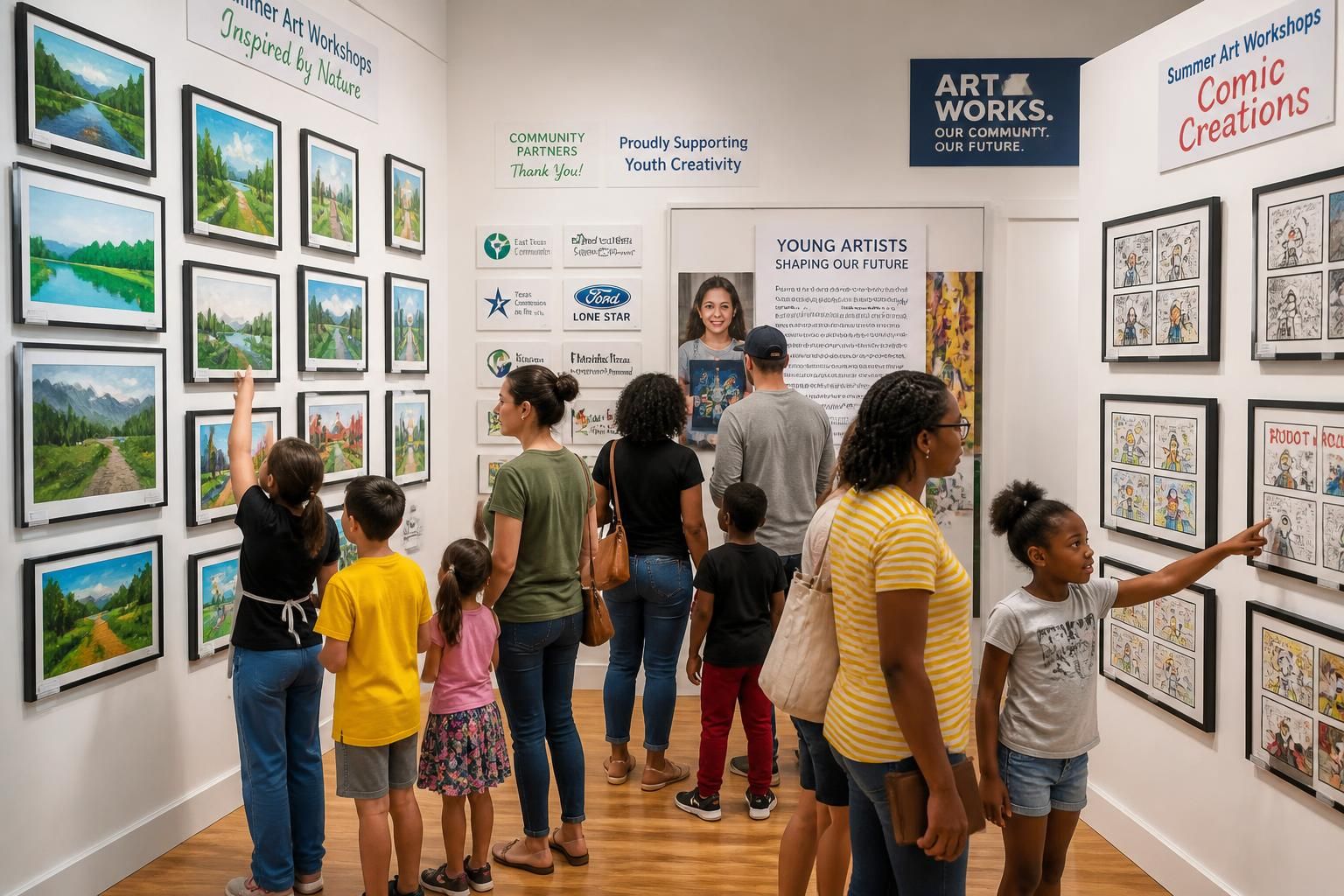
The range of pieces is central to the exhibition’s appeal. Visitors can encounter landscape paintings alongside comic-strip drawings, with each format reflecting a different way students interpreted the lessons and materials available to them. A painted landscape may show a student responding to colour, horizon, weather, or a familiar East Texas setting. A comic sequence can reveal visual storytelling, timing, character design, and humour. Together, these Creative Masterpieces show that artistic development does not follow one formula.
The format also makes an important statement about Art Education. Children and teenagers need more than a finished product to gain confidence; they need a setting where their ideas are taken seriously. Displaying their work inside an Art Museum gives that process a public context. It shows participants that sketching, painting, printing, and assembling images are not peripheral activities. They are recognised forms of communication and cultural participation.
For families, the showcase changes the museum visit. A parent may initially arrive to see one child’s piece, then spend time comparing different approaches to a shared topic. A younger sibling may discover that a comic panel or a bold painted sky feels familiar and achievable. This kind of visit naturally extends beyond a quick photo opportunity. It encourages people to ask what materials were used, how an idea changed during a class, and what the artist might create next.
One participant, Eden Cook, described the museum as a place that is enjoyable and welcoming, noting the value of regular opportunities for children. That response captures the practical strength of the programme. A successful youth arts offer is not defined only by its final display. It depends on whether young people feel comfortable returning, trying unfamiliar techniques, and seeing the institution as a place designed for them as well as for adult visitors.
Why public display gives workshop art lasting value
Workshop Art gains a different meaning when it moves from a classroom table to gallery walls. In the classroom, students may focus on finishing before the session ends. In the gallery, they can view the same work with distance and pride. They can notice details that were easy to overlook while creating: a repeated line, a colour contrast, a surprising expression on a drawn face, or a confident choice of composition.
This approach benefits local cultural organisations as well. Student-focused Art Exhibitions create a bridge between education, family programming, and visitor development. They welcome people who may not otherwise plan an Art Museum visit, while demonstrating that the venue supports living creativity rather than only preserving established collections. For Marshall, that bridge has genuine community value because it connects regional families to a continuing cultural resource.
A practical visit can begin with one simple question: “Which work makes you want to know more about its maker?” This shifts attention away from deciding whether a piece is technically perfect. It supports observation, curiosity, and respect for Creative Expression. The real achievement of the showcase is not uniformity; it is the evidence that many young people found a personal visual voice.
Summer Workshops Connect American Art History with Hands-On Creative Expression
The Art Across America programme uses a clear educational model: local artists lead classes and introduce students to different movements in American art history. This structure gives practical making a meaningful frame. Students are not simply asked to produce an image; they are invited to explore how artists in different periods used form, subject matter, colour, and materials to respond to the world around them.
For a young participant, an art-history reference becomes useful when it leads to a decision at the table. A lesson on landscapes can prompt discussion about perspective, light, or the emotional effect of a distant horizon. A session focused on printmaking can open a conversation about repetition and graphic contrast. A comic-based activity can introduce sequential storytelling and the relationship between words and pictures. These are concrete creative choices, not abstract museum vocabulary.
Local artists are especially valuable in this setting because they translate broad cultural topics into accessible activities. They can demonstrate a technique, explain why a material behaves in a certain way, and reassure a student when an early result does not match the idea in their head. This immediate feedback helps students understand that revision is not failure. It is a normal part of the artistic process.
Consider a fictional student named Maya, aged ten, who begins a landscape activity by placing a green line across the middle of the page. After looking at examples and hearing a teacher discuss foreground and distance, she adds a winding path, lighter colours farther away, and a dramatic cloud formation. The resulting painting may not imitate a historical work, nor should it. What matters is that Maya has used a cultural reference to make clearer visual decisions of her own.
This balance between context and freedom is what distinguishes effective Summer Workshops. Students receive enough guidance to build skills, yet retain ownership of the final result. That matters for children who believe they “cannot draw” as much as it matters for those who arrive with established interests. In both cases, a well-designed class offers a low-pressure way to experiment with an unfamiliar visual language.
Practical elements that make Art Education more effective
Museums and cultural centres planning similar sessions can learn from this model. The strongest activities generally combine a short visual reference, a teacher demonstration, individual making time, and a simple discussion at the end. Each part has a purpose. The reference creates context; the demonstration removes uncertainty; the making time allows experimentation; and the discussion helps participants articulate what they noticed and changed.
| Workshop component | Visitor and learner benefit | Useful museum practice |
|---|---|---|
| 🎨 Artist-led demonstration | Students see a technique broken into manageable steps. | Use close-up visuals or a phone camera feed for larger groups. |
| 🖼️ American art reference | Creative work gains historical and cultural context. | Choose one clear visual idea rather than a long lecture. |
| ✏️ Independent making time | Participants can test their own interpretations. | Provide varied materials and encourage revision. |
| 🔊 Brief reflection | Students practise describing their artistic choices. | Offer optional audio prompts for inclusive participation. |
For institutions, accessibility should be built into the session rather than added afterwards. Instructions can be read aloud and displayed in large type. Visual examples should be placed at a height children can see. Museums can also offer recorded explanations through a smartphone audio guide, allowing families to replay key information at their own pace. This is particularly useful in busy spaces where one spoken explanation may be difficult to hear.
Visitors interested in the museum’s ongoing learning offer can consult the Michelson Museum education resources for future opportunities. When history, making, and reflection work together, Art Education becomes a practical tool for confidence rather than a passive lesson.
The next question is how the museum can present these individual learning journeys in a gallery environment without reducing them to a collection of isolated finished pieces.
Student Art Exhibitions Build Family Engagement and Local Cultural Participation
A Student Art showcase is often one of the most effective ways for an Art Museum to deepen its relationship with local families. The initial motivation may be personal: relatives come to see a child’s painting, drawing, or comic strip. Yet the wider outcome is collective. Families walk through the same rooms, notice the achievements of other participants, and experience the museum as a shared civic space.
At Marshall’s Michelson Museum, the summer display follows a programme that provides free classes for students across a wide grade range. That access matters. A fee-free entry point can reduce one of the most common barriers to cultural participation, especially during the summer when families are balancing childcare, transport, and activity costs. Free programming does not lower standards; it broadens the range of people who can benefit from professional teaching and museum resources.
The exhibition also offers a gentle route into recurring museum attendance. A family that visits for a child’s work may return for a seasonal exhibition, a school-holiday activity, or a community event. This is why youth programmes should not be treated as separate from a museum’s broader visitor strategy. They are a credible way to build trust with audiences over time.
For staff, the visitor journey should remain straightforward. Clear signs at the entrance, a visible welcome point, and a simple floor route are more useful than dense interpretation. Families need to know where to begin, where artwork is displayed, and whether photography is permitted. A small printed or digital guide can provide the names of workshop themes without forcing visitors to read long blocks of text while accompanying children.
Turning a showcase visit into a comfortable shared experience
A good family visit respects different attention spans. Some visitors will examine each piece carefully, while others will focus on locating a relative’s work and then move quickly through the gallery. Both are valid. The museum can support these patterns by offering several layers of information: a short label for quick reading, a deeper optional explanation for curious adults, and a child-friendly question that encourages conversation.
For example, beside a group of comic-strip drawings, a concise panel might ask, “What happens between the first and final frame?” This invites children to study sequence and narrative without telling them what conclusion to reach. Near landscape paintings, the prompt could ask visitors to identify the colour that creates the strongest mood. These small interactions support observation and reinforce what students learned during the classes.
Digital tools can improve this experience when they remain discreet and optional. A QR code linked to a mobile page can host a short welcome message, a map, and audio clips from educators discussing the activities. Audio should be brief, clearly labelled, and easy to control through a visitor’s own phone. The goal is not to make technology the centre of the visit. It is to offer support for people who prefer listening, need language assistance, or want extra context without crowding around a wall panel.
Organisations can draw useful ideas from other regional cultural stories, including this overview of an Art Museum in South Texas, where visitor access and local cultural identity are equally important themes. Across different cities, the core lesson remains consistent: audiences engage more deeply when the museum removes unnecessary friction.
The showcase has value beyond the day it opens. Teachers can refer to it in later sessions, families can talk about it at home, and students can remember that their work was displayed in a professional venue. Public recognition turns a summer activity into a meaningful cultural memory, which is often the first step toward lasting participation.
Accessible Audio Tools Can Improve the Experience of Creative Masterpieces
Visual art is naturally associated with looking, but listening can make an exhibition more accessible, informative, and relaxed. In a Student Art presentation, audio does not need to be elaborate. A short recording from a workshop leader can explain the origin of a theme. A child-friendly prompt can encourage close observation. A family can choose to listen while moving through the space instead of gathering around a single printed panel.
This is especially relevant when galleries host visitors with different needs. Some guests may have low vision, reading difficulties, limited time, or children who respond better to spoken information than to text. Audio description can identify major visual elements without interpreting them too rigidly. For a landscape, it may describe a wide blue sky, a dark tree line, and a bright path leading into the distance. This gives listeners a foundation for their own response.
Smartphone-based systems are practical because most visitors already carry the necessary device. Museums can create a simple audio route without distributing dedicated hardware, reducing preparation and maintenance demands. The important operational details are basic: test Wi-Fi and mobile coverage, use short file lengths, provide a visible link or QR code, and make sure volume controls and transcripts are available.
For a small institution, one recorded stop per workshop theme is enough to begin. A 45-second track about landscape painting, another about comic storytelling, and a welcome clip from an educator can add meaningful context. The content should sound natural, not like a formal lecture. Children and families benefit from direct language: “Look for the lines that show movement,” or “Notice how this artist chose a close-up view for the first frame.”
Audio planning that protects the gallery atmosphere
The most effective museum audio is designed around the visitor’s pace. It should never force people to stand still for several minutes or compete with conversation in the room. Short segments allow a parent to pause when a child wants to point something out. They also prevent a digital layer from taking attention away from the original Student Art on display.
A practical production process can be modest. Staff can write a script of 80 to 110 words per stop, record it in a quiet room, check names and terms carefully, and publish it in a mobile-friendly format. A transcript should accompany every recording. This supports accessibility and allows visitors who prefer reading to obtain the same information. If young artists’ voices are included, the museum should secure clear family permissions and avoid sharing personal details that are not necessary to the visitor experience.
Audio can also be used before the visit. A short orientation message can explain opening hours, arrival information, and the location of the gallery. The Michelson Museum of Art is located at 216 North Bolivar Street in Marshall, with regular public hours that visitors should confirm before travelling. Clear advance information is a small detail, but it helps families plan confidently and reduces avoidable uncertainty on the day.
Other art venues have shown how digital interpretation can complement, rather than replace, direct engagement with exhibitions. The approach discussed in this feature on nomadic museum art experiences is relevant here: technology is most useful when it gives visitors control over how much information they receive and when they receive it.
For the Michelson showcase, an audio layer could preserve the energy of the Summer Workshops after the display closes. A short archive of educator recordings and selected anonymous process images can help future participants understand what the programme involves. Accessible audio works best when it makes looking easier, deeper, and more inclusive—not when it distracts from the artwork.
Once visitor access is considered, the final priority is continuity: turning the enthusiasm generated by a single summer exhibition into a reliable pathway for future learning and community involvement.
Future Programming at Marshall’s Michelson Museum Can Extend the Value of Summer Workshops
The summer showcase is a visible milestone, but its greatest value lies in what it can lead to next. Students who complete a class and see their work displayed have already crossed an important threshold: they have participated in a creative process, received guidance from local artists, and entered a museum environment as contributors rather than only spectators. Future programming can build on that momentum with clear, manageable next steps.
For younger participants, a follow-up session might focus on one material used during the summer, such as watercolour, collage, or printmaking. For teenagers, a workshop could introduce portfolio selection, artist statements, or basic exhibition design. These are not only technical skills. They help young people understand how artwork moves from an idea to a form that can be shared with others.
The museum can also use feedback from families to refine future sessions. A short optional survey after an exhibition can ask whether booking was clear, whether the length of activities worked, which topics children mentioned afterwards, and what would make return visits easier. Questions should be specific enough to produce useful changes. “What did you think?” is less actionable than “Would a Saturday morning workshop or a weekday afternoon workshop better suit your household?”
Event calendars are another practical part of continuity. Visitors can consult the Summer Art Showcase listing in Marshall for the event context, while the museum’s own channels remain the best source for confirmed future dates and registration details. Publishing details early helps parents arrange transport and keeps opportunities visible to teachers, youth organisations, and local partners.
Building a reliable pathway from participation to return visits
A sustainable programme does not require every participant to become a future professional artist. Its role is broader. Some students will return because they want to improve a technique. Others will come back for the social setting, the familiarity of the museum, or the chance to make something without being judged. All of these reasons are legitimate indicators of a healthy cultural offer.
Partnerships can strengthen that pathway. Schools may share programme information with families before summer begins. Libraries can host small displays or reading lists connected to American art themes. Tourism and visitor organisations can include the museum in family-friendly itineraries, ensuring that cultural experiences are visible alongside restaurants, historic sites, and outdoor activities. Such coordination helps residents and visitors see the museum as part of Marshall’s wider identity.
The museum can also maintain a balanced programme calendar. Summer classes serve one need, but short school-break activities, teacher resources, artist talks, and intergenerational making sessions reach different audiences. A grandparent-and-child workshop, for instance, can create an easy first encounter for families who might feel uncertain about enrolling in a longer course. The barrier to entry remains low, while the quality of facilitation stays high.
Public-facing communication should show process as well as outcomes. A carefully selected image of materials on a table, a teacher demonstrating a technique, or a gallery installation in progress can explain what participation looks like. The museum’s community updates on social media can support this ongoing connection when posts include practical details rather than only promotional language.
For cultural professionals, the lesson is direct: measure success through repeat engagement, accessibility, family confidence, and the quality of the learning experience—not just attendance on exhibition day. Marshall’s student showcase demonstrates how an Art Museum can turn local teaching into public recognition while keeping Creative Expression at the centre. A clear next activity, shared early and designed for real family schedules, is the most useful invitation any summer programme can offer.
What artwork is included in the Michelson Museum summer showcase?
The display features Student Art created in Art Across America summer classes, including landscape paintings and comic-strip drawings, alongside work developed through other hands-on activities led by local artists.
When were the Michelson Museum summer classes held?
The Art Across America classes took place weekly during June and July, giving local students repeated opportunities to explore art movements and create original work.
Why are student art exhibitions important for young participants?
A gallery display recognises effort, builds confidence, and helps students see their ideas as part of their local cultural community. It also gives families a practical reason to visit and discuss art together.
How can visitors learn about future Michelson Museum programmes?
Visitors can check the Michelson Museum of Art website and education pages for confirmed programming, registration information, hours, and future family activities.
