
Peu de temps ? Voici l’essentiel à retenir :
✅ Ford is set to introduce an AI voice assistant on its mobile apps in 2026, expanding to in-car integration by 2027.
✅ The automaker is pursuing Level 3 autonomous driving by 2028, offering hands-free, eyes-off capabilities through its Universal Electric Vehicle (UEV) platform.
✅ Developing core AI and hardware technologies in-house allows Ford to balance innovation, cost, and vehicle accessibility.
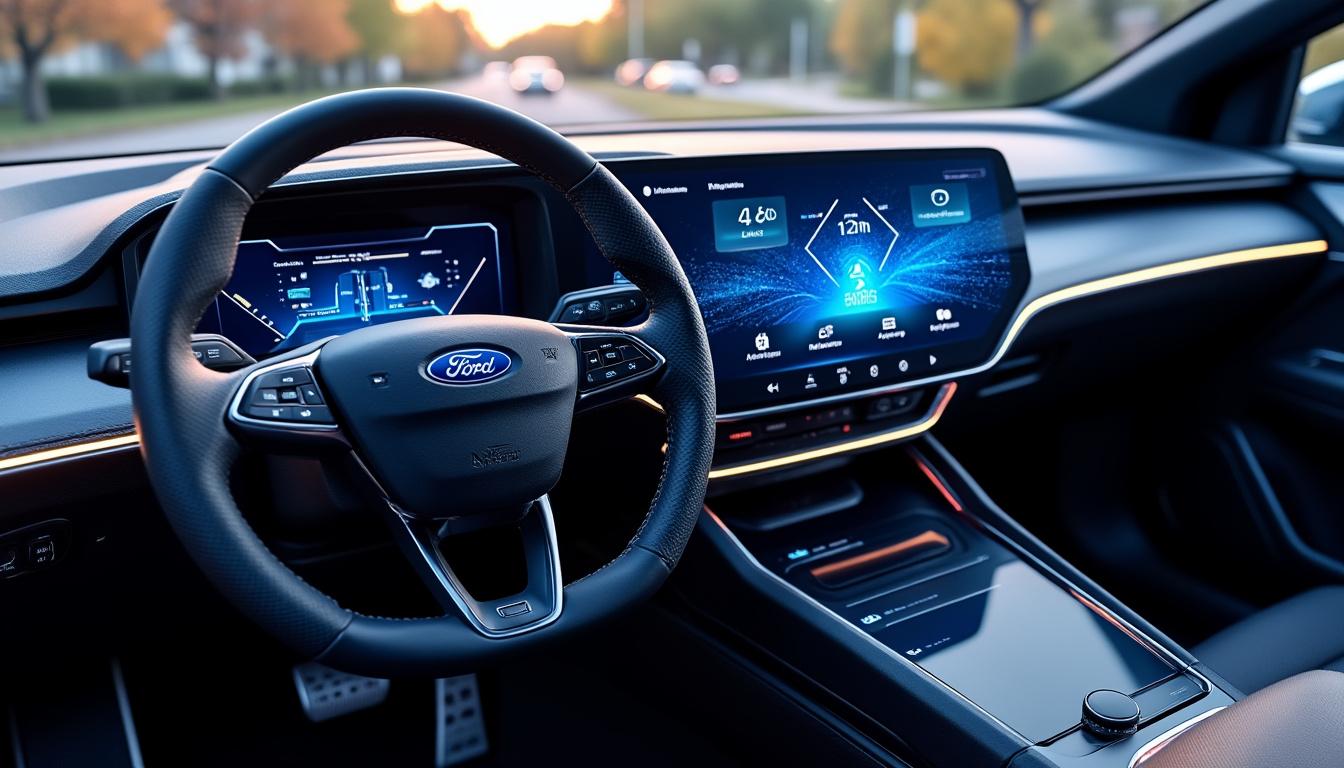
Ford’s AI Voice Assistant: Enhancing User Interaction Through Intelligent Voice Recognition
Ford’s commitment to upgrading the driving experience through AI is crystallized in the launch of its AI voice assistant scheduled for 2026. Originally debuting on Ford and Lincoln smartphone applications, the assistant will offer users an intelligent, context-aware voice interaction tool. This assistant leverages deep integration with vehicle-specific data to deliver responses tailored to each user’s vehicle features, such as trim levels and configurations, offering practical, real-time assistance that surpasses generic AI chatbots.
For example, a customer standing in a hardware store considering how many bags of mulch will fit in their truck bed can use the AI assistant to snap a photo and receive an accurate, detailed answer based on their vehicle’s specifications. The AI assistant’s vehicle-contextual awareness allows it to surpass standard large language model (LLM) chatbots like ChatGPT or Google Gemini in delivering relevant and actionable guidance.
Ford’s strategy emphasizes a chatbot-agnostic design, enabling compatibility with various LLMs including Google’s Gemini, providing flexibility and resilience in its AI ecosystem. Despite relying on third-party LLMs, Ford develops its own electronic components and computing modules to ensure the assistant operates efficiently within the constraints of automotive technology, emphasizing reliability and optimized performance.
This initiative aligns seamlessly with Ford’s broader push towards accessible technology in automotive experiences, contributing to a more intuitive in-car ecosystem that enhances driver confidence and safety. It also addresses the evolving expectations of modern drivers who demand multifunctional, adaptive digital experiences integrated directly into their vehicles.
By leveraging highly specialized voice recognition technology, Ford’s AI assistant aims to facilitate seamless human-machine communication, reducing distraction and increasing the usability of connected vehicle features. This technological advancement is poised to redefine automotive interaction paradigms, supporting advanced mobility solutions in both urban and rural contexts.
In this light, Ford’s AI voice assistant is not merely a customer convenience feature but a foundational pillar in the automaker’s evolving technological roadmap towards smarter, safer driving experiences. For additional insights on voice AI innovations, see the latest developments in real-time voice AI tailored for multimodal applications.
Architecting a New Era: Ford’s In-House Development of AI and Computing Modules for Cost-Effective Innovation
Ford adopts a strategic approach by building critical hardware and software components in-house, sidestepping the high costs and supply-chain complexities prevalent in the automotive AI industry. Unlike peers such as Tesla and Rivian who emphasize developing proprietary large language models or AI silicon, Ford focuses on integrating efficient electronic modules and compact computing units for optimal performance and cost balance.
This innovation reflects a radical rethinking of traditional vehicle computing architecture. Ford’s new “brain” will synchronize infotainment, driver assistance systems, and voice commands in a unified computing platform, drastically improving response times and energy efficiency. According to Paul Costa, Ford’s executive director for electronics platforms, the redesigned systems are 44% smaller, 30% less expensive, and substantially more powerful than those currently in use.
The economic benefits manifest in the democratization of advanced technologies, making features like hands-free driving accessible in vehicles with more moderate price brackets. This is significant considering Ford’s previous challenges in achieving profitability with electric vehicles like the Mustang Mach-E and F-150 Lightning. By reducing costs without sacrificing capability, Ford aims to restore financial viability while delivering high-value innovation.
Equipped with components developed independently by Ford’s engineering teams—including former BlackBerry experts and members of the acquired Argo AI group—the automaker fortifies its capability to maintain control over system updates, security, and feature expansions. This vertical integration secures a more flexible timeline and ongoing adaptability to shifting user needs and regulatory environments.
This architectural overhaul promises a new operational benchmark, reducing reliance on external suppliers for critical modules, thereby accelerating development cycles. The focus on integrated hardware and software interplay exemplifies an emerging trend in automotive technology where innovation is driven as much by system cohesiveness and sustainability as by raw processing power.
More about intradepartmental AI and hardware synergy can be explored at Ford’s AI brain development insights, which unveils how holistic design informs smarter automotive systems in 2026.
Reaching Level 3 Autonomous Driving: Ford’s Roadmap to Hands-Free and Eyes-Off Driving
Ford’s ambitious goal to implement Level 3 autonomous driving by 2028 marks a pivotal evolution in automotive technology. This capability means drivers can disengage from constant monitoring in certain scenarios, though they must remain ready to take control when prompted. This hands-free, eyes-off driving is designed to attenuate driver workload during specific highway or traffic conditions, leveraging an enhanced sensor suite and sophisticated AI algorithms.
Currently, Ford’s flagship hands-free driving system, BlueCruise, represents a Level 2 driver-assist feature that allows hands-free operation on designated highways but requires drivers to keep eyes on the road. The new system’s advancement lies in point-to-point navigational abilities capable of recognizing traffic lights and maneuvering intersections autonomously, which are critical safety and usability enhancements.
Ford’s head of ADAS and infotainment, Sammy Omari, highlights that the Level 3 system demands rigorous validation and optimization across sensors, computing units, and software to ensure a balance between safety, affordability, and functionality. The goal is to attain this with a system roughly 30% less costly than existing hands-free driving solutions, opening this technology to a broader market segment.
Despite potential concerns about safety related to drivers’ attentiveness during Level 3 operation, Ford is advancing with cautious engineering and continuous testing. The system will require drivers to resume control upon system alerts, preserving human oversight while delivering substantial automation benefits.
Ford’s approach addresses regulatory and market pressures by aligning with global trends towards conditional automation rather than fully autonomous fleets for the near future. This measured transition also responds to Ford’s strategic shift since the discontinuation of its Argo AI venture, focusing more on practical driver-assist technologies.
For comprehensive coverage on Ford’s autonomous driving development, including technical evaluations and market positioning, the detailed report at AI Chief News offers pertinent insights into the evolution of hands-free mobility.
Ford’s AI and Autonomous Driving Impact on Automotive Technology and User Experience
Ford’s upcoming AI assistant and autonomous driving systems are transformations designed to align automotive technology with modern user expectations and safety standards. This integration embodies the convergence of voice recognition, driver assistance, and automated vehicle control to produce cohesive, intuitive experiences on the road.
The adoption of AI-powered voice assistants facilitates natural language interaction, drastically reducing driver distraction and simplifying access to navigational data, infotainment controls, and vehicle diagnostics. This evolution enhances usability for diverse user groups, including those less familiar with digital technologies, making driving safer and more engaging.
Complementarily, the progression towards Level 3 autonomy fundamentally changes the relationship between driver and vehicle. Users gain freedom from constant active control during specific phases of driving, which can reduce fatigue on long journeys or congested traffic conditions, potentially enhancing road safety through AI-supported decision-making.
These technological advances support the growing ecosystem for smart tourism and cultural exploration, where voice assistants can augment travel experiences and offer context-aware guidance during journeys. Ford’s initiative dovetails with emerging trends in smart mobility by providing enriched, accessible on-the-go interactions.
Ford’s dedication to accessible innovation is also visible in its messaging around avoiding an arms race focused solely on processor speed (“TOPS”). Instead, the automaker advances a balanced perspective that optimizes cost, size, and capability for automotive needs, underscoring responsible technological adoption.
Practical applications of these advancements include:
- 🛠️ Intelligent cargo management based on real-time vehicle dimension data.
- 🎯 Enhanced route planning with semiautonomous navigation avoiding complex intersections.
- 🔊 Personalized interaction within vehicles via voice AI, improving infotainment and safety response.
- 🚗 Broader deployment of affordable autonomous features encouraging safer driving habits.
To deepen understanding of how voice AI is reshaping user interaction within vehicles, one can explore complementary resources such as the Voice AI Innovator’s Niche article, which explores niche applications and innovations in conversational AI for mobility solutions.
Challenges and Future Prospects for Ford’s AI-Powered Vehicles and Autonomous Technologies
The road towards widespread adoption of AI voice assistants and Level 3 autonomous driving is lined with technical, regulatory, and market challenges. Ford’s pursuit implies not only advancing technology but also managing risks related to safety standards, consumer trust, and infrastructure readiness.
Technically, integrating multiple sensor sources, ensuring fail-safe transition between human and automated control, and maintaining cybersecurity constitute significant engineering hurdles. Ford mitigates these through in-house development and continuous testing, but industry-wide standards and real-world validation remain ongoing considerations.
Regulatory frameworks worldwide are still evolving in response to Level 3 autonomy and driver-assist technologies. Ford’s approach to conditional autonomy aligns with current approval trends but requires continual engagement with policymakers to ensure compliance and safety assurances.
Market acceptance also depends on consumer education around the capabilities and limitations of AI assistants and autonomous systems. Transparent communication about when and how drivers must intervene is pivotal to preventing misuse or overreliance on technology, thus reducing accident risk.
Ford’s pivot from fully autonomous vehicles to conditional autonomy is a pragmatic adaptation to these challenges. This shift offers immediate value to drivers while laying the foundation for future Level 4 and beyond capabilities as technology and regulation mature.
The future holds promise as Ford continues to iterate on its Universal Electric Vehicle platform and AI capabilities. Integration with emerging trends in smart vehicle ecosystems, connected urban mobility, and smart tourism enhances the relevance and utility of Ford’s innovations.
Below is a table summarizing key features and projected timeline for Ford’s AI voice assistant and autonomous driving initiatives:
| Feature 🚗 | 2026 ✅ | 2027 🔄 | 2028 🚀 |
|---|---|---|---|
| AI Voice Assistant Launch 🎙️ | Ford & Lincoln apps deployment | In-car integration begins | Full vehicle integration widespread |
| Level 2 Driver Assistance 🛣️ | BlueCruise on highways | Expanded operational design | Point-to-point hands-free guidance |
| Level 3 Autonomous Driving 🤖 | Concept & testing phase | Refinement & validation | Official market launch |
| Hardware Innovation 🔧 | In-house computing modules | Unified vehicle computing architecture | Optimized cost & size modules |
For further technical aspects and timeline details, see the comprehensive updates at The Verge’s Ford AI assistant coverage.
What makes Ford’s AI voice assistant unique compared to other automotive assistants?
Ford’s AI assistant is uniquely integrated with real-time, vehicle-specific data, enabling personalized responses and context-aware interactions that go beyond traditional large language model-based assistants.
How does Level 3 autonomous driving differ from previous levels?
Level 3 autonomy allows drivers to take their eyes off the road and hands off the wheel under certain conditions, but requires readiness to take back control when requested, unlike Level 2 which mandates constant driver attention.
Why is Ford focusing on in-house hardware and software development?
Developing technology internally helps Ford reduce costs, improve control over system updates, and tailor solutions specifically to automotive requirements without excessive reliance on suppliers.
When will Ford’s AI assistant be available in vehicles?
The AI voice assistant will launch on Ford and Lincoln mobile apps in 2026 and expand to in-car integration starting in 2027.
What are the safety considerations for Level 3 autonomous driving?
Level 3 systems require robust driver monitoring to ensure the driver can safely take over when needed. Ford is implementing rigorous testing and sensor integration to manage these safety requirements effectively.
